Egypt Edition
  MENA+ Edition
  UAE Edition
  Saudi Edition
  AI + Innovation (MENA)
  Logistics (MENA)


 Share Issue





Good morning, everyone. Who’s building cities, and who’s buying stocks? We’ve got two stories on the docket today to dive into.
But first, we’ve got news from President Sisi and President Xi. The two leaders published op-eds (here and here) teasing what’s to come during Xi’s anticipated visit, spanning batteries, desalination, and AI.
Meanwhile, NUCA is overhauling its allocation rules. The government is rewriting land-allocation rules for new cities, moving to a competitive digital auction and putting large, proven developers at the front of the queue. The move filters the market by decree, but some think the planned Real Estate Developers Federation should put a filter into law as well.
And there’s more to the EGX story than its modest gains. The benchmark gained 2.66% with every sector in the green, but foreign institutions swung back to net selling after July’s brief reversal, offloading a net EGP 3.9 bn, mostly out of banks. The EGX70 outperformed sharply at 14.6%.
***
ARE YOU MORE OF A LISTENER? Morning Drive is a 10-minute summary of today’s issue crafted for you to enjoy with your morning coffee, while getting the kids ready for school, or driving through the morning rush. And if you like it, tell your friends to tell their friends. They can find us on Apple, Spotify, or wherever they get their podcasts.
***

The Chinese takeover with Ankush Arora: When Chinese cars first appeared in Egypt around a decade ago, they were met with backlash. Now, they’re everywhere. Why? And how?
On this episode of Making It, Ankush Arora, CEO of Al Mansour Automotive Group, joins Patrick to break down how this happened, and why the pace of adoption is accelerating.
Listen to the episode on: Apple Podcasts | Spotify | Anghami | YouTube
Sign up to our newsletter to get Making It in your inbox.

The EnterpriseAM Egypt Forum is back — and we’re devoting the full day to the singular set of questions on everyone’s mind: What does AI actually mean for your company, your people, your economy, your own job — and your kids’ future?
Every session on stage answers one question: “So, what do I actually do about it?”
Join us on 5 October in Cairo. Seats are limited and attendance is by invitation only.
Request your invitation here.
Ahlan w sahlan, Xi
We have a glimpse of what’s on the table as China’s Xi Jinping lands in Cairo: more Chinese factories, more technology, and a bigger role for Egypt in China’s supply chain. Presidents Abdel Fattah El Sisi and Xi laid out the broad agenda in their op-eds (here and here): Chinese investment in EVs, batteries, renewable-energy equipment, electronics, desalination components, and shipbuilding, alongside cooperation on telecoms, AI, and space. The Suez Canal Economic Zone is likely to be right at the heart of the conversation — Cairo wants to turn all that infrastructure spending into factories, exports, and a real industrial and logistics hub.
But there’s a bigger question: Can this partnership start delivering more than Chinese-built projects and Chinese imports? Xi sees Egypt as China’s gateway to Arab and African markets, while El Sisi wants Chinese industry to plug into Egypt’s localization drive and make better use of BRICS, the BRICS-led New Development Bank, the Asian Infrastructure Investment Bank, and Egypt’s dialogue-partner status in the Shanghai Cooperation Organization. Trade, investment, access for Egyptian exports, and Chinese AI technology are all likely to come up. What matters, though, is whether the visit brings commitments that put more production, know-how, and export capacity on the ground here, rather than widening the trade gap.
The wildcard is Huawei: The company is reportedly seeking to build local facilities stocked with chips for training AI models and running them, while Washington is said to be preparing a counteroffer for Cairo. Egypt could find itself weighing Chinese AI infrastructure against the prospect of closer access to US technology. The UAE faced the same choice before it received easier access to US chips and defense technology after distancing itself from Huawei and other Chinese tech providers. There may be more conventional agreements, too: Egyptian-Chinese Business Council Deputy Chairman Mostafa Ibrahim told us last week that he expects new agreements and MoUs, with Chinese investment potentially rising by USD 4 bn this year to USD 14 bn cumulatively.
Egypt’s Banque Misr spared “on purpose”
Washington deliberately stopped short of sanctioning Banque Misr’s parent bank in Egypt when it moved against the lender’s UAE branches last week, US Treasury Secretary Scott Bessent said on the sidelines of the G20 finance leaders’ meeting in Asheville, North Carolina. “We did not sanction them because we did not want to go back to the Egyptian parent.”
BACKGROUND- Bessent also cast last week’s proposed restrictions on Banque Misr UAE as the first in a potentially sustained series of actions — on a weekly basis — against financial institutions that Washington says facilitate Iranian money flows. The Treasury Department’s Financial Crimes Enforcement Network has proposed barring US financial institutions from opening or maintaining correspondent accounts for Banque Misr UAE over alleged transactions involving Iranian shadow-banking networks. The proposal has not yet been finalized.
Wind in the sails
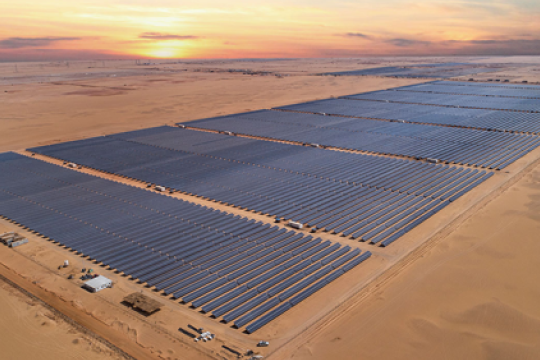
Infinity Power and Hassan Allam Utilities Energy have signed a power-purchase agreement with the Egyptian Electricity Transmission Company for a planned 1-GW wind farm in Ras Shokeir on the Red Sea, according to a statement (pdf). Infinity Power — the renewables JV between Egypt’s Infinity and UAE clean-energy company Masdar — will develop the project with Hassan Allam’s energy arm on a 143 sq km site in the Gulf of Suez wind corridor. Once up and running, the companies say it will supply the national grid and generate enough electricity for more than 1.2 mn homes.
REMEMBER- This is the second major Ras Shokeir wind development to surface this year, after Aeolus, Engie, and Orascom Construction signed a PPA for a separate 900-MW wind farm. The two partners have previously teamed up with Masdar on 1.2 GW of solar projects in Benban and the Dakhla Oasis, including battery-storage capacity. For the whole country, the Electricity Ministry targets renewables to account for 45% of installed generating capacity by 2028.
PSA-
WEATHER- It’s a warm, humid late-summer day in Cairo today, with a high of 35°C and a low of 25°C, according to our favorite weather app.
Alexandria will be a few degrees cooler, with temperatures reaching 31°C during the day and falling to 23°C overnight.
The big story abroad
The regional war is once again coming to a head, with the US launching a barrage of airstrikes on Iran yesterday, attacking Islamic Revolutionary Guard Corps targets. The strikes — which focused on air defence and radar systems alongside minelaying and communications capabilities — were in retaliation for Tehran’s attempt to lay mines in the Strait of Hormuz, US President Donald Trump said.
Tehran’s response? Iranian parliament speaker Mohammad Bagher Ghalibaf warned that US attacks could lead to a blockade on all oil exports through the critical waterway. Meanwhile, Iran’s military threatened to inflict high costs on US forces in the region.
Bond crisis continues: Global bond markets extended their slide yesterday as worries over inflation and government debt threatened higher borrowing rates for consumers and enterprises. Global bond yields reached multi-decade highs in Japan, the UK, Germany, France, and the US, where the 10-year Treasury yield edged close to 4.8%, a level not seen since January 2025.
In the M&A space: Nestle is looking to sell its mainstream vitamins and supplements unit to US private equity outfit Yellow Wood Partners for USD 1 bn as CEO Philipp Navratil limits the Swiss foodmaker’s strategic scope. The transaction — featuring brands like Nature’s Bounty and Osteo Bi-Flex — continues a series of divestitures, following this year’s sale of half of the firm's water business.

*** It’s Hardhat day — your weekly briefing of all things infrastructure in Egypt: EnterpriseAM’s industry vertical focuses each Wednesday on infrastructure, covering everything from energy, water, transportation, and urban development, as well as social infrastructure such as health and education.
In today’s issue: A new alliance can keep up to 80% of the savings it books running new-city street lighting, but the government and the alliance can’t agree on how much will be saved.