Egypt Edition
  MENA+ Edition
  UAE Edition
  Saudi Edition
  AI + Innovation (MENA)
  Logistics (MENA)

 Share Issue





Good morning, folks. Another year, and another EnterpriseAM Egypt Forum logged in the books. This year’s AI Edition asked the hard questions, and our panelists left us with plenty to think about: What does AI really cost us at work and at home? Who is accountable for it? And can Egypt build momentum in the sector? We want to thank every speaker and attendee who joined us this year and all you good people who start your day with us. It’s an honor to share our mornings with you.
Today’s issue brings you highlights from yesterday’s panels, kicking off with an update from our friends at MNT-Halan. The fintech giant’s IPO just landed its first anchor, and it’s a big one. CIB signed on for up to EGP 2 bn in shares, a stamp of approval that lands before the book has even been opened. Our friends at EFG Holding have three more IPOs lined up for the EGX this year, and Group CEO Karim Awad says one of them could be a “massive game changer.” On the telecoms front, Orange Egypt wants to be a lender. CEO Hesham Mahran told us the company is weighing its options on a foray into consumer finance.
More on all these stories and other headlines below.
***
ARE YOU MORE OF A LISTENER? Morning Drive is a 10-minute summary of today’s issue crafted for you to enjoy with your morning coffee, while getting the kids ready for school, or driving through the morning rush. And if you like it, tell your friends to tell their friends. They can find us on Apple, Spotify, or wherever they get their podcasts.
***

The Gulf’s sovereign funds and largest companies are committing bns to AI infrastructure at home and to AI companies in the US and beyond. EnterpriseAM AI + Innovation reports on where that capital goes, who controls it and what it is actually buying.
Every Tuesday and Thursday, we also cover the startups and established firms across MENA putting AI to work, and how it is changing jobs, education and the way business runs.
It’s sharp, analytical and skeptical journalism that ignores hype and is laser-focused on informing our readers, not pleasing our sources.
Sign up here to be among the first to get it straight to your inbox.
Hope for 48, budget for 54
Three CEOs, three views on the EnterpriseAM Forum stage: Egypt went into 2026 in “quite a sweet spot,” and the war hasn’t changed EFG Holding Group CEO Karim Awad’s view that the country can come out ahead. Orange Egypt’s Hesham Mahran says the war has made Egypt look like “the safest zone for investment,” and Marakez’s Dasha Badrawi says money is flowing back into Egypt through investments and remittances, with a big market enjoying “relative stability compared to previous years” as a strong pitch to global investors. The catch, Badrawi says, is high oil prices and what they do to the EGP. Egypt can still be a net gainer but only if it plays its cards right.
All three are budgeting for a weaker EGP in 2027 than the average rate of EGP 52 the market has been trading at recently. Orange Egypt is planning on EGP 53-54 to the USD, Mahran told the EnterpriseAM Egypt Forum yesterday. Badrawi puts his range wider at EGP 55-60.
Everything hinges on the war: EFG Holding’s macroeconomist sees the EGP at EGP 52-54 by end-2027 if the war drags on and at 49-50 if it ends, Awad told the audience. Mahran is hoping for 48-49 once there’s a resolution.
The same war logic shaped how far they’re willing to go on pay. Mahran said roughly 20% is a fair raise for Orange this year. Meanwhile, Badrawi expects Marakez’s shareholders to probably resist after three straight years of 20%+ raises at the company and will steer this year toward an inflation-linked raise instead, with something closer to the headline inflation currently at 14.5%. Awad said EFG is still finalizing its numbers, but it will be tiered: its lowest-paid staff members get the steepest percentage increase, in line with what Mahran and Badrawi are offering, while its highest-paid employees get no raise at all this year.
A reckoning for call centers
AI is starting to erode the advantage that built Egypt’s outsourcing industry — language, Capgemini Egypt CEO Hossam Seifeldin said at the EnterpriseAM Egypt Forum yesterday. Seifeldin predicts the call center business will face “lots of pressure” as AI systems take on multilingual work at scale. Capgemini entered Egypt three to four years ago specifically to tap that same talent pool.
Seifeldin laid out three stages of AI adoption. Most firms are in the first stage, where AI boosts productivity; the second (business process re-engineering) is just starting; and the third (new business models) is further off. At one client’s service desk, an AI tool Capgemini built already handles 56% of traffic with no human involvement. “Technology used to be an asset that depreciates with time,” he said. “AI is the first thing that is actually appreciating with time because of the knowledge that is being generated.” He argued that the bottleneck is not the technology itself; it’s inconsistent data and undocumented legacy code. Startups can build their AI foundation from scratch; incumbents are stuck modernizing first.
What’s at stake: Egypt’s outsourcing sector generated USD 5.2 bn last year, roughly 70% of the country’s digital exports, employing some 195k people across 252 companies. The government is targeting USD 12 bn in outsourcing exports and 630k jobs by 2029. Information Technology Industry Development Agency chief Ahmed El Zaher told us last month the industry “stopped being a call center business years ago” and that AI will open higher-value work in engineering R&D and data analytics. Seifeldin’s warning cuts the other way: the multilingual talent pipeline that drew global players (Capgemini included) is exactly what AI hits first.
He offered one sector where AI could be a net positive: education. Wider access to AI-delivered knowledge could ease the pressure on government budgets tied to building schools and hiring teachers while preserving the social function of physical schools, Seifeldin said.
Six blocks, one wager
Chevron will invest at least USD 88 mn to drill two exploration wells and reprocess 3D seismic data in the Lotus offshore block in the Mediterranean, under a concession agreement with state gas holding company Egas, according to a ministry statement. Lotus is about 200 km offshore in waters 2-2.8km meters deep — a stretch of the Mediterranean no one has drilled for deep exploration before. No drilling date has been announced.
Lotus is block number six in Chevron’s Mediterranean portfolio. The company is already in Narges — the 3.5 tcf gas field discovered in 2022 (Chevron 45%, Eni 45%, and Tharwa 10%) that started drilling its first production well earlier this year. It also holds North Dabaa (Chevron sold a 23% stake to QatarEnergy in 2024), North West Atoll and North Semyan (both secured by a Chevron-Shell consortium in 2025), and North Cleopatra in the West Med, where the Velox well recently showed oil indicators. Earlier this year, Chevron committed USD 114 mn to one well in the ministry’s USD 1 bn+, 14-well Mediterranean campaign. The Lotus agreement adds at least another USD 88 mn to that tab.
Why it matters: Egypt’s gas output hit an eight-year low in 2024. The country went from net exporter back to importer, and the LNG import bill keeps climbing. Lotus is a wager on a frontier zone that might help reverse that slide. Oil Minister Karim Badawi said the agreement was made possible by the state finally clearing its arrears to international partners — a move he has argued rebuilt confidence and unlocked new spending.
Data point
47.2 — that’s where the headline seasonally adjusted Purchasing Managers’ Index (PMI) landed in September, down from August’s seven-month high of 49.6 and below the survey’s long-run average of 48.2, according to S&P Global’s latest report (pdf). The reading — the ninth straight month below the 50.0 break-even mark — signals a faster contraction across output, new orders, and purchasing activity, with firms citing weaker market conditions, geopolitical disruptions, and elevated cost pressures.
The bright spot: Hiring rose for a second consecutive month — the first back-to-back employment increase in more than a year — as unfinished work accumulated for a fifth straight month and firms remained optimistic about the 12-month outlook, though confidence eased from August’s four-year high.
PSA-
WEATHER- Cairo is holding steady today, with a high of 29°C and a low of 19°C — same as yesterday as the autumn pattern settles in, according to our favorite weather app.
It’s a notch warmer on the coast in Alexandria too, with a high of 28°C and a low of 19°C.
The big story abroad
Anthropic’s lease of Google microchips has secured backing from major Wall Street banks. Bank of America, Citigroup, and Morgan Stanley have begun syndicating part of a USD 60 bn debt package — partially guaranteed by semiconductor maker Broadcom — in what stands as the largest chip-financing agreement to date. The move tests AI debt appetite as investors demand higher returns amid long-term profitability fears.
Singapore-based data center operator DayOne filed for a US IPO, marking the latest in a wave of public listing plans across the sector amid robust demand for AI infrastructure. The firm has secured more than 1.5 GW of bookings for capacity across Asia-Pacific and Europe since 2022, and closed a USD 4.5 bn Series C funding round in June.
McDonald’s is facing a proposed nationwide class-action lawsuit alleging that the company coordinates menu pricing between corporate locations and independent franchises using an AI system trained on nonpublic data.

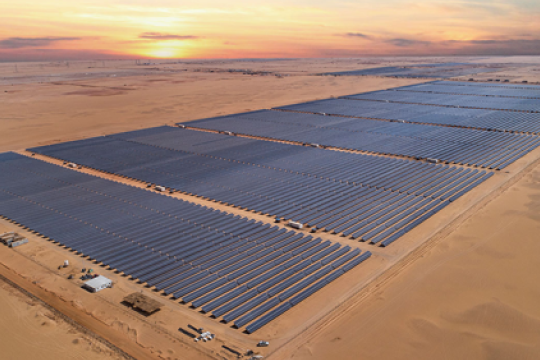
*** It’s Going Green day — your weekly briefing of all things green in Egypt: EnterpriseAM’s green economy vertical focuses each Tuesday on the business of renewable energy and sustainable practices in Egypt, everything from solar and wind energy through to water, waste management, sustainable building practices and how you can make your business greener, whatever the sector.
In today’s issue: We track where Egypt’s 2026 renewables plan stands. One solar plant is fully online, a second is feeding the grid in phases, and a third was scheduled for 3Q 2026.