Good morning, friends. Over the past two days, Patrick and I have been writing about the things that slow business down, from rank-and-file bureaucrats who treat companies as guilty until proven guilty to a two-decade-old “single window” that still has industrialists chasing approvals from one governorate to the next.
Today, I want to look at a different kind of intervention — regulators who grow a market on a healthy diet and know when to pause it for a checkup, before a sector’s problem becomes the economy’s. I’m not writing to offer applause, since none of us can see the whole picture from our seats. But from my vantage point, a bureaucracy that blocks something already working is a long way from a regulator that steps in to adjust the rules and let business carry on.
The FRA spent the past decade building the rules for securitization as the market grew, adapting them to new fintech and consumer finance loan books. Then both the CBE and FRA spent the past couple of years pushing the brakes where credit was seen as growing too fast, using a number of measures. The FRA froze new consumer-finance licenses while rewriting OTP and verification rules to stamp out BNPL cash-liquidation abuses, then required that companies get regulatory sign-off on securitized portfolios. The CBE pushed banks to pause or mind their exposure as they ended up holding the lion’s share of corporate and securitized paper.
This friction isn’t accidental — it’s how a maturing financial system tries to avoid trouble. Even as they tighten the screws on consumer credit, both regulators are opening new doors elsewhere, from the FRA easing conversion rules for real estate funds, to the CBE rolling out frameworks for digital banks.
Nobody enjoys a freeze while trying to close a deal or grow a loan book. But between a regulator that pauses a hot market for a health check and a bureaucracy that leaves business waiting for a stamp, I know which one I’d rather deal with. –Abdelhamid
IN TODAY’S ISSUE: Nassef Sawiris has spent fourteen months getting his two listed companies back together; OCI delists in Amsterdam tomorrow, and the countdown to the share distribution is on. The bill: 97.2 mn new Orascom shares, or 47% of the enlarged contractor, handed to OCI’s holders, and the Sawiris family holds close to 78% of OCI.
We talked to Motaz El Dreny about why our debt market needs buyers who aren’t banks. With the CBE having leaned on lenders’ bond exposure, issuers are living on 12-month paper sold to money market funds, and he says that can’t last. Our sit-down covers securitization from loan book to bond, the NBFI licensing freeze, and why M&A has stalled.
Elsewhere in the issue: Visa is chasing small merchants now that an Android phone works as the card machine, and Enppi has signed up to design gas networks inside two Jordanian industrial cities, the front end of a USD 70 mn UAE-funded program to get factories off diesel.
Doubling dough for Baghdad
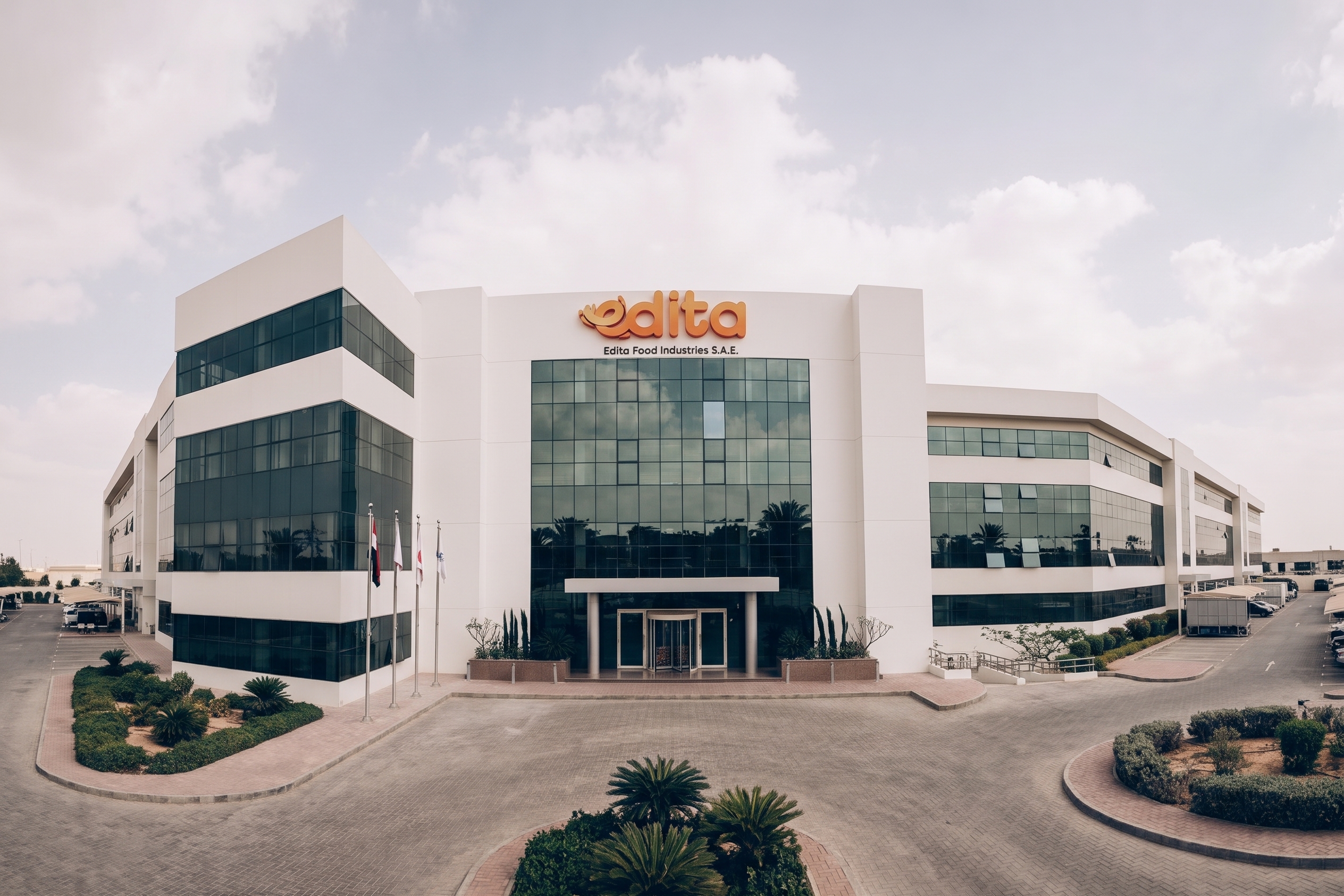
The International Finance Corporation (IFC) is lending our friends at Edita USD 25 mn to more than double their production capacity in Iraq within two years, according to a joint statement (pdf). The money funds new lines and a new plant under the three-year capex program of more than USD 27 mn that Edita announced when it entered Iraq in January 2025, with some also going to working capital in Egypt. It is the IFC’s third investment in the snackmaker, after 2019 and 2023. We heard of the loan in July, when it was a disclosure awaiting board approval; IFC approved it on 27 August, signed on 23 September, and invested on 20 October, according to the project disclosure.
Cake output began in March at Edita’s Iraq plant, and the bakery line followed in July — both expected to be fully utilized next year — taking Iraq sales to EGP 144.4 mn in the third quarter, nearly twice Morocco’s EGP 76.9 mn, according to the results release. Close to half of what Edita sells in Iraq next year will still ship from Egypt, deputy group CEO Sameh Naguib told analysts on the results call.
Inputs now bankable
The government’s EGP 30 bn industrial facility built to buy machines can now buy inputs too. The Cabinet moved half of the envelope, EGP 15 bn, to working capital (raw materials, production inputs, and spare parts) and left EGP 15 bn for machinery, according to a Cabinet statement. Plants can now qualify a year into construction once they’re 60% built. Loans carry a 15% rate for five years, with the Finance Ministry covering the gap to market rates.
Industries the state deems strategic can borrow more, up to EGP 200 mn per borrower from EGP 100 mn, with a committee from the Finance Ministry and the Industrial Development Authority deciding case by case. The changes follow a slow start. Some EGP 6 bn had gone out by September 2025, when industrialists complained that only one project out of several was getting approved.
Deadly truck fire in Giza
At least 31 people were killed and 21 were injured when a truck carrying petroleum products caught fire on the Ring Road near Imbaba yesterday, spreading to passing vehicles, according to a report from Ahram Online and a statement from the Health Ministry. Footage of the incident published by Al Arabiya shows the scale as the multi-vehicle fire broke out.
Initial estimates suggest 27 cars and motorcycles were burned, according to a Public Prosecution statement. An investigation to determine the cause of the incident is still underway.
Ring Road traffic was heavily disrupted, leaving hundreds of commuters stranded. The Bus Rapid Transit (BRT) dispatched 12 buses from Adly Mansour Station to transport passengers from the scene. BRT head Reda Saafan said the buses cleared everyone within 30 minutes using the BRT’s dedicated lane. Saafan told Ahmed Moussa on Sada El Balad that Transport Minister Kamel El Wazir ordered the service to continue at no cost along the 75 km stretch from the Alexandria Agricultural Road to Hadayek El Ahram.
The Transport Ministry hasdenied claimscirculated on social media that a fallen power cable caused the fire. The ministry said it will not comment on the cause while the Public Prosecution is investigating.
Two power circuits were disabled after the fire broke out, and backup supply from a nearby station kept the power running in the surrounding areas, Electricity Ministry’s spokesperson Mansour Abdel Ghany told Al Qahera News.
The Egyptian Red Crescent has sent teams to the scene and to hospitals to support the injured, according to a statement. The teams are providing emergency response and helping reconnect families.
PSA-
WEATHER- Cairo swaps a degree of its afternoon for one overnight today, with a high of 23°C and a low of 15°C, and that cool-to-cold morning still in the air at first light, according to our favorite weather app.
It’s a degree cooler overnight in Alexandria too, with a high of 23°C and a low of 14°C.
And over the weekend, expect to see the capital edge back a degree by day, with a high of 24°C on Friday and Saturday, and as low as 14°C for our friends on the Mediterranean.
The big story abroad
S&P Global Ratings may cut Nvidia’s AA credit rating by one notch, given governance concerns after CEO Jensen Huang’s exit and quick return. Huang left amid revelations of extramarital affairs, including one with a woman US authorities investigated for allegedly spying for China. The board reinstated him less than two weeks later. S&P also flagged questions over possible export control breaches.
Bigger picture: A downgrade could push up borrowing costs for a company that bankrolls much of the AI industry. The cost of insuring Nvidia’s debt against default hit a record high yesterday, Bloomberg reports.
Elon Musk’s Neuralink has won FDA approval for a pivotal trial of its brain implant, which aims to let people with paralysis control devices with their thoughts. The study will test whether the implant is safe and effective for people with severe paralysis from ALS, the company said in a statement. It follows early trials with more than 30 participants.
Why it matters: The trial aims to build the evidence Neuralink needs to bring its implant to market. The company has been one of the biggest fundraisers among brain-computer interface companies. It closed a USD 650 mn round in 2025 at a USD 9 bn valuation, Bloomberg reports.
Elsewhere in big tech, Microsoft has declared a “Code Red” over a 24-hour software outage, according to internal memos seen by Reuters. The 12-13 November outage took down Outlook, Teams, and other Microsoft 365 services, hitting governments, trading firms, and airlines. Microsoft blamed a Windows flaw that went undetected after it was introduced in July.
What’s next: Code Red is Microsoft’s top-priority alert, used to fix flaws in how it builds and runs its services, as the outage raised concerns about how exposed critical digital infrastructure is. The company now aims to fix future outages worldwide within an hour, using AI agents for diagnostics, Reuters reports.
Somabay welcomes elite riders and horses for the Egypt International Equestrian Cup on 3-6 December. Showcasing international show jumping excellence against the backdrop of the Red Sea, the event reinforces Somabay’s growing presence on the international sporting calendar.
Nassef Sawiris’ two listed companies are almost one: Orascom Construction closed its acquisition of OCI Rembrandt Holdings from Dutch-listed OCI Global yesterday, wrapping up a transaction that was first announced in September 2025, according to two separate statements (here, pdf and here, pdf).
Four parties moved, each with a different job:Orascom Construction, the Abu Dhabi- and Cairo-listed contractor, bought OCI Rembrandt Holdings, the vehicle holding what was left of OCI’s business, and paid in new Orascom shares. OCI Global, the Dutch-listed chemicals company, sold it and will pass those shares to its own investors before delisting and liquidating. NNS Holding, the Nassef Sawiris family investment vehicle, bought OCI stock for EUR 4.10 a share incash, without which the merger vote could not go ahead. Agrofert, the Czech chemicals group, bought OCI’s ammonia business (pdf) and is buying half its nitrogen plant (pdf).
What Orascom owns now is mostly money: OCI sold its ammonia business to Agrofert in a EUR 290 mn transaction completed in March and agreed in June to sell half its Geleen nitrogen plant for 50% of EUR 110 mn, with the transaction expected to close in 2H 2027, and a put/call on the rest exercisable two years after the sale closes.
What’s left sits in Rembrandt: chiefly the cash from those sales, which left OCI with USD 1.05 bn in held-for-sale net cash as of 30 June 2026 — up from USD 695 mn at end-March, after the ammonia sale closed on 31 March — according to OCI’s 1H results (pdf). This is in addition to the 561.8k Orascom shares (pdf) it already held and its 50% stake in OCI’s production facility in Geleen, the Netherlands.
Sawiris wants the combined group to be renamed Orascom and to be an infrastructure and investment house, with Orascom’s record USD 11.6 bn backlog behind it and as much as USD 50 bn of planned US investment, data centers included.
The price was a 47% stake in the buyer: Orascom issued 97.2 mn new shares, lifting its share count to 207.4 mn from 110.2 mn and its issued capital to USD 207.4 mn at a nominal USD 1 each, an 88% increase, by our math. Counting the Orascom stock it already held, OCI comes out with c. 47% of the contractor.
Nearly all of that belongs to the family: NNS and Nassef Sawiris hold 68.77% of OCI after their offer went unconditional this month, and family members holding a further 9.07% signed undertakings not to tender. That works out to c. 78% of OCI by the 30 November record date, on our math — meaning c. 78% of the Orascom shares distributed in December reach the family, on top of the Orascom stock it already owns.
WHAT’S NEXT- OCI trades for the last time on Euronext Amsterdam today, delists and goes ex-distribution tomorrow, with a 30 November record date; the Orascom shares are due to reach OCI’s holders on or around 8 December, after which OCI dissolves, possibly behind one more EGM. The 15% Dutch dividend withholding tax will be funded by selling some of those shares, with “no gross-up” promised. One step is still outstanding: the new Orascom shares have not yet been admitted to trading on the ADX or the EGX, having missed their 24 November target.
REFRESHER- The transaction brings back together two businesses that were split in the 2015 demerger that created Orascom Construction. Orascom shareholders approved the share swap in January at an exchange ratio of 0.4634 Orascom shares for every OCI share, while OCI shareholders signed off late last month. The Enterprise Chamber of the Amsterdam Court of Appeal had blocked OCI’s shareholder vote in January over Sawiris’ interests in both companies and appointed two independent directors with the decisive vote on the transaction. The directors agreed to let the vote go ahead on condition that NNS launch, declare unconditional, and settle its cash offer. A separate petition by Value8 seeking an inquiry into OCI was before the court as of mid-October and did not prevent the transaction from closing.
Our corporate debt market has run almost entirely on bank money since the last public bond offering more than 15 years ago, which left issuers short of buyers this summer when the CBE tightened the rules on how much of it banks can hold.
Issuers who used to place their bonds with a handful of lenders are now funding themselves on notes of up to 12 months, sold to money market funds, says Motaz El Dreny (LinkedIn), Founder and Managing Partner of law firm Dreny & Partners. He doesn’t think this can last. “All we have now in Egypt is equity capital markets,” he tells us. “You can hardly find someone telling you, ‘I’ve traded corporate bonds.’”
El Dreny has worked in capital markets since 2007-2008, with his firm acting as counsel on many of the securitizations we’ve covered. Those include the New Urban Communities Authority’s (NUCA) EGP 30 bn program, whose second and final EGP 15 bn issuance closed in November 2023, Valu’s EGP 519.2 mn 13th securitization round, and Al Ahly Leasing and Factoring’s EGP 878 mn issuance.
We sat down with El Dreny to talk about how his job has changed, how a securitization gets from loan book to bond, the NBFI licensing freeze, why debt has stayed private and in banks’ hands, the IPO and M&A pipeline, real estate funds and the one change he’d make to the market.
Edited excerpts from our conversation:
EnterpriseAM: You’ve done capital markets work here for nearly 20 years, from the pre-2011 highs through the post-2011 lows and the lean decade since. How has the job changed? Is the tighter regulation you deal with now a sign the market is maturing?
Motaz El Dreny: It used to be easier. Local and foreign investors had a better appetite for the market here, so deals flowed. Over the past decade, things have become more regulated, but I wouldn’t say over-regulated, because the rules are there to face rising risks, globally and locally, especially in financial services. So yes, the market is definitely maturing, but as a reflection of what’s happening in the economy more than of deal flow. Volumes haven’t been big for the past five or even 10 years, with little variety in the transactions.
E: How do law firms secure mandates in that kind of market?
MD: Without an upside market for, let’s say, the past 10 years, clients are cost-sensitive, so fees are often the deciding factor. A strong track record with the regulator gives you some pricing leverage, though not by a large margin. Competition is fierce because the market pie is shrinking. Roughly half of our capital markets mandates come through investment banks, which aim to satisfy the client’s needs, and keeping costs down is one of them. It’s getting tighter, to be honest, but at the end of the day this is what we do, and we have to survive, so I can’t complain.
E: Walk us through a securitization. What happens between a lender deciding to sell its loan book and investors buying the bonds?
MD: Say a consumer finance company has lent EGP 1 mn on five-year installments. Rather than wait, it sells the portfolio to investors at its present value, maybe EGP 700-800k, as bonds repaid from what the loans generate. Most people, I think, see securitization as a lending activity. It’s not, it’s a true sale: the risk and reward leave your balance sheet, as if you’d sold a building.
The financial advisor models default rates and repayment history to see if the sale is viable and profitable for the lender. We do legal due diligence on the portfolio, not the company: every customer’s ID, contract and repayment method. An auditor runs a separate financial review. Both reports go to the rating agency, since you can’t legally issue unrated debt, and the minimum is BBB-. In a sense, the agency is my client, because they tell us exactly what they need to see.
Then we draft the information memorandum, the deal’s bible. Since October 2024, I think, after certain incidents, the FRA’s NBFI supervision department must review and sign off on the portfolio before Corporate Finance proceeds with the memorandum. It adds time, though it has never been a deal-breaker — and clients actually treat the sign-off as an endorsement that helps them secure bank credit lines. Once Corporate Finance reviews the draft and the rating certificate is added, everyone signs and we file the full package with the regulator.
E: You work on NBFI licensing mandates as well. How is your licensing work distributed right now, and how have theFRA’s license freezesand regulatory shifts impacted the sector?
MD: Traditional consumer finance and microfinance licenses were paused two years ago, and the fintech route into consumer finance was paused the following year. Today, the bulk of new applicants are fintech-based players in microfinance, SME lending and mortgage — like Manzel, Adfa, and Dayra — alongside some work on consumer factoring.
The sector is in what I call an active stagnation. Everyone says it’s a three-to-six-month pause while the regulator revisits its rules. It’s tightening OTP and client verification, and going after abuses like buying phones on BNPL cards at big retailers to resell for cash. There are rumors, and I’m not sure, that Basel III capital standards will apply from 1Q 2027, on top of last year’s capital increases for leasing, mortgage, and factoring. Small players might not survive.
E: We haven’t had a public corporate bond offering in years, banks buy anestimated 90% of NBFI paper, and in July the CBE tightened banks’ exposure limits on corporate and securitization bonds. Why has the market stayed private and bank-only, what has the tightening done to issuers, and why haven’t they gone abroad instead?
MD: I think the last public offering was Orascom’s, in 2009 or 2010. Since then it’s been private placements, with at least two investors required since 2020, I’d say. NUCA’s multi-bn offerings, which we worked on, were still covered by just a handful of banks. We hoped a quasi-government name would open the door to public offerings. It didn’t.
The CBE has no jurisdiction over debt capital markets, but it does over banks, and it fears a bubble, so it has kind of told them to pause. Investment banks have shifted to money market funds, which only take notes of up to 12 months. BNPL, consumer finance, and auto lenders can survive on that for now. I don’t think it’s sustainable.
Awareness matters too. Your bank relationship manager sells CDs or treasury bonds, never corporate bonds. Abroad, FX rates and repatriation risk are the first hurdle — foreign investors worry about currency volatility and whether they’ll be able to repatriate their coupons. Meanwhile, GCC funds ask why they’d buy a corporate bond over local government debt. Only internationally rated names like CIB or TMG have managed it — privately, like CIB’s deal with the IFC. Between the sovereign rating and FX risk, it’s a narrow door.
E: The IPO window reopened this autumn with MNT-Halan’s and Banque du Caire’s offerings. What’s holding the equity and M&A pipeline back, and is any of it legal or bureaucratic?
MD: It’s not red tape or paperwork. It’s the economic, political, and geopolitical unrest — as they say, the stock exchange is just a mirror of the economy. What catches foreign buyers off guard isn’t getting a deal done, since things usually look good at the beginning; it’s how the share actually trades and performs after listing. Those macro risks are why foreign investors are holding back right now. M&A is on hold. We have a small private deal in agriculture and one in financial services, but since the consumer finance scandal, everything has stopped.
E: Real estate funds look like a bright spot. The FRAeased the conversion rulesin August, requiring EGP 500 mn in net equity. Who is actually converting, and what would it take to see these funds listed on the EGX?
MD: That’s where much of our work is. Families are converting property into REIT-style funds, and developers are using development funds, which put land in and raise money to build. Investment funds hold rent-earning offices or retail and raise capital against that cash flow. It’s tax-friendly, the government backs it, and it brings real estate under a regulator, which Egypt otherwise lacks.
Few developers can convert, because it takes size, and I think the big ones will resist. Banks are kind to them because the lending is asset-backed. I think we saw A Capital take the first step toward converting a subsidiary under Decree 179 in the last couple of weeks. I hope we see more. At the FRA, things take time rather than get stuck, and once it’s done once, the path is paved.
Listings need better tax treatment, investor awareness, and regulatory flexibility. The surge is a healthy reaction to what’s happening in banking and real estate. A fund certificate is more liquid than a property you can’t sell, and you’re not tied to one developer.
E: If you could change one thing in the rules to deepen domestic capital markets, what would it be?
MD: Widen the investor base for corporate debt. Let retail and high-net-worth investors in. Above all, get Egypt Post, with its mns of clients, and the social insurance funds to put even a small slice of their portfolios into corporate debt capital markets through their fund managers. The rules already allow tools the market hasn’t used, like future cash flow securitization. Beyond that, it’s inflation, rates, FX, and geopolitics, and those are out of our hands.
Visa’s next push is on the merchant side: Now that Android users can pay by tapping their phones, “our focus now is on expanding this access through Long Tail Acceptance,” bringing more small and micro businesses into the digital payments ecosystem, Malak El Baba, Visa’s Country Manager for Egypt, Libya & Sudan, tells EnterpriseAM.
Shops with a card terminal are already set, since “almost all existing POS terminals are already enabled to accept tokenized transactions,” she says. For shops without one, Visa points to Tap to Phone service as an example which “can turn an NFC-enabled smartphone into a contactless acceptance device without additional POS hardware.” There’s plenty of ground to cover, with only 26% of small and micro enterprises in a Visa-commissioned survey (pdf) using financial technology as of October 2024.
On the customer side, the Android service runs through banks’ own apps rather than a phone maker’s wallet as Apple Pay does. That lets banks “retain their brand, customer experience and direct relationship with their cardholders,” El Baba says. Which cards qualify, and when, “will be determined by each participating bank,” she adds.
REMEMBER- The Central Bank of Egypt launched card tokenization on Android on Monday, and National Bank of Egypt, Banque Misr, CIB, and QNB Egypt rolled out the service through their own apps the same day. CIB’s app only takes Mastercard cards for now, according to its website. Apple Pay alone handled around 292 mn transactions worth EGP 228 bn between its December 2024 launch and the end of September, according to the central bank.
State contractorEnppi will design the internal gas network for two Jordanian industrial cities after signing an agreement with theJordan Oil Terminals Company(JOTC). The contract covers preliminary engineering designs and the tender documents for choosing the contractors that will build the networks in Al Muwaqqar and Al Rawda, Jordanian state news agency Petra reports. Neither side disclosed the value.
IN CONTEXT- The design work is the front end of a USD 70 mn program the Abu Dhabi Fund for Development is financing to connect the two industrial cities to Jordan’s main gas network. The ministry wants factories off diesel and heavy fuel oil, which cuts industrial energy costs and creates demand for gas produced locally. The Jordanian oil storage and logistics firm will build, run, and maintain the internal networks in this first phase.
Zooming out: The work extends a long Egyptian presence in Jordanian gas infrastructure. Enppi and Petrojet are finishing the Al Khanasri compressor station for the Jordanian-Egyptian Fajr company, past 96% complete as of July. The pipelines feeding the two cities were awarded in August, with a consortium of Petrojet and Jordan’s Ahmad Yousef Al Tarawneh landing the Al Muwaqqar contract and TAQA Arabia securing Al Rawda’s 14-km line.
Chinese synthetic fiber manufacturerXin Feng Ming Groupbroke ground on the first USD 280 mn phase of a USD 800 mn polyester fiber complex in Sokhna, its second plant inside TEDA Egypt’s zone, the Suez Canal Economic Zone (SCZone) said in a statement. Rated at 360k tons a year on 240k sqm and due to reach 1 mn tons a year over three lines, it is expected to record sales near USD 500 mn at start-up. The zone had 212 operating factories in September and 176 more under construction.
REFRESHER- Xin Feng Ming first agreed to the project with SCZone in April 2024. It was announced again in December 2025, getting a May 2026 date for breaking ground and a 4Q 2027 date for kicking off production — putting this month’s groundbreaking roughly six months behind schedule. About half of its output is earmarked for export.
IN OTHER NEWS-General Motors Egypt has started regular production of the Chevrolet Groove at its 6th of October plant, with an investment ticket of USD 20 mn and local content at 45%, the Cabinet said in a statement. GM says 95% of the vehicles it sells in Egypt are made locally, leveraging 81 local suppliers. The Groove goes on sale in Egypt before the end of 2026.
REMEMBER- At 45% local content, more than half of each Groove is still imported, the same ratio as the El Nasr EV that rolled off late last month. The government’s target is 100k vehicles a year at 60% local content; Prime Minister Mostafa Madbouly put the industry at 18 carmakers running 27 plants, with 300k vehicles in annual capacity.
Three teams of AUC undergraduates took all three top spots in the undergraduate category at the 2026ACM SIGSPATIALstudent research competition, the first clean sweep in the university’s history, according to an AUC statement (pdf). Ebtsam Zyada (LinkedIn) took first with GraphFi, which works out the floor a phone is on from its WiFi signal; trained on a single building in Spain, it worked in Finland without retraining at roughly three times the accuracy of existing systems. Ebram Thabet (LinkedIn) took second with SkyWeave, an air-traffic control system for drones and air taxis that resolved more than 98.9% of potential conflicts. Yasmina Mahdy (LinkedIn) took third with CropSelf, a farm robot navigation system that trains robots to navigate crop rows using their own cameras instead of hand-labeled images.
Our friends at Beltone Holding promoted Fahd El Hadidy (LinkedIn) to CEO of Beltone Mortgage, the group’s mortgage finance arm, they said in a statement (pdf). El Hadidy steps up from deputy CEO and CFO of the company, bringing more than 30 years in financial services that include CFO roles at Moharram & Partners and Leverage FC and a run as CEO and managing director of FDR Trading. Before that, he was group CFO of CITEX Systems Holding, where he also ran the group’s petrochemicals business in Egypt in partnership with ExxonMobil.
Al Futtaim is bringingCheval Collection, the UK serviced-apartment operator, to Cairo Festival City with 242 furnished apartments opening in 2028, Al Futtaim said in a statement. It is the brand’s first address in Africa and the largest in its MENA portfolio. The units — which range from one- to three-bedroom apartments spread across eight buildings — carry an investment of about USD 110 mn, an official at Al Futtaim Real Estate, which owns the destination, tells EnterpriseAM.
Why it matters: Serviced apartments are the product Egyptian developers have reached for as luxury and mid-income housing saturate. They rent like hotel rooms and live like apartments, a format that suits Egyptians working abroad, Arab and foreign visitors, and students, who Osama Saad El Din, head of the Federation of Egyptian Industries’ real estate division, told us in 2024 were driving demand. The business district next door houses more than 40 multinational companies.
One brand on the shelf
Nissan has taken the whole shelf at Valu Shift: no other brand sells on the fintech’s car marketplace for a year. Shift, which since May has let buyers browse, finance, and pay for any new model in one place, now gives Nissan buyers approval on national ID alone, 6-84 months to repay, and collection from dealers, Valu said on LinkedIn. Selected plans carry zero down payment, no resale ban, and no mandatory insurance or admin fees. When we compared car financing options in January, Shift offered six-month to seven-year plans at an average 15.5% rate with no admin fees and offered perks for a 40% down payment, where a credit study is conducted to obtain the car without a sales ban.
Jingle bells, full hotels
Occupancy at hotels in Hurghada, Sharm El Sheikh, and Cairo should reach 80-90% over Christmas and New Year, up from 70-80% now, Asharq Business reports, citing industry players’ projections. This comes as Russian arrivals recover and European guests reroute Gulf beach holidays to the Red Sea. On the other hand, UK, French, and Ukrainian bookings are softer. Hurghada is seen holding November’s 75%, and South Sinai operators expect a pick-up even with rates up 10-15% on last winter. The government targets 23 mn visitors in FY 2027/28 and 30 mn by FY 2029/30, up from 20.2 mn in the current fiscal year, and says it needs 160k-180k rooms added to the currently existing c. 280k.
More on our radar
Insurers will be able to issue policies in foreign languages within days: Under Decision 216 of 2026, the Financial Regulatory Authority (FRA) will approve foreign-language wordings for foreign and multinational insureds. (Statement)
Emirates NBD Egypt is adding Beltone Asset Management’s B-Secure Fund, an EGP-denominated fixed-income product, to its investment shelf. (LinkedIn).
Safir Hotels & Resortssigned a 10-year management agreement withApache Developmentsto run a 134-room, four-star beachfront hotel in the Mersea project on the North Coast. Due to open in 2029, the new project will bring Safir’s Egypt portfolio to six hotels, alongside existing locations in Cairo, Dahab, Sharm El Sheikh, Marsa Matrouh, and Sohag. (Statement)
Our peanuts are cleared to enter Indonesia, one of the world’s biggest peanut importers. Jakarta’s quarantine authority finished its pest risk analysis and approved import conditions for shelled and unshelled nuts, effective around 17 December. (Statement)
Deutsche Bank has the Federal Reserve hiking three more times to 4.625% by March. The call sits in the bank’s 2027 World Outlook shared with EnterpriseAM: another 75 bps of tightening in quarter-point steps in December, January, and March on the argument that the neutral rate has moved to 3.75-4%, more than 100 bps above the post-2008 norm. October’s data makes it harder to dismiss, with core Personal Consumption Expenditures (PCE) at 3.3% and headline at 3.8%, while the economy grew 4.3% in the third quarter, CNBC reports, citing Commerce Department figures.
SOUND SMART- The neutral rate is the level at which monetary policy neither speeds the economy up nor slows it down. If it now sits at 3.75-4%, a 4.625% Fed funds rate is barely restrictive, which is why Deutsche Bank frames these hikes as catching up rather than squeezing. The fiscal arithmetic does the rest: the deficit widens from 6.5% of GDP this year to 6.7% the next, federal debt goes through 100% of GDP, and term premia, the extra yield investors demand for holding a long bond instead of rolling over short ones, stay above 2010s levels.
Traders have accepted most of the first two. They fully price a quarter-point move at the 8-9 December meeting and two hikes in total, but they put only a one-in-three chance on the third, down from 50-50 on Tuesday, according to CME FedWatch data CNBC cites. Nothing in the labor market argues for patience either: weekly claims came in at 189k, a 13k drop, according to the Labor Department, and inflation has run above target for some five-and-a-half years.
REMEMBER- The committee itself is not settled. Treasury Secretary Scott Bessent is lobbying for a smaller hike, while Governor Lisa Cook doubts a quarter point is enough, a split that matters more than usual when the next move is up rather than down.
The equity half of the same report is where the bill lands. Deutsche Bank’s strategists keep an S&P 500 target of 9k by end-2027, roughly 25% above current levels, on earnings that now have to be delivered at a higher markdown rate. AI capex is adding about 0.9 percentage points to annualized US growth, with equipment spending slowing from 16% to around 10% in 2027, and the report names overinvestment as the risk.
BUT- This is a spike, not a regime, on DB’s own numbers. Its table has fed funds back at 3.875% by the fourth quarter of 2028, with Brent sliding from around USD 90 in the first quarter to about USD 70 in the second half of 2027 and world growth holding at 3.5%. The hikes end because disinflation arrives, not because the economy breaks — the difference between a hawkish forecast and a recession call, by our read.
MEANWHILE- Part of the inflation the Fed is fighting is now tariff-built. US Trade Representative Jamieson Greer proposed duties on 14 economies yesterday under Section 301, with China paying 20% on top of its 2018 levies and Vietnam facing 20%, while existing agreement caps are honoured, Reuters reports. Duties lift the price level rather than the growth rate, which is the combination that keeps a central bank hiking into a slowdown.
WHAT’S NEXT- The Federal Open Market Committee decides in two weeks, then meets again in January and March. Comments on the Section 301 proposals close on 5 January, with a hearing set for 25 January, so the tariff leg of the inflation story will still be live when the Fed’s next hike lands.
MARKETS THIS MORNING-
South Korea's Kospi fell more than 6% yesterday, wiping out the gains made the previous day on the back of Jensen Huang's return to Nvidia. Talk of new US tariffs also weighed on investors. Japan’s Nikkei also dropped by 2.8% amid doubts over the AI rally.
EGX30
50,539
-0.7% (YTD: +20.8%)
USD (CBE)
Buy 54.63
Sell 54.76
USD (CIB)
Buy 54.63
Sell 54.73
Interest rates (CBE)
20.00% deposit
21.00% lending
Tadawul
9,914
-0.6% (YTD: -5.5%)
ADX
9,920
+0.5% (YTD: -0.8%)
DFM
6,388
+0.4% (YTD: +9.7%)
S&P 500
7,183
-0.3% (YTD: +4.9%)
FTSE 100
10,427
-0.4% (YTD: +5.0%)
Euro Stoxx 50
5,894
-1.8% (YTD: +1.7%)
Brent crude
USD 94.66
+0.1%
Natural gas (Nymex)
USD 3.68
+0.7%
Gold
USD 3,591
+0.7%
BTC
USD 60,779
+2.7% (YTD: -30.6%)
S&P Egypt Sovereign Bond Index
1,160
0.0% (YTD: +16.8%)
S&P MENA Bond & Sukuk
148.95
+0.1% (YTD: -1.9%)
VIX (Volatility Index)
28.29
+7.3% (YTD: +89.2%)
THE CLOSING BELL-
The EGX30 fell 0.7% at yesterday’s close on turnover of EGP 6.2 bn (43.3% below the 90-day average). Local investors were the sole net sellers. The index is up 20.8% YTD.
In the green: TMG Holding (+1.1%), Valmore Holding-EGP (+0.7%), and Mopco (+0.6%).
In the red: Raya Holding (-4.2%), AMOC (-2.9%), and Orascom Construction (-2.8%).
Karim Shafei, co-founder and chairman of Al Ismaelia for Real Estate Investment: Each week, My Morning Routine looks at how a successful member of the community starts their day — and then throws in a couple of random business questions just for fun. Speaking to us this week is Karim Shafei (LinkedIn), co-founder and chairman of Al Ismaelia for Real Estate Investment.
Edited excerpts from our conversation:
For the past 20 years, I’ve been focused on unlocking Downtown Cairo’s potential. I’m a father and an entrepreneur, and I’ve spent my career building businesses. I co-founded Al Ismaelia for Real Estate Investment and serve as its chairman. I set the strategy, find potential investments, build partnerships, and make sure we’re creating long-term value.
My job is to look beyond individual buildings and see the bigger picture. We were drawn to Downtown’s untapped potential, and what began as a plan to buy one building grew into a vision to regenerate an entire district. We wanted to save its architectural heritage, but we realized that wasn’t possible without an economically sustainable model. Everyone else was looking at the outskirts. We saw a way to align society’s wish to preserve that heritage with investors’ need for returns.
Our goal was to bring life back to Downtown and offer a real urban experience, while preserving its architectural and cultural identity. At the time, the suburbs were becoming people’s only option, and their gated communities lacked the diversity, energy, and excitement that cities offer. There was also huge demand for a truly Egyptian space, one rooted in our culture rather than copied from imported models and global trends.
The most interesting shift right now is toward urban regeneration and mixed-use destinations. People increasingly want neighborhoods where they can live, work, eat, and experience culture. Downtown already has all of those ingredients; we just need to reconnect them.
We’ve barely scratched the surface. There’s so much more to do with adaptive reuse and investing in heritage buildings, both in Downtown and other neighborhoods across Egypt. We hope to give every Egyptian a chance to own a piece of Downtown, and the tools to make that happen now exist.
Egypt shouldn’t be a one-time trip. Right now, it’s a bucket-list destination that people visit once. We’re working to position Downtown as a place tourists return to again and again for its culture, entertainment, and character. That means developing concepts around performing arts, hospitality, food, and design-led brands. The goal is for Cairo to be known as a fun, unique arts and culture destination, not just for its antiquities.
My day starts around 5am, and the first few hours are my “me time.” I read the news, catch up on emails and messages, and go over my schedule. EnterpriseAM drops into my inbox at exactly 6am, and that’s when I read it. By 7am, I’ve moved on to exercise, whether it’s a jog, the gym, or a round of golf. I’m at the office by 9:30am.
Those three hours of reading and exercise are the one constant in my day. I keep the same schedule on weekends. Even when I’m traveling several time zones away, I’m up by 6am at the latest and still set aside at least a couple of hours for the routine.
Hardly any two days look alike in my business. Our office is in Downtown, right next to our buildings, so I’m constantly walking around the area. I like to hold meetings on location, and I often take partners, investors, and reporters on tours of the neighborhood. I usually leave the office around 5pm, but my day rarely ends there. Most evenings, I’m at an art or cultural event in one of our buildings.
My days are a huge mess. I’ve just developed a long list of techniques to convince everyone I’m organized. On a serious note, I do most of my thinking in the morning, and the rest of the day is execution. Lately, several AI agents have taken a lot off my plate by managing my emails and calendar and reading reports on my behalf. I also use AI to plan trips, organize my days, and handle paperwork and logistics, and it has transformed how I live.
When you love what you do, work and life sort of merge. I’m lucky to have a job I enjoy, and my meetings are usually a lot of fun. I’m always working with creative people, I meet a lot of talented ones, and I get to see the full breadth of Egyptian society.
I wish my days had 36 hours instead of 24, but I still manage to fit a lot into each one. To switch off, I rotate through a long list of hobbies, and getting out of the city to the beach is one of my favorite escapes.
“If you’re walking on a main street, don’t go into an alley.” A much older, established businessman gave me that advice when I was 25. It means you shouldn’t complicate things. If you’re doing well, stick to what you do best and keep your eyes on the ball. Don’t start inventing new things or get yourself into a mess just to keep life interesting.


 Egypt Edition
 MENA+ Edition
 UAE Edition
 Saudi Edition
 AI + Innovation (MENA)
 Infrastructure


 Share Issue