Egypt Edition
  MENA+ Edition
  UAE Edition
  Saudi Edition
  Logistics (MENA)


 Share Issue






Good morning, friends. Today’s issue is about the gap between what looks good on paper and what actually happens on the ground.
First up, July’s annual urban inflation ticked back up to 14.9%, breaking a neat three-month disinflation streak. But no need to worry, this pickup is almost entirely a base effect because monthly prices actually remained completely flat, giving the Central Bank plenty of breathing room ahead of its rate call next week.
Meanwhile, the government is getting creative by prepping its first-ever tax-backed sukuk, luring cash-rich corporates park their excess liquidity with the state today in exchange for a solid yield and future tax offsets.
We also take a deep dive into our Universal Health Ins. system, tracking the state’s preparations to double the reach of the program in its Phase 2 before Phase 1 pilot results are even finalized.
***
ARE YOU MORE OF A LISTENER? Morning Drive is a 10-minute summary of today’s issue crafted for you to enjoy with your morning coffee, while getting the kids ready for school, or driving through the morning rush. And if you like it, tell your friends to tell their friends. They can find us on Apple, Spotify, or wherever they get their podcasts.
***

The EnterpriseAM Egypt Forum is back — and we’re devoting the full day to the singular set of questions on everyone’s mind: What does AI actually mean for your company, your people, your economy, your own job — and your kids’ future?
Every session on stage answers one question: “So, what do I actually do about it?”
Join us on 5 October in Cairo. Seats are limited and attendance is by invitation only.
Request your invitation here.
Telecom operators face scrutiny over SIM card fraud
The National Telecom Regulatory Authority (NTRA) has referred Egypt’s four telecom operators to the public prosecutor, citing recent violations involving SIM lines registered in users’ names without their knowledge, the authority said in a statement.
Anti-fraud measures: The NTRA ordered a suspension on the sale and activation of new corporate lines across both private-sector and government entities, while requiring operators to notify existing corporate line holders via SMS to re-register in person or face permanent line cancellation. Operators are mandated to fast-track the integration of biometric verification features, enabling customers to more securely verify their identities.
Some context: A story made the rounds last week of several individuals discovering unauthorized lines registered in their names, sparked by a student being linked to a drug trafficking case via an unknown line registered to him. This coincided with an outage of the authority’s My NTRA app, which lets users check all lines registered in their name.
Suez comeback continues
Shipping giants Maersk and Hapag-Lloyd rerouted their joint AE19 Gemini service from around the Cape of Good Hope to the Suez Canal, according to a press release. The companies called the move a “step towards a gradual return to the trans-Suez corridor,” following assessments of the security situation in the Red Sea. The service connects Asia, Saudi Arabia, Egypt (via Port Said), and other Mediterranean ports, before doubling back to Singapore.
The broader comeback: The decision comes after Maersk rerouted three services through the Suez Canal last month — most recently resuming the WAF6, MECL, and the jointly operated A15 loop.
Self-checkout
The EGX’s conversion into a joint-stock company is back on the table after Prime Minister Mostafa Madbouly discussed the plan yesterday with Investment Minister Mohamed Farid, FRA Chairman Islam Azzam, and EGX Chairman Omar Radwan, according to a cabinet statement. The discussions included trading infrastructure upgrades, securities lending and derivatives mechanics, and a push to get private ins. funds to put more of their mandated equity allocations into EGX-listed stocks and funds.
Radwan told us just that last week. “Most exchanges internationally operate as corporate entities — it is the global norm,” he said, arguing that a privately managed structure would make it easier for foreign stakeholders to engage with the EGX the way they’re used to elsewhere and give the exchange more agility in governance and tech.
On whether EGX would list its own shares: “There are details to work through, but the decision will be made carefully, and we will do whatever serves the market best.”
Data point
79% — that’s where Egypt’s financial inclusion rate stood at the end of June, up from 77.6% at end-2025 and bringing the country even closer to its 80% target by FY 2029-30, according to the latest data from the Central Bank of Egypt (CBE). Some 56.4 mn of the country’s 71.4 mn citizens aged 15 and above now hold active accounts. Meanwhile, financial inclusion among women climbed to 72.5%, up from 19.1% in 2016.

Destination Sahel Issue III drops this week, and we’re diving into how the North Coast is adapting to a changing market.
Developers are recalibrating as buyer behavior shifts, luxury retail is carving out a bigger piece of Sahel’s economy, and the wellness and sports scene has become a summer destination on its own.
In this issue, we get into what’s actually changing on the ground, from how developers are adjusting their pitch to where to shop and how to stay active this season.
Coming straight to your inbox tomorrow, 12 August.
Happening today
The Industrial Development Authority (IDA) opens the tender for eight new billet-production licenses today, adding a combined 2.8 mn tons of annual capacity, the authority said in a statement. Four licenses cover 500k tons each, and four cover another 200k tons each, with tender documents available through 20 August and bids due by 9 September. The launch sets dates and production tiers for the eight-license auction we flagged last week, when the IDA was still finalizing the terms.
PSA-
WEATHER- We are back to the 40s in Cairo today, recording a high of 40°C and a low of 27°C, according to our favorite weather app.
It’s much cooler in Alexandria, with a high of 33°C and a low of 25°C.
The big story abroad
In the latest twist in the regional war, US President Donald Trump has issued a counter-demand for financial compensation from Iran, turning Tehran’s own claim for war damages back on the Islamic Republic. Iranian officials had indicated that reparations and an end to sanctions, largely in line with the terms of the interim truce signed in June, are prerequisites for opening the Strait of Hormuz.
Wall Street’s next big AI wager: Nvidia is looking to mobilize USD 500 bn for AI infrastructure after signing MoUs with six major financial firms, including BlackRock, Blackstone, Apollo, Goldman Sachs, and KKR. The chipmaker aims to launch first-of-their-kind compute financing platforms, accelerating AI infrastructure expansion across labs, enterprises, and cloud providers.
Meta has unveiled Muse Glimmer, an open-weights version of its most powerful AI model, Muse Spark, making its underlying calculations accessible to the public. Muse Spark, however, will remain closed and accessible only to paying users. The announcement was accompanied by an essay by CEO Mark Zuckerberg, who championed his vision for a transparent tech landscape vis-a-vis AI innovation.
Speaking of Meta: A US appeals court has allowed thousands of lawsuits against Meta, Google, TikTok, and Snapchat to move forward over claims that the companies designed their platforms to be addictive to young users. The cases were brought forward by states, municipalities, school districts and individuals claiming that the social media platforms contribute to depression, anxiety, body-image issues among young demographics.
Also in the AI world: OpenAI wrapped up a USD 7 bn share buyback sale, allowing current and former employees to sell stock ahead of an anticipated Wall Street listing. The startup opted to buy back its shares from its employees rather than tapping outside investors, which values the company at USD 852 bn.
At least 111 people were killed in Colombia yesterday after a magnitude 7.4 earthquake struck, damaging nearly 1.6k homes and collapsing 60 buildings. It was Colombia's most powerful earthquake this century, its geological service said.

*** It’s Going Green day — your weekly briefing of all things green in Egypt: EnterpriseAM’s green economy vertical focuses each Tuesday on the business of renewable energy and sustainable practices in Egypt, everything from solar and wind energy through to water, waste management, sustainable building practices and how you can make your business greener, whatever the sector.
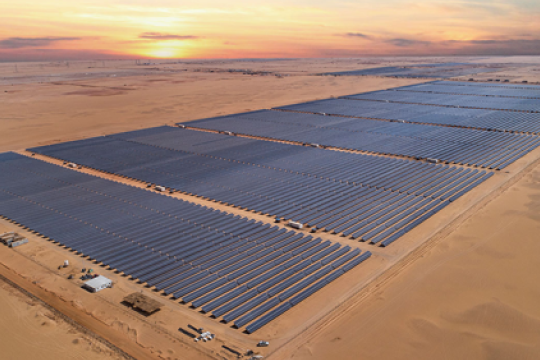
In today’s issue: We test Egypt’s new 45% renewable energy target against what’s actually been built, funded, and disclosed.