Good morning, wonderful people. Thanks for starting your workweek with us.
I’m delighted to welcome an old friend as the latest backer of your morning read — and to show off our fresh coat of paint.
I’ve known (and admired) Hani Berzi and his team for longer than is polite to say. We love Edita’s brand- and innovation-led approach to growth at home — and anyone who has gotten me talking about strategies for international growth has heard me wax poetic about how Hani chooses expansion markets, including his use of Egypt as a manufacturing base from which to export to more than 20 countries.
And while the rest of us have pushed into “red oceans” like the Gulf, Hani has looked for white space, setting up successful on-the-ground operations in Morocco and Iraq. (Forgive me the mixed metaphor — ‘tis still early.)
Edita joins us this morning as our newest pillar supporter, and we couldn’t be prouder to have them on board. It’s thanks to Edita and all of our other commercial partners (including Qalaa Holdings, the new sponsor of this note) that EnterpriseAM remains available to you every morning without charge more than a decade since we first hit “send.”
Given how brand- and design-forward Edita is, it’s fitting that they’re joining us on a redesign morning. The morning edition now matches the look and feel of our afternoon and weekend editions. We think the font is a lot easier to read and the design is much crisper. Look for more improvements in the months to come.
We’ll start each morning with a short welcome note here from me or Abdelhamid, our national editor for Egypt. After tl;dr, you’ll find The Lede, where we’ll dive deep each day into a story that’s in the headlines — or that should be.
Today’s Lede is a deep dive into an ambitious bid to export green compute to Europe, where the Sheta family’s Income group joins a list of ambitious projects backed by other first-class names in our community, including Hassan Allam Utilities and A15, which committed USD 400 mn earlier this year to the first phase of a big data center bid.
Nationwide, we have only about 60 MW of installed data center capacity — a figure that puts us way behind the Gulf in a sector that is becoming critical to the global economy. And our legislative framework isn’t friendly to the cloud, whether you’re talking Central Bank of Egypt restrictions on its use or the ongoing bureaucratic wrangling over who has access to what. We’ll continue covering the tick-tock on this generationally important story in EnterpriseAM Egypt and our newly launched AI + Innovation edition, out Tuesdays and Thursdays.
We’re also going to be focusing on tighter writing and more of the human voice that makes us … us. Our vision is simple: To be the Arab world’s business daily, telling stories of our region’s people and companies that you won’t find anywhere else.
Thank you, everyone, for choosing to start your day with us. Writing you every morning is the honor of my professional career. –Patrick
IN TODAY’S ISSUE: We speak to the developer behind Project Atlas, which is bidding to sell green compute to Europe. The solar-backed AI campus in New Borg El Arab is being built by Income Egypt and Dubai-based Sustainable Infra Capital. Phase one of the project, which is set to hold no Egyptian data, is due to clock in at 180 MW and would cost around USD 2.15 bn, Income’s Aly Sheta tells us, with financial close targeted for end-2027.
Speaking of power: The 900 MW Shokeir wind farm in the Gulf of Suez has reached financial close on around USD 588 mn of debt. Once it’s running, it’ll be Engie’s largest onshore wind farm anywhere. The close landed about four months after Orascom’s target, but construction has been underway since June.
On the energy front: Egyptian General Petroleum Corporation has hired Halliburton to design a 50-well fracking program in the Western Desert, going after the oil that conventional extraction approaches left behind. The Oil Ministry’s preliminary estimate is 50k-100k bbl / d of crude. For now, the plan only includes studies and design, and drilling comes if the numbers hold up.
***
SEND US A VOICE NOTE? Ever wondered how EnterpriseAM makes money, how the newsroom runs over the course of the day, from Egypt to Saudi to the UAE, or why, in the age of reels and zippy TikTok virals, we’re still betting on long-form journalism?
We’re looking for reader questions for an upcoming episode of Making It and would love to hear from you. Send your question as a WhatsApp voice note to +20 100 988 8800 or email it to us by replying to this email.
Shy? We’re happy to take written questions, too.
***
IMF talks go virtual
Talks on the final review of Egypt’s USD 8 bn extended fund facility with the IMF are moving online after the Fund’s mission to Cairo (which ran from 25 October to 5 November) wrapped without a staff-level agreement. “Important progress was made during the mission,” IMF Communications Director Julie Kozack said during a press briefing on Thursday.
Kozack gave no timeline or details on a follow-up program, saying the Fund remains focused on the current one, and that what comes next “is very much for the Egyptian authorities.” The review of the EFF and a separate resilience and sustainability facility would unlock c. USD 2.3 bn before the program expires on 15 December.
Signed, sealed, delivered
Egypt is now the first country outside Europe whose electronic signature framework is technically aligned with the EU’s, according to statements from the EU and the Information Technology Industry Development Agency (ITIDA) (pdf). The European Commission plans to add Egypt to its Third Countries List of Trusted Lists (alongside Moldova and Ukraine), which would let EU member states validate Egyptian e-signatures and seals. ITIDA is returning the favor, adding the EU’s list to Egypt’s own so that European signatures can be validated here.
Why it matters: The EU is Egypt’s largest trading partner, accounting for 24.6% of Egypt’s total trade and EUR 32.3 bn in goods trade last year, according to EU data.
Happening today
Exporters will hear how therevamped export rebate programworks in practice this afternoon, when the Finance and Investment ministries brief them at a 4pm press conference at the St. Regis in the New Administrative Capital, according to an invitation EnterpriseAM received. The Cabinet approved the program earlier this month, and its new rates already cover shipments made since the start of November.
Happening tomorrow
More than 70 senior executivesfrom global companies arrive in the New Capital tomorrow for the World Economic Forum’sCountry Strategy Meeting on Egypt, which runs Monday and Tuesday, 16-17 November. President Abdel Fattah El Sisi will hold a special dialogue with the visiting CEOs while cabinet members make the case for investment. The pitch: 1.5 bn consumers reachable tariff-free through pacts including the EU Association Agreement and African Continental Freetrade Area.
PSA-
WEATHER- Cairo is back in the mid-20s today, with a high of 26°C and a low of 17°C, according to our favorite weather app.
It’s a degree warmer by day on the coast in Alexandria too, with a high of 25°C and a low of 16°C.
The big story abroad
Microsoft apologized on Friday for a global outage that cut offbusinesses, schools, and governmentsfrom Outlook, Teams, and other workplace tools. The company blamed “an issue during an earlier network capacity upgrade that surfaced following a recent network change,” rather than a cyberattack or anything AI-related. Microsoft said the service is showing “broad recovery and stability” and has promised a full post-incident report once a review is complete.
Airlines in the United States canceled 4.5k flights and pushed back another 4.4k yesterday, with the country still reeling from the longest nationwide flight shutdown since the 9/11 attacks, Reuters reports. A major communications breakdown on Friday led US aviation authorities to ground almost every departing flight across the country for almost five hours. Transportation Secretary Sean Duffy traced the disruption to at least one new router that FAA contractor L3Harris had installed at a remote site, and is seeking USD 50 bn to modernize the country’s air traffic control systems.
Some106k people protested across Franceyesterday, including 24k in Paris, according to the Interior Ministry. Demonstrators took to the streets over issues ranging from rising living costs to a proposal to give police greater legal protection. The protests were smaller than other recent demonstrations.
Setting the record straight
OLA Energy says reports that it plans to invest EGP 2 bn in 20 new integrated fuel stations in Egypt in FY 2027/28 are incorrect, according to a statement the company sent to EnterpriseAM. The Libyan-owned fuel retailer says the figures, which we noted on Thursday citing Asharq Business, did not come from the company.
Somabay welcomes Golf & Gourmet 2026 from 21-29 November, bringing together golf enthusiasts from Germany, Austria, and Switzerland for nine days of championship golf and exceptional culinary experiences, featuring renowned chef Otto Koch and his team. A celebration of golf, hospitality and the Red Sea.
Alexandria may soon be home to a green AI data center built purely to export compute. Income Egypt for Infrastructure & Investment and Sustainable Infra Capital (SIC), a Dubai-based platform backed by Saudi and South Korean capital, are developing Project Atlas, a campus in New Borg El Arab whose 180-MW first phase targets European AI demand, according to a press release (pdf). Phase 1 would cost around USD 2.15 bn, Income Head of Strategy and Head of Digital Infrastructure Aly Sheta tells EnterpriseAM.
The consortium is targeting financial close by end-2027, with a first phase ready for service in 4Q 2028. The sponsors unveiled the project late last month at Cushman & Wakefield’s London headquarters, where the firm, which is also advising on Atlas, released a white paper (pdf) on Mediterranean data centers that uses Atlas as its Egypt case study.
The USD 2.15 bn covers the campus alone and excludes the equipment inside it. The figure includes the solar park, the core and shell, supporting infrastructure, and the building’s mechanical and electrical systems (MEP works), or “everything that essentially builds the campus itself,” Sheta tells us, adding that the estimate is high-level and will firm up closer to financial close. The servers, racks, and chips fall to tenants, who typically spend three to four times the cost of the core and shell. “Our scope ends at the shell and the MEP works,” he says.
Compute follows power
Cushman & Wakefield’s white paper lays out the case for Atlas, starting with Europe’s shortage. Demand for AI computing is here, yet the continent has struggled to build enough of it, largely because of long waits to connect to aging grids. The firm expects Southern Europe’s data center capacity to grow tenfold, from 800 MW to 8 GW, which it says will mean severe competition for grid connections and land. A site that has to wait five years for a grid connection is less competitive than an emerging market that can deliver capacity sooner, according to the firm.
Some of that demand could spill across the Mediterranean, much as Malaysia’s Johor became a “release valve” for Singapore. The firm argues that southern Mediterranean markets “should not be viewed simply as domestic data center markets,” since they can host European workloads that don’t need to run inside Europe’s cities.
The paper places Egypt at the eastern end of that corridor and points to three advantages — scale, connectivity, and geography. On scale, Egypt has North Africa’s largest grid, with around 60 GW of installed capacity against a record peak load of 40.2 GW in August. Its neighbors have far less room. Morocco runs a system of around 12 GW, where consumption is growing faster than generation, while Tunisia, with peak demand of around 5 GW, saw rolling power cuts during this summer’s heatwave.
On connectivity, Egypt has 15 operational subsea cables in the Mediterranean and two more planned, against five for Tunisia and one for Morocco. Yet the firm tracks just 13.5 MW of operating data center capacity in Egypt, or 0.1 MW per mn people, the lowest ratio in its benchmark. That’s why the paper sizes up northern Egypt by how much foreign demand it can accommodate, starting with workloads that can’t find capacity in Southern Europe and the Eastern Mediterranean and potentially extending to East Africa, the Middle East, and Asia.
Income is pitching Atlas as exactly that kind of project. The press release says the campus addresses Europe’s three bottlenecks of power, land, and permits, and its permits are already in hand. Atlas will use Egypt’s subsea cables to carry AI workloads to and from Europe at low latency, running its own dedicated fiber linking the campus to the cable landing station, the release adds. The paper’s argument on grid headroom also skips gas supply, which by our reading is the tighter limit, as the state cuts gas to fertilizer and steel plants this month.
SOUND SMART- Data takes 34-37 milliseconds to make a round trip from Egypt to Marseille and about 37 ms to Frankfurt, according to Cushman & Wakefield, against 21-23 ms from Morocco and 12-14 ms from Tunisia to Marseille. That makes Egypt a “poor” fit for highly latency-sensitive work such as gaming or high-frequency trading, and a strong one for work that can tolerate the delay, such as fine-tuning, synthetic-data generation, and batch inference. Atlas is pitched at that second group, from model training to large-scale inference, according to the release.
Bigger than the whole market
To put 180 MW into perspective, estimates of how much data center capacity Egypt has installed range from 15 MW to 60 MW, with Sheta putting it at around 29 MW. But it’s a sector that is attracting interest from nimble players including Hassan Allam Utilities and A15 (which together committed USD 400 mn to the first phase of a new data center in June). Gulf Data Hub and Elsewedy are backing a USD 2.1 bn plan for up to 192 MW of compute.
Atlas and its sponsors are in talks with hyperscale and AI customers, including hyperscalers such as AWS, Microsoft, and Meta, which Sheta says opened in Kenya, Morocco, Nigeria, and South Africa instead of Egypt. Atlas has been on the drawing board since January 2024, when Income, Record Digital Asset Ventures, and SIC — then called Swicorp Infra Capital — signed an MoU with the Communications Ministry. Record Digital has since left the consortium.
The cost of going greener
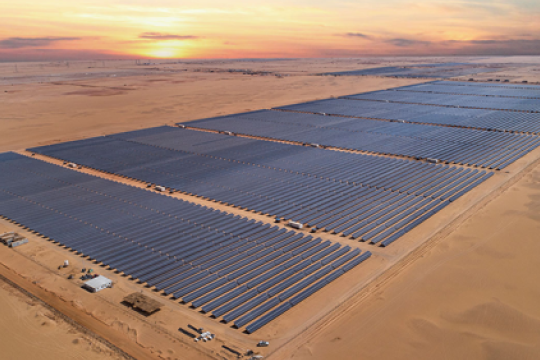
The data center itself will take up just 160k sqm of the project’s 5.4 mn sqm site, on a plot that Income has bought outright and will run as a private service freezone, Aly Sheta tells us. Income holds the rest of the land under a usufruct arrangement and will build the solar plant there to feed power straight to the campus without a grid connection of its own. At full build-out, the plant could reach 485 MW at peak output, while phase one will need more than 200 MW of solar to cover its planned 40% share of the power mix, Sheta says.
Sheta says the 40% share could climb, at a price. “We have the ability to actually scale it up to 60, 70%, but that entails you scaling up your BESS as well,” Sheta says, referring to the battery energy storage system. “That could mean you have more of a green component, but also it means that you could have a higher LCOE, so your landed cost of electricity could increase, but you’d essentially be more green,” he adds.
The final solar share, battery size, and campus design will all be settled with the technical partner, which is yet to be appointed. For now, Sheta expects a battery system of around 800 MWh, potentially slightly more or less. Cooling will run on a closed loop, which he says limits water use to the initial fill and minor top-ups from the local utility. The consortium is ready to revise the preliminary design that UK-based Future-Tech drew up, which uses direct-to-chip liquid cooling. “We always knew that the incoming technical partner or operator is going to have his own specs,” Sheta tells us. “But we just wanted to go to the market with something.”
Atlas is also negotiating a 220 MW power purchase agreement with the grid. “We’re essentially willing to pay hard currency to the country, and at a significantly higher rate than the industrial norm,” Sheta tells us, declining to give the tariff beyond saying that it would be well above what large industrial consumers such as Ezz Steel and Egypt Aluminium pay.
Sheta sees grid supply as essential however large the solar plant grows. “Renewable power will never be enough,” he says. “Even if you scale up your BESS to a ludicrous figure, you can easily be faced with three, four days of overcast, cloudy days, and suddenly you’re cornered.”
Tenants first, then debt
The consortium is looking to finance around 70% of the project through non-recourse debt, with sponsors putting up the remaining 30%. The debt has yet to be committed, although development finance institutions have shown interest. “We’ve had preliminary discussions with IFC, EBRD, and all of them have expressed a lot of interest,” Sheta tells us.
That interest only turns into money once tenants sign, and none have so far. “That typically entails securing long-term binding offtake agreements. I think that’s the crucial element to securing the level of finance that we’re looking for,” Sheta says of reaching financial close.
Finding tenants will largely fall to a technical partner that the consortium is still recruiting. Cushman & Wakefield has spent around six months running that search and has opened preliminary talks with Equinix and Digital Realty, Sheta tells us. That partner would handle day-to-day operations and would typically bring its own customers, he adds, though Egyptian buyers need US Commerce Department approval for Nvidia hardware, and it isn’t yet clear whether they would get the highest-end parts.
Offshore island, onshore rules
Atlas’s business model depends on being walled off from Egypt, with Sheta describing the goal as becoming “a digital embassy or an offshore island” that holds no Egyptian data and connects to no Egyptian network. He says that isolation is what makes Atlas compliant with the EU’s data protection rules. “Once we were completely isolated from Egyptian networks, we realized that that actually enables us to become GDPR-compliant, which essentially allows us to process and store European data here in Egypt,” Sheta tells us. “Something that’s very difficult to do.”
A Magic Circle law firm, which he declined to name, has signed off on that setup, Sheta says, while the campus’s agreement with Telecom Egypt bars it from storing any local data. Because no local data is stored on site, he adds, the campus falls outside the scope of local audits. “You need to ensure that there’s going to be no sort of meddling or auditing when it comes to the workloads being transported to the campus,” he tells us.
That sign-off covers whether Atlas meets European rules, and it leaves open whether Egyptian law will guarantee the isolation Atlas is promising. Egypt’s wider legal framework was written with telecom operators in mind, leaving hyperscalers asking for clearer rules before they build, according to the lawyers and investors whom our AI + Innovation team interviewed about the sector. Under the 2020 data protection law, which Egypt began fully enforcing earlier this month, each transfer of data abroad “needs its own permit, granted case by case,” says Soliman, Hashish & Partners Managing Partner Mohamed Hashish.
Investors are also asking for “a judge’s approval for any government access to data,” says Clyde & Co Partner Sameh Dahroug. They also want “a fixed fee they can plan around” in place of the share of revenue that data centers now pay, as telecom companies do, he adds. Formal data embassies, which would place a facility’s data under a foreign jurisdiction, look unlikely because they would probably require a constitutional amendment, according to Dahroug and Al Tamimi & Company’s Ayman Nour.
The government is working on both the rules and the projects, with a national data center strategy due before year-end. Communications Minister Raafat Hindy is also targeting five to seven large-scale facilities over the next four to five years, some of them exporting services by 2030. Sheta says officials have backed Atlas since its early days. “We were pleasantly surprised by the willingness to support,” he tells us, crediting the Communications Ministry and the Housing Ministry’s New Urban Communities Authority for championing the project.
Built for Europe by design
The export-only model came from Income’s board, which was looking for businesses that could generate hard currency. The domestic market couldn’t fill a campus this size anyway, as an early study that Income ran with CBRE found Egyptian demand nowhere near what Atlas would need. “You’re talking about things that really require a heavy, heavy amount of data processing. And you just don’t have the demand coming from Egypt yet,” Sheta says.
Cushman & Wakefield concludes that northern Egypt’s role is to serve as “a regional AI factory, rather than a conventional data center market.” That means complementing Milan, Marseille, and Frankfurt for workloads where power, scale, and cost per token, the cost of each unit of AI output, matter more than the final tens of milliseconds of latency. If developers can deploy 100+ MW of GPU capacity in Egypt faster or more cheaply than in an established European hub, a 30-50 ms network delay “can be entirely acceptable for a substantial class of inference workloads,” the firm writes.
To capture that demand, frontier markets need to deliver what the paper calls a “shopping list.” It runs from retail power below USD 0.10 per kWh and power that can be added “in months rather than years” to a robust GDPR-based sovereignty framework, carrier-neutral fiber, and governments that welcome the sector. The final item, “perhaps most importantly,” is early engagement with offtakers, the long-term tenants who would rent the capacity.
Shokeir Wind Energyreached financial close on its 900 MW plant near Ras Shokeir in the Gulf of Suez, according to the sponsors’ joint statement (pdf), and once it’s running, it’ll be Engie’s largest onshore wind farm anywhere. Lenders have committed around USD 588 mn of non-recourse debt, the Japan Bank for International Cooperation (JBIC) said in a statement on Thursday. The Finance Ministry is guaranteeing the state’s side of the 25-year power purchase agreement signed in March, under which the state grid operator buys every unit the farm produces.
Behind it is the same trio that already runs two wind farms in the Gulf of Suez. These are Engie (35%), Aeolus (40%) — Toyota Tsusho’s African renewables platform — and Orascom Construction (25%), which is also building the civil and electrical works and supplying some local components. The farm’s 86 Goldwind turbines (10.5 MW each) will take the trio’s Egyptian wind capacity from 912.5 MW to 1.8 GW once they’re all running.
The close took longer than advertised: Orascom said in March it expected financial close by early 3Q 2026, and it landed on Friday, about four months late. But work on site didn’t wait for the money, as construction has been underway since June.
Once it’s fully running, the farm should generate about4 TWh a year, according to Engie, and avoid roughly 2 mn tons of CO2 emissions annually. That power goes into a grid the government wants at 45% renewables by 2028, the same year this farm is due to come online.
What’s next: The first 300 MW should enter commissioning in January 2028 and the rest by 3Q 2028, the sponsors said, though the golden license the Cabinet granted on 28 October allows a little more time, pointing to completion on 1 November 2028.
In other news
The Egyptian Competition Authority has clearedEDF Power Solutionsto buy 20% ofEnergy Valley, the company behind Scatec’s 1.95 GW of solar at East Minya and 3.9 GWh of batteries, on condition that the French utility uses the project’s commercially sensitive data only to run the project. The stake gives EDF “material influence” over the company, according to a statement by the authority, so its board and committee representatives may not share, discuss, or vote on commercially sensitive information; they must sign confidentiality agreements and face periodic compliance reviews.
REMEMBER- EDF is already Scatec’s partner on two other Egyptian projects: it holds 20% of the 1.1 GW Obelisk solar-and-battery plant at Nag Hammadi and is taking a targeted 29% of the 900 MW Shadwan under-construction wind farm. Energy Valley itself is roughly 60% owned by the platform Scatec set up with the European Bank for Reconstruction and Development last month, in which the bank holds 40% of it, for up to USD 221 mn. Financial close is due before year-end.
Nick Oberheiden, US President Donald Trump’s nominee to become ambassador to Cairo, called Egypt the United States’ “largest export market in Africa” at his confirmation hearing (watch, runtime: 6:02) before the Senate Foreign Relations Committee on Tuesday, adding that more than 2.1k US companies operate in the country. He also committed to “continue implementing the President’s Comprehensive Peace Plan for Gaza.”
Did he just flag sympathy for the GERD file? Oberheiden said he looked forward to working with the Egyptian government on the Nile, noting that “President Trump understands the deep significance of the Nile River for Egypt and its people, and if confirmed, I look forward to working with Foreign Minister Dr. Abdelatty and Water Minister Dr. Sewilam on this critical challenge.”
^^ The key there: Putting Abdelatty ahead of Sewilam is big. The mention of the file by Egyptian diplomats typically sees other Western embassies in Cairo wave their hands and change the subject.
Oberheiden also zeroed in on trade and investment opportunities for US companies, noting that the US has a trade surplus here and that he would “make America the obvious first choice and make sure US companies have every opportunity to compete and succeed.”
The clock is ticking: Democrats swept the US midterm elections and will take over the Senate Foreign Relations Committee in January. The committee is yet to vote on Oberheiden’s nomination, which has been pending since June.
BACKGROUND- Oberheiden is the founder and principal of Oberheiden P.C., a US federal litigation firm, and has practiced national security, federal, and international law for over a decade, according to the State Department’s certificate of competency. He was previously a litigator at White & Case in New York and has advised the State Department on policy questions as an outside legal consultant. He holds a law degree from Germany’s University of Hamburg and a JD from the University of California.
The Financial Regulatory Authority (FRA) is keeping the door shut on new consumer finance and microfinance lenders for another year, extending its freeze on new license applications through the traditional route to 11 October 2027, according to an FRA statement. The ban also covers NGOs seeking to run microfinance programs. A separate, renewable freeze on fintech-based consumer finance licenses remains in place until 25 February 2027.
The FRA first froze licensing inOctober 2024after granting 10 microfinance and 15 consumer finance licenses in two years, and this time it cites financial stability, market needs, and the quality of services. By our reading, the regulator wants a tighter field of sturdier lenders while the business keeps growing fast: consumer finance volumes were up 57% y-o-y to EGP 96.3 bn across 48 licensed companies by end-2025, according to FRA data we reported in May.
In other FRA news
#1- Misr Life Ins. has become the first life ins’er in Egypt to get a fintech license from the FRA, according to a statement. The company says years of tech investment went into a platform that now runs the whole customer journey online, from choosing and pricing a policy to paying premiums and settling claims, with AI used to assess risk and speed up service. The license comes as the ins’er, which holds 22% of Egypt’s life ins. market, according to the Sovereign Fund of Egypt, prepares to float up to 20% of its shares on the EGX in an IPO led by EFG Hermes.
#2- The ins. sector’s deadline for meeting the capital rules in decision 196 of 2024 has been extended to July 2027, the end of the Unified Ins. Law’s third transition year, according to an FRA statement. This gives ins’ers and managing general agents (MGAs) another three months to sign up to its new MGA registration framework. A companion decision, 200 of 2026, does the same for risk assessors and loss adjusters. This is not the first reprieve: ins. auxiliary firms had until 31 October to meet their capital minimums, and 82 of 132 had done so by then.
The government is going back for the oil it left behind in the Western Desert. The Egyptian General Petroleum Corporation (EGPC) has contracted US oilfield services giant Halliburton to design a 50-well program over 18 months in the concessions of the state-owned General Petroleum Company (GPC), built on horizontal wells fractured in stages, the Oil Ministry said in a statement. The contract only covers studies and design for now, and drilling would follow if the numbers hold up.
SOUND SMART- Conventional drilling goes straight down and lets the reservoir’s own pressure lift the oil. Unconventional rock will not yield that way, so the well is turned sideways through the layer to expose far more of it, then cracked with water and sand pumped in under pressure; the cracks carry the oil to the well. The target is the Abu Roash F, the layer that generated the Western Desert’s fields. Most of its oil never reached a trap (a fold or fault where oil pools), so it’s still there, in rock tight enough to need the cracks.
Egypt hasn’t emptied its conventional book — eight Mediterranean blocks remain open until 14 December, but the onshore province where GPC operates is old. Not a dry basin, but a mature one where each barrel left costs more to lift.
IN CONTEXT- None of this is new to Egypt, which has been fracking wells since the early 1990s, with over 1k treatments in the Khalda Ridge fields in the Western Desert. Badr El Din Petroleum Company is fracturing Obaiyed Field this month, and Abu Roash F itself was cracked: TAG Oil re-entered a vertical well in Badr Oil Field in 2023 for 140 bbl / d, then put 12 stages into a 308-meter lateral in 2024. The equipment and the know-how have been in the country for decades, so the holdup is money, by our read.
And even if every well matched the pilot, the numbers would be modest. NES-8, GPC’s test well in the Western Desert, produced nearly 3 mmcf / d of gas from tight rock when it was fractured this year. Fifty wells matching that rate would add 150 mmcf / d, about five weeks’ worth of the roughly 120 mmcf / d a month that existing fields lose due to natural decline, by our math. And that’s gas, while the program is targeting oil. The ministry’s own preliminary estimate for fracking the Western Desert is 50k-100k bbl / d of crude, at most a fifth of what Egypt pumps today.
Why it matters: The alternative to a tight barrel is an imported one. Egypt no longer lifts enough to cover what it burns, so the shortfall comes in by tanker and is paid for in USD. A barrel cracked out of Abu Roash is hard currency kept at home, which is why the ministry is redrawing the contracts this work needs: performance and integrated-service deals, turnkey packages, and faster recovery of capex. Whether the studies due in 3Q FY 2026/27 turn into signed drilling is the test.
Contact Financial Holding’sSarwa Insurancehas named Mohamed Abdel Aziz (LinkedIn) managing director effective January 2027, the company said in a statement. He takes a seat that has been filled on an acting basis since October, when Ahmed Khalifa (LinkedIn) left to run Al Buhaira National in the UAE. Abdelaziz, who served as Sarwa’s deputy managing director for strategic planning and growth from 2020 to 2023, comes back from Gulf General Cooperative in Saudi Arabia, where he has been technical director since July 2025.
Raya is ready to sign on its data center buy: Raya Holding’s proposed buy of a local data center has received board approval. The board gave management the green light to push ahead with talks on an agreement and to get an independent estimate of a fair value for the unnamed target’s shares, according to a bourse filing (pdf).
IN CONTEXT- Raya’s board approved in September up to USD 60 mn, money that only becomes a commitment if Raya secures the asset. Raya Information Technology, its wholly owned tech arm, would put it into a capital increase at Raya Data Center to cover the equity portion of a USD-denominated price, and that vehicle is not wholly Raya’s: Africa50 paid USD 15 mn for 42.9% of Raya Data Center in 2024. It’s not clear whether the pan-African investor is also kicking in capital for the data center buy.
Still not clear — the target or how much Raya might pay. Raya Holding has been returning to its roots with investments in tech of late: Marwa Abbas took over Raya IT as CEO in July after 30 years at IBM, and the group launched AI company Raya Nexus with EGP 250 mn in September.
Copper-bottomed expansion
The European Bank for Reconstruction and Development (EBRD) signed a USD 45 mn senior loan agreement withEgyptian German Industrial Corporate(EGIC), according to the lender’s project summary. EGIC will use the funds to expand its copper valves and inserts production capacity and build a finished-goods warehouse. This is the third facility from EBRD for the Cairo plumbing-systems maker, after USD 25 mn in 2013 and USD 50 mn of long-term working capital approved in 2023. EGIC was set up in 1991 to bring PP-R plumbing to Egypt; it now runs four plants here and one in Germany, including a copper foundry it bills as the Middle East’s largest.
Weaving closer European ties
Apparel, textile councils sign EU sourcing pact: The Apparel Export Council and the Textile Export Council have signed an MoU with Euratex, Europe’s apparel and textile industry confederation, to broker joint ventures and sourcing agreements between Egyptian factories and European buyers, according to a LinkedIn post. The agreement lands as garment makers chase a USD 4 bn export target for 2026 and ride a wave of European demand: Europe took USD 1.29 bn of the sector’s exports in the first nine months of 2026, up 32% y-o-y and 44.6% of the total, according to the Apparel Export Council. Egyptian garments enter the EU duty-free under the EU-Egypt Association Agreement, an edge that widens as tariffs rise elsewhere.
Distressed factories get the fund
Subscriptions to the EGP 1 bn distressed-factories fund were fully covered on 3 November, about a month after the Central Bank and the Industry Ministry launched it, CI Capital Holding said in a statement. CI Capital’s direct-investment arm manages the closed-ended fund, which takes equity in industrial companies that have viable assets but are in financial or operational trouble. It works with management on debt restructuring, fresh capital, and governance under Financial Regulatory Authority oversight. The five banks contributing to it are the National Bank of Egypt, Banque Misr, Arab African International Bank, the Agricultural Bank of Egypt, and EBank. Most recently, the ministry was in talks with investors to acquire some 30 distressed factories.
A Japanese zone of their own
Egypt is studying a purpose-built industrial zone for Japanese manufacturers, Investment Minister Mohamed Farid Saleh told a delegation of 25 companies from the Central Japan Economic Federation, among them Mitsubishi, Mitsui, and Marubeni, according to a ministry statement. The pitch is a cluster that plugs Japanese plants into local supply chains and points their output at exports, though no site, size, or timeline has been set.
Anthropic’s tn-USD moment is almost here. The Claude maker’s shares are expected to start trading on Nasdaq on or around 19 November at a price that would value the whole company at up to USD 1.4 tn — a bit less than some investors had hoped, Reuters reports. It’s only selling a small slice of itself, but that could still bring in as much as USD 64.4 bn, CNBC says. Google, Nvidia, Microsoft, and other tech giants are buying an extra USD 26 bn of its shares.
Investors have put in orders for six times more stock than is for sale, Bloomberg reports, and bankers are now mulling whether to price the shares above the range, which could value Anthropic at USD 1.5 tn or more, the Financial Times adds. Goldman Sachs and Morgan Stanley are expected to price the offering on 18 November.
The timing is tricky: Investors will be watching how Anthropic’s shares sell to judge whether Wall Street is still bullish on AI. They’re a little jumpy right now. AI stocks have only partly bounced back from last week’s post-midterm selloff, as we noted on Tuesday.
SPEAKING OF WHICH- That selloff is already hitting Gulf wallets. Abu Dhabi’s Mubadala may be down about USD 17.5 bn on its AI wagers since the end of June, while Saudi Arabia’s PIF is down about USD 5.64 bn, according to estimates by consultancy GlobalSWF first reported by Semafor.
Investors aren’t about to pull out of AI completely. If anything, lower prices could let long-term investors like these pick up more of some AI stocks. We’ve long argued that any air being let out of the AI bubble might be seen by Gulf sovereign funds as a chance to up their stakes in companies they see building a transformative technology.
Why this matters for the Gulf: Abu Dhabi’s state fund MGX and the Qatar Investment Authority already own pieces of Anthropic, so the company’s performance next week will affect Gulf public money. UAE investors are also leading OpenAI’s next funding round, which is why investors are watching Anthropic’s IPO for clues about how OpenAI might fare.
OpenAI’s numbers are a mixed bag. In 3Q 2026, it made USD 10 bn in sales in a single quarter for the first time ever, nearly 50% more than the quarter before, Bloomberg reports. But it also lost USD 10.9 bn over the same three months, The Wall Street Journal reports.
Take that with a grain of salt: OpenAI and Anthropic don’t use the same rules about how to count revenue. Anthropic includes the full value of the sales it makes through Amazon, Google, and Microsoft’s clouds, then books its partners’ cuts as an expense. OpenAI’s top line includes only what it keeps after Microsoft gets its cut.
EGX30
52,023
-0.9% (YTD: +24.4%)
USD (CBE)
Buy 53.37
Sell 53.50
USD (CIB)
Buy 53.35
Sell 53.45
Interest rates (CBE)
20.00% deposit
21.00% lending
Tadawul
10,326
+0.2% (YTD: -1.6%)
ADX
9,667
-0.6% (YTD: -3.3%)
DFM
6,198
-0.6% (YTD: +2.5%)
S&P 500
7,562
-0.4% (YTD: +10.5%)
FTSE 100
10,903
+0.4% (YTD: +9.8%)
Euro Stoxx 50
6,387
-0.2% (YTD: +10.2%)
Brent crude
USD 95.84
0.0%
Natural gas (Nymex)
USD 3.23
-3.3%
Gold
USD 3,886
0.0%
BTC
USD 63,677
-6.8% (YTD: -27.4%)
S&P Egypt Sovereign Bond Index
1,151
+0.1% (YTD: +15.9%)
S&P MENA Bond & Sukuk
148.34
-0.4% (YTD: -2.3%)
VIX (Volatility Index)
19.30
+3.2% (YTD: +29.1%)
THE CLOSING BELL-
The EGX30 fell 0.9% at Thursday’s close on turnover of EGP 10.2 bn (8.9% below the 90-day average). Local investors were the sole net buyers. The index is up 24.4% YTD.
In the green: Alexandria Containers and Goods (+1.7%), Emaar Misr (+1.4%), and Egypt Aluminum (+1.3%).
In the red: Beltone Holding (-2.4%), Juhayna (-2.3%), and TMG Holding (-2.0%).


 Egypt Edition
 MENA+ Edition
 UAE Edition
 Saudi Edition
 AI + Innovation (MENA)
 Infrastructure


 Share Issue