Saudi Arabia's Folk Maritime pauses growth until the war settles

1

WHAT WE’RE TRACKING TODAY

TODAY: Folk Maritime puts expansion on hold over war costs + Gulf crude is back, the rest of the trade isn't

Good morning, wonderful people. The war is still working its way through regional trade, and this morning's issue shows how unevenly the costs are landing.

Folk Maritime has put its expansion plans on hold as war-driven costs climb. It's one of the clearest signs yet that the pressure has reached operators' long-term plans as well as their day-to-day running costs. We break down the decision and what it means for the company below.

Gulf crude, meanwhile, is back to prewar levels. The rest of the region's trade has yet to recover, and we look at what's holding it back.

Our favorite detail this morning: Saudi Arabia and the UAE are parking their crude closer to their biggest buyers in Asia. If you can't control the chokepoint, you can at least shorten the trip.

And on the war front, the Houthis have hit Saudi airports and energy infrastructure: The group claims its strikes disturbed air traffic at King Khalid International Airport and set fires at Aramco's Rabigh refinery, and it has warned airlines to stop flying in Saudi airspace. The General Authority of Civil Aviation said Jazan's King Abdullah bin Abdulaziz International Airport and Najran International Airport were targeted on Monday, leaving three people with minor injuries.

The strikes come as Yemen's Saudi-backed government says it has retaken the coast along the Bab Al Mandab Strait and Dhubab Airport. It also launched what it calls a “strategic attack” on Sanaa. Government forces took Dhubab district in Taiz, which overlooks the strait, cutting the road between Dhubab and Al Makha, and have since captured Al Makha and the towns of Bab and Hadeid. The campaign,announced last weekend, aims to restore state institutions and retake Sanaa and other Houthi-held territory.

Saving for a rainy strait

Saudi Arabia and the UAE want to keep more of their crude on the Asian side of Hormuz. The two are expected to back a Japan-led push to build bigger oil reserves across Asia at the Asia Zero Emission Community ministerial meeting in the Philippines on Thursday, Nikkei reports. Riyadh and Abu Dhabi would supply more crude and could offer emergency priority access. Japan would fund the stockpiles through its USD 10 bn Power Asia program.

It’s a bigger version of agreements already in place: Both have asked Japan to expand their existing Japan-based crude inventories roughly tenfold from around 8 mn barrels each. Aramco also holds 5.3 mn barrels in South Korea, with Seoul holding emergency purchase rights.

Most of Asia needs the cover: Japan holds more than 200 days of oil reserves.Thailand had 61 days as of March, the Philippines 53, and Vietnam just 30.

Saudi Arabia is also cutting prices to gain back Asian buyers: Aramco set November Arab Light at a USD 5 per barrel reduction to Oman-Dubai, its deepest since 2020, Reuters reported. Gulf exports are already back around pre-war levels, Reuters reported separately.

Japan isn’t going anywhere either: It sourced around 94% of its crude from the Middle East in 2025. Taiyo Oil CEO Takahiro Yamamoto wants it to stay above 90% once conditions normalize, even after Taiyo cut its own Gulf exposure to nearly 15% during the war, Bloomberg reported.

Ship of state

Iraq wants to deliver its own oil beyond Hormuz instead of handing it to buyers at Basrah, and its tanker company is looking to buy the ships to do it again, INA reported. The Iraqi Oil Tankers Company sent a VLCC it secured with specialist firms through the strait with 2 mn barrels aboard, its first such voyage in decades. The company says the shift lets state marketer Somo capture “better sales and pricing.”

So far, Iraq's buyers have carried the Hormuz crossing. Iraq sells FOB, with buyers responsible for collecting barrels inside the strait, and the costs are steep. Reliance paid USD 23-25 mn to lift 2 mn barrels of Basrah crude on a Sinokor VLCC, against about USD 2 mn before the war. Somo was also offering Basrah crude for ship-to-ship pickup near Oman, moving the handoff outside the Gulf.

The company's fleet is small and old. It runs six tankers of “limited capacity and older models,” the Oil Ministry said in August, when it set out a plan to acquire vessels carrying up to 2 mn barrels each through partnerships, deferred-payment purchases, or leases.

Aramco and Adnoc already run their own shuttles. Both take crude through the strait and hand it to buyers’ tankers outside it, with Aramco using dedicated tankers. Adnoc, which charters around 15 crude carriers, is buying five more from Frontline, and Aramco's Bahri runs around 50 VLCCs.

UAE-Jordan’s new rail link on track

The UAE-Jordan railway project kicked off yesterday with Abu Dhabi Crown Prince Khaled bin Mohamed bin Zayed Al Nahyan arriving in Aqaba, Jordan, to mark the launch of the Aqaba-Shidiya-Ma’an railway project, according to state news agency Wam. He was received by Jordan’s King Abdullah II, alongside other senior officials.

BACKGROUND- Jordan and the UAE inked an agreement on the USD 2.3 bn railway project back in 2024, with plans to connect Jordan’s Al Shidiya and Ghor es Safi mining regions with its sole maritime gateway in Aqaba. As part of this, the two agreed to set up the UAE-Jordan Railway Company to develop and operate the 360-km railway project. Financial close is expected in early 2027, and construction is estimated to take five years.

The Gulf’s sovereign funds and largest companies are committing billions to AI infrastructure at home and to AI companies in the US and beyond. EnterpriseAM AI + Innovation reports on where that capital goes, who controls it and what it is actually buying.

Every Tuesday and Thursday, we also cover the startups and established firms across MENA putting AI to work, and how it is changing jobs, education and the way business runs.

It’s sharp, analytical and skeptical journalism that ignores hype and is laser-focused on informing our readers, not pleasing our sources.

The newsletter launches Monday, 5 October, at the EnterpriseAM Egypt Forum's AI edition.

Sign up here to be among the first to get it straight to your inbox.

Market watch

Oil prices climbed this morning as storm risks and Houthi attacks on Saudi Arabia offset rising Middle East supply, Reuters reports. Brent crude futures gained USD 1.05 to USD 101.63 / bbl by 04.30 GMT, while West Texas Intermediate (WTI) increased USD 0.80 to USD 90.24 / bbl.


The Baltic Index eased once again: The Baltic Exchange’s dry bulk index — which tracks rates for the capesize, panamax, and supramax vessel segments — was down 2.2% to 3,002 points on Tuesday.The capesize index declined 4% to 4,638 points. The indices measuring panamax and supramax remain mostly unchanged,

Data point

55.3 — that’s the UAE PMI reading (pdf) for September, remaining unchanged from August, as sustained improvement in business conditions allowed firms to raise output prices at the fastest pace in 15 years to offset rising input costs, including freight and raw materials. Exports also increased at the fastest pace since 2024, driving a rise in new orders — not as high as August levels, though.

September’s data is a sign that the non-oil sector “has moved past the mid-year slowdown linked to the Middle East conflict,” Principal Economist at S&P Global Market Intelligence David Owen said. Still, sentiment is subdued for the year ahead, a sign that firms “still view the economic outlook as uncertain,” Owen added.

Output rose at the fastest pace since February — before the war — on strong demand, and businesses staffed up in response, though staffing saw only a modest rise. Still, that’s an improvement from August, when employment fell for the second time in three months.

***

YOU’RE READING EnterpriseAM Logistics, the essential MENA publication for senior execs who care about the industry that connects producers and retailers to global markets. We’re out Monday through Thursday by 10:15am in Cairo and Riyadh, and 11:15am in the UAE.

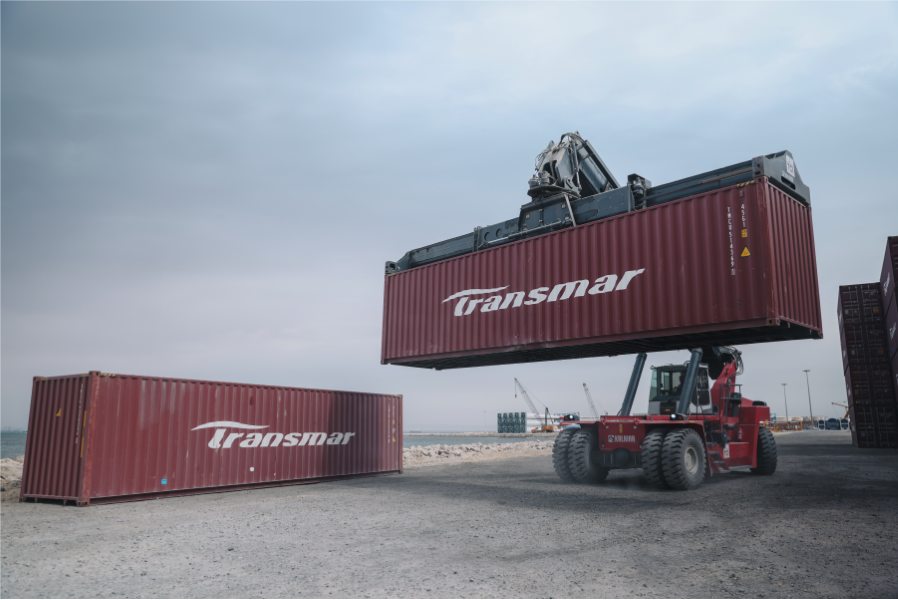
EnterpriseAM Logistics is available without charge thanks to the generous support of our friends at Hassan Allam Utilities and Transmar.

Were you forwarded this email? Tap or click here to get your own copy of EnterpriseAM Logistics.

Want to send us a story idea, request coverage, ask for a correction, or otherwise get in touch? Reach out to us on [email protected].

DID YOU KNOW that we also cover Egypt, Saudi Arabia, and the UAE? ***

This publication is proudly sponsored by

2

Shipping + Maritime

PIF-owned Folk Maritime pauses growth as shipping costs jump

Folk Maritime has put its expansion on hold as the regional war pushes its costs by as much as 40% and makes it harder to secure additional shipping capacity, CEO Poul Hestbaek tells EnterpriseAM. The Public Investment Fund-owned container line had been growing across the Middle East, the Indian subcontinent, Southeast Asia, and East Africa. Hestbaek says it has “flattened out” that growth until market conditions normalize.

Why it matters: Saudi's state-backed carrier is sitting tight while the region's shipping market is in turmoil. As a PIF-owned company, Folk's priority is covering its added costs and keeping supply flowing into the Kingdom, Hestbaek says. It has no plans to expand aggressively on the back of the disruption.

Congested ports are cramping Folk’s volumes

Folk has the cargo, and its ships are full: The company runs six vessels, five of them owned, plus leased ships and capacity bought from partners. What holds it back is how quickly those ships can get through congested ports, and what it would cost to add more. “Everything is high. Shipment cost, cost of vessels, the cost of leasing vessels, the cost of fuel … the cost of insurance, everything is high,” Hestbaek notes.

Folk is moving about 1k fewer containers a week than it planned: The firm aimed to move around 250k containers this year, or roughly 5k a week, and is currently closer to 4k. A round trip between India and the Red Sea that normally takes around 20 days now takes about 30, and Hestbaek expects Folk to finish the year below target.

Overall costs are up 30-40%, and some individual expenses have more than doubled. Folk has passed much of the increase on to customers, which limits the financial hit, but conditions are changing so quickly that planning is getting harder.

Buying more ships doesn't make sense at today's prices. Vessel prices are roughly double their pre-Covid averages, Hestbaek says, and the few ships coming to market are often lower quality.

Folk is piling into the Red Sea and steering clear of Bab Al Mandab

The war has squeezed both of the region's main shipping chokepoints. The US-Israel conflict with Iran, which began in February, has severely disrupted traffic through Hormuz. Iran-aligned Houthi forces in Yemen have also widened their reach around Bab Al Mandab, the southern gateway to the Red Sea, seizing the port of Al Makha and reaching Perim Island in September. For shipping companies, that has meant longer voyages, fewer available vessels, and higher fuel, insurance, and chartering costs, which are the same pressures behind Folk's pause.

Folk has moved c. 75% of its capacity into the Red Sea, up from roughly half before the conflict. Business there is busy, Hestbaek says, as larger lines gradually return vessels to the Suez route and need feeder services to move cargo around the region.

Hormuz is open to Folk on a case-by-case basis: The company makes occasional test crossings and decides week by week, using intelligence providers to assess security. Its most recent crossing, in September, went through normally.

Bab Al Mandab is a harder call: Folk hasn't crossed the strait “for a while,” Hestbaek says, given uncertainty over which vessels the Houthis might target. “We want predictability, and for the time being, we don't have that.”

What's next: The firm will keep growing organically through 2030 and consider acquisitions or consolidation only once it reaches its target scale. In 2027, it plans to expand partnerships with Saudi logistics providers instead of building its own warehousing and land-side services.

3

Trade

Hormuz's crude recovery hides a slower one for LNG, fertilizer, helium, and aluminum

Oil was the easy cargo, and the rest of the Gulf’s exports haven’t caught up. Middle East crude exports ended September at roughly their pre-war levels and topped them on several days, Reuters reports. Diesel and gasoline shipments are running at 58% of pre-war volumes, JPMorgan analysts said. LNG, fertilizer, aluminum, and helium are recovering more slowly still, Asharq Business reports.

Why it matters: For anyone buying gas, fertilizer, or metal from the Gulf, the crude numbers make Hormuz look closer to normal than it is. What’s holding the other cargoes back is a mix of cost, routing, and war damage, and some of that damage will take years to repair even after the strait reopens.

Our take: Crude has the margins to pay its own way. Supertanker rates from the Middle East to China hit a record USD 656k per day in late August, more than 10 times their level a year earlier, and TotalEnergies' CEO put the cost of moving a single cargo through Hormuz at around USD 20 mn. That bill is easy to absorb when TotalEnergies is buying Gulf crude at USD 50-60 per barrel with Brent above USD 90 per barrel.

No way around: LNG and helium

Qatar's LNG is getting through more often, but buyers still can’t plan around it. Four carriers loaded at Ras Laffan resurfaced outside Hormuz last weekend after making largely untracked crossings, following at least five loaded vessels spotted outside the Gulf since mid-September. In August, there were none. QatarEnergy is still extending force majeure, with Pakistan, Bangladesh, and at least one Indian buyer shut out until November, and Italy's Edison until early December.

There’s no pipeline to fall back on: Qatar went into the crisis exporting around 77-80 mn tons of LNG a year, roughly a fifth of global supply, with no meaningful bypass around Hormuz. Ship-to-ship transfers can’t carry anything close to that volume. Qatar's share of Taiwan's helium imports fell from nearly 88% to about 30% in 1H 2026, as US supply jumped to nearly 60% from under 4%, and its share of South Korea's fell to about 34% from 55%, Taiwan News reported in July.

Fertilizers’ bypass runs on thousands of trucks

Fertilizer has no easy escape route: Unlike crude, producers have no pipeline escape route and generally have less room to absorb elevated freight and war-risk costs, Wolfgang Lehmacher, former head of supply chain and transport industries at the World Economic Forum, tells EnterpriseAM.

Then the bottleneck moves inside the plant. “Vessel shortages trigger initial shocks, but storage saturation and continuous-process chemistry quickly become primary operational bottlenecks. Synthesis loops (ammonia, urea, phosphates) require constant off-take. While facilities deploy thermal loops to manage hazardous inputs like molten sulphur, operating at minimum load without off-take rapidly exhausts buffer capacity,” Lehmacher says.

Gulf fertilizer has a land route, and it takes enormous truck fleets to move. Saudi Arabia has been trucking urea west since May, and UAE producers have redirected cargo toward Fujairah for loading alongside Omani material. It took Sabic about 1.3k trucks to move a single 25k-ton urea cargo from Jubail to Yanbu, and Ma’aden deployed some 3.5k trucks to move phosphate fertilizer from Ras Al Khair toward Yanbu.

Even if roads can move it — but not all ports can load it. Scaling that workaround to mns of tons would overwhelm road capacity and destroy the economics of low-margin bulk cargoes, Lehmacher argues. Meanwhile, Red sea terminals can’t necessarily replicate the specialized loading infrastructure available at Gulf ports.

By sea, the trade has barely restarted: Roughly a third of seaborne fertilizer trade crossed Hormuz before the war, but only eight urea vessels left Gulf waters in September, up from two in August, and ammonia has all but stopped, Asharq added, citing Argus Media.

The squeeze runs as far as Morocco: Gulf countries supply around 44% of global seaborne sulfur exports, which phosphate fertilizer makers need as feedstock. Morocco's fertilizer giant OCP imports some 3.7 mn tons a year from the region.

Sulfur is much harder to replace: Urea production can shift toward other gas-rich producers when Gulf supply is disrupted but sulfur is concentrated around oil and gas processing hubs and has far fewer substitutions, Lehmacher says. That makes a Gulf sulfur shortfall a much more rigid constraint on phosphate fertilizer production.

Some of the losses will outlast the strait

A reopened Hormuz would still leave Qatar short of LNG for years. Two Ras Laffan trains hit by earlier strikes are still offline, removing 12.8 mn tons a year, about 17% of Qatar's LNG capacity, with repairs expected to take three to five years.

Aluminum is on a shorter clock, but its shipments are still tied to the strait: Gulf smelters supply roughly 9% of the world's primary aluminum. Emirates Global Aluminium had restarted 25% of its reduction cells at Al Taweelah by late August and expects hot metal production to reach pre-incident levels in 1Q 2027. Shipments won't return to pre-incident levels until Hormuz reopens, the company says.

So what does normal actually look like? Trade normalization would be indicated by war-risk ins surcharges returning to pre-crisis levels, major regional producers securing spot and contract charters over multiple weeks, idled ammonia loops and gas-sweetening facilities being fully recommissioned, and sulfur-price spreads across China, India, and Brazil narrowing, Lehmaher notes. Another signal would be the resolution of the 30-40 days dry-bulk vessel ballasting lag as tonnage returns to Gulf berths, he adds.

4

Investment Watch

La Voie Express to invest MAD 100 mn in second Agadir logistics site

Morocco’s first state-built logistics zone under AMDL's 2028 program is drawing private money: La Voie Express will invest MAD 100 mn in a platform on a 25k sqm plot at Lqliaa, south of Agadir, Morocco World News reports. The logistics arm of H&S Group bought the land from the Moroccan Agency for Logistics Development (AMDL), and the site will be its second in the Agadir region.

The platform is built for distribution across Souss-Massa, where agriculture, fisheries, and trade generate heavy freight volumes. It will combine warehousing, order preparation, value-added services, transport, and regional distribution for manufacturers, distributors, and retailers.

Agadir fills the south of La Voie's national network: The group already runs its Casa and Lakhyayta hubs plus facilities in Oujda, Nador, Tangier, and Khouribga, and says it plans to keep building closer to Morocco's production and consumption centers. Its parent, Moncef Belkhayat's H&S Group, said in January it plans six IPOs by 2030.

Lqliaa still has plenty of room

The state has already built the zone: The state has already built the zone. It put MAD 350 mn into Lqliaa's 45-hectare first phase, with MAD 250 mn from AMDL and MAD 100 mn from the Souss-Massa Regional Council. That phase includes 29 warehousing lots and a 200-truck terminal, Infomediaire reported.

What's next: Buyers have a year to build. Under the terms AMDL set when the plots went on sale, buyers must put up their logistics facilities within 12 months, according to Infomediaire. If that applies to La Voie, the platform should be built by late 2027. Beyond Lqliaa, AMDL is targeting 750 hectares of logistics zones nationwide by 2028, Le Desk reported.

BACKGROUND- Morocco is filling the inland gaps: AMDL and Fez-Meknes Regional Council began work in July on a MAD 275 mn logistics zone near Fez, whose first 32-hectare phase will add warehousing, cold storage, transport services, and serviced land for private companies. Private money is moving alongside it: APM Capital Morocco closed a MAD 2.2 bn transport and logistics pool in February, targeting express logistics, 3PL, air cargo handling, and cold storage.

5

Also on Our Radar

Adnoc L&S grows its gas carriers fleet ot 15

Adnoc L&S is growing its very large gas carrier (VLGC) fleet to 15 with a USD 324 mn order for three more vessels, according to a disclosure (pdf). The 90k cbm carriers are due in 2H 2029 and will enter a seven-year contract with Adnoc Global Trading upon delivery, the company said.

BACKGROUND- The order takes Adnoc L&S's vessel commitments this year to roughly USD 3 bn. The firm had announced about USD 2.7 bn of acquisitions and newbuild orders by late August. That includes six LNG carriers from Jiangnan Shipyard for roughly USD 1.3 bn in total, all due in 2029.


OCTOBER

12-14 October (Monday-Wednesday): The Airport Show, Dubai, UAE.

20-22 October (Tuesday-Thursday): TOC Americas, Cartagena, Colombia.

21-22 October (Wednesday-Thursday): Global Ports Forum, Singapore.

26-29 (Monday-Thursday): Air Cargo Forum, Miami, US.

27-29 October (Tuesday-Thursday): Routes World, Riyadh, Saudi Arabia.

NOVEMBER

2-5 November (Monday-Thursday): ADIPEC Maritime and Logistics Exhibition and Conference, Abu Dhabi, UAE.

10-11 November (Tuesday-Wednesday): TOC Asia, Singapore.

10-12 November (Tuesday-Thursday): Intermodal Europe, Rotterdam, Netherlands.

11-13 November (Wednesday-Friday): Logitrans, Istanbul, Turkey.

18-19 November (Wednesday-Thursday): Breakbulk Asia, Singapore.

FEBRUARY 2027

10-12 February (Wednesday-Friday): Routes Americas, San Juan, Puerto Rico.

MARCH 2027

16-18 March (Tuesday-Thursday): CMA Shipping, Houston, US.

16-18 March (Tuesday-Thursday): Routes Asia, New Delhi, India.

APRIL 2027

20-22 April (Tuesday-Thursday): Routes Europe, Antalya, Turkey.

26-29 April (Monday-Thursday): Transport Logistic and air cargo Europe, Munich, Germany.

26-29 April (Monday-Thursday): Saudi Smart Logistics, Riyadh, Saudi Arabia.

Now Playing
Now Playing
00:00
00:00