Unlocking solar at Abu Zenima

1

WHAT WE’RE TRACKING TODAY

Egytrans Nosco’s board cleared AGL to begin due diligence on its buyout bid

Good morning, everyone. We have two infrastructure stories today, one about unlocking a single industrial zone and one about redesigning how Egypt finances infrastructure altogether.

Karm Holding is trying to make a new solar blueprint. Karm is planning to invest USD 8.5-10mn to build and operate an independent solar microgrid for Abu Zenima. Electricity has been the bottleneck for this industrial zone, and Karm is betting it can remove it, and create a template for connecting other off-grid zones to power across the country.

The World Bank story is the bigger structural play. The USD 520 mn infrastructure guarantee facility we reported on last week has a board date for 21 December, and a project document that fills in the details. Egypt has been trying to make this shift away from sovereign guarantees for years under IMF pressure, and this is the most concrete mechanism yet.

***

ARE YOU MORE OF A LISTENER? Morning Drive is a 10-minute summary of today’s issue crafted for you to enjoy with your morning coffee, while getting the kids ready for school, or driving through the morning rush. And if you like it, tell your friends to tell their friends. They can find us on Apple, Spotify, or wherever they get their podcasts.

***

Destination Sahel is back for a second edition — and this year, it’s not just about the beach.

Gulf sovereign wealth funds are pouring serious capital into the North Coast, Gulf buyers keep showing up despite regional headwinds, and a new 400 km master plan could reshape the whole coastline before summer’s out.

Over this season’s series, stay tuned to see who’s really buying Sahel, where the money’s coming from, and what could still go wrong.

Plus, the hotels, restaurants, and openings worth checking out this season.

Coming straight to your inbox — tomorrow, Wednesday, 29 July.

Due diligence, not a done agreement

AGL’s bid for Egytrans Nosco is picking up pace: Egytrans Nosco’s board has cleared Africa Global Logistics (AGL) to begin due diligence, according to an EGX disclosure (pdf), a step up from two weeks ago, when the board had only tasked management with studying the French group’s buyout offer. AGL will have 60 days from the start of examination to complete the review, subject to extension. The move marks the clearest sign yet that AGL’s bid to take over and delist the EGX-listed logistics firm is advancing, though the board noted the access grant does not equal approval.

REFRESHER- AGL made a non-binding indicative offer in early July to acquire up to 100% of Egytrans Nosco at EGP 11.25-12.25 per share. The top-end valuation comes in at EGP 2.76 bn, representing an 18.4% premium to the stock’s pre-news close. The mandatory tender offer (MTO) needs 75% minimum execution to trigger, though AGL says it’s ready to buy out all shareholders in USD or EUR and eventually delist.

A card for cross-border bills

The National Bank of Egypt has partnered with Mastercard to launch a corporate debit card that allows Egyptian businesses to make cross-border payments in USD, according to a statement (pdf). The card, which is available to both large companies and SMEs, allows businesses to pay international suppliers, service providers, and digital platforms in USD, with the two partners positioning it as a way to simplify overseas payments and improve companies' access to global markets.

Why it matters: The launch could help address a longstanding pain point for local businesses that rely on foreign software, cloud services, and other digital subscriptions, many of which require payment by international card rather than bank transfer. While the announcement does not disclose operational details such as spending limits or funding mechanics, the card could make it easier for companies to pay overseas vendors directly, easing access to global digital services and supporting cross-border trade.

Mostakbal Misr, restructured

President Abdel Fattah El Sisi has ratified the law reorganizing the Future of Egypt Authority for Sustainable Development (Mostakbal Misr), issued as Law 147/2026 in the Official Gazette. The law transfers supervision of the authority from the Defense Ministry, placing it under the direct oversight of the presidency. It also establishes two new entities: a sovereign wealth fund, Nile Pyramids, and a service fund, Da’em.

The House passed the bill this month, after a joint committee narrowed the government’s original draft, restoring the Central Auditing Organization’s standard oversight, dropping the Treasury-funded tax-cover provision, limiting the authority’s real-estate reach to land it owns, and preserving the right to sue by property rights holders.

Aton raises funds for Hamama drilling

Aton Resources is looking to raise fresh financing to fund exploration and development at the Eastern Desert’s Hamama project, as well as general and administrative expenses. The Canadian gold miner is looking to raise CAD 4 mn via a non-brokered private placement by issuing 7.6 mn shares at CAD 0.525 a pop, it said in a statement. The placement is expected to close by the end of this month, pending the approval by the Canadian TSX Venture Exchange.

Aton’s Hamama Deposit is located to the west of its Abu Marawat Concession, where the company announced earlier this year that it recorded high grades of precious metals as part of its 2025 exploration drilling program. The company invested EGP 1 bn in the Hamama area of the concession between 2010 and 2023.

PSA-

WEATHER- It’s another warm day in Cairo, with the capital looking at a high of 36°C and a low of 25°C, according to our favorite weather app.

It’s a little cooler in Alexandria, with a high of 31°C and a low of 24°C.

The big story abroad

As the lull in direct US-Iran hostilities continues, US President Donald Trump said that both sides are engaged in "good talks" and a pact remains within reach, though he warned that military strikes will resume if negotiations falter. Meanwhile, Saudi Arabia, Jordan, and Iraq reported drone attacks yesterday.

Big Tech’s lenders are sweating: Credit risk for Big Tech appears to have inclined, as prices for credit default swaps — used to wager against corporate debt — have recently hit record highs for the likes of Alphabet, Amazon, Meta, Nvidia, Oracle, and others, LSEG data shows. Credit markets dislike instability, with the unpredictability surrounding the speed and cost of funding AI straining investor confidence, Sona Asset Management’s John Aylward said.

Asset management giant BlackRock closed a USD 12.5 bn bond sale, the proceeds of which will fund a Meta data center campus in Texas. The loan’s structure enables the Facebook parent to secure off-balance-sheet funding, alleviating concerns over excessive leverage and reassuring investors.

And in the fashion world: IPO hopeful Shein may face a battle in its planned Hong Kong listing, as its prospectus indicated tapering growth and a sudden drop in popularity. Although the fast fashion player saw topline rise 8% in 2025, its net income dropped 39% in the same period, recent US tariff developments and new EU import fees are weighing on sales and costs.


*** It’s Going Green day — your weekly briefing of all things green in Egypt: EnterpriseAM’s green economy vertical focuses each Tuesday on the business of renewable energy and sustainable practices in Egypt, everything from solar and wind energy through to water, waste management, sustainable building practices and how you can make your business greener, whatever the sector.

In today’s issue: While the government's industrial solar targets are clear, the lack of backing decrees or regulations leaves them legally unenforceable.

The EnterpriseAM Egypt Forum is back — and this year, we’re giving the full day to the one question on every business leader's mind: What does AI actually mean for your company, your people, and your own job?

Leaders in New York, London, Abu Dhabi, and Singapore are asking the same things, and nobody has built a playbook that works yet. We're all figuring it out in real time — and for Egypt, the stakes are unusually high.

Egypt could leapfrog a generation on the back of this technology — or watch AI hollow out the industries and jobs we can't afford to lose. The leaders who get literate early will be the ones who get to decide which road we take.

Every session on stage answers one question: “So, what do I actually do about it?”

Join us on 5 October in Cairo. Seats are limited and attendance is by invitation only.

Request your invitation here.

2

Infrastructure

Karm Holding is planning to build a solar microgrid to unlock South Sinai's stalled industrial zone

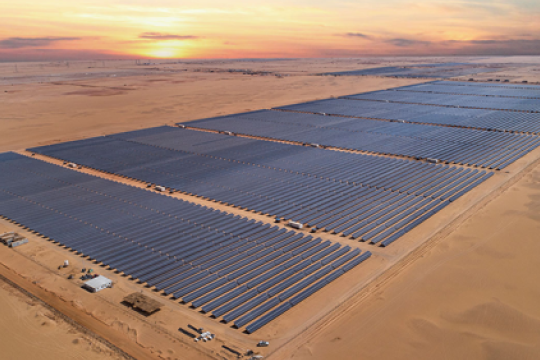
Karm Holding will invest an initial USD 8.5-10 mn to build and operate an independent solar microgrid serving South Sinai’s long-stalled Abu Zenima industrial zone, CEO and Co-founder Ahmed Zahran tells EnterpriseAM. The company expects to begin construction within around four months, subject to securing regulatory and construction approvals.

Why it matters: Electricity is the bottleneck that has kept the zone dormant. The 3.9k feddans industrial zone on the eastern shore of the Gulf of Suez sits close to deposits of manganese, silica sand, and a specialized mining port, but has stalled for years because factories lacked affordable, reliable power. “The main bottleneck is electricity — not water or logistics — that’s what will unlock everything else,” Zahran tells us.

SOUND SMART- Manganese is a critical mineral and an increasingly sought-after input for EV battery cathodes, while high-purity silica sand is the feedstock for solar panels and semiconductors. Both sit upstream of industries Egypt has said it wants to build — from a domestic EV supply chain to its solar-manufacturing push.

How it works: The South Sinai governorate awarded Karm an assignment order to provide the zone’s electricity infrastructure, including its internal distribution network and connections to factories, Zahran says. The company will finance, build, own, and operate the system without capital contributions from the governorate or tenants, who will pay only for their final connection to the network.

A two-stage system: The zone’s energy demand currently sits below the 30 MVA threshold Egyptian Electric Utility & Consumer Protection Regulatory Agency (EgyptERA) requires to be allowed to connect to the national grid. During Karm’s first stage, it will have to supply energy through an isolated solar-and-battery system, with diesel potentially needed as a backup. Once the zone’s demand crosses the threshold, Karm can connect the zone to the national grid for its second stage. At that point, Karm could generate solar power at another site, inject it into the grid, and wheel an equivalent amount to Abu Zenima. That would eliminate the need for diesel and cover the zone’s full consumption with solar.

The initial solar and battery-storage capacities are still being assessed, Zahran tells us. Two factories currently operating within the zone will provide the project’s initial demand, he adds. Rather than signing long-term PPAs to purchase output from a specific power plant, tenants will subscribe directly to Karm’s local network under utility-style distribution agreements, covering their connection, metering, and electricity consumption. Karm will act as both the power producer and the licensed distributor.

The immediate savings: Karm expects the system to cut the factories’ energy costs by about 30% from day one against what they currently spend running on diesel. Savings could rise to about 60% — and potentially higher — as demand climbs toward 30 MVA, according to Zahran.

The bigger hedge is off-grid

Remote and underserved areas are core markets rather than marginal ones. “The 8% of Egypt where everything is located — around the Nile and the Delta — is extremely saturated,” Zahran says. New industrial, agricultural, and tourism developments are consequently moving toward areas that are not yet fully served by the national grid. “Our mandate is connecting areas to the grid,” he adds.

A possible template for other industrial zones: Abu Zenima shows how decentralized solar can open new industrial areas before conventional grid infrastructure arrives. “We are hoping that Abu Zenima will be a model for the inclusion of renewable energy — specifically solar energy — in industrial zones,” Zahran says.

The assignment order is the first — and most difficult — regulatory step, Zahran tells us. Karm must now submit its proposed electricity pricing for review by EgyptERA’s higher committee, obtain an electricity-distribution license, and secure construction permits from the governorate.

In the meantime, Karm is pushing the Sinai partnership further: KarmBuild, a specialized construction and infrastructure subsidiary of Karm Holding, will join an existing team working with the governorate on plans to restore the historic Al Jubeil village in El Tor, focusing on implementation planning, sustainable construction, and conservation. Karm is also weighing several charging hubs along the Cairo-Sharm El Sheikh route, though locations haven’t been selected yet. “Today, no one will drive to South Sinai as long as there is no coverage,” Zahran says. The hubs would bridge that by giving EVs places to stop and recharge — creating demand rather than responding to existing traffic.

This publication is proudly sponsored by

Some places become part of your story.

This summer, slow down, reconnect, and create moments that linger long after the season ends. From sunrise by the sea to unforgettable experiences, every stay at Somabay is designed to become a memory worth keeping.

3

DEBT WATCH

USD 520 mn guarantee facility heads to the World Bank board in December

A World Bank project document has filled in the missing details on the USD 520.38 mn infrastructure guarantee facility we reported on last week and set it on course for a World Bank board vote on 21 December 2026, according to a disclosure from the international lender. The government would hold a minority stake in the vehicle — the proposed Infrastructure Financing Guarantee Facility of Egypt (IFGFE) — which is designed to pull private money into infrastructure and ease Egypt’s reliance on sovereign guarantees, the Project Information Document (pdf) says.

What’s new: The facility would issue three kinds of guarantee — payment, termination, and debt service — to cover off-taker payment and debt-servicing risk on the projects it backs. The document also breaks down the financing more precisely than before — USD 150 mn from the International Bank for Reconstruction and Development, USD 370 mn in unguaranteed commercial financing, and a USD 380k counterpart contribution from the Egyptian government — and names the Planning and Economic Development Ministry as the implementing agency, running the project through a dedicated Project Management Unit.

It also sets out the ownership structure: The government will take a minority equity stake, indicatively 20-25%, alongside development finance institutions in a first phase, with private-sector investors joining in a second. The IFGFE itself is envisioned as a commercially managed entity carrying a targeted AAA rating on the local scale and low investment grade internationally. Funding sources go beyond the World Bank: commercial banks, institutional investors, other DFIs, and Gulf investors are all named as capital the facility is meant to draw in.

The mandate has grown more specific. Beyond the renewable energy, transmission, desalination, wastewater, and waste-to-energy sectors already flagged, the document adds battery storage and logistics to the target list, and sets out three formal components: capitalizing and operationalizing the facility, building a pipeline of bankable infrastructure projects, and project coordination and implementation. The operation also funds technical assistance for sector reforms. The World Bank will track success through two indicators — the volume of private capital mobilized and the number of direct and indirect jobs created by the projects it ends up guaranteeing.

Why it matters: The facility fits into a broader pivot away from blanket sovereign guarantees for Egyptian infrastructure projects to reach financial close — a shift the OECD has been pushing. The Finance Ministry already cut its sovereign guarantee ceiling to EGP 560 bn for FY 2026/27, down from EGP 740 bn, with any new guarantees now needing annual Cabinet approval — a direct response to International Monetary Fund (IMF) pressure over Egypt’s guarantee stock. The IMF’s specific complaint has centered on Egyptian General Petroleum Corporation (EGPC): the state oil company alone accounted for 50% of Egypt’s EGP 6.2 tn in guarantees, and Egypt’s own first climate fiscal risk statement put a number on how lopsided that is — EGPC holds EGP 108.7 bn in fixed assets but carries EGP 3.1 tn in gov’t guarantees, nearly 29 times its own asset base and equivalent to 18% of GDP.

What’s next: The operation goes to the board on 21 December, but the facility won’t write its first guarantee until it sets up a World Bank-approved environmental and social management system — a gate the Bank has made explicit given the substantial risk rating on the infrastructure it will backstop. The project runs to a March 2032 close.

4

A MESSAGE FROM VISA

From solar to science labs: nine women-led businesses on the She’s Next Egypt shortlist

She’s Next Egypt’s latest shortlist brought together nine women-led businesses with serious range. Visa’s latest She’s Next Egypt round, run with CIB Business Banking and Shark Tank Egypt, featured companies working across cleaner energy, digital learning, health, safety, inclusive fashion, hospitality, and circular design. The program gave women founders visibility, strategic support, and a wider market for their business models.

The shortlist turned the data into names, products, and actual companies. Visa’s Women SMB Digitization Index describes a market where women entrepreneurs are funding, digitizing, and scaling their businesses while navigating bias and tight capital — and She’s Next sits within Visa’s longer push to support founders beyond one campaign cycle.

The nine broke into three snapshots of where women-led businesses are building. Some are expanding access to learning and knowledge: Asmaa Zakaria’s Codinger Platform teaches coding, AI, cybersecurity, and digital skills to children and teens; Mariam Soliman’s Learning Rockets develops educational apps; and Khadija Elbedweihy’s PraxiLabs offers 3D virtual science lab simulations.

Another group built around health, safety, and inclusion. Nesma Amin’s Aziza is a menstrual health app built in Egyptian Arabic, while Sara Aziz’s SAFE Egypt works on education and awareness around child protection and sexual abuse prevention. Noura Halawa’s Rafeya is an ethical fashion brand built around custom sizing and inclusive production.

The rest pointed to sustainability and new consumer models. Doaa Eid Mostafa’s Norko Solar focuses on renewable energy solutions; Yara Yassin’s Up-Fuse has built a business around upcycled fashion and artisanal production; and Amira Selim’s Kennah brings adaptive reuse into tech-enabled hospitality.

The shortlist already made its own point: nine women-led businesses put serious models in front of the market, spanning sectors where capital, customers, and corporate partnerships could turn visibility into scale.

5

Also on our Radar

Government set to finalize its post-IMF economic program before the end of September

Egypt will finalize its post-IMF economic program before the end of September, with the government hoping to avoid fresh loans or financing from the Fund once the current USD 8 bn program expires in December, according to Deputy Prime Minister for Economic Affairs Hussein Eissa. The comment adds a timeline to the government’s earlier signal that it does not plan to pursue a successor program.

Banque du Caire’s IPO is still on the table, as the government is waiting for a suitable market window that takes global and regional conditions into account, Eissa said. The listing has already moved from its initial June target toward year-end and remains part of the government’s wider divestment pipeline.

ALSO- The government is close to transferring six public-sector holding companies to line ministries or other state entities, while the second phase of restructuring 65 subsidiaries will begin at the end of 2026, according to Eissa.

Rameda’s next dose

EGX-listed pharma manufacturer Rameda is breaking into the Saudi market, it said in a bourse filing (pdf), confirming earlier media reports of a c.USD 70 mn pharma plant. The group will set up a factory in partnership with its largest shareholder LVP Pharma, which is owned and operated by homegrown healthcare investment firm LimeVest. No further details were given.

REFRESHER- LVP Pharma has been steadily increasing its position in Rameda this year, most recently snapping up an 8.3% stake for EGP 847 mn, effectively buying out Equinox Pharma, and coming away with 31.5% of the pharma giant.

Paper gains

Bonyan For Real Estate Investments is handing shareholders a 10% stock dividend — one bonus share for every ten held — after the real estate investment firm’s board finalized the distribution timeline last week, according to an EGX disclosure (pdf). The company tapped its own retained earnings for EGP 170.4 mn to fund the issue. The bonus shares are set to hit accounts and begin trading on 6 August.

More on our radar:

  • Private equity firm B Investments is not selling its stake in El Ezaby, shooting down market chatter. The firm — which holds roughly 49% of the pharmacy chain, alongside the Sovereign Fund of Egypt, through their JV EZ International — was said to be prepping El Ezaby for an IPO. (Disclosure, pdf)
  • Alexandria for Investment and Urban Development filed to list on the EGX’s main market. The company, a subsidiary of the state-owned Holding Company for Construction and Development, is looking to list an issued capital of EGP 1.47 bn, split across 293.08 mn shares at EGP 5 par value. (Disclosure)

6

PLANET FINANCE

Trump’s 2027 minerals deadline runs into US supply reality

US industry struggles to meet 2027 deadline: US President Donald Trump may struggle to end US reliance on Chinese critical minerals in just over five months, as domestic mining and processing companies remain far from meeting demand. That leaves his plan to ban federal purchases of rare earths, magnets, tungsten, molybdenum, and tantalum from China, Russia, Iran, and North Korea facing a significant supply shortfall.

REMEMBER- Since returning to the White House, Trump has made critical minerals a priority, channeling tens of bns of USD into roughly 150 mining and processing companies to reduce China’s grip on supply chains for defense and other strategic industries, but he has repeatedly granted waivers because domestic supply has been unable to catch up with demand. Trump criticized those exemptions in a May 10 post on his Truth Social platform, insisting federal agencies should buy American-made products “with no exceptions,” and last week, he signed an executive order making it more difficult for defense contractors to obtain waivers.

A supply gap too large to close: US demand for the most widely used rare earth magnets reached about 48k metric tons in 2025, while domestic production totaled only 300 metric tons, according to Arthur D. Little consultancy. Even with new projects, US capacity is expected to reach just 5k metric tons by the end of this year. But US investment in rare earths has been hampered by persistently low Chinese mineral prices, which Washington says undermines the economic viability of domestic projects. Beijing maintains that it complies with WTO rules and is committed to market stability.

US projects still years away: Building a domestic critical minerals supply chain has proven more difficult than Washington anticipated, with technical hurdles and shifting Pentagon requirements delaying several flagship projects. Reuters reported that Pentagon-backed Ucore Rare Metals pushed back its RapidSX refining project following changes to Defense Department specifications. Some production is now expected no earlier than 2027.

Separately, MP Materials is still calibrating its refining equipment ahead of producing magnets for General Motors, while its Pentagon-dedicated magnet plant is due to open in 2028. MP Materials has spent years calibrating its solvent extraction processing equipment — what CEO Jim Litinsky called a “painstaking process.” Other companies — including ReElement Technologies, USA Rare Earth, and Energy Fuels — are also expanding processing capacity, though most projects are not expected to reach full scale until 2028-2030.

ALSO- The Trump administration launched the USD 12 bn Project Vault in February to build a strategic stockpile of critical minerals for US manufacturers. In April, officials acknowledged they will need to buy minerals from “anywhere in the world, including China”. Experts say partnerships with Japan, South Korea, and other allies could serve as a bridge until the domestic projects ramp up.

China’s dominance: While the US holds reserves of most critical minerals, it lacks sufficient mining and refining capacity — meaning it could take years to get the required infrastructure in the ground to compete, minerals industry analyst Chris Berry noted. Now, China controls more than 80% of the global minerals refining industry, giving Beijing influence over the supply chain. This month, the IEA warned that industries worth USD 6.5 tn could face disruption if China tightens rare earth exports, as it has done several times this year.

MARKETS THIS MORNING-

Asia-Pacific markets opened lower this morning as Wall Street’s selloff in semiconductor and AI-infrastructure stocks spilled into Asian equities. South Korea’s Kospi led losses, dropping 8.0%, while Japan’s Nikkei fell 3.8%. “The latest selloff in chipmakers shows that doubts over spending, returns and valuations are still deepening rather than fading,” Vantage Global Prime’s Hebe Chen said.

EGX30

53,634

+0.4% (YTD: +28.2%)

USD (CBE)

Buy 50.66

Sell 50.79

USD (CIB)

Buy 50.60

Sell 50.70

Interest rates (CBE)

19.00% deposit

20.00% lending

Tadawul

10,769

0.0% (YTD: +2.7%)

ADX

9,845

+0.2% (YTD: -1.5%)

DFM

5,844

+1.0% (YTD: -3.4%)

S&P 500

7,413

0.0% (YTD: +8.3%)

FTSE 100

10,782

+0.4% (YTD: +8.6%)

Euro Stoxx 50

6,282

0.0% (YTD: +8.4%)

Brent crude

USD 88.36

-8.7%

Natural gas (Nymex)

USD 2.74

-0.9%

Gold

USD 4,135

0.0%

BTC

USD 63,851

-2.4% (YTD: -27.1%)

S&P Egypt Sovereign Bond Index

1,084

+0.1% (YTD: +9.1%)

S&P MENA Bond & Sukuk

150.20

+0.2% (YTD: -1.1%)

VIX (Volatility Index)

18.67

+0.5% (YTD: +24.9%)

THE CLOSING BELL-

The EGX30 rose 0.4% at yesterday’s close on turnover of EGP 11.1 bn (19.2% above the 90-day average). International investors were the sole net buyers. The index is up 28.2% YTD.

In the green: ADIB (+4.8%), Rameda (+3.7%), and Valmore Holding -USD (+1.5%).

In the red: Qalaa Holdings (-2.9%), E-finance (-2.7%), and GB Corp (-1.9%).

7

Going Green

Egypt has industrial solar targets but no decree or rulebook to enforce them

The government has set concrete renewable energy targets for industry, but it hasn’t laid the groundwork to enforce them yet. Energy intensive factories like fertilizers and steel are set at 25%, while other industrial facilities are set at 15%, but no decree, regulation, or Supreme Energy Council decision has been published so far to make the change happen, an Industry Ministry official tells Enterprise. The government is now building out the financing mechanisms, documentation requirements, and technical support that manufacturers will need to comply with its solar measures, the official says.

“There’s a difference between a number existing and a number being enforceable,” Carboun Institute’s Executive Director Karim Elgendy tells EnterpriseAM. An indicative target without a clear framework for how a factory actually procures and verifies its share is hard for an investor or lender to price with confidence, he adds.

The shift toward new renewable energy targets started back in January, when comments from then-Industry Minister Kamel El Wazir indicated that the Industry Ministry now gives “preferential consideration” to new and renewable energy use when it assesses applications to establish new factories to ease pressure on the grid. Additionally, the Supreme Energy Council now requires large, energy-intensive facilities to source “a significant share” of their energy needs from solar as part of the approval process. The push to require new factories to incorporate solar power forms part of a broader strategy to increase the share of renewable energy in industry, reduce production costs, improve manufacturing efficiency, and strengthen the competitiveness of Egyptian exports.

The plan has raised questions about how it will work in practice. Since El Wazir’s January announcement, no publicly available decree or regulation has been released. That leaves important questions unanswered on which projects are covered, how compliance will be assessed, and whether the requirements are legally binding.

The cost squeeze is compounding the problem. Industrial demand for renewable energy projects has slowed despite the government’s push, because higher costs have made new installations less attractive, a source at a renewable energy company tells us. The cost of building solar projects has risen to around EGP 20 mn per MW, up from EGP 14.5 mn, driven by the stronger USD and higher import costs for panels and other equipment due to the regional escalations and maritime volatility, the source says. Higher upfront investment has lengthened payback periods, dragging demand further.

Egypt is taking a different route from the Gulf. “The Gulf led with cheap supply and let demand follow. Egypt, with the gas crunch putting industry first in line for power cuts, is leading with a license condition instead. But right now it’s a filter rather than a market,” Elgendy says. The UAE and Saudi Arabia built the model around a single state buyer running competitive auctions, which drove solar tariffs to record lows. “Industry then bought into cheap, clean power because it made sense, not because anyone required it to,” he adds.

The government is working on the financing side. Officials are discussing technical support and concessional financing with local and international development partners and Egyptian banks to help manufacturers finance solar installations, the government official notes. The ministry is also studying amendments to the Finance Ministry-backed 15% subsidized lending initiative for industry to allow financing for solar plants, the official adds.

Another potential solution: Electricity-bill savings for factories which have adopted solar have grown, our source at the renewable energy company tells us. The source proposes establishing a dedicated fund that would recycle part of those savings into concessional loans for factories that haven’t yet installed solar capacity.

What to watch: Elgendy flags two signals. First, “whether these targets end up in a decree or executive regulation, or stay as negotiated sector targets,” he says. Second, “whether procurement catches up: a working wheeling regime and a bankable certificate scheme matter more here than the percentage itself.” Our government source says that the ministry’s near-term focus is on familiarizing industrial companies with the renewable energy plans and the required documentation, while finalizing financing arrangements with development institutions and financing initiatives through the Federation of Egyptian Industries.

OUR TAKE- Egypt has the numbers: 25% at energy-intensive factories, 15% everywhere else. But it doesn’t have the rulebook: no decree, no regulation, no verification scheme. Solar got pricier too: EGP 20 mn per MW, up from EGP 14.5 mn. Payback periods are stretching just as factories are asked to hit an unenforceable target. A wheeling regime, a certificate scheme, or the financing talks with banks and the Federation of Egyptian Industries could close that gap. Until something does, every industrial solar announcement is directional, not binding.


JULY

28-30 July (Tuesday-Thursday): EduGate, Egypt International Exhibition Center, Cairo.

AUGUST

19 August (Wednesday): Connected Banking Summit, Fairmont Nile City Hotel Cairo.

20 August (Thursday): Monetary Policy Committee’s fifth meeting of 2026.

26 August (Wednesday): Prophet Muhammad’s birthday.

SEPTEMBER

8-10 September (Tuesday-Thursday) El Alamein International Airshow, El Alamein International Airport.

10-12 September (Thursday-Saturday): Egyptian Entrepreneurship Sector Diagnostics Report Summit, El Gouna.

15 September (Tuesday): IMF to hold its eighth review of Egypt’s USD 8 bn EFF arrangement.

24 September (Thursday): Monetary Policy Committee’s sixth meeting of 2026.

27-29 September (Sunday-Tuesday): Global Conference on Population, Health, and Human Development.

28-29 September (Monday-Tuesday): Egypt Mining Forum, St. Regis Hotel New Capital.

30 September - October 3 (Wednesday-Saturday): Cityscape, Egypt International Exhibition Center, Cairo.

OCTOBER

5 October (Monday): The EnterpriseAM Egypt Forum.

6 October (Tuesday): Armed Forces Day.

10-11 October (Saturday-Sunday): Egypt Women’s Health Summit (EWHS), Cairo Marriott Hotel.

26-28 October (Monday-Wednesday): IEX Egypt, Egypt International Exhibition Center, Cairo.

29 October (Thursday): Monetary Policy Committee’s seventh meeting of 2026.

NOVEMBER

6-8 November (Friday-Sunday) : Global Entrepreneurship Festival, JW Marriott Hotel, New Cairo.

8-11 November (Sunday-Wednesday): Cairo ICT Forum.

DECEMBER

7-10 December (Monday-Thursday): Food Africa, Egypt International Exhibition Center, Cairo.

17 December (Thursday): Monetary Policy Committee’s eighth meeting of 2026.

EVENTS WITH NO SET DATE

Mid-August: IMF Board expected to decide on the seventh review of the loan program.

2H 2026: Operations at Deli Glass Co’s new USD 70 mn glassware factory kick off.

2026: The Egyptian-American Economic Forum.

4Q 2026: Banque du Caire IPO.

2027

20 January-7 February: Egypt to host the African Games.

1-3 February (Monday-Wednesday): Agri Expo, Cairo International Convention Center.

April 2027: Tenth of Ramadan dry port and logistics hub to begin operations.

EVENTS WITH NO SET DATE

2027: Egypt to host EBRD’s annual meetings.

2027: Egypt-EU Summit 2027.

End of 2027: Trial operations at the Dabaa nuclear power plant expected to take place.

September 2028: First unit of the Dabaa nuclear power plant begins operations.

Now Playing
Now Playing
00:00
00:00