Retail investors rode out the EGX halt, but a long slump would be a harder test

1

WHAT WE’RE TRACKING TODAY

Gov’t weighs parking state entities’ surpluses in its own debt to cut borrowing needs

Good morning, nice people. For most of this new retail crowd, 25 October was the first EGX trading halt they had ever seen, and it came after five years when buying every dip just worked.

Our big story today is what October’s selloff says about the investors now holding this market up: individuals were 74.9% of open-market turnover in October, by our math, while institutions sat out. Three of them tell us how they played the halt, and what the leverage behind the market means if the recovery is slow.

Also in the news well below, inflation did the CBE’s work for it. Urban prices slowed to 12.7% in October, a nine-month low, though monthly core picked up to 1.2%. We look at what that leaves for the last rate meeting of the year on 17 December and for the IMF review due 15 December.

And we have MNT-Halan’s first results since listing. Net income more than doubled q-o-q to EGP 836 mn, helped by fatter margins on the EGP 6.8 bn of loans it offloaded. The y-o-y is 31% lower — and we unpack the gap.

In energy, Alcazar closed USD 436 mn of European debt for its two Ras Ghareb wind farms, a third each from the EBRD, the EIB, and DEG. It’s the template Egypt needs for its 2028 renewables target without paying for the build itself.

***

We want to hear from you: Ever wondered how EnterpriseAM makes money, how the newsroom runs over the course of the day, from Egypt to Saudi to the UAE, or why, in the age of reels and zippy TikTok virals, we’re still betting on long-form journalism?

In an upcoming episode of Making It, Patrick and the team will answer some of these questions, along with anything else you’re curious about.

Record your question as a voice memo (30-45 seconds), tell us your name at the top, and send it to [email protected] by Thursday, 12 November. We’ll also take written questions, but since we’re an audio show, we’d love to play yours in your own voice.

***

The state as its own lender

The government is studying whether to put part of state entities’ surpluses and funds into its own securities, a move that Finance Minister Ahmed Kouchouk says would directly cut state borrowing needs at home and abroad. Kouchouk presented the study’s results to President Abdel Fattah El Sisi at a meeting with Prime Minister Mostafa Madbouly yesterday, according to a presidency statement.

The shift would reduce the state’s overall reliance on high-cost debt from foreign markets, he says, which fits his broader argument that sustaining the budget’s primary surpluses will help bring down the national debt and narrow the deficit. Progress on that front carves out space in the budget for basic services, health, education, and social protection, he adds.

The treasury could use the help, since nearly everything it borrows now goes to rolling over old debt. It borrowed about EGP 4.3 tn at home in the first four months of FY 2026/27, almost all of it for refinancing. Short-term treasury bills, which mature within a year, made up 85% of accepted domestic issuance last quarter. Banks are carrying a chunk of the load, holding 36% of the outstanding EGP T-bill portfolio as of March.

How much difference it makes depends on details the statement leaves out, like which entities are covered, how large their surpluses are, and what yields they’d earn. The move builds on the Finance Ministry’s push earlier this year to claim a bigger share of earnings from public-sector companies and economic authorities. Their transfers came to EGP 35 bn in the first half of FY 2025/26, a figure a senior government source called “disproportionately low” given the companies’ strong operating performance.

Kouchouk also says the government wants to attract more investors to long-term bonds, which would stretch maturities on new domestic issuance from the current average of about a year. He also says swapping part of the debt for investments and quality alassets would ease the state’s financing burden.

Pricing for the pipeline

Banque du Caire (BdC) closed its first week on the EGX 5.5% above its EGP 5.30 offer price, ending Monday’s session at EGP 5.59 a share, according to market data. Trading has cooled since the debut, with turnover running at around EGP 250 mn a session, against EGP 2.02 bn on 2 November, or about 12% of the first day’s level by our math.

Part of the slowdown is by design, since the cornerstones have agreed to lock-ups that keep their shares off the market for now. Retail buyers have a cushion too: for 30 days after trading starts, they can sell their shares back at the offer price if the stock trades below it, under a stabilization mechanism run by CI Capital. That means fewer shares changing hands and less pressure to sell in a hurry. Banque Misr’s remaining 55% won’t be coming to market soon either. It can’t sell more shares for a year without the bookrunners’ consent, and EGX rules lock up 51% of the bank for at least two years. How BdC trades still matters beyond this transaction, since the state has more offerings lined up behind it.

Government sellers should be pricing for the pipeline rather than the transaction, Menthum co-founder and CEO Himanshu Shrimali tells EnterpriseAM. “It’s not about getting the max possible valuation from this specific IPO. It’s about building a market where people have faith that, ‘Hey, if I invest in IPOs, I am invariably going to get at least 15 to 20% pump.’” Leaving 10-20% on the table is good practice, in his view, precisely because the state has another 10 or 20 companies lined up, so the aim is to “keep the confidence going.”

REFRESHER- BdC listed on 2 November after Banque Misr sold 45% for EGP 36.37 bn (c. USD 658 mn), the largest IPO the EGX has seen in at least a decade and the state’s first privatization by IPO in two years. Institutions covered the private placement 5.95x, or 19.79x excluding cornerstones. Four foreign cornerstones (Helikon, Redwheel, Sustainable Capital, and Waha Investments) committed USD 256 mn pre-launch, and the EBRD and the IFC each agreed to take up to 15.74% of the enlarged private placement, worth as much as c. USD 102 mn apiece, or up to some 13.5% of the bank between them.

Data point

49.4 — that’s where Egypt’s Logistics Growth Index fell to in October, down 1.2 points from a revised 50.6 in September, according to the World Research Institute (WRI). That puts it back under the 50 line that separates expansion from contraction. It’s also the lowest reading in two months and below the index’s three-month average of 49.7. Egypt ranks 32nd of the 42 economies WRI tracks and last of the five in Africa, where the regional reading was 50.4 against 51.2 worldwide.

The decline came as business volume fell, with non-oil private-sector output and new orders dropping at their fastest pace in four months, WRI says. Supply strains made it worse: maritime disruptions tightened transport capacity, and supplier delivery times lengthened by the most since June, which WRI economist Stephen Poh links to material shortages. The contraction came even as early figures showed more freight moved through the Suez Canal in October.


What should we teach our kids in the age of AI? And on the policy-level, where do we start? On this episode of Making It, Sherif Kamel, dean of AUC’s Onsi Sawiris School of Business, discusses how AI shows up in the classroom.

Listen to the episode on: Apple Podcasts | Spotify | Anghami | YouTube

Sign up here to get Making It in your inbox.

PSA-

WEATHER- Cairo is in for a crisp autumn day today, with a high of 23°C and a low of 14°C, a degree off yesterday’s high and a clear two degrees down on the night, according to our favorite weather app.

It’s a notch cooler in Alexandria too, with a high of 23°C and a low of 17°C.

The big story abroad

Lenders cooling on AI debt: Banks and credit investors are scrutinizing AI-related financing more closely and are wary of adding exposure to borrowers. Some say they would be hesitant to fund more transactions, even with guarantees from the biggest names in tech, Reuters reports, citing banking and credit sources. The pullback follows a selloff that wiped USD 2.5 tn off the Nasdaq 100 on Thursday, plus worries that the midterm results would bring more oversight on data centers.

Spying reports are rattling Nvidia investors. The chipmaker’s shares fell more than 5% yesterday after the company opened an investigation into reports that CEO Jensen Huang had been targeted by a Chinese intelligence operation. China has denied trying to entrap Huang, dismissing the allegations as “unsubstantiated” and “nothing but smears against China.”

France is blaming Iran for last month’s supermarket cyberattack. Paris summoned Iran’s ambassador and plans retaliatory sanctions “at a European level” over the October hack, which hit some 700 retailers. The hackers reportedly took remote control of store refrigerators and freezers, switched on defrost cycles to push up temperatures, and destroyed large amounts of fresh and frozen food. Some of the equipment caught fire. Tehran did not immediately comment on the allegations.

*** It’s Going Green day — your weekly briefing of all things green in Egypt: EnterpriseAM’s green economy vertical focuses each Tuesday on the business of renewable energy and sustainable practices in Egypt, everything from solar and wind energy through to water, waste management, sustainable building practices and how you can make your business greener, whatever the sector.

In today’s issue: We look into why Green Tech has put Abu Rawash plant on hold over a tariff split between USD and EGP, and why the regulator says the rate stands.

Decades of trust, a new chapter of growth.

ROBINSON and Somabay extend their longstanding partnership, announcing a second club resort with approximately 250 rooms, planned to open in 2029, alongside a major refurbishment of the existing ROBINSON SOMA BAY.

2

The Big Story Today

EGX’s newest investors meet their first selloff

How a new generation of retail investors weathered the EGX’s first trading halt in five years: October’s selloff drew three very different reactions from three investors we spoke to. One bought more shares as prices fell, another decided she’d had enough of picking stocks, and the third held enough liquidity to barely feel it.

“It was scary, but I had to remove my emotions from my decision and bought more at the dip,” the first investor tells EnterpriseAM. Shares kept sliding after he bought, then began to recover, and he has no regrets: “It wasn’t fun emotionally, but they were the right decisions in the end.” For him, the selloff was part of the market’s normal ups and downs and a chance to pick up shares on the cheap.

The second investor came out of the selloff with most of her money intact but far less confidence in the market. The 25 October trading halt “made me wary,” she tells us. “It gave me the feeling that the market isn’t as stable as I thought, and my trust in it became iffy.” Her losses were minor, but with the region’s wars still weighing on her outlook, she’s moving her money into funds and gold until she has a clearer sense of what to expect.

The third investor came through relatively unscathed, largely because of what he wasn’t holding. He went into October with more than 40% of his portfolio incash, which left him down just 4% even at the height of the selloff. “I knew the market was bad for people, but for me it was fine,” he tells us. His holdings included EGX30 constituents Elsewedy Electric and Egypt Aluminium, as well as newly listed Korra Energi, which at one point made up 12.7% of all equity trading on the exchange in a single session as it fell 19.93% in mid-October. When prices slipped, he bought more Elsewedy shares to bring down his average cost. He then sold out anyway, mostly because of the regional war and developments abroad, so he was already out by the time stocks began to recover.

For all their different reactions, the three investors had one important thing in common: none of them borrowed to invest or put in money they’d need back soon, which allowed them to make decisions without repayments looming. The third investor says he pays his installments from his fixed salary and invests what’s left. Analysts fear much of the EGX’s retail crowd lacks that cushion, which could make a drawn-out slump a far harder test than October.

IN CONTEXT- Individuals have set prices on the EGX day to day for most of this year, accounting for 72.7% of gross trading in listed stocks in 1H 2026, while the institutional money that would normally balance them has largely stayed away. That left a big question hanging over the rally: how would a generation of investors who had never been through a market-wide halt react when the market finally turned? The test came on 25 October, when trading stopped for half an hour after the EGX100 fell 10%, the first market-wide suspension since October 2021.

The broader retail base behaved more like the first investor. Individuals ended October as net buyers of EGP 4.14 bn of listed shares, excluding block trades, while institutions were net sellers of the same amount. What worries analysts is investors carrying debt or relying on money they’ll need back soon, since upcoming repayments could leave them little room to ride out another downturn.

The cracks beneath the data

Retail investors dominated trading through October, accounting for 74.9% of open-market turnover against 25.1% for institutions, by our math. Beneath the headline numbers, smaller stocks fell far harder than the benchmark. Even so, Menthum co-founder and CEO Himanshu Shrimali thinks the damage could have been worse. “It’s not as bad as one would have imagined if people had really, really panicked,” he tells EnterpriseAM. He calls the month a pause the market needed after a five-year run and says it held up better than he’d expected.

Leverage made things worse further down the market. “Margin calls tend to concentrate in the sharpest sessions and in the most actively traded mid- and small-caps,” Okaz Asset Management Managing Director Randa Hamed tells us. That’s where October’s heaviest losses were: the EGX70 fell 9.91% over the month, against 4.43% for the benchmark. Part of that gap is sentiment, and part of it, by Hamed’s account, is brokers closing positions once the collateral ran out.

SOUND SMART- Thin freefloats are why small- and mid-caps swing so much further on the same money. Only a fraction of a typical EGX company’s shares actually trade, against 40-50% for a comparable US-listed name, Shrimali says. The EGX also lacks the algorithmic trading and options market that absorb some of that volatility elsewhere, though algo trading is starting to arrive: EFG Hermes launched Younit earlier this month, the first platform to give Egyptian retail investors algorithmic trading through APIs, allowing traders to automate strategies and backtest them against historical data before going live.

The third investor saw the split between the small-cap selloff unfold in the Facebook and WhatsApp trading groups he follows. He says losses there were enormous, concentrated in the EGX70 and in names with heavier retail ownership, while his own EGX30 positions held up. All three investors also skipped the MNT-Halan and Banque du Caire offerings, preferring to let newly listed shares settle before buying. “I know more than 20 people who didn’t take part in either,” the third investor tells us. Members of his group objected to MNT-Halan on religious grounds, he said, telling each other not to buy into a consumer lender.

The only tool is the sell button

EGX investors have few ways to protect themselves when the market falls. Turnover in weekly derivatives, the market’s main hedging tool, ran under EGP 10 mn in late October in a market worth EGP 3.9 tn, according to Hamed’s figures. “The deeper issue is that investors have almost no way to hedge,” she says. “So the only way to reduce risk is to sell, and in margin accounts, that selling is forced.” That dynamic was already visible in mid-October, before the halt. Liquidity leaving the market pushes prices down, which erodes margin ratios, which forces leveraged holders to sell and pushes prices lower again, Tycoon Securities’ Sameh Gharib told us at the time, describing a snowball effect. Al Ahly Pharos Head of Research Hany Genena put the sequence this way: the big players head for the exit first, the smaller holders sell behind them, and the leveraged ones sell behind those.

Regulators have spent the year building alternatives, but none has caught on yet. The EGX secured its futures license in January, launched index futures in March, and added single-stock futures on CIB and TMG in June. The FRA issued its short-selling rulebook in August, and the central lending pool that short-selling depends on was still in trials ahead of an early-November rollout.

Debt and stocks

A sizable share of retail investors are carrying debt elsewhere while keeping much of their money tied up in equities. That raises the question of how long they can afford to hold on when prices fall. Almost half the respondents to a poll Menthum ran on its WhatsApp channel said they had borrowed through buy-now-pay-later providers while heavily investing in equities, Shrimali says. “If they are paying 50% or so interest rate on their borrowing and still investing in the stock market, their expected return from the market is 50% plus.”

For a while, the market delivered. It returned about 60% in the year to September, enough to cover the interest with some left over. Shrimali’s worry is the assumption underneath: that 50% to 60% a year is normal rather than an exceptional run. He calls that “fantastical.”

The timing of the money matters as much as the debt. Investors are buying equities with liquidity that they’ll need back soon, for an installment next month or school fees in January, Shrimali says. “So the moment the stock market takes a downturn of 10 to 20%, obviously they are panicking because they don’t have spare [liquidity] which is set aside as a safety cushion.”

That lack of spare money could also slow the recovery, since investors who are fully invested and paying interest have nothing left to add. “I don’t think they have extra money to bring into the market to move to the next phase,” Shrimali says. He adds that the next leg of buying would have to come from institutions, foreigners, or high-net-worth investors. So far, there’s little sign of it: foreigners have been net sellers of EGP 13.5 bn this year, and institutions accounted for only a quarter of October’s turnover.

Plenty of investors still expect big gains despite the selloff. In a follow-up poll of its investor community, Menthum found that 23 of 47 respondents expect the EGX30 to gain 30-50% over the next 12 months. Another three forecast gains of more than 50%, and nine expect losses or a correction. Hopes for outsized gains have cooled since September, when seven of 33 respondents expected returns above 50%, against three now, while the share expecting a correction has roughly doubled. More than half still expect gains of at least 30%.

A 10% drop isn’t the thing that breaks you

The halt was the first that most of this cohort had lived through, but analysts worry more about what happens if the market doesn’t bounce back quickly. EGX Chairman Omar Radwan went on television (watch, runtime: 10:55) that afternoon to call the suspension routine. He said plenty of newer investors had never been through a sharp decline and that the answer was to diversify and hold for the long term instead of selling in a hurry. “Some investors don’t know that investment is supposed to be long-term,” Radwan said, adding that seeing someone else sell is often enough to make them sell too.

Shrimali doesn’t expect a drop of this size to change investor behavior much. “This is not the first time we are taking a 10 to 15% dip in the last five years,” he says. He notes that buying the dip paid off on each of the last three occasions because the market came back quickly. That may leave investors used to those rebounds less prepared for a market that stays down.

A long flat stretch would test them more, Shrimali says. “If the market goes down further, or if the market stagnates at this particular level for a longish period, and for the retail kind of investor, I would say even two months is longish enough for them, they would suddenly start feeling the fatigue,” he says. That’s when investors start running the numbers: “Hey, over the last six months, I was minus 6%. Over the next two months, I am 0%. Am I doing the right thing with my money?”

The bigger long-term worry is what a painful downturn could do to a whole generation’s appetite for stocks. “Once they feel the burn, some will fall, and some will blame the new fintechs and how easy it is,” Menthum co-founder Ismail Sarhank tells us. He points to his parents’ generation, who still hear “stock market” and think of money lost. “Our generation still didn’t see it. We’re not okay with seeing our money down. We never took it, even in schools or in universities. It was never in our DNA.”

OUR TAKE- Conviction means little without the liquidity to back it, especially for investors carrying debt at rates of up to 50% with repayments and other commitments looming. October showed that retail investors were willing to hold on through a sharp selloff, with some buying more. A prolonged slump would be a much harder test for those who can’t afford to wait for the recovery.

This publication is proudly sponsored by

3

Economy

Egypt’s urban inflation slowed to 12.7% in October despite non-food momentum

Annual urban headline inflation slowed for a third consecutive month to 12.7% in October, down from 13.9% in September, its lowest level since January, according to Capmas data (pdf). Annual core inflation, a gauge computed by the Central Bank of Egypt (CBE) that strips out volatile prices, eased to 13.1% from 14.1%, according to a CBE note.

On a monthly basis, headline prices rose just 0.7%, slowing from September’s 1.3% clip. But monthly core inflation picked up to 1.2%, compared to 0.8% in September, pointing to lingering underlying cost pressures across non-food goods and services. And the annual relief also leans on a high base: urban prices jumped 1.8% m-o-m in October 2025, so this year’s smaller gain was enough to pull the 12-month rate down.

Vegetable prices broke their rally: Food and beverage costs, the heaviest weight in the CPI basket, rose 1.1% m-o-m in urban areas, slowing from September’s 2.8% jump. That kept annual food inflation steady at 7.1%. Most of that reprieve came from fresh vegetables, which dropped 2% m-o-m after September’s 14.7% spike. Fruit costs also fell 0.8% m-o-m. Offsetting those declines were poultry prices, which climbed 7.4% m-o-m, meat (+3.1%), and cooking oils (+7.4%).

Outside the food basket, transport costs picked up, but housing costs remained in the cooling trend: Transport was the fastest-growing spending category y-o-y and picked up 1.4% m-o-m, pushing the annual rate to 25.8%, driven by higher personal transport operation expenses (4.0% m-o-m). Housing and utilities rose 0.6% m-o-m, but the category’s annual rate cooled sharply to 24.5% (down from 35.2% in September), as last year’s utility tariff hikes dropped out of the baseline.

Analysts had expected worse: JPMorgan lifted its October call to 13.8% annual, judging that the EGP’s 7.3% slide in October would add 0.8-0.9 percentage points to prices, so the print came in more than a point below its forecast. The bank also raised its December estimate to 14.3% from 13.4% as the favorable base runs out — the re-acceleration risk the central bank cited when it hiked rates.

What it means for the CBE

Core is what the CBE is watching: When the Monetary Policy Committee (MPC) raised rates by 100 bps on 29 October, it leaned on the monthly figures, specifically the core inflation’s jump to 0.8% from 0.3%. October’s 1.2% extends that run for a third month, which supports the committee’s reading of momentum.

The real rate just widened: The 20.0% overnight deposit rate now sits 7.3 percentage points above headline inflation, against 6.1 after the hike measured on September’s figure, by our math. Headline is still 3.7 percentage points above the top of the CBE’s 7% (±2 pp) target band, which the bank now expects to reach on average in 4Q 2027. That gives foreign carry allocators the cushion EFG Hermes’ Mohamed Abu Basha has called more than enough: around 500 bps insulates local debt from the Fed, he says.

Deutsche Bank flags the risk to that cushion: In a research note seen by EnterpriseAM, the bank says inflation is “likely to accelerate again given high FX pass-through,” which would eat into the real rate buffers that keep foreign money in EGP debt. And foreign positioning adds to the risk: strip out the collateral Egypt holds at the CBE and foreign investors still own roughly 20% of the T-bill stock, which the bank calls “more than enough room” for an unwind if risk returns.

What’s next: The CBE’s Monetary Policy Committee convenes for its final rate-setting meeting of the year on 17 December. With real rates firmly in positive territory and the Cabinet’s spending rationalization decree postponing non-essential state capex for three months of FY 2026/27, the central bank has room to leave borrowing costs on hold. Also in December: the government needs to clear the final IMF review (worth some USD 2.3 bn) before the program expires on 15 December.

4

EARNINGS WATCH

MNT-Halan more than doubles q-o-q net income in its first results since listing

Newly listed MNT Tech Holding for Financial Investments, the local arm of fintech MNT-Halan, more than doubled its net income q-o-q to EGP 836 mn in 3Q 2026, according to its first earnings release (pdf) since debuting on the EGX on 20 October. Revenue climbed 15% q-o-q to EGP 5.4 bn, and annualized return on average equity rose 20 percentage points to 41.1%.

Most of the q-o-q jump came from offloading income, cheaper funding, and a one-off gain. Offloading income (the gains from selling loans through securitization, bilateral deals, and sukuk) rose 17% q-o-q to EGP 2.3 bn, and the company offloaded EGP 6.8 bn of receivables in principal at a 34.3% margin, up from 28.7% a year earlier. Cheaper funding helped too, with interest expense down 26% q-o-q. Then there’s the one-off EGP 279 mn gain from waiving an intercompany loan at a subsidiary outside Egypt. Strip that out and pre-tax net income still roughly doubled q-o-q, by our math.

Against last year, the numbers look weaker: Net income fell 31% y-o-y during the quarter, and revenue slipped 2%, as interest income shrank 40% and credit costs climbed 88%. Part of that is by design: the release says MNT now sells the shorter-term portion of each loan to the debt market and keeps only the final portion on its books. That shift, along with interest rate cuts since April 2025, pulled its on-book yield down to 30.3% in 9M 2026 from 47.7% in full-year 2025. The comparison base is also unusually high, since 3Q 2025 alone accounted for 62% of the company’s 9M 2025 net income.

Over nine months, the picture is steadier: Net income fell 11% y-o-y to EGP 1.75 bn in the first nine months of the year, even as revenue rose 11% to EGP 15.4 bn. That’s already 88% of the company’s full-year 2025 net income. The release notes that 2025 net income was unevenly spread, with a light fourth quarter.

Consumer finance is taking a bigger slice of the book: The gross loan book grew 14% y-o-y to EGP 48.1 bn, and consumer finance’s share rose to 29% from 23%, with that portfolio up 42% y-o-y. SME lending went the other way, slipping to 29% from 33% as the company pulled back from higher-risk lending, which dropped to 15% of disbursements in 3Q 2026 from 25% a year earlier. Microfinance held steady at 39%.

New businesses are coming online: The company launched a digital brokerage in 3Q, backed by its new FRA custodian license, along with a small-ticket factoring business for small enterprises. Outstanding customer investments rose 4.9x y-o-y to EGP 4.6 bn during the quarter, while brokerage execution value doubled y-o-y to EGP 6.7 bn.

What they said: “This places us in an exceptionally strong financial position within our sector, providing the capital and flexibility to accelerate our next phase of growth,” founder and CEO Mounir Nakhla said in the release, referring to the EGP 4 bn raised through the post-IPO capital hike.

REFRESHER- MNT-Halan’s parent, MNT Investments BV, sold 20% of the Egyptian arm in October in an IPO that raised some EGP 7.84 bn. Cornerstone investors CIB and London-based Redwheel took more than a third of the base offering. The institutional tranche was 11.2x oversubscribed, while the retail tranche drew 43.6x the shares on offer. The stock closed its first day of trading up 6.6% at EGP 26.12, defying regional market jitters sparked by the war.

5

Energy

Alcazar closes USD 436 mn of European debt for its 500 MW Niat and Rasgha wind farms

Another 500 MW of Red Sea wind projects are fully financed: The Niat and Rasgha wind projects at Ras Ghareb reached financial close, with the European Bank for Reconstruction and Development (EBRD), the European Investment Bank (EIB), and German Investment Corporation (DEG) each providing a third of a USD 436 mn debt package (around USD 145.3 mn apiece, by our math), project developer Alcazar Energy Partners said in a statement yesterday. The two 250 MW farms cost USD 626 mn combined and are due to start commercial operation by the end of 2028.

With the money in place, the notice to proceed has gone out: Siemens Gamesa will supply the wind turbines and handle long-term maintenance, while Orascom Construction will deliver all civil and electrical works. On the other end of the wires, state grid operator Egyptian Electricity Transmission Company (EETC) will off-take the power under a 25-year power purchase agreement. Alcazar expects the farms to generate more than 2.3 TWh annually (about 6.3 GWh a day, by our math) and avoid nearly 1.1 mn tons of CO2-equivalent a year.

The lenders’ own filings fill in the detail: The EBRD’s project documents put its two loans for Niat and Rasgha, approved in July, at up to USD 80 mn each, while the EIB signed its loan in September. DEG’s share is USD 145.5 mn. The USD 200 mn package the EBRD was still weighing in June was ultimately trimmed to the amount signed.

The other side of the USD 626 mn is equity — about USD 190 mn, by our math — from Alcazar Energy Partners II, the USD 490 mn fund that wholly owns both projects, according to the EBRD’s project page. That puts the EBRD, the EIB, and DEG on both sides of the transaction: they’re lending to the farms and are also investors in the fund that owns them, along with the International Finance Corporation (IFC), the Asian Infrastructure Investment Bank (AIIB), France’s Proparco, and Dutch entrepreneurial development bank FMO.

IN CONTEXT- The close comes as Alcazar works through its other Egyptian wind investment, the USD 420 mn privatization of the state-owned 580 MW Gabal El Zeit wind farm, signed in July and has yet to close its own financing. Ras Ghareb is one of a queue of DFI-backed wind financings this year: the EBRD signed USD 192 mn for Scatec’s Shadwan wind farm in August, and the IFC is weighing USD 120 mn for the Gabal El Zeit purchase. All told, Alcazar puts its two Egyptian transactions at more than USD 1 bn.

Why it matters: The build is paid for with European public money (three development banks plus an EU guarantee) and repaid out of a single 25-year promise EETC, the farms’ only buyer. That’s the template Egypt now leans on to reach its 45% renewables target by 2028, since a state balance sheet stretched by the gas import bill can’t fund that build on its own.

In other energy news…

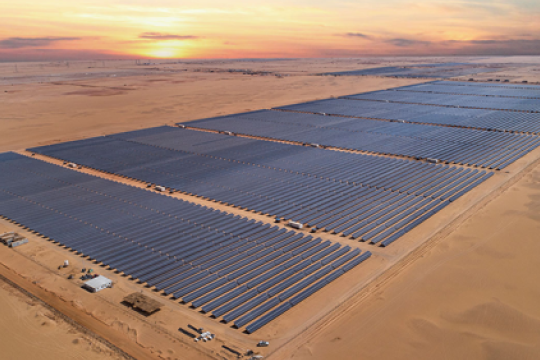
Benban is getting a battery: The EBRD arranged up to USD 63.5 mn in financing for a 258.5 MWp solar plant (200 MW AC) paired with a 120 MWh battery energy storage system (BESS) at Aswan’s Benban Solar Park, the bank said in a statement yesterday. The project company, Nefer Benban for Renewable Energy, is a joint venture between Infinity Power and Hassan Allam Utilities (HAU) Energy. The package splits into up to USD 56 mn of the EBRD’s own funds and a USD 7.5 mn concessional tranche from the Climate Investment Funds’ Clean Technology Fund.

IN CONTEXT- The package builds on the USD 65 mn construction bridge loan the EBRD extended to HAU Energy in April, part of a broader debt package of up to USD 127 mn alongside DEG.

Why it matters: The plant is one of Egypt’s first grid-scale solar farms to add battery storage, which tackles solar’s obvious limit: it only generates by day. By our math, the battery holds about 36 minutes of the plant’s AC output, so it shifts the evening peak rather than supplying power overnight. EETC will buy the output under a 25-year power purchase agreement. The project also sits under the energy pillar of the state’s Nexus of Water, Food, and Energy (NWFE) program, which aims to retire 5 GW of inefficient fossil-fuel capacity and add 10 GW of private-sector renewables by 2028.

6

Also on our Radar

Evergreen sends its first ship through Suez Canal in nearly three years as canal receipts pick up steam

Taiwanese container carrier Evergreen has resumed sailings through the Suez Canal after a nearly three-year hiatus prompted by Red Sea disruptions, according to a Suez Canal Authority (SCA) statement. The line marked its return on Sunday, 8 November with the transit of the 16.6k TEU mega container vessel Ever Eon, which sailed through as part of the canal’s north convoy on its voyage from Rotterdam to Singapore. Evergreen plans to gradually route more scheduled sailings back through the waterway.

Why it matters: Evergreen’s return chips away at the multi-year revenue hit sustained by the SCA, whose receipts dropped 45.5% to USD 3.6 bn in FY 2024/25 after carriers rerouted around the Cape of Good Hope to avoid the Red Sea. While toll receipts bounced back 18.5% to USD 2 bn in 1H FY 2025/26, they remain roughly 53% below the USD 4.3 bn of the same period in FY 2022/23. The rebound is accelerating: October receipts rose 94% y-o-y to USD 724 mn, the highest monthly level since the Red Sea crisis began. The Taiwanese line is the latest major carrier to redirect vessels through the shortcut, following Maersk and Hapag-Lloyd’s decision to reroute an Asia–Europe service in July, as well as selective service resumptions by CMA CGM, MSC, and COSCO.

Rigging up in Kuwait

Egyptian Drilling Company (EDC) landed a second rig contract in Kuwait, with expected revenue of about USD 30 mn over five years, and the rig is due to start work in March 2027, Asharq Business reports, citing an unnamed government official. It follows the 1.5k-horsepower rig EDC agreed to operate for Kuwait Oil Company (KOC) in January. EDC has been in the Kuwaiti market since 2022, doing well maintenance and repair and managing a well-maintenance rig with a Kuwaiti partner.

The contract extends an overseas build-out: EDC sent its EDC 42 and 52 rigs into Turkey in April under a USD 43 mn contract with TPAO and is now targeting Saudi Arabia, Kuwait, and Turkey — with India, the UAE, Oman, and West Africa next. It plans to spend about USD 100 mn on three new rigs and a fleet upgrade in FY 2026/27, which began in July. The company booked revenue of about USD 402 mn in 2025, with net income after tax of about USD 132 mn, while logging an operating efficiency rate of 98.8%.

7

PLANET FINANCE

Developing-world debt hits record USD 9.4 tn as private lenders return, at a price

External debt in low- and middle-income countries (LMICs) climbed 5.5% y-o-y to a record USD 9.4 tn in 2025, according to the World Bank’s International Debt Report 2026 (pdf). This is the fastest pace since 2021 and more than four times the 2022-2024 average. It came as capital markets reopened (at a price), the USD weakened against other currencies, and private investors were willing to lend.

A weaker USD flattered the headline: Currency valuation effects accounted for 28.2% of the rise in public and publicly-backed debt, the report says. The real driver was private money. Debt owed to private creditors rose by 5.2% in 2025, reaching USD 5 tn, which is a huge leap from the 0.6% rate recorded a year earlier. The reopening of bond markets came at a price too. Bond issuance by LMIC public-sector borrowers rose 34.6% to USD 250.6 bn, or 68.1% of new disbursements.

The poorest borrowers are paying the most: Countries eligible for International Development Association (IDA) saw their external debt rise 8.1% to USD 1.3 tn and paid an average 8.2% on new commitments, the highest since the late 1980s. The interest rate gap between what these borrowers pay to private lenders and what they pay official creditors widened to 5.5 percentage points from 3.4 points in 2016.

Money is flowing back in, but debt service is still rising: LMICs’ total debt service rose 1.9% to USD 1.4 tn in 2025, a fifth straight annual increase, with payments to bondholders up 13.7% to USD 363.1 bn. Although the 2022-2025 period saw LMICs pay out roughly USD 436.1 bn more than they received, net long-term flows swung to a USD 45.4 bn inflow after a USD 118.4 bn outflow in 2024.

Market access has not faded in 2026: Several countries — including India, Indonesia, Angola, and the Philippines — had already passed their full-year 2025 volumes by August 2026, even as the Middle East conflict that began in late February raised inflation and borrowing costs across emerging markets, the IMF says, as well as commodity prices.

In our region, debt is growing faster than income: External debt in the Middle East, North Africa, Afghanistan, and Pakistan grew 5.8% to USD 598 bn at end-2025, and the region’s debt-to-gross national income (GNI) ratio rose to 29.4% from 26.7% — the biggest one-year jump of any LMIC region — even as debt service eased to 3.1% of GNI. Relative to income, Sub-Saharan Africa carries one of the heaviest burdens: external debt there equals 48% of GNI, up from 34.4% in 2015.

The bank puts Egypt’s external debt at USD 164.3 bn at end-2025, up 5.3% y-o-y and equal to 47% of GNI. Private creditors hold some USD 51.2 bn of the USD 127 bn public and publicly-backed portion (c. 40%), against USD 41.9 bn owed to multilaterals, USD 33.8 bn to bilateral lenders, and a further USD 34.4 bn in short-term debt. Egypt also ranked among the largest IMF recipients of all LMICs in 2025, the report notes. New private commitments came at an average of 7.8% against 5.1% from official creditors.

REMEMBER- The Central Bank of Egypt’s (CBE) own external position report put total external debt at USD 161.2 bn at end-FY 2024/25 (stock-to-GDP 44.2%), and a later CBE print put it at USD 166.7 bn at end-June 2026 (pdf).

No GCC state is covered by the report, and Saudi Arabia appears in Egypt’s numbers only as a creditor — owed USD 6.4 bn, behind Russia’s USD 7.1 bn.

Why it matters: The money that is coming back is the money that can leave. Private lending “expands in favorable global conditions and contracts sharply when conditions tighten,” the report says, while official lending is “highly countercyclical” by comparison. That is the exposure in Egypt’s mix: the steadier money comes from official lenders, and the market that reopened is the more expensive half.

MARKETS THIS MORNING-

Asian markets broadly gained ground earlier today. South Korea’s Kospi rose 3.5% and Japan’s Nikkei surged 2.6%, spurred by Wall Street’s gains, tech sector momentum, and easing crude prices. MSCI Asia Pacific closed 2% higher, even as US stock futures held steady.

EGX30

51,415

+1.2% (YTD: +22.9%)

USD (CBE)

Buy 53.91

Sell 54.05

USD (CIB)

Buy 53.93

Sell 54.03

Interest rates (CBE)

20.00% deposit

21.00% lending

Tadawul

10,107

+0.9% (YTD: -3.7%)

ADX

9,483

+1.0% (YTD: -5.1%)

DFM

6,087

+1.0% (YTD: +0.7%)

S&P 500

7,550

+2.4% (YTD: +10.3%)

FTSE 100

10,783

+1.0% (YTD: +8.6%)

Euro Stoxx 50

6,290

+1.9% (YTD: +8.5%)

Brent crude

USD 92.57

-5.9%

Natural gas (Nymex)

USD 3.20

-0.5%

Gold

USD 4,147

+0.8%

BTC

USD 75,024

+0.8% (YTD: -14.4%)

S&P Egypt Sovereign Bond Index

1,146

+0.1% (YTD: +15.4%)

S&P MENA Bond & Sukuk

149.69

-0.1% (YTD: -1.5%)

VIX (Volatility Index)

19.92

-22.3% (YTD: +33.2%)

THE CLOSING BELL-

The EGX30 rose 1.2% at yesterday’s close on turnover of EGP 10.1 bn (9.4% below the 90-day average). Local investors were the sole net buyers. The index is up 22.9% YTD.

In the green: Raya Holding (+5.8%), E-finance (+5.1%), and Juhayna (+5.1%).

In the red: Abu Qir Fertilizers (-2.7%), Mopco (-2.6%), and ADIB (-1.2%).

8

Going Green

Green Tech tells us why Egypt’s first municipal waste-to-power plant is stuck on EGP 0.35

Egypt’s first planned plant turning municipal waste into power is stuck on EGP 0.35. Green Tech Egypt has put its Abu Rawash waste-to-power plant on hold because the current tariff pays 7 US cents plus EGP 0.35 per kWh, and the company says its lenders won’t finance a project whose revenue is split across two currencies. The regulator, however, says the rate stands and favors turning waste into cement kiln fuel instead.

“Any bank or investor will never finance a project if they find a tariff split where part is in USD and part is in EGP,” a Green Tech official tells EnterpriseAM. Even an EGP-denominated portion that small is enough to make the project unviable, the official says. “It is simply not feasible,” the official says, adding that the project’s low internal rate of return (IRR) makes full USD indexation the minimum it needs to be bankable.

What Green Tech wants: The company asked for 7.7 cents fully pegged to the USD and settled in EGP at the Central Bank of Egypt’s (CBE) rate on each monthly invoice. It also wants a 1% annual escalation to cover rising operating costs over the 25-year contract. It first sought 8.2 cents, the USD value of its original EGP 1.40 tariff when Decree 41/2019 set it, but was told 7.7 was the ceiling, the official says. The decree pegs only part of the rate: Prime Ministerial Decree 4096/2025 (pdf), published on 11 November 2025, repealed Cabinet Decree 41/2019 and capped the tariff at 7 cents plus EGP 0.35, with no annual escalation. It also caps any single plant at 20 MW, though Green Tech already holds an exception that lets Abu Rawash connect above that level to the transmission grid, the official says. The Egyptian Electricity Holding Company backs the electricity distribution companies’ 57% share of the tariff, but the decree gives the contracting authority’s 43% (Giza Governorate, in Abu Rawash’s case) no Finance Ministry backing. The final decree ran contrary to what Green Tech had requested, the official says. Of the 92 companies that answered the government’s 2020 call for interest in the waste-to-power projects, only nine remained interested, the official adds.

Why the peg matters: Foreign lenders charge 6-7% on USD loans, while Egyptian banks charge 21-23% on EGP debt, a big gap on a USD 140 mn project, the official says. Projects earning revenue in EGP must also borrow in EGP under CBE rules, which is why Green Tech’s financial adviser has made full USD indexation a prerequisite for financing, the official explains.

Abu Rawash, by the numbers: The company puts the plant at 1.5k tons of municipal waste a day and 35-36 MW gross, with 3-4 MW used on site and 32-33 MW exported round the clock across some 8.2k hours a year. Each ton of waste yields 0.4-0.6 MWh, and roughly USD 5 mn has already gone to designs, site prep, and consultants, the official says. The plant was set at 1.2k tons and 30 MWh as recently as August 2024, according to a Military Production Ministry statement.

Green Tech’s case to the state is a fuel bill. Imported gas at USD 14 / MMBtu puts the cost of gas-fired generation at around 14 US cents per kWh, against the 7.7 cents Green Tech is asking, the official says. The plant would run as baseload, displacing gas-fired generation one for one, he adds. The obstacle, the official argues, is that the ministry paying the tariff isn’t the one paying for fuel: “The Electricity Ministry does not pay the natural gas bill; the Finance Ministry does.” The savings the project generates, he says, sit with neither the body that would pay the tariff nor the one asking for the power. The rate stands, and no further revision is under discussion, Waste Management Regulatory Authority (WMRA) CEO Yasser Abdallah says. “If I have EGP 100, and one technology costs me EGP 100, and another technology costs EGP 1k, I’ll work with what’s available,” he tells us. Mechanical biological treatment, which produces refuse-derived fuel (RDF), compost, and recyclables, delivers more at lower cost, he adds, pointing to how Saudi Arabia holds back from waste-to-power on the same economics. Egypt’s advantage is its cement plants, which take processed waste as fuel and pay the state for it, he says. Power plants, in his view, suit areas where existing waste facilities are already full or places where transport costs are prohibitive. The fuel route has a record behind it: Egypt now has 38 municipal waste recycling plants handling around half of the country’s generated waste, up from under 12% before 2022, Abdallah says, with close to 1 mn tons a year of RDF replacing coal in cement plants. He sets Abu Rawash against the national picture of 10-12 mn tons of waste recycled a year.

The reject rate is Green Tech’s counter. Sorting and RDF plants send around 60% of incoming waste to landfill, against roughly 5% as bottom ash at Abu Rawash, the official says. WHAT’S NEXT- Green Tech has asked the Cabinet to amend the tariff or exempt its project, the official says. “If our requests are approved, we are ready to proceed immediately,” he tells us.


NOVEMBER

7-10 November (Sunday-Wednesday): Cairo ICT Forum, Egypt International Exhibition Center, New Cairo.

9-20 November (Monday-Friday): COP31 — UN climate conference, Antalya, Türkiye.

10 November (Tuesday): Cityscape Egypt Forum, Cairo.

12-15 November (Thursday-Sunday): Stone Africa Expo, Cairo International Convention Center, Nasr City, Cairo.

14 November (Saturday): Rolling mills’ Administrative Court challenge.

14-15 November (Saturday-Sunday): Destination Africa, Egypt International Exhibition Center, Cairo.

15 November (Sunday): Air Cairo resumes direct Cairo–Damascus flights.

16-17 November (Monday-Tuesday): World Economic Forum’s (WEF) first dedicated business meeting in Egypt + MENA, New Capital.

26-29 November (Thursday-Sunday): Cairo WoodShow, Cairo International Conference Center, Cairo.

28-30 November (Saturday-Monday): Egypt-Africa engineering industries and innovation forum (EGITEC), Egypt International Exhibition Center, Cairo.

DECEMBER

7-10 December (Monday-Thursday): Food Africa, Egypt International Exhibition Center, Cairo.

7-10 December (Monday-Thursday): interpack MEA, Egypt International Exhibition Center, Cairo.

11-12 December (Friday-Saturday): ISER International Conference, Cairo.

15 December (Tuesday): Egypt’s 48-month IMF extended fund facility expires.

17 December (Thursday): Monetary Policy Committee’s eighth meeting of 2026.

17-19 December (Thursday-Saturday): EVs Electrify Egypt, Egypt International Exhibition Center, Cairo.

17-20 December (Thursday-Sunday): MacTech Egypt, Egypt International Exhibition Center, Cairo.

17-20 December (Thursday-Sunday): Airtech Cairo, Egypt International Exhibition Center, Cairo.

17-20 December (Thursday-Sunday): Handling Expo, Egypt International Exhibition Center, Cairo.

EVENTS WITH NO SET DATE

Mid-November: Egypt–Saudi Arabia’s 3 GW electricity interconnection officially launches.

November: The IMF’s eighth and final review of Egypt’s EFF programme is expected, unlocking around USD 2.3 bn.

2H 2026: Operations at Deli Glass Co’s new USD 70 mn glassware factory kick off.

2026: The Egyptian-American Economic Forum.

2027

20 January-7 February: Egypt to host the African Games.

1-3 February (Monday-Wednesday): Agri Expo, Cairo International Convention Center.

April 2027: Tenth of Ramadan dry port and logistics hub to begin operations.

29 September - 2 October (Wednesday-Saturday): Cityscape Egypt Exhibition, Cairo.

EVENTS WITH NO SET DATE

2027: Egypt to host EBRD’s annual meetings.

2027: Egypt-EU Summit 2027.

End of 2027: Trial operations at the Dabaa nuclear power plant expected to take place.

September 2028: First unit of the Dabaa nuclear power plant begins operations.

Now Playing
Now Playing
00:00
00:00