ALCN hikes Alexandria fees as Egypt’s ports absorb rerouted Gulf trade

1

WHAT WE’RE TRACKING TODAY

TODAY: ALCN reprices Egypt’s main box gateway + Iraq looks for ways to move oil without going through Hormuz

Good morning, ladies and gents. There’s a theme forming across today’s issue, and it’s this: everyone’s looking for a way around the chokepoint rather than through it.

Iran and Oman are talking about reopening Hormuz’s middle passage — a real sign of progress. But it’s worth noting what’s actually on the table: Oman is pushing for a regional management system, not an Iranian-controlled corridor, with a Gulf-backed mechanism modeled on Strait of Malacca cooperation — a voluntary fund covering navigation, environmental protection, and search-and-rescue.

Iraq isn’t waiting to find out how long that takes. Fuel oil is already reaching US buyers by truck via Syria's Baniyas port, and Baghdad just authorized talks to turn that route into a pipeline.

And Alexandria just got more expensive. ALCN is adding new container charges from 1 September, right as Egypt’s ports pick up rerouted Gulf trade.


Destination Sahel is back for a second edition — and this year, it’s not just about the beach.

Gulf sovereign wealth funds are pouring serious capital into the North Coast, Gulf buyers keep showing up despite regional headwinds, and a new 400 km master plan could reshape the whole coastline before summer’s out.

Over this season’s series, stay tuned to see who’s really buying Sahel, where the money’s coming from, and what could still go wrong.

Plus, the hotels, restaurants, and openings worth checking out this season.

Coming straight to your inbox — today.

Hormuz’s middle path

Iran and Oman are negotiating an agreement to restart commercial shipping through Hormuz — with one proposal centered on reopening the waterway’s middle passage — in a sign the physical chokepoint on Gulf oil exports could start easing before the diplomatic freeze fully lifts, Bloomberg reports. Even after an agreement, owners would still need naval safety assessments, ins. guidance, and proof the pause in attacks will hold — as the middle passage contains mines laid by Iran, and those would need to be cleared before ships can use it regularly.

Oman is pushing a regional management system, not an Iranian-controlled corridor. Muscat has reportedly presented Tehran with a Gulf-backed mechanism modeled on cooperation in the Strait of Malacca, Reuters reports. The proposal would prevent any one state from controlling Hormuz and create a voluntary fund paid into by users to cover navigation management, environmental protection, and search-and-rescue services

IN CONTEXT- Oman had previously introduced temporary routes north and south of Hormuz’s regular traffic lanes, while Iran pushed ships toward monitored crossings close to its coast for maritime services.

Red Sea’s loss, Sidi Kerir’s gain

At least eight VLCCs are heading to Egypt’s Sidi Kerir Mediterranean terminal, with arrivals scheduled through mid-August, as Houthi threats and rising war-risk ins. costs make Yanbu-loaded exports riskier and push Saudi crude onto Egypt’s pipeline workaround instead, Bloomberg reports. Aramco started offering additional crude cargoes from Sidi Kerir on a spot basis earlier this week, with no volumes or pricing disclosed.

Why Sidi Kerir? Sidi Kerir lets tankers collect Saudi crude in the Mediterranean without ever entering the Red Sea or paying Suez Canal tolls. Saudi barrels move through Aramco’s East-West Pipeline to Yanbu, then north through the Red Sea to Ain Sokhna. From there, the crude crosses Egypt via the Sumed pipeline and loads onto tankers at Sidi Kerir on the Mediterranean.

Aramco is weighing a new pricing mechanism for Sidi Kerir cargoes sold to Asia to reflect the higher shipping costs created by rerouting through Sumed, Reuters reports, citing three sources in the know. One source estimated the detour around the Cape of Good Hope could add about USD 10 mn per cargo — roughly USD 5 / bbl.

At the loading point, it’s a different story: No tankers were publicly visible at Yanbu early yesterday, although some may have loaded with their transponders switched off. Traffic through Bab Al Mandab remained relatively brisk, with Chinese vessels, tankers carrying Russian crude, and ships linked to Iran-friendly countries continuing to transit, while Western and more risk-averse Asian operators diverted or limited their exposure.

Market watch

Oil prices rose USD 3 this morning on Iraq strikes, intercepted Iranian missiles, and a US crude draw, Reuters reports. Brent crude futures gained USD 3.30 to USD 87.39 / bbl by 03.00 GMT, while West Texas Intermediate (WTI) increased USD 3.05 to USD 82.31 / bbl.


The Baltic Index keeps losing momentum: The Baltic Exchange’s dry bulk index — which tracks rates for the capesize, panamax, and supramax vessel segments — was down 1.2% to 2,664 points on Tuesday. The capesize index fell 1.4% to 4,140 points, while the panamax declined 0..6% to 1,998 points. The smaller supramax dipped 1.3% at 1,648 points.

***

YOU’RE READING EnterpriseAM Logistics, the essential MENA publication for senior execs who care about the industry that connects producers and retailers to global markets. We’re out Monday through Thursday by 10:15am in Cairo and Riyadh, and 11:15am in the UAE.

EnterpriseAM Logistics is available without charge thanks to the generous support of our friends at Hassan Allam Utilities and Transmar.

Were you forwarded this email? Tap or click here to get your own copy of EnterpriseAM Logistics.

Want to send us a story idea, request coverage, ask for a correction, or otherwise get in touch? Reach out to us on [email protected].

DID YOU KNOW that we also cover Egypt, Saudi Arabia, and the UAE? ***

This publication is proudly sponsored by

2

Ports

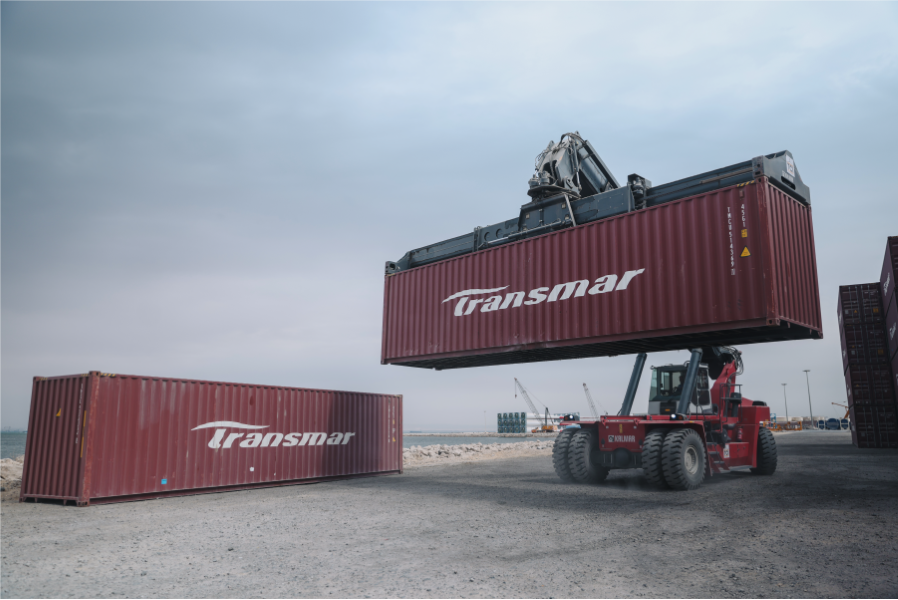
Alexandria’s container operator is raising terminal fees just as Egypt’s ports pick up rerouted Gulf trade

Alexandria Container and Cargo Handling Company (ALCN) will introduce four new container charges and raise a fifth starting 1 September, according to a summary of board resolutions filed with the EGX (pdf). The new charges cover full export container entry (USD 15-20), empty container handling (USD 10-20), container retention in the inspection yard (USD 10-20), and container movement for weighing (USD 30-60). The existing inspection and examination charge will rise to USD 32-64 from USD 30-60. All are collected in EGP at the USD equivalent, with the tariff set to be reviewed every six months.

PLUS- There’s a yard expansion in the mix: The board approved awarding an EGP 97.4 mn contract, excluding VAT, to build Yard B at El Dekheila Container Terminal as part of the company’s infrastructure and capacity-expansion plans.

Why this matters: ALCN is the port’s dominant container operator, and that’s what gives this repricing national weight. Its two terminals, spanning roughly 1.6 km of quay across the Alexandria and El Dekheila ports and wired into the national rail network, carry a combined capacity of 1.5 mn TEUs. That’s only about three-quarters of the 2 mn TEU of container capacity the two ports are designed to handle, according to Alexandria Port Authority figures. Containers accounted for 28.3 mn of the port’s record 82 mn tons of cargo in FY 2024/25 — the dry and liquid bulk that make up the rest move through berths ALCN doesn’t run.

However, containers are where Egypt’s manufactured exports and rerouted transit boxes flow, and the bulk of that capacity is ALCN’s. A repricing at its gates, in a complex that handles about 60% of Egypt’s foreign trade, is a cost added at the country’s main container gateway.

Zoom out, and the picture gets less flattering. The new charges land as the terminals ALCN operates sit at the center of two things Egypt is counting on. Strategically, Cairo is targeting USD 145 bn in annual exports by 2030, a goal that relies on the same container gates ALCN is about to make more expensive to pass. Tactically, the port has become a transit beneficiary of the Middle East conflict: with Gulf shipping rerouting around Hormuz disruption, Egypt’s Mediterranean gateways have picked up volume they wouldn’t otherwise see. Imposing fees at this moment runs against the government’s own stated goal of lowering logistics costs and boosting export competitiveness, shipping sources tell us.

Will the repricing actually leave a mark? Currency volatility is the real problem for importers, not the new fees, Matta Bishay, head of the Internal Trade Committee at the General Division of Importers, tells EnterpriseAM, adding that a USD 20-30 increase per container won’t move the needle on a USD 100k shipment. The total hit comes in under 0.5% of final product prices — the kind of bump that turns an EGP 10 item into an EGP 10.25 one — and is a fair response to rising global shipping and ins. costs, Ahmed Ataby, head of the Exporters and Importers Division at the Giza Chamber of Commerce, tells us.

The counterargument: fees add up. The fee may be negligible by shipping-cost standards, but exporters are looking to save every EGP to stay price competitive, Amr El Samadony, secretary-general of the International Transport and Logistics Division, tells us. He warns, however, that its cumulative effect could weigh on exporters facing fierce price competition in Gulf and European markets. Any increase in logistics costs has to be passed on to the price of the goods, potentially weakening their position against rivals with stronger, cheaper logistics networks, he adds.

Ataby sees it differently — for him, the timing is the justification, not the problem. Global shipping pressures, not ALCN’s balance sheet, explain the increase, he tells us. Fuel alone accounts for around 65% of voyage costs, and marine ins. premiums have climbed sharply on the back of the same disruptions. Against that backdrop, he calls ALCN’s increase modest and justified.

What’s next? No other Egyptian container terminal has announced similar increases so far, though industry sources say the Transport Ministry could step in if the fees threaten export competitiveness. Ataby, for his part, expects the opposite. He predicts that other Egyptian terminals will eventually follow ALCN’s lead, arguing that its dominant role in the country’s trade makes its pricing a benchmark for the rest of the market.

Who controls ALCN: Abu Dhabi sovereign wealth fund ADQ holds an indirect majority (51.33%) through Alpha Oryx (32%) and AD Ports subsidiary Black Caspian Logistics (19.33%). A move to consolidate that holding under AD Ports — and potentially lift it to as much as 90% — stalled after the Egyptian government refused to sell its combined 43.9% stake. That state holding is split between the Holding Company for Maritime and Land Transport (36.3%, following a stake increase in April) and the Alexandria Port Authority (7.6%). The remaining 4.76% is in freefloat on the EGX. In FY 2024/25, ALCN posted an EGP 8.37 bn top line, with an adjusted EBITDA margin of 64%.

Tags:

3

Projects

Iraq is quietly building a way to move oil without ever touching Hormuz

Can a truck route and an unbuilt pipeline do what a strait can’t — ensure that Iraq’s oil keeps moving, no matter what happens at Hormuz? Iraqi fuel oil trucked to Syria’s Baniyas port has started reaching US buyers, Reuters reported last week — cargoes that have been moving since mid-June — and Iraq’s cabinet has since authorized Basra Oil Company to sign an MoU with Syria to convert that same corridor into a pipeline, Iraqi state news agency INA reports.

The caveat? One tanker load beats a month of trucking: More than 600k tons of Iraqi fuel oil reportedly reached Syria by road in June, with Baniyas processing roughly 900 tanker trucks a day. A fleet running at that pace could plausibly move 450k-840k tons a month, transport and logistics specialist Ziya Mammadov tells EnterpriseAM. “The carrying capacity, cost efficiency, and economies of scale offered by tanker vessels simply cannot be replicated by road transport,” Mammadov says.

The corridor was never meant to move oil faster, but rather to buy Iraq time. Its real job is pulling fuel oil out of storage before Iraqi refineries run out of tank space — a pressure valve, not a substitute. Truck queues stretch more than 30 km outside Baniyas — “border processing capacity, truck turnaround times, driver availability, security conditions, and operational coordination would ultimately determine the corridor's practical limits,” Mammadov tells us.

Of everything Iraq has in motion, only one project has an actual price tag and a tender date. Baghdad moved the estimated USD 4.6 bn Basra-Haditha pipeline toward tendering in April, a roughly 2.25 mn bbl / d line running from the southern fields toward western and northern Iraq that could become a common trunk feeding several export branches rather than locking the country into one fixed route.

Downstream of that trunk, nothing is at the same stage of readiness. A Ceyhan extension could tap Turkey's existing corridor and its roughly 1.5 mn bbl / d of nameplate capacity — most of it currently unused — but only once Basra-Haditha physically reaches it. The Baniyas branch has the freshest news behind it — the MoU — reviving a line once designed for around 300k bbl / d, still with no construction award, financing, or timeline attached.

Some of Iraq’s hedges aren’t about avoiding Hormuz at all — just about who’s on the hook while still using it. TotalEnergies has been offering Basrah Medium and Basrah Heavy to Asian refiners on delivered terms, chartering VLCCs itself rather than making buyers send vessels into the Gulf. Basra Oil Company contracted Italy’s Micoperi and Turkey’s Esta to build a third offshore export pipeline with capacity of around 2.4 mn bbl / d, including a 61 km offshore section, a 9 km onshore section, two platforms, and a floating export buoy.

Lebanon wants a piece of the Syria branch, too. Lebanon has proposed extending the Syrian corridor with a pipeline branch from Syria into northern Lebanon, which would give Iraqi crude and products access to Tripoli’s storage, export facilities, and a proposed refinery, The National reports. Iraq and Lebanon will set up a joint technical team, but the plan is still at the statement-of-intent stage and hinges on first reviving the wider Iraq-Syria pipeline system. Near term, Iraq could truck products into Tripoli’s existing storage as it does in Syria, though Lebanon’s USD 1.2 bn in unpaid dues from an earlier Iraqi fuel agreement remains a complication.

The bottom line: Iraq is not choosing between trucks, delivered cargoes, and pipelines as each measure addresses a different weakness in the country’s export system, and, “in today's geopolitical environment, diversified transport corridors have become an essential component of energy logistics [...] in my opinion, this should be understood as a resilience strategy rather than a replacement strategy,” Mammadov says.

4

Moves

Noatum CSM appoints Xanthos Kyriacou as CEO

Noatum CSM names new CEO: Noatum CSM, the Dubai-based ship-management JV between AD Ports Group and Cyprus-based Columbia Group, has appointed Xanthos Kyriacou (LinkedIn) as chief executive officer (CEO), according to an announcement. Kyriacou succeeds Julian Panter (LinkedIn), who led the JV since 2025. Kyriacou steps into the role after more than two decades at Columbia, most recently as regional managing director, overseeing its expansion across Italy, Turkey, and the Middle East.

5

Also on Our Radar

Asyad sells down its LNG newbuilds + Flynas firms up 25 Airbus jets

Asyad sells in

Asyad brings local investors into its newest LNG carriers: Asyad Shipping sold a 20% stake in each of the companies that own the Muscat LNG and Musandam LNG carriers to two Omani investors, according to a disclosure (pdf) to the Muscat Stock Exchange. The Oman LNG Development Foundation and Mars Development and investment will each hold 10% in both shipowning companies, while Asyad will retain the remaining 80%.

REMEMBER- This comes alongside an ongoing fleet renewal. Asyad has been disposing of older tonnage while replacing it with younger, more efficient vessels. The company agreed late last year to sell four partially owned LNG carriers for USD 110 mn, booking an expected USD 51 mn loss, and sold the 2001-built Sohar LNG for USD 23 mn in June.

Going long

Flynas confirmed five A330neo widebodies and 20 A321neos under its existing Airbus agreements, according to a press release. The purchase takes its firm Airbus orderbook to 235 aircraft — 84% of its 280-jet total — with the A330neo commitment rising to 20 and the A321neo commitment to 56.

These jets were already on the books as options and purchase rights. Flynas converted five A330neo options and 20 of its 55 available A321neo purchase rights under its existing 2016 and 2024 Airbus agreements, according to a Tadawul disclosure. That leaves 10 A330neo options and 35 A321neo purchase rights still available. Deliveries run 2032-2034, with pricing and terms unchanged from the original agreements.


AUGUST

30 August-1 September (Sunday-Tuesday): Air Cargo Middle East, Riyadh, Saudi Arabia.

30 August-1 September (Sunday-Tuesday): Saudi Warehouse and Logistics Expo, Riyadh, Saudi Arabia.

SEPTEMBER

16-17 September (Wednesday-Thursday): Saudi Maritime & Logistics Congress, Dammam, Saudi Arabia.

22-23 September (Tuesday-Wednesday): Breakbulk Americas, Houston, US.

22-24 September (Tuesday-Thursday): Seamless Middle East, Dubai, UAE.

28-30 September (Monday-Wednesday): Transport Logistics Middle East, Riyadh, Saudi Arabia.

OCTOBER

12-14 October (Monday-Wednesday): The Airport Show, Dubai, UAE.

20-22 October (Tuesday-Thursday): TOC Americas, Cartagena, Colombia.

21-22 October (Wednesday-Thursday): Global Ports Forum, Singapore.

26-29 (Monday-Thursday): Air Cargo Forum, Miami, US.

27-29 October (Tuesday-Thursday): Routes World, Riyadh, Saudi Arabia.

NOVEMBER

2-5 November (Monday-Thursday): ADIPEC Maritime and Logistics Exhibition and Conference, Abu Dhabi, UAE.

10-11 November (Tuesday-Wednesday): TOC Asia, Singapore.

10-12 November (Tuesday-Thursday): Intermodal Europe, Rotterdam, Netherlands.

11-13 November (Wednesday-Friday): Logitrans, Istanbul, Turkey.

18-19 November (Wednesday-Thursday): Breakbulk Asia, Singapore.

FEBRUARY 2027

10-12 February (Wednesday-Friday): Routes Americas, San Juan, Puerto Rico.

MARCH 2027

16-18 March (Tuesday-Thursday): CMA Shipping, Houston, US.

16-18 March (Tuesday-Thursday): Routes Asia, New Delhi, India.

APRIL 2027

20-22 April (Tuesday-Thursday): Routes Europe, Antalya, Turkey.

26-29 April (Monday-Thursday): Transport logistic and air cargo Europe, Munich, Germany.

26-29 April (Monday-Thursday): Saudi Smart Logistics, Riyadh, Saudi Arabia.

Now Playing
Now Playing
00:00
00:00