Amendments to Banking Act to make central bank the primary consumer protection agency for the banking industry: Amendments to the Banking Act, which are still being drafted by the central bank, will, in effect, make the CBE the primary consumer protection agency for the banking industry, Al Mal reports. Under the law’s provisions, the CBE will be responsible for taking consumer complaints and investigating them. The CBE will also be charged with adjudicating between customers and banks in the event of a dispute. The law will also afford the CBE the right to order settlements and mete-out punitive measures against financial institutions found in violation of laws and standards. The amendments would also see the CBE assume some powers of the Egyptian Competition Authority, making it the ultimate arbiter of what constitutes a monopoly in the sector.
The CBE may begin issuing consumer-centric regulations ahead of the law. These will include new, customer-focused transparency regulations and disclosure rules, said Khaled Bassiouny, head of the CBE’s financial inclusion unit, at the Seamless North Africa fintech conference. These new rules will also see the establishment of the customer complaints unit.
Also coming of the Seamless fintech conference: The central bank is planning to establish an EGP 1 bn venture capital fund, CBE Governor Tarek Amer announced. The bank will look to finance “innovative ideas and projects” through the fund, he added. Also in the cards, Amer says: All things digital, Al Borsa reports.
Also speaking at the conference was Prime Minister Sherif Ismail, who said Egypt aims to become a regional hub for fintech innovation.
Related
LEGISLATION WATCH- Is privatization of the EGX in the cards after the House Economics Committee okays regs allowing private stock exchanges? Or is it a commodities exchange that would be private? The House of Representatives’ Economics Committee agreed to amendments to the Capital Markets Act yesterday to allow the establishment of privately-owned stock exchanges. Private exchanges, which would fall under article 26 of the act, would be established as joint stock companies and allowed to trade in or two types of securities at most, only after obtaining approval from Cabinet based on a recommendation from the Financial Regulatory Authority (FRA), according to Al Mal. Private exchanges would face licensing fees of no more than EGP 100k, and the regulations on shareholders, capital requirements, board members, and management structure would fall to Cabinet to set, presumably via executive regulations. The new exchanges’ financials would also have to be monitored by FRA-sanctioned personnel.
Other amendments will permit new instruments, toughen sanctions: Among the new instruments could be sukuks, futures, and a commodities exchange.
Will FRA include short-term debt instruments as part of Capital Markets Act amendments? Other amendments to the Capital Markets Act now under study by the committee could see the introduction of short-term debt instruments. The FRA had reportedly suggested including provisions to allow for the issuance of short-term bonds, ranging from seven days to two years, at the hearing held yesterday on the law, Youm7 reports. It is unclear whether this is a proposal for future amendments after the current ones are passed or whether FRA is trying to include a last minute change to the act. FRA had hoped to begin allowing the issuance of short-term instruments before the end of 2017. The move aims to facilitate financing of SMEs, particularly those whose products and services are seasonal, officials had previously suggested
Tension between the bourse and the FRA? Disagreements with FRA Chairman Mohamed Omran over lowering the EGX’s listing fees reportedly led deputy bourse chief Mohsen Adel to abruptly leave in the middle of yesterday’s discussion session. The Economics Committee had proposed lowering listing fees to EGP 50,000 on bonds and EGP 250k instead of EGP 500k on securities, which Al Mal says did not sit well with Adel.
Related
Brokerages cheer EGX drive to interest banks in financing margin trading: Brokerages and industry associations are welcoming recent steps by the EGX to increase the involvement of banks in margin trading, according to Al Mal. EGX head Mohamed Farid had met last week with the Federation of Egyptian Banks to discuss mechanisms that would encourage the banking sector to finance margin trading and help reduce risk. Banks had been reluctant in the past few years to finance margin trading on fears of turbulence in the stock market, said the head of the securities division of the Federation of Egyptian Chambers of Commerce, Awni Abdel Aziz.
Related
Economic growth in Egypt is expected to accelerate to 5.5% in FY 2018-19, Bloomberg Economics’ Chief Middle East Economist Ziad Daoud expects, according to CPI Financial. He sees four tailwinds supporting growth in Egypt. First is declining inflation rates. Second are the lower interest rates expected, which “should boost growth through faster expansion in consumption and investment.” Tourism is also set to recover, with more tourists arriving and staying for longer. The fourth tailwind is the increased natural gas production domestically. “The story of Egypt is positive in the short term. However, most of the factors behind the expected recovery are temporary, and as these fade or reach their limit, Egypt will need to find new drivers for growth,” said Daoud.
Related
Fuel subsidy costs are up 34% y-o-y in 1H2017-18, Oil Minister Tarek El Molla told Reuters. The cost has gone up to EGP 51 bn from EGP 38 bn, but El Molla notes that the spent amount remains EGP 4 bn below budgeted. In total, the government expects to spend EGP 110 bn on fuel subsidies in FY2017-18.
Will this send the deficit to 10.5% of GDP, or is the 9.4% projection from last week still on? An official from the Finance Ministry tells Al Mal that the spike in fuel subsidies bill will raise budget deficit projections. This comes despite the ministry laying out conservative estimates. The official justified the discrepancy by stating that the biggest spike in global oil prices had taken place in mid-FY2017-18, so these were not accounted for. The source did not clarify whether the hike in fuel prices was factored into the ministry’s updated budget deficit projection from last week, which project a deficit of 9.4% of GDP. Ashraf Al Araby, a member of the House of Representatives’ Economics Committee, says that the fuel subsidy cost increases will lead to a budget deficit closer to 10.5% of GDP, though he does not explain where he got those figures.
Related
M&A WATCH- Beltone Financial is planning new acquisitions to diversify the products it offers in frontier and emerging markets. “Beltone is in a very big growth mode,” CEO Bassem Azab said in an interview with Bloomberg on Wednesday. “We spent the past two years establishing and re-positioning ourselves in investment banking, asset management and brokerage. Now that we have our pillars reinforced on the ground, we are looking at other business lines that we want to grow.” Beltone is looking at acquisitions in leasing and consumer finance in Egypt and might consider starting a microfinance business, Azab added.
Beltone is also looking to buy companies outside Egypt to diversify product offerings beyond equities, Azab said. Beltone’s last major acquisition was New York-based brokerage Auerbach Grayson & Co in 2016.
On the IPO front, Beltone expects to bring as many as three IPOs to the EGX this year in the consumer, healthcare and industrial sectors. The firm is also pitching to co-manage a share sale in Nigeria, investment banking head Sobhy El Sehrawy said.
It also has an “aggressive” plan in 2018 to expand research coverage outside Egypt and add more analysts to its team, said Mostafa Abdel Aziz, the head of its brokerage unit.
Related
An Elsewedy Electric consortium with Siemens was awarded a USD 300 mn EPC contract by the Dubai Electricity and Water Authority (DEWA) for the Aweer H station, phase IV Power Plant in Dubai, the company announced. The 800 MW gas-fired open cycle power project is located in AI Aweer in Dubai and is to come into service by 2020. “Elsewedy Electric’s scope of work includes engineering, procurement and installation of balance of plant in addition to the erection and installation of the Siemens gas turbines. In addition, Elsewedy Electric will be responsible for the site preparation, levelling and the civil, construction and site utilities for the project Siemens scope of works includes fabrication, supply, testing and commissioning of the gas turbine generators in addition to joint project management.”
Related
On restoring flights with Russia, Egyptian officials say one thing, while the Russians say another: Carriers EgyptAir and Aeroflot have not yet received permits for flights between Cairo and Moscow from Russia’s Federal Air Transport Agency, said Russia’s Federal Air Transport Agency head Alexander Neradko, TASS reports. This followed comments by Egypt’s ambassador to Russia, Ehab Nasr, that the last remaining obstacle to the resumption of flights was for the two airlines to agree on procedures and details among themselves. Earlier in the week, Bassem Abdul Karim, a top advisor at the Civil Aviation Ministry, said EgyptAir and Aeroflot had received all permits for flights between Moscow and Cairo, starting from 1 February. Russian Deputy Prime Minister Arkady Dvorkovich has said that both governments need to sign a separate security agreement before flights can resume.
Conflicting remarks suggests outstanding security issues remain? The rhetoric from Russia appears to suggest that so-called “procedures and details” such as setting up a gate at Cairo International Airport exclusively for Russians, may be part of further security measures demanded by Moscow. Officials at CAI insisted yesterday to Al Mal that this is not the case and noted that flights to the US have their own specific gate. They added that the airport had acquiesced to setting up a boarding terminal for Russians.
In other procedural matters, TASS notes that “Aeroflot plans to fly to the Egyptian capital from the Moscow based airport of Sheremetyevo twice a week — on Saturday and Wednesday. Egyptian national carrier EgyptAir plans to carry out three flights to the Russian capital via Domodedovo, another Moscow-based airport — on Tuesdays, Thursdays and Sundays.”
Related
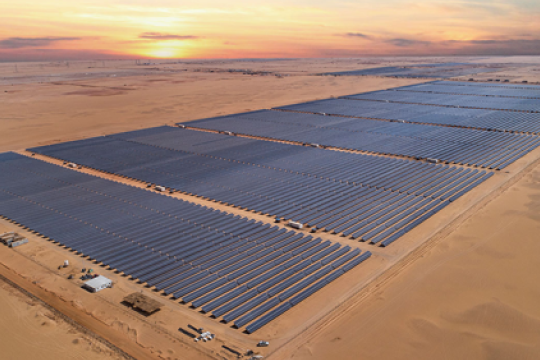
The Benban solar power complex won Thomson Reuters’ Project Finance International Award for “Global Multilateral [transaction] of the Year” yesterday. The USD 2 bn complex, where 30 solar power plants will eventually generate around 1.5 GW of power, represents the second phase of Egypt’s feed-in tariff (FiT) program and is being funded by a number of international lenders, including the International Finance Corporation and European Bank for Reconstruction and Development. The award “crowns the success of the (FiT) and its participants,” according to a statement from our friends at Zulficar and Partners (pdf), who had acted as legal counsel for the Egyptian Electricity Transmission Company on the project.
Companies broke ground on their respective projects in Benban this week after receiving their 25-year power production licenses from the Egyptian Electric Utility and Consumer Protection Agency (Egyptera), Al Borsa reported yesterday. The Finance Ministry had issued letters of guarantee earlier this month.
Related
The Ismail Cabinet granted preliminary approval yesterday to the Pharma Regulator Act, according to an official statement. The legislation would establish three separate bodies to regulate the pharma sector: The Supreme Council for Medicine and Medical Technology to set and implement overarching policies for the sector; the Egyptian Medical Technology Authority to oversee the procurement of pharmaceutical products and medical equipment; and the Egyptian Medical Authority to oversee the manufacturing, sale, and import of human and veterinary medicine. Plans for the Pharma Regulator Act have been in the works since early 2016, when widespread reports of meds shortages led the House Healthcare Committee to announce it was drafting a bill to establish a new market regulator.
Cabinet also signed off during its weekly meeting on the new Customs Act. Amendments to the legislation would widen the scope of goods eligible for temporary exemption of customs taxes and other fees, and bar the release of goods without approval from the Customs Authority. The amendments would also unify additional customs fees and taxes, and reduce the maximum amount of time for fee and tax exemptions to two years, down from four. Additionally, the legislation would reduce the maximum amount of time allotted for the withdrawal of unclaimed inventory to three months, down from two years.
The ministers also agreed to set up a Supreme Authority for Upper Egypt Development. The new body, which will be based in Aswan, will be mandated with drafting a holistic strategy for the economic, social, and urban development of regional areas.
Also approved yesterday:
- BP and Apache concession agreements in the Northeast Ramadan Concession in the Gulf of Suez and the East Bahariya Concession in the Western Desert, respectively;
- The establishment of the National Council for Persons with Disabilities, which will replace the National Council for Disability Affairs.
Related
A reconstruction boom to take place in post-war Syria? The reconstruction of Syria is going to be a “generational project” as the destruction is severe and widespread in scale, Steven Heydemann, Middle East studies professor at Smith collegetells Carnegie Middle East Center. Heydemann talks about the politics of reconstruction and it how it is set to benefit specific political factions more than others. Watching this, we wanted to look beyond the politics of the inevitable reconstruction effort. We were wondering who would be there on the ground when the moment comes and whether any Egyptian companies would be eyeing this potential opportunity (runtime 06:26).
Related
Uber is bolstering its investments in EMs in a tough year for the company: Despite a tough year of lawsuits, data breaches, and rising competition, Uber saw its greenfield investment in overseas operations rise to a new high of USD 191 mn during 2017, a 57% increase from its previous high in 2015 and almost three times the amount invested in 2016, according to the Financial Times. Of its total greenfield FDI in 2016 and 2017, 65% went into emerging markets including Brazil, Morocco, Egypt, Bulgaria and Vietnam.
Related
Did Saudi Arabia allow Israel-bound commercial flights to use its airspace? The Kingdom reportedly granted Air India approval to operate direct flights from Delhi to Tel Aviv in a historic first, sources in the Israeli flight industry told Haaretz. However, a spokesman for Saudi Arabia's General Authority of Civil Aviation speaking to Reuters denied the report. A move like this would be the first time the Saudis are allowing commercial flights to Israel to use their airspace and would be the first overt policy shift by the Kingdom towards normal ties with Israel.
Related


 Egypt Edition
  MENA+ Edition
  UAE Edition
  Saudi Edition
  Logistics (MENA)


 Share Issue