The UAE’s decade of investment in Egypt is turning into a Hormuz hedge as the war shrinks Dubai’s economy

1

WHAT WE’RE TRACKING TODAY

THIS MORNING: An IPO on the horizon?

Good morning, everyone. The regional conflict continues to be at the forefront of most of our stories in today’s issue, bleeding through everything from the UAE’s investment portfolio in Egypt to a recent contraction in Dubai’s economy.

Regional instability is making a near-decade worth of UAE state-backed investments in Egypt look less like emerging market wagers and more like ins. against future disruption. We look at how Emirati investments spanning gas fields, petrochemicals, fuel stations, and ports are becoming a hedge for the UAE as Strait of Hormuz disruptions continue.

Dubai’s real GDP logged its first contraction since the pandemic, falling 2.3% y-o-y in 1H to AED 473 bn, even as sectors like financial services grew 8.8%, as regional disruption weighed on trade and transport — two crucial sectors for the emirate’s economy.

A possible IPO from Dubai Investments Park is a bright spot today as reports come in of executives testing investor appetite that could end the IPO drought we’ve seen so far this year. And in some more positive news: the IMF’s executive board is getting its first Emirati.

Could Dubai Investments Park break the UAE’s IPO drought?

Dubai Investments Park (DIP) is testing investor appetite for what could be the UAE’s first IPO of 2026, with executives planning to meet investors between 19-26 October, Bloomberg reports, citing people it says are familiar with the matter. Parent Dubai Investments has previously proposed floating a 24% stake in the unit, which operates a 2.3k-hectare mixed-use development housing warehouses, hotels, schools, and other facilities.

It’s been a long time coming: Dubai Investments reaffirmed plans for a listing this year after earlier delays, with management previously valuing the unit at AED 10.8-11 bn and putting occupancy at roughly 90%. Citi, Emirates NBD Capital, and HSBC are working on the offering, according to Bloomberg’s earlier reporting.

The stakes go beyond DIP: The UAE is yet to see an IPO in 2026, with several would-be issuers delaying or shelving their plans as the war compounded an already cooling market. The investor meetings could show whether investors are ready to back a UAE listing again — or if DIP needs to wait a little longer. No offer price or launch date has been confirmed.

Dubai’s financial district isn’t done growing

Another USD 1.4 bn development is taking shape in the Dubai International Financial Center (DIFC), with H&H Development launching Water Gardens, a four-building complex featuring offices, residences, hotels, and retail space, according to a statement. The project will bring nearly 22k sqm of Grade A office space, 132 rental apartments, and luxury branded residences to the district, with construction already underway and completion slated for 2028. The project’s valuation and apartment count were reported separately by Bloomberg.

But the market isn’t what it was: H&H Chairman Shahab Lutfi told Bloomberg that the developer’s property sales fell at least 50% between March and September compared with the same period last year, while construction material costs climbed around 15%. Buyers haven’t entirely disappeared, though: some 85% of Water Gardens’ branded residences have already sold, with prices topping AED 8k per sq ft.

And there’s plenty more in the pipeline: DIFC has already opened 600k sq ft of fully leased office space at DIFC Square, while the AED 100 bn DIFC Zabeel District is expected to add 17.7 mn sq ft of mixed-use space through 2040. That’s a lot of new supply for a market where office rents stopped climbing in 2Q for the first time in five years, although prime office demand has held up better than the broader property market.

More signs of warming UAE-Saudi relations…

Yesterday saw another meeting between senior Emirati and Saudi officials in Abu Dhabi. UAE Deputy Prime Minister Sheikh Mansour bin Zayed Al Nahyan met with Saudi Defense Minister Prince Khalid bin Salman bin Abdulaziz Al Saud, according to Wam. The two discussed “the deep-rooted fraternal relations” between the two countries, the state news agency reports, as well as their commitment to strengthening cooperation.

On regional geopolitics, the officials discussed the need for more cooperation “to consolidate regional security and stability,” according to Wam, echoing a recent statement from diplomatic adviser to the UAE president Anwar Gargash, who called for “revived collective Gulf action” in response to attacks on Saudi Arabia.

A two-and-a-half-year-old report reopens an old fight

Abu Dhabi’s International Media Investments (IMI) is pushing back hard against a UK regulator’s verdict that its bid for The Telegraph would have posed a risk to freedom of the press. IMI “completely rejects” the recently released report from media regulator Ofcom, saying in a statement its conclusions “were reached before the evidence was examined.” Ofcom found the takeover could have undermined freedom of expression and the accurate presentation of news because of the bidder’s ties to the UAE government, ITV News reports.

The timing is awkward: IMI is owned by Vice President Sheikh Mansour bin Zayed Al Nahyan, who also owns Manchester City. Last month, a Premier League independent commission found the club guilty on 114 of 115 charges, covering financial breaches over nine seasons and failure to cooperate with the league’s investigation. City denies wrongdoing and has appealed.

IMI’s case: IMI says Ofcom made no findings of editorial interference and judged the bid “on its origin and not its conduct.” It also argues that the regulator ignored its offered binding commitments, which included a guarantee never to influence The Telegraph’s editorial decisions and an independent editorial trust with a veto over the editor’s appointment and removal.

BACKGROUND- Ofcom’s report covers the original 2023 bid for The Telegraph and The Spectator by RedBird IMI, a JV between US private equity firm RedBird Capital and IMI. Ofcom and the Competition and Markets Authority sent their findings to the then-conservative government in early 2024, and the government went on to ban foreign state ownership of UK newspapers. RedBird Capital later made a second attempt with a c. GBP 500 mn bid, restructured to fit new rules capping foreign state stakes at 15%, which cut IMI’s share to that limit. It pulled out last November amid regulatory uncertainty and opposition from inside The Telegraph newsroom. The Telegraph went to Germany’s Axel Springer for GBP 575 mn, while The Spectator was sold to British hedge fund manager Paul Marshall for GBP 100 mn.

ADGM wants to keep business centers in check

ADGM wants to license business centers — providers that rent out furnished, serviced offices and often double as companies’ registered addresses. The Registration Authority’s proposals aim to protect tenants who could lose their offices and registered corporate addresses at once if a provider loses its own lease or shuts down. That risk multiplies when the tenant is a company service provider whose clients share the same address, according to a statement and consultation paper (pdf).

The key rules: Under the proposed framework, operators would be barred from signing client agreements that run past their own lease and would have to disclose pricing and exclusions in writing upfront. They would also need to notify the regulator of anything threatening their ability to keep operating and maintain a wind-down plan. On the financial side, they would need USD 50k in immediately available capital, at least USD 1 mn in public liability ins. per claim, and a ban on cash transactions above USD 3k.

Part of a bigger regulatory push: ADGM has already proposed tighter rules for legal, tax, and company service providers, while its expansion onto Al Reem Island has brought more businesses under its jurisdiction. Existing operators would get six months to comply with several requirements if adopted, with consultation open until 6 November.

PSA

WEATHER- Temperatures are set to reach highs of 37°C and overnight lows of 27°C in both Abu Dhabi and Dubai today, according to our favorite weather app.

Happening today

RAK’s ruler is in China this week courting Chinese business: Ras Al Khaimah Ruler Sheikh Saud bin Saqr Al Qasimi landed in Shenzhen on Saturday at the start of a working visit to China, with stops planned across Guangdong and Fujian provinces through Friday, 23 October, state news agency Wam reports. On the agenda: a Ras Al Khaimah-China Business Summit in Shenzhen, the opening of an RAK representative office in Guangzhou, and a stop in Fuzhou to sign an agreement establishing formal ties with Fujian.

The Guangzhou office is the bit to watch. It gives RAK a permanent presence in China’s biggest provincial economy rather than relying on visits. It also builds on Sheikh Saud’s two trips in 2024: in November, RAK signed a cooperation agreement with Guangdong, and in September, he gave the keynote at the China International Fair for Investment and Trade in Xiamen, Fujian.

The Sharjah Chamber of Commerce and Industry is in Addis Ababa today, as part of a three-day trade mission to Ethiopia, according to a press release. The visit will include a Sharjah-Ethiopia Business Forum that will be held in the capital tomorrow as the emirate looks to open up more access for UAE products to markets in Africa.

Also on the agenda: The two sides will look into joint investment options, private sector cooperation, and bilateral trade partnerships.

The big story abroad

Europe takes to the streets: Protests have erupted across the continent, from Spain, France and Portugal to Italy, Belgium and Albania, fueled by frustration over social and economic problems. School conditions and the cost of living, particularly housing, are among the main drivers of the unrest.

Accenture weighs China sale: Accenture has hired JPMorgan to conduct a strategic review of its China business, which could lead to a sale worth up to USD 1.5 bn. The IT consultancy wants to focus on its fastest-growing operations and show investors it can adapt to AI. Private equity firms and strategic buyers are expected to show interest. Accenture may keep a significant minority stake to facilitate continuity for customers.

Daiichi Life Group launched a bid to acquire the remaining 79.5% of shares in Challenger for roughly AUD 7.9 bn (USD 5.5 bn). Daiichi Life Group, a Japanese ins. firm, is offering to pay AUD 11.80 per share, roughly 20% higher than Friday’s closing price.

***

You’re reading EnterpriseAM UAE, your essential daily roundup of business, economics, and must-read news about the UAE, delivered straight to your inbox. We’re out Monday through Friday by 7am UAE time.

EnterpriseAM UAE is available without charge thanks to the generous support of our friends at Mashreq and Hassan Allam Properties.

Were you forwarded this email? Tap or click here to get your own copy of EnterpriseAM UAE.

Want to send us a story idea, request coverage, ask for a correction, or otherwise get in touch? Reach out to us on [email protected].

DID YOU KNOW that we also cover Egypt, Saudi Arabia, and the MENA logistics industry?

***

Check out our full calendar on the web for a comprehensive listing of upcoming news events, national holidays and news triggers.
This publication is proudly sponsored by

Rise every day
From OUR FAMILY to YOURS
2

THE BIG STORY TODAY

A decade of UAE investments in Egypt’s ports and energy is turning into a hedge against Hormuz

The UAE’s state-backed investors have spent close to a decade buying into Egypt’s gas fields, petrochemicals, fuel stations, and ports. With traffic in the Strait of Hormuz still down to a trickle amid ongoing attacks, that portfolio is starting to look less like a set of emerging-market wagers and more like an ins. policy. Egypt offers Gulf capital something it can’t build at home: two coastlines on either side of the Suez Canal and a gas market hungry for investment.

The latest piece is a storage hub on the Mediterranean. In August, Egypt approved a 737.9k-sqm private freezone in New Alamein for Fujairah Alamein Oil and Gas Co., a JV with Fujairah. The zone sits next to El Hamra Petroleum Port and will store and trade crude and refined products, all of which are slated for export. It is the commercial base for Fujairah’s USD 3 bn oil logistics buildout at El Hamra, which grew out of three agreements signed last October, including one to supply petroleum products to EGPC. Separately, a USD 457 mn expansion of the port with state-owned Wepco aims to more than double El Hamra’s crude storage to 5.3 mn barrels by December. Egyptian Prime Minister Moustafa Madbouly met Fujairah officials last month to push the project into implementation.

It’s part of a broader hedging strategy the UAE has been building at home all year. Adnoc has been shuttling crude out of the Gulf to transfer points like Fujairah so buyers can collect it without sending their own ships through Hormuz. On the container side, Gulftainer’s Khorfakkan terminal has gone from a low-key transshipment hub to the UAE’s main gateway outside the strait.

Why it matters: Abu Dhabi is already routing around Hormuz at home, and Alamein extends that logic across the Red Sea. The Habshan-Fujairah pipeline has carried the UAE’s Hormuz bypass through the war. Adnoc is fast-tracking a second line to double crude flows through Fujairah by 2027, part of what Foreign Trade Minister Thani Al Zeyoudi calls the goal of “zero Hormuz dependency.” Fujairah itself is not out of range: Iranian drones targeted the port in March. El Hamra gives Fujairah-linked operators storage on the Mediterranean — on the European buyer’s side of the canal. It also gives Egypt a supply buffer it currently lacks.

Investors have been building toward this for years, driven by two motivating factors: “Egypt’s growing need for investment to reverse declining domestic production and the UAE’s broader strategy of expanding its international energy portfolio,” Natalia Katona, commodity analyst at Oilprice, tells EnterpriseAM.

The UAE has been in Egypt’s energy sector since at least 2018. Mubadala bought into the Shorouk concession, home to the Zohr field, that year. Dubai-owned Dragon Oil agreed in 2019 to buy BP’s Gulf of Suez assets, including its stake in the Gulf of Suez Petroleum Company (Gupco). In 2023, ADQ paid USD 800 mn for 35% of Egyptian Linear Alkyl Benzene (Elab), 30% of Egyptian Ethylene and Derivatives (Ethydco), and 25% of Egyptian Drilling Company.

A logistical hedge, bought before it was needed

“Egypt offers a logistics position that is not dependent on a single strait. That’s what Abu Dhabi is buying,” supply chain analyst Wolfgang Lehmacher tells us. Egypt became attractive “not because it was cheap,” he says. Red Sea attacks, and now the war, made it “almost a necessity” for Gulf states trying to spread their exposure.

The turning point was Ras El Hekma. ADQ’s USD 35 bn pact to develop Ras El Hekma on the North Coast came in 2024, when Egypt was short of foreign currency. The agreement helped unlock a USD 8 bn IMF financing package. Lehmacher calls it a “golden moment.” UAE operators already had a foothold in Egypt’s ports: DP World has run Sokhna since 2008, and ADQ bought into Alexandria’s main container operator in 2022. AD Ports has since picked up pace, signing new concessions at Sokhna and a 50-year agreement for an industrial and logistics zone at East Port Said. That gives UAE operators access to both of Egypt’s coasts — on the Med and on the Red Sea.

Gassed up in upstream

Egypt’s shrinking gas output has been the main driver of upstream investment, says Katona. Production averaged c. 3.8 bcf / d in 1H 2026, about 44% below the same period in 2021, while demand kept climbing.

This summer, Egypt kept the lights on, but it paid heavily to do so. The grid hit a record 40.2 GW peak in August without returning to load-shedding. That took 7.94 mn tons of LNG imports in the first seven months of the year, more than double the same period in 2025, plus Israeli pipeline gas pushed to its ceiling and fuel oil as a backup. The two summers before were harder: gas cuts in 2024 and 2025 forced fertilizer producers to scale back or halt output, including Abu Qir, EgyFert, and Mopco.

This is why gas matters more than oil: “Natural gas investments are considerably more important for Egypt’s economy than incremental oil production,” says Katona. Gas runs both power generation and the fertilizer industry. That gives UAE-backed upstream gas assets more weight than conventional oil investments, she adds.

Egypt has paid off the debts that drove investors away. Arrears to international oil companies stood at USD 6.1 bn in 2024 and dragged down investment and output. The government fully cleared them in June. “The government’s efforts to settle these obligations and improve upstream contractual terms have helped support renewed investment,” says Katona.

Cairo sweetens the offer

The long-term prize for the UAE is not just Egypt’s gas market but a potential Eastern Mediterranean gas hub, “particularly if additional regional supplies become available for processing, domestic consumption or eventual re-export,” says Katona.

Arcius is the clearest example. BP holds 51% and XRG, Adnoc’s international investment arm, owns 49% of the JV, which was set up in 2024. BP contributed its existing Egyptian assets, including its stake in Zohr. Arcius’s first work is in Egypt: the North Damietta concession and the Harmattan field, which reached a USD 500 mn final investment decision with Egas in April. A deepwater exploration campaign starts with the West Atoll well.

Better terms have made projects investable: The government has raised the price it pays foreign partners for selected production and loosened production-sharing terms. Wood Mackenzie counts Harmattan among the projects where more flexible fiscal terms helped secure an FID, EnterpriseAM’s Egypt desk reported in its Power Trip series.

Where the hedge gets thin

Midstream and downstream are a harder sell: “The commercial [prospects] in midstream and downstream are constrained by the structure of the domestic market and the country’s geographical exposure to regional shipping disruptions,” Katona says. State-controlled fuel prices keep margins thin and returns unpredictable. Infrastructure tied to trade is also exposed to disruptions around the Suez Canal and Bab El Mandeb, which can cut transit volumes and push up freight and ins. costs, she adds.

That exposure applies to Alamein too. Barrels heading from Fujairah to the Mediterranean still have to pass through Bab El Mandeb to get there.

A backup, not a fix

Egypt gives the UAE storage and a foothold beyond Hormuz, but it doesn’t replace Fujairah. The Alamein zone is built for export, and El Hamra’s expanded tanks will sit on the Mediterranean. But the barrels that fill them still have to come from the Gulf, and Fujairah remains the starting point for that trip.

Looking ahead: “The last 10-15 years have been an Egypt moment already that became bigger,” says Lehmacher. The geopolitical environment is likely to sustain the appeal of such investments, he says. The bigger point is their longevity: 30-year concessions mean the ports, railways, and energy infrastructure will likely outlast today’s crises.

3

A MESSAGE FROM VISA

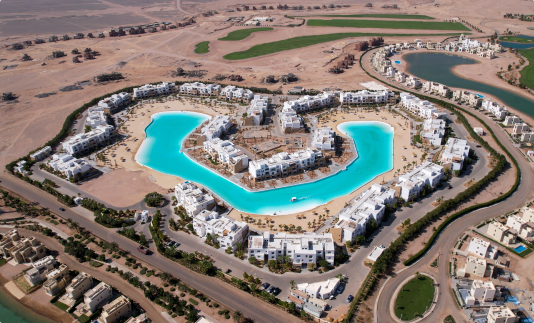
El Gouna Red Sea runs on a five-year clock

Most business plans wait for demand. El Gouna Red Sea built a hospital before it had patients and a school before it had students.

That tells you something about the clock Mohamed Amer and his team work on. In the latest episode of Access Tomorrow, Leila Serhan, Visa’s senior vice president and group country manager for North Africa, Levant and Pakistan, sits down with El Gouna’s CEO, Mohamed Amer, to talk about what happens when you build a complete town over decades, put patient capital behind the vision, and invest years before the demand shows up.

Getting people to El Gouna Red Sea is only half the job. The business model depends on turning traffic into belonging. Amer describes the team’s job simply: drive “relevant traffic” — get people to visit, experience the town, and eventually want to become part of the community. But keeping that funnel moving gets tougher as affluent consumers become harder to impress and easier to lose. Taste is shifting away from extravagance and toward experience and “quiet luxury.” Amer’s shorthand for what El Gouna is ultimately selling is simpler: happiness.

Technology now has to protect that feeling rather than interrupt it. For Amer, the line on AI is between “curated” and “surveilled”: use data to make the guest experience more relevant without making people feel like they are living inside an algorithm. The same principle applies to payments. At a restaurant, the customer should be thinking about the food and the conversation — not the transaction. The payment should effectively disappear.

Click here to watch the full episode of *Access Tomorrow*, presented by Visa.

4

ECONOMY

Dubai’s economy shrank 2.3% in 1H as the war hit trade and transport

Dubai’s real GDP contracted 2.3% y-o-y in 1H, closing out the six-month period at AED 473 bn, state news agency Wam reports, citing data from the Dubai Data and Statistics Establishment. Nominal GDP, however — which doesn’t adjust for inflation — rose 0.2% y-o-y.

The damage was concentrated in the sectors that make Dubai a hub. Wholesale and retail trade, the largest slice of the economy at 20.5%, fell 6% in real terms to AED 96.9 bn. Officials partly blamed inflation, noting that the sector still grew 2% at current prices. Transport and storage dropped 7.4% to AED 50.6 bn, and real estate slipped 2.5% at constant prices.

Dubai underperformed the wider UAE, where real GDP grew 0.4% in 1H on the back of a strong first quarter before contracting 2.1% in 2Q. Dubai grew 2.4% in 1Q, which means its 2Q contraction was deeper than the half-year figure suggests. It’s the first contraction Dubai has reported since the pandemic, though the figures come from a recalibrated series that roughly doubles earlier estimates of the economy’s size, so they aren’t directly comparable with numbers published before this year.

Even the first quarter showed signs of slowing. The emirate posted GDP growth in 1Q at 2.4% y-o-y; however, that was already a dip from the 4% recorded for the same quarter the year before.

Finance kept growing through it. Financial and ins. activities expanded 8.8% to AED 65.9 bn, lifting their share of GDP to 14% from 12.5% a year earlier. Health (+14.3%), utilities (+5.4%), information and communication (+2.7%), and construction (+2.4%) also grew, but together they weren’t enough to offset the losses.

REMEMBER- Financial firms have continued setting up shop in Dubai despite the regional instability. However, analysts have flagged that other more war-exposed sectors that generate substantial revenue for the emirate, such as tourism, would take a hit from the war. Still, Dubai has already moved to cushion the blow, in particular to its private sector, with stimulus packages to support business activity.

What’s next: S&P forecast in June that Dubai’s economy would contract c. 2.5% this year, putting 1H roughly in line, and said a tourism recovery depends on a lasting end to the war.

Tags:

5

MOVES

First Emirati elected to IMF’s executive board

Ali Alhosani became the first Emirati elected executive director at the IMF. He will represent the Arab Group and the Maldives on the Fund’s 25-seat executive board, The National reports. The board approves IMF lending, and this constituency includes program countries such as Egypt and Jordan. The appointment comes as the UAE prepares to host the 2029 IMF / World Bank annual meetings.

Alhosani already knows the Fund well: Alhosani has been the constituency’s alternate executive director since 2021. Before that, he advised the executive director at the World Bank and managed a portfolio at the IFC in Washington. His new role was most recently held by former Egyptian finance minister Mohamed Maait.

Plus: Abu Dhabi sovereign wealth fund L’imad is lining up a Fortress Investment Group veteran to run its new investment arm, L’imad Capital, Bloomberg reports, citing sources it says are familiar with the matter. Dean Dakolias (LinkedIn), a former co-chairman who helped build the US firm’s credit business, is being considered for CEO, though the appointment still needs approvals.

Dakolias already has an Abu Dhabi connection: Dakolias spent nearly 25 years at Fortress before leaving at the end of last year, according to his LinkedIn profile, including his final stretch under Mubadala, which holds a 68% stake in the asset manager.

The appointment would come as L’imad looks to bring in outside capital through its investment arm L’imad Capital as early as next year. The new strategy would see L’imad act like a holding company, with L’imad Capital taking on more of a buyout group role.

6

PLANET FINANCE

Investors turn on the debt behind the AI build-out

The debt financing the world’s AI build-out is being repriced for a reckoning. Bonds backing some of the largest data centers have fallen well below par, a run of marquee listings has been pulled, and the debt of the “neocloud” providers at the center of the boom is trading where markets park distress. The common thread is investors have stopped assuming AI revenue will arrive fast enough to service the tns being borrowed to build the capacity.

“Data center bonds are having their Darwin moment, where the weakest credits struggle to survive,” Allianz CIO Ludovic Subran told the Financial Times. Spreads blew out after a wave of power and construction delays, he argued, proof the debt had been “priced too tight for execution risk.” The market, in other words, has started to separate the survivors from the casualties, and is doing it fast.

The sell-off has reached almost everything with AI exposure. Debt behind the Meta-anchored “Hyperion” project, issued through a Blue Owl and Meta-backed vehicle called Beignet Investor, has slid from above par in early July to just under USD 0.92. Bonds for two Hut 8 sites — one in Louisiana, a Texas campus leased by Nvidia — sit near USD 0.94 and USD 0.92; Blackstone’s QTS Project Excalibur in Georgia, leased to Microsoft, is below USD 0.88. Roughly USD 18 bn of loans tied to Oracle’s Project Jupiter in New Mexico have slipped into stressed territory after power-permitting delays, and debt for Oracle’s Michigan campus has fallen to USD 0.87 from par in July.

The neoclouds have been hit hardest, because they borrowed hardest. CoreWeave — a crypto miner four years ago, now the best-known of the breed — watched one of its unsecured bonds sink below USD 0.80, dragging yields toward 15%, while the shares dropped nearly 25% over the week. Nebius lost 18%. Even Nvidia, which has poured tens of bns into the sector’s start-ups, gave up about USD 270 bn of market value in a week.

Why it matters: The math stops working at these prices. Tech consultancy Gartner reckons AI data center owners need USD 8.5 tn of revenue by the end of 2030 to cover capital and financing costs and still clear a healthy return, against the USD 3.6 tn it expects consumers and companies to actually spend on AI services. Stay on the current path, it warns, and more than USD 4 tn of asset value is exposed to writedown risk through 2032, with 80% of neoclouds set to “cease independent operations” by 2030.

Confidence cracked on a run of soft demand signals. OpenAI pushed its IPO into next year, and its annualized revenue came in around USD 20 bn below what it had guided. Anthropic’s 3Q sales growth also fell short of expectations, slowing down from the year’s start. A Bank for International Settlements study added to the unease, finding “a significant portion” of AI financing and commercial ties are self-referencing. That means chipmakers bankrolling the clouds that buy their chips and labs backing the developers that house their models.

The equity window has all but shut. Firmus, the Nvidia- and Blackstone-backed operator, pulled what would have been Australia’s second-largest listing earlier this month, a float valuing it at AUD 44 bn (USD 30.5 bn), roughly double the valuation set three months earlier, the FT reports. AirTrunk scrapped a Singapore REIT days later, SoftBank’s SB Energy mothballed a USD 50 bn listing, and Nvidia-backed Nscale is still chasing a USD 35 bn New York debut that bankers say is a hard sell right now. CoreWeave chief Mike Intrator said the troubles at Firmus, AirTrunk, Lambda Labs, and Nscale were “bleeding into the narrative” around his company, in a memo seen by the FT.

The physical world is pushing back, too. At least 47 large projects have been delayed, withdrawn or blocked in 2026 — a “conservative” count, says regulatory-intelligence firm RegLayer — and more than 1k US communities have moved to curb AI infrastructure this year. Bernstein estimates only about 35% of the planned US pipeline is credible. Utility regulators are now withholding grid connections unless a project brings its own power, and every slipped deadline hands Big Tech tenants a contractual door to walk through.

The builders’ own numbers show how stretched the model is. SB Energy, majority-owned by SoftBank and backed by OpenAI and Nvidia, has yet to finish a single data centre but carries USD 174 bn in capital needs against USD 430 bn of future contracts, most of them with OpenAI. Nebius CEO Arkady Volozh told a Citi conference in September that his 5 GW plan needs some USD 250 bn in financing: “So far, we financed maybe 20% of that.” Nscale had 25k advanced chips running in August against the roughly 500k it plans to operate. Anthropic can walk away from a USD 45 bn deal with Nscale if the start-up misses its financing and delivery dates.

Not everyone is heading for the exit. Nvidia’s Jensen Huang said he doesn’t expect CoreWeave to need a backstop, telling Bloomberg “their cost of capital is actually decreasing,” and talked up Nscale in London as a possible “most valuable UK company” created in the decade.

Anthropic is the cleaner bull case: Kroll Bond Rating Agency handed it a BB+ in June, the top speculative-grade score and one notch below investment grade, ahead of a USD 35 bn chip financing led by Apollo, in a rating the Financial Times saw. Its revenue rose nearly 50% to USD 16.8 bn in 3Q and it has been profitable on an adjusted basis for two straight quarters, though growth has slowed from its earlier pace and landed below the summer’s most bullish forecasts.

MARKETS THIS MORNING-

Asian markets were in the red earlier today. Japan’s Nikkei fell around 1% and South Korea’s Kospi slipped around 0.4%. MSCI's broadest index of Asia-Pacific shares excluding Japan was down 0.3% amid growing unease over AI's massive funding needs, which undermined confidence ahead of a week packed with earnings.

ADX

9,808

0.0% (YTD: -1.9%)

DFM

5,867

+0.6% (YTD: -2.1%)

Nasdaq Dubai UAE20

4,837

+0.4% (YTD: -1.1%)

USD : AED CBUAE

Buy 3.67

Sell 3.67

EIBOR

3.5% o/n

5.0% 1 yr

TASI

10,190

+0.8% (YTD: -2.9%)

EGX30

50,896

-2.6% (YTD: +21.7%)

S&P 500

7,659

-1.1% (YTD: +11.9%)

FTSE 100

10,882

+0.4% (YTD: +9.6%)

Euro Stoxx 50

6,204

+0.6% (YTD: +7.0%)

Brent crude

USD 109.01

+3.72%

Natural gas (Nymex)

USD 3.05

-2.3%

Gold

USD 4,181

+0.3%

BTC

USD 81,127

0.0% (YTD: -7.4%)

Lunate JP Morgan UAE Bond UCITS ETF

AED 3.51

0.0% (YTD: -6.4%)

S&P MENA Bond & Sukuk

148.50

+0.2% (YTD: -2.2%)

VIX (Volatility Index)

19.99

+21.5% (YTD: 33.7%)

THE CLOSING BELL-

The ADX remained flat on Friday on turnover of AED 685.8 mn.The index is down 1.8% YTD.

In the green: Hayah Ins. Company (+9.6%), Finance House (+4.1%), and Americana Restaurants International (+2.9%).

In the red: Alpha Data (-4.8%), Al Ain Alahlia Ins. Co. (-4.3%), and Ooredoo (-3.4%).

Over on the DFM, the index rose 0.6% on turnover of AED 593.6 mn. Meanwhile, Nasdaq Dubai rose 0.4%.

Corporate actions: Invest Bank is giving its shares a makeover

ADX-listed Invest Bank secured shareholder approval for an 82.18-to-one reverse stock split, according to a bourse disclosure (pdf). The bank will combine every 82.18 existing shares into one, bringing its share count down from some 263.2 bn to 3.2 bn and raising the nominal value of each share from AED 0.0122 to AED 1 — all without changing its AED 3.2 bn share capital.

Same pie, fewer slices: The consolidation won't change the value of shareholders' holdings or their proportional ownership, aside from adjustments for fractional shares. Investors holding 82 shares or fewer will receive one new share, while trading will be suspended for five trading days from 21 October as the bank puts the changes into effect.


OCTOBER

20-22 October (Tuesday-Thursday): Future Health Summit, Adnec Center Abu Dhabi.

27-28 October (Tuesday-Wednesday): Arab Competition Forum, Dubai.

27-28 October (Tuesday-Wednesday): Federal Open Market Committee (FOMC) meeting.

30 October (Friday): Large businesses achieving annual revenues equal to or above AED 50 mn must appoint an accredited service provider for e-invoicing implementation.

Signposted to happen sometime in October 2026:

  • Abu Dhabi Space Week, Abu Dhabi.

NOVEMBER

2-5 November (Monday-Thursday): Adipec, Adnec Center, Abu Dhabi.

2-6 November (Monday-Friday): Dubai Future Finance Week, Dubai.

4 November (Wednesday): Digital Transformation Summit, Sofitel, Abu Dhabi.

4-16 November (Wednesday-Monday): ADIB rights trading period.

9-10 November (Monday-Tuesday): Annual government meetings, Abu Dhabi.

9-12 November (Monday-Thursday): EMEA Council on Hotel, Restaurant and Institutional Education Conference, Dubai College of Tourism, Dubai.

9-13 November (Monday-Friday): World Congress of Military Med, Adnec Center, Abu Dhabi.

10-12 November (Tuesday-Thursday): Dubai International Electric Vehicle Exhibition & Conference, Dubai World Trade Center.

10-24 November (Tuesday-Tuesday): ADIB rights issue subscription period.

16-18 November (Monday-Wednesday): World Police Summit, Dubai World Trade Center, Dubai.

18-19 November (Wednesday-Thursday): Touchdown Middle East 2026, Conrad Abu Dhabi Etihad Towers, Abu Dhabi.

25-26 November (Saturday-Sunday): Doers Summit, Dubai Silicon Oasis, Dubai.

DECEMBER

2-4 December (Wednesday-Friday): UN Water Conference, UAE.

4-6 December (Friday-Sunday): Formula 1 Abu Dhabi Grand Prix, Abu Dhabi.

8-9 December (Tuesday-Wednesday): Capital Market Summit, Madinat Jumeirah, Dubai.

8-9 December (Tuesday-Wednesday): Federal Open Market Committee (FOMC) meeting.

7-10 December (Monday-Thursday): Abu Dhabi Finance Week, Al Maryah Island, Abu Dhabi.

8-10 December (Tuesday-Thursday): Abu Dhabi Water & Power Week, Adnec Center, Abu Dhabi.

8-10 December (Tuesday-Thursday): Middle East & North Africa Business Aviation Association Show, DWC, Dubai Airshow Site.

Signposted to happen sometime in 2027:

  • 1 January: Deadline for large businesses to implement e-invoicing;
  • 14-17 January (Thursday-Sunday): MOC27 Motor, Outdoor & Camping Festival, Dubai Sevens Stadium, Dubai.
  • 1Q 2027: Completion of the first phase of Hassyan seawater desalination project;
  • 1-3 February (Monday-Wednesday): World Governments Summit;
  • 31 March: Small businesses with annual revenues of less than AED 50 mn are obliged to contract with an accredited service provider for e-invoicing implementation;
  • 31 March: Government entities are required to appoint an accredited service provider for e-invoicing implementation;
  • 21-22 April (Wednesday-Thursday): Token2049, Dubai;
  • 31 May-2 June (Monday-Wednesday): RailX Dubai, Dubai World Trade Center, Dubai.
  • 1 July: Deadline for small businesses to implement e-invoicing;
  • 1 October: Deadline for governments to implement e-invoicing;
  • November: HR Tech, Abu Dhabi.
  • Abu Dhabi’s solar and battery energy facility, combining 5.2 GW of solar capacity and 19 GWh of battery storage, is set for commissioning.

Signposted to happen sometime in 2028:

Signposted to happen sometime in 2029:

  • Sibos 2029 organized by the Society for Worldwide Interbank Financial Telecommunication (SWIFT), Dubai;
  • Annual Meetings of the World Bank Group and the International Monetary Fund, Abu Dhabi;
  • The commissioning of the seventh phase of Mohammed bin Rashid Al Maktoum Solar Park.
Now Playing
Now Playing
00:00
00:00