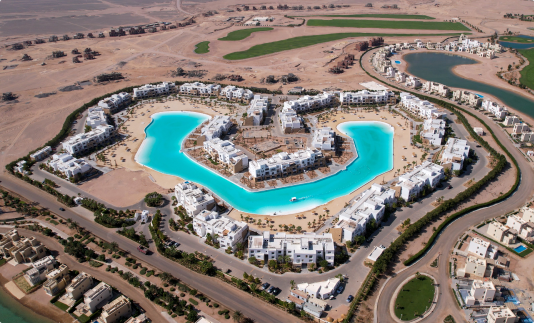
Mubadala’s getting bids for Porto Sudeste

1

WHAT WE’RE TRACKING TODAY

THIS MORNING: Mubadala’s Brazil port attracts interest from buyers + Khorfakkan Port to double handling capacity

Good morning, everyone. The UAE is still building out its east coast hedge, with Sharjah’s port authority planning to double Khorfakkan Port’s handling capacity to 10 mn containers. This adds to the UAE’s growing list of Hormuz workarounds, alongside Adnoc’s West-East Pipeline and DP World’s new Fujairah terminals.

PLUS- We sit down with Mashreq Qatar’s country head, Salman Gulzar, to discuss the bank’s strategy in Qatar — its first outpost outside the UAE. The strategy? To follow Qatari sovereign wealth funds and investors wherever their capital heads, as Qatari entities deploy capital at a scale the domestic market cannot absorb.

On the earnings front, AD Ports posted a jump in 2Q net income despite the war, with higher rates and asset sales cushioning the blow from the Hormuz disruption. Orascom and Amanat Holdings also posted strong results.

Mubadala’s Brazil port sale heats up

Mubadala's Brazil port sale is picking up steam: Sovereign wealth fund Mubadala’s subsidiary Mubadala Capital and trading giant Trafigura Group have received two offers to acquire Porto Sudeste, their iron ore export terminal in Brazil, Bloomberg reports, citing people in the know. The terminal has a 100 mn ton expansion license and is linked to a major iron ore-producing state.

The bids: One offer came from a consortium comprising BlackRock’s Global Infrastructure Partners, Brazilian miner Vale, and steelmaker Gerdau, while the second came from infrastructure investor I Squared Capital. The offers value the port at some USD 3 bn and USD 3.5 bn — lower than a previous valuation of USD 5 bn — although it is unclear which bidder tabled the higher amount.

BACKGROUND- Mubadala and Trafigura took control of the terminal back in 2014 through a USD 996 mn transaction, before exploring the sale 10 years later in 2024. The sale was initially going to package Porto Sudeste with their Morro do Ipe iron ore mining operation in Minas Gerais.

IN CONTEXT- Mubadala was reportedly planning to use the sale proceeds to boost investments in Bahia state, where its subsidiary recently secured USD 1.5 bn to build a biofuels refinery in the region. The sovereign wealth fund has been reshuffling its Brazil portfolio for some time now, and closed its third Brazil fund in April, raising USD 900 mn.

Khorfakkan doubles down

Khorfakkan Port is aiming to more than double annual handling capacity to 10 mn containers, up from a smaller target of 5 mn initially, Wam reports, citing the Sharjah Ports, Customs, and Freezones Authority. The east coast port sits on the Gulf of Oman, giving shippers direct access to international routes outside the UAE’s west coast port cluster and, more importantly, outside the Strait of Hormuz.

Why it matters: Sharjah is pairing that sea access with inland reach, logistics hubs, road networks, border crossings, and GCC trade corridors. It already has deep-water berths and cranes able to handle the world’s largest container vessels. The expansion plans come as the UAE is focusing increasingly on its east-based assets to hedge against future disruption in the Strait. Adnoc is accelerating construction of its West-East pipeline and DP World is building two new terminals at Fujairah.

Space42 secures approval for 2.5% share buyback

Spacetech firm Space42 is moving ahead with a 2.5% share buyback of its issued share capital, after securing ADX and shareholder approval for the move, the company said in a disclosure (pdf).

The rationale: According to the firm’s management, “the current share price undervalues the intrinsic value of the company,” Space42’s Managing Director Karim Michel Sabbagh said. The company recorded a strong 1H, with revenue climbing 14.6% y-o-y to USD 259.5 mn; however, net income was down on the back of higher finance costs. Its shares last traded at AED 1.71 on Friday, up 1.8% following news of the buyback, but are up 8.9% YTD.

REMEMBER- Space42 is on a run to expand its national security capabilities via a tie-up with US defense contractor Leonardo DRS. Separately, it inked a USD 7 mn agreement with South Korea’s Autonomous A2Z to deploy Level-4 autonomous driving systems in the UAE.

Data point

AED 5.59 tn — this was the value of the UAE banking sector’s total assets as of the end of June, according to the Central Bank of the UAE’s latest monetary and banking report (pdf). Gross credit rose 0.9% m-o-m to AED 2.8 tn, driven by an AED 19.9 bn jump (3.5%) in foreign credit and an AED 4.8 bn rise (0.2%) in domestic credit.

Individuals kept borrowing: Within domestic credit, lending to individuals rose AED 6.8 bn, contributing 0.3 percentage points to domestic credit growth. Lending to government-related entities rose 1.5%, government credit was up 0.6%, and lending to other financial corporations jumped 11.4%.

Deposits are still growing, but slowly: Bank deposits rose 0.3% m-o-m to AED 3.5 tn, helped by a 1.2% increase in resident deposits to AED 3.2 tn. Private-sector deposits made the biggest contribution to resident deposit growth, rising 0.7% to AED 2.3 tn, while government deposits rose 2.2% to AED 454.6 bn and GRE deposits climbed 4.1% to AED 355 bn.

PSA

Abu Dhabi residents, you now have more time to build or re-do your houses. The Abu Dhabi Housing Authority (ADHA) has extended the activation period for housing construction, demolition, reconstruction, and maintenance loans by two years, giving Emirati beneficiaries more time to plan and execute their housing projects, ADHA said in an announcement.

Why the extension? The move aims to ease pressure around project planning, contractor selection, and construction costs — which are currently seeing a tougher pricing environment due to the war — while giving beneficiaries more flexibility.

IN CONTEXT- The extension builds on the emirate’s push to make housing finance more flexible for UAE nationals. Just last week, the ADHA partnered with First Abu Dhabi Bank, Abu Dhabi Islamic Bank, and Al Maryah Community Bank to offer housing-loan top-ups, giving borrowers additional funding to plan and complete residential projects.

Bridge Summit pushed to late 2027

The second edition of the Bridge Summit has been pushed back by a year, with the event now slated for November or December 2027 rather than this November, according to a press release. No reason was provided for the delay, but it comes after several other events were postponed or canceled earlier this year due to the regional conflict. The conference focuses on the media and entertainment sectors, and includes a trade show.

WEATHER- The mercury rises to 44°C today in Abu Dhabi with lows of 30°C, while Dubai will see highs of 43°C and lows of 32°C, according to our favorite weather app.

The big story abroad

The news cycle is led by developments on a few geopolitical fronts. Regional tensions have flared amid Israel’s renewed strikes on Gaza and Lebanon, where 11 people were killed, as the IDF claimed to have killed senior Hezbollah commander Abu Hassan Alaa. Meanwhile, US envoys met with Egyptian, Turkish, and Qatari mediators in Cairo to progress Washington’s peace plan for Gaza.

Trump snubs Seoul to favor Pyongyang? US President Donald Trump has instructed the Pentagon to “substantially reduce” an upcoming joint military exercise with South Korea on the basis that it would send a “hostile” message to North Korea. Trump also cited Seoul’s lack of help in the “denuclearization” of Iran for pulling away from Washington’s long-time ally.

Over in the business press: Financial infrastructure platform Stripe has signed up to buy OpenRouter — a unified API and marketplace — for over USD 7 bn, indicating a demand for the startup’s services — helping firms switch between AI models. The final value of the acquisition could change, sources told Bloomberg.

***

You’re reading EnterpriseAM UAE, your essential daily roundup of business, economics, and must-read news about the UAE, delivered straight to your inbox. We’re out Monday through Friday by 7am UAE time.

EnterpriseAM UAE is available without charge thanks to the generous support of our friends at Mashreq and Hassan Allam Properties.

Were you forwarded this email? Tap or click here to get your own copy of EnterpriseAM UAE.

Want to send us a story idea, request coverage, ask for a correction, or otherwise get in touch? Reach out to us on [email protected].

DID YOU KNOW that we also cover Egypt, Saudi Arabia, and the MENA logistics industry?

***

Circle your calendar

Check out our full calendar on the web for a comprehensive listing of upcoming news events, national holidays and news triggers.

This publication is proudly sponsored by

Rise every day
From OUR FAMILY to YOURS
2

SPOTLIGHT

As Qatari sovereign and corporate money moves abroad, Mashreq is following it out the door

Qatari capital keeps finding its way to London, New York, and Cairo as sovereign and quasi-sovereign investors deploy hydrocarbon wealth at a scale the domestic market alone can’t absorb. Mashreq’s Qatar franchise is building its strategy around trailing that money wherever it lands, Country Head Salman Gulzar tells EnterpriseAM.

BACKGROUND- Mashreq’s roots in Qatar date back to October 1971, making it the bank’s first market outside Dubai. Since then, the bank has played a major role in backing some of Qatar’s biggest infrastructure projects — including contractor financing for Hamad International Airport, the Doha Metro, multiple FIFA World Cup stadiums, the Qatar National Library, and Qatar Education City Trams, alongside extensive road, water, and power infrastructure across the country. That heritage is now the platform for something broader: chasing the same clients as their capital moves offshore.

The lender is following deployments abroad by Qatari entities like the Qatar Investment Authority and its real estate investment arm Diar, including the risk-management book (interest rate and currency hedges) that comes with it, Gulzar tells us. The approach, he says, is agnostic on structure: bilateral or syndicated, whichever the client actually needs. “We support our clients in the structure that best serves their objectives — whether that is bilateral, syndicated, or capital markets-based — and we have seamlessly moved between these formats as transactions evolve,” he says.

A green transaction for Qatari Diar is the latest sign of where the investment-tracking strategy is headed. Mashreq recently facilitated a GBP 450 mn green loan refinancing for The Chancery Rosewood hotel in Grosvenor Square — marking one of the bank’s largest green financing facilities of the year, Gulzar says. It follows Mashreq’s first sustainability-linked facility with Landmark Retail in Qatar in 2024, which marked the country’s first bilateral SLF agreement in the private sector.

Why it matters: Qatari sovereign and quasi-sovereign capital is increasingly deploying outside the country’s borders (Read: The Gulf is writing cheques as often as it is cashing them). Gulzar’s read is that global mandates are ultimately earned through relationship depth at home.

The domestic strategy has evolved with Qatar’s economy

In 2016, Mashreq took the strategic decision to exit retail banking in Qatar, consolidating its presence from five branches to one and sharpening its focus on corporate and institutional banking. The embargo hit the following year, in the middle of that unwind, and forced a second, more consequential shift: less dependent on what Gulzar called “elephant hunting” — where the team went after large one-off transactions — and an intensified focus on the more granular working-capital needs of clients.

“2017 forced us to look internally,” Gulzar says. Today, 40% of Mashreq Qatar’s book is working capital, supporting sectors ranging from FMCG and electronics to white goods and automotive distribution.

That experience has also shaped the bank’s response to this year’s regional conflict. Mashreq’s transaction banking and relationship teams were engaging clients on letters of credit, supply-chain resilience, and logistics contingencies within the first week of the disruption, Gulzar says. Throughout the disruptions, the bank did not suspend cash-deposit services for a single day and remained the only fully operating bank for clients for a period of 10 days.

Real estate is another major focal point

That same follow-the-client philosophy underpins Mashreq’s real estate push in Qatar, which brings a successful franchise, developed in Dubai’s mature property market, to the Gulf country. This comes as Qatar has been pushing to boost real estate supply and deepen its property market as part of a broader diversification push, especially after the World Cup helped trigger more demand, with investments in projects like Lusail City, The Pearl-Qatar, and Msheireb Downtown.

Its credentials so far: The bank has played a leading role in some of the sector’s biggest transactions, including advising on Qatar’s largest private-sector real estate syndication and the country’s first USD 1 bn corporate sukuk. It’s now also an advisor to the government on real estate regulatory matters, including supporting the development and implementation of the country’s escrow account framework.

3

EARNINGS WATCH

AD Ports, Orascom, Amanat Holdings turn in 2Q figures

Hormuz disruption costs AD Ports volumes, not income

Higher rates and asset sales are offsetting the war’s impact on AD Ports Group’s cargo volumes. The port and logistics operator’s net income rose 88% y-o-y to AED 836 mn in 2Q 2026, according to its earnings release. UAE container throughput fell 65% y-o-y to 573k TEU, and bulk and general cargo volumes dropped 67% to 3.1 mn tons, as Hormuz disruptions kept ships away from its home ports. Revenue climbed 47% y-o-y to AED 7.1 bn during the period — with AED 650 mn in contribution from warehouse sales.

AD Ports also credited its landlord model for cushioning the blow: With rents largely untied to cargo volumes, the company said its presence across the whole supply chain, along with new routes via Fujairah Terminals and Khor Fakkan Port on the Gulf of Oman, helped offset lower UAE throughput. Container capacity utilization in the UAE stood at just 22% during the quarter, against 61% internationally.

The group’s near-term priority is funding its acquisition spree: AD Ports has AED 5.89 bn in undrawn credit facilities, including an accordion option, to close its pending buys — Brazil’s CLI agri-bulk terminal operator for an enterprise value of AED 3.1 bn (expected to close by the end of 3Q 2026) and Germany’s MBS Logistics for AED 300 mn (expected in 4Q 2026). It also completed a 30% stake increase in Global Feeder Shipping, taking its holding to 81% for AED 1.1 bn.

Growth on both sides drove Orascom’s results

Orascom Construction’s net income attributable to shareholders rose 73.9% y-o-y to USD 61.9 mn in 2Q 2026 on an adjusted basis, while its revenue climbed 36.2% to USD 1.51 bn and its EBITDA increased 46.5% to USD 92.6 mn, according to the company’s latest earnings release (pdf). The comparison excludes a USD 22 mn non-operational gain recorded in 2Q 2025 related to case settlements in Qatar and Saudi Arabia. On a reported basis, net income rose around 7.5% y-o-y.

Growth came from both sides of the business: MEA revenue rose 19% y-o-y to USD 757.4 mn, while US revenue jumped 59.5% to USD 752.2 mn, driven by progress across transportation, power, water, and data center projects. Consolidated backlog, excluding BESIX, hit a record USD 10.9 bn at the end of June, up 13.9% y-o-y, while new awards jumped 67% to USD 2.95 bn in 2Q, led by US data center projects.

1H earnings also grew: Revenue rose 52.3% y-o-y to nearly USD 3.0 bn in the first half of the year, EBITDA increased 71.1% to USD 200.9 mn, and adjusted net income attributable to shareholders climbed 90% to USD 115.3 mn. Including the group’s 50% share in BESIX, pro forma backlog stood at USD 14.5 bn at the end of 1H.

Healthcare expansion drives Amanat’s 2Q growth

Amanat Holdings’ healthcare and education expansion continued to feed through to earnings in 2Q, with net income attributable to shareholders rising 17% y-o-y to AED 55.4 mn as revenue climbed 24.7% to AED 284 mn, according to the company’s financials (pdf). Higher patient volumes, new healthcare capacity, and student enrollment drove the gains, the company said in its earnings presentation (pdf) and press release.

On a 1H basis: Revenue grew 24% y-o-y to AED 582.5 mn, while shareholder earnings rose 19% to AED 101.4 mn. The company’s education segment brought in AED 347.2 mn in revenues, while healthcare provided AED 235.3 mn. Cambridge Health Group (CHG) was the faster-growing business, with revenue up 28% as its inpatient census climbed 32%. Amanat took full control of CHG in June. Almasar Education’s revenue rose 22% as student and beneficiary numbers increased 21% to around 28.9k.

It’s already funding the next leg: More than AED 500 mn has been deployed or committed to acquisitions and expansion, including a planned 155-bed Riyadh facility and 70 additional beds in Jeddah. The push builds on Amanat’s recent KSA expansion, including taking full control of Jeddah-based Sukoon International Holding earlier this year. The spending sits within a wider AED 1.5 bn three-year investment plan, backed by AED 1.1 bn in liquidity at the end of June.

Dividends: Amanat declared an AED 75 mn interim payout, or 3 fils per share — the first under its new three-year policy targeting minimum annual distributions of 7 fils per share.

4

MOVES

FAB’s interim joint credit chief steps down + Shuaa taps new head of digital assets

First Abu Dhabi Bank’s (FAB) interim joint chief credit officer Antoine Sokhn (LinkedIn) has stepped down after 15 months in the role, The Banker reports. Sokhn has been with FAB for over nine years. He had served as executive vice president and head of credit risk before he was appointed interim joint chief credit officer, after Neil Barrable stepped down in 2025 following less than a year in the role.

The latest resignation comes after a wider restructuring for the lender in the past year, as it looks to strengthen its financial and advisory services. So far, FAB hasn’t said whether Harsimrat Singh, who was appointed as co-CCO alongside Sokhn, will continue in the role alone or if the lender will tap a new lead.

Shuaa Capital has appointed Faris Mesmar (LinkedIn) as its head of business growth and strategic partnerships, according to a LinkedIn post. Mesmar will lead the buildout of its tokenization and distribution platform, focusing on expanding access to Shuaa’s institutional-grade assets for retail and accredited investors. The new hire is a founding partner of Dubai-based VC firm Hatch & Boost, and he held a role at the Khalifa Fund for Enterprise Development.

5

PLANET FINANCE

Why African local-currency debt is the year’s best EM story

African local-currency debt is having the best year in EM fixed income. Bond markets across the continent have returned 5.5% year-to-date versus 3.2% for broader emerging-market peers, with demand so strong that current supply cannot satisfy investor appetite, Vontobel Asset Management Portfolio Manager Carlos de Sousa said in a Bloomberg report published Thursday.

The country-level dispersion tells the actual story. Zambia’s local ZMW-denominated bonds have delivered a 36% return YTD in USD terms — more than any other emerging market Bloomberg tracks, per Citi’s late-July call. Nigerian government bonds are yielding around 21%, Ugandan bonds 16%, Zambian bonds 18%. Real yields across the continent’s high-yield names sit at some of the most attractive levels globally, backed by IMF programs, fiscal resets, and — in the cases of Nigeria, Ghana, and Zambia — structural reforms that have moved from theory to execution.

Why does this matter for Gulf SWFs? The LP base sitting on 2H 2026 EM debt deployment mandates has a clean alternative to hard-currency EM sovereign bonds that doesn’t require wagering on the Fed cycle. PIF, Mubadala, Adia, and QIA have historically anchored their EM debt exposure through USD-denominated sovereign paper — a trade that has become structurally harder to price under a Warsh Fed that shows no signs of cutting. African local-currency debt sidesteps the trade entirely. The returns come from local rates and currency appreciation against a softening greenback, not from spread compression on Fed easing that isn’t coming.

The trade also produces something the hard-currency market has struggled to offer this year — real returns commensurate with real risk, priced by domestic markets rather than mediated through the global USD liquidity cycle. WisdomTree’s analysis shows local-currency EM debt has surged toward 20% returns in early 2026, outpacing hard-currency peers closer to 15%, reversing a decade-long pattern in which USD-denominated EM debt outperformed by a wide margin.

Egypt is not excluded from this trade by geography — it is excluded by its own market structure. EGP-denominated debt yields sit in the same 15-20%+ tier as Ghana and Nigeria, but foreign investors buying Ghanaian or Zambian local-currency debt can generally sell and convert back to the greenback in normal conditions. In Egypt, that round-trip has been repeatedly disrupted by FX rationing, USD queues, and periodic sharp devaluations. That history means institutional investors typically cap their EGP allocations at a fraction of what they would deploy in an African peer with the same nominal yield.

Egypt’s Eurobond window — previously estimated at a clean 8-11% yield — was shut in the spring on the assumption of a Fed cut cycle that markets have since pushed further out. With CME FedWatch now showing a 64% probability of a September hold at 3.5% and no cuts priced through year-end, the pricing window needed hasn’t reopened.

The bottom line: African local-currency debt is the trade of the year in EM fixed income, and it is a trade that runs entirely outside the Fed cycle logic since April CPI. For Gulf SWF LPs deploying into 2H, the question is no longer where the yield is — it is whether their EM debt mandate allows them to take it in ZMW, NGN, and UGX rather than USD.

MARKETS THIS MORNING-

Asian markets showed little activity this morning, with Japan’s Nikkei dropping around 0.1%. MSCI’s broadest index of Asia-Pacific shares, excluding Japan, remained flat. South Korea’s stock market is closed today due to a national holiday.

ADX

10,047

+0.0% (YTD: +0.6%)

DFM

5,886

-0.4% (YTD: -2.7%)

Nasdaq Dubai UAE20

4,863

+0.1% (YTD: -0.5%)

USD : AED CBUAE

Buy 3.67

Sell 3.67

EIBOR

3.4% o/n

4.3% 1 yr

TASI

10,920

+0.9% (YTD: +4.1%)

EGX30

55,855

+1.1% (YTD: +33.5%)

S&P 500

7,786

-0.2% (YTD: +13.7%)

FTSE 100

10,750

-0.2% (YTD: +8.2%)

Euro Stoxx 50

6,540

-0.1% (YTD: +12.8%)

Brent crude

USD 88.52

+1.7%

Natural gas (Nymex)

USD 2.73

+0.2%

Gold

USD 4,437

+0.4%

BTC

USD 62,912

-0.4% (YTD: -28.2%)

Chimera JP Morgan UAE Bond UCITS ETF

AED 3.62

+0.0% (YTD: +1.0%)

S&P MENA Bond & Sukuk

151.07

-0.1% (YTD: -0.5%)

VIX (Volatility Index)

14.90

-1.7% (YTD: -4.7%)

THE CLOSING BELL-

The DFM fell 0.4% on Friday on turnover of AED 946.9 mn. The index is down 2.7% YTD.

In the green: Parkin Company (+5.1%), Takaful Emarat (+2.4%), and Taaleem Holdings (+1.9%).

In the red: National Cement Company (-4.9%), Alec Holdings (-4.3%), and Air Arabia (-4.0%).

Over on the ADX, the index remained flat on turnover of AED 829.4 mn. Meanwhile, Nasdaq Dubai was up 0.1%.


SEPTEMBER

1-3 September (Tuesday-Thursday): Middle East Energy, Dubai World Trade Center, Dubai.

7-9 September (Monday-Wednesday): AIM Congress, Dubai World Trade Center.

7-9 September (Monday-Wednesday): International Property Show, Dubai World Trade Center, Dubai.

12-13 September (Saturday-Sunday): Emirates International Congress on AI & Visionary Leadership in Transforming Healthcare, Adnec Center Abu Dhabi.

14-17 September (Monday-Thursday): Arabian Travel Market, Dubai World Trade Center, Dubai.

15-16 September (Tuesday-Wednesday): Federal Open Market Committee (FOMC) meeting.

17-19 September (Thursday-Saturday): International Real Estate & Investment Show (IREIS), Adnec, Abu Dhabi.

29-30 September (Tuesday-Wednesday): AFCM Annual Conference, Abu Dhabi.

OCTOBER

4-10 October (Sunday-Saturday): World Space Week, Abu Dhabi.

5-7 October (Monday-Wednesday): AI Everything Global, Adnec Center, Abu Dhabi.

12-14 October (Monday-Wednesday): Airport Show, Dubai World Trade Center, Dubai.

14-15 October (Wednesday-Thursday): Sharjah Investment Forum, Jawaher Reception and Convention Center, Sharjah.

13-15 October (Tuesday-Thursday): Annual Meeting of Global Future Leaders, Dubai.

20-22 October (Tuesday-Thursday): Future Health Summit, Adnec Center Abu Dhabi.

27-28 October (Tuesday-Wednesday): Arab Competition Forum, Dubai.

27-28 October (Tuesday-Wednesday): Federal Open Market Committee (FOMC) meeting.

30 October (Friday): Large businesses achieving annual revenues equal to or above AED 50 mn must appoint an accredited service provider for e-invoicing implementation.

Signposted to happen sometime in October 2026:

  • Abu Dhabi Space Week, Abu Dhabi.

NOVEMBER

2-6 November (Monday-Friday): Dubai Future Finance Week, Dubai.

4 November (Wednesday): Digital Transformation Summit, Sofitel, Abu Dhabi.

9-10 November (Monday-Tuesday): Annual government meetings, Abu Dhabi.

9-12 November (Monday-Thursday): EMEA Council on Hotel, Restaurant and Institutional Education Conference, Dubai College of Tourism, Dubai.

10-12 November (Tuesday-Thursday): Dubai International Electric Vehicle Exhibition & Conference, Dubai World Trade Center.

16-18 November (Monday-Wednesday): World Police Summit, Dubai World Trade Center, Dubai.

18-19 November (Wednesday-Thursday): Touchdown Middle East 2026, Conrad Abu Dhabi Etihad Towers, Abu Dhabi.

25-26 November (Saturday-Sunday): Doers Summit, Dubai Silicon Oasis, Dubai.

DECEMBER

2-4 December (Wednesday-Friday): UN Water Conference, UAE.

4-6 December (Friday-Sunday): Formula 1 Abu Dhabi Grand Prix, Abu Dhabi.

8-9 December (Tuesday-Wednesday): Capital Market Summit, Madinat Jumeirah, Dubai.

8-9 December (Tuesday-Wednesday): Federal Open Market Committee (FOMC) meeting.

7-10 December (Monday-Thursday): Abu Dhabi Finance Week, Al Maryah Island, Abu Dhabi.

8-10 December (Tuesday-Thursday): Abu Dhabi Water & Power Week, Adnec Center, Abu Dhabi.

8-10 December (Tuesday-Thursday) Middle East & North Africa Business Aviation Association Show, DWC, Dubai Airshow Site.

Signposted to happen sometime in 2027:

  • 1 January: Deadline for large businesses to implement e-invoicing;
  • 1Q 2027: Completion of the first phase of Hassyan seawater desalination project;
  • 1-3 February (Monday-Wednesday): World Governments Summit;
  • 31 March: Small businesses with annual revenues of less than AED 50 mn are obliged to contract with an accredited service provider for e-invoicing implementation;
  • 31 March: Government entities are required to appoint an accredited service provider for e-invoicing implementation;
  • 21-22 April (Wednesday-Thursday): Token2049, Dubai;
  • 1 July: Deadline for small businesses to implement e-invoicing;
  • 1 October: Deadline for governments to implement e-invoicing;
  • Abu Dhabi’s solar and battery energy facility, combining 5.2 GW of solar capacity and 19 GWh of battery storage, is set for commissioning.

Signposted to happen sometime in 2028:

Signposted to happen sometime in 2029:

  • Sibos 2029 organized by the Society for Worldwide Interbank Financial Telecommunication (SWIFT), Dubai;
  • Annual Meetings of the World Bank Group and the International Monetary Fund, Abu Dhabi;
  • The commissioning of the seventh phase of Mohammed bin Rashid Al Maktoum Solar Park.
Now Playing
Now Playing
00:00
00:00