Bond spreads are still wider than pre-war levels, and corporate spreads are even wider than at the war’s peak

1

WHAT WE’RE TRACKING TODAY

THIS MORNING: Lulu Island is in for a revamp + Finnair is the latest airline to cancel flights to Dubai for the year

Good morning, friends. There's a split-screen quality to today's issue. On one side: UAE bond spreads that are still telling a more cautious story than the headlines about the region's stability would suggest, with Abu Dhabi corporate paper pricing wider over Treasuries than it was even in March. On the other: capital keeps finding its way into very specific, very selective wagers. The Sawiris family — through a Houston investment firm — just anchored a USD 13 mn investment in Swvl. Adnoc L&S keeps adding ships to its fleet. And Eagle Hills is about to turn a 1990s breakwater into another Abu Dhabi real estate showpiece.

The throughline, if there is one, is discernment. Masdar walked away from a green hydrogen project (also a story in our news well this morning), not because the thesis is dead, but likely because it ran the numbers and they don’t make sense at present.

The same instinct seems to be steering capital elsewhere — toward tangible assets with clear utility (vessels, islands, water infrastructure) and growth stories with credible anchors.

Destination Sahel Issue IV, the final issue in the series, drops this week, and we’re exploring how Egypt’s North Coast could become more than a summer story.

Living in Sahel year-round is moving from a seasonal idea to a serious question; an industrial push is reshaping the Coast’s economic base, and Egyptian homebuyers are weighing Sahel against Dubai, London, and other Mediterranean markets for where to put their money.

In this issue, we get into what it would take for Sahel to work beyond the summer, how industry fits into the Coast’s next chapter, and the numbers behind the Sahel-vs-everywhere debate.

Click here to subscribe to the Egypt edition, coming straight to your inbox today.

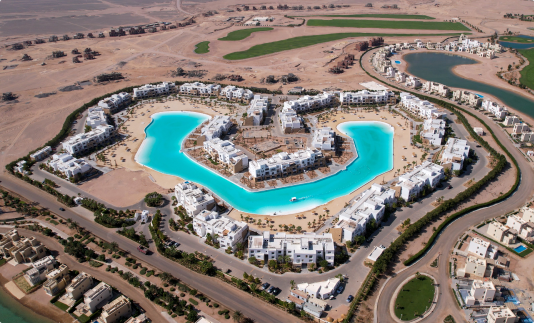
Eagle Hills takes on Abu Dhabi’s Lulu Island revamp

One of Abu Dhabi’s largely untouched islands is finally getting a makeover: Eagle Hills Properties — Emaar Properties founder Mohamed Alabbar’s other private real estate venture — has confirmed that it is leading the development of Lulu Island, a man-made island roughly 500 meters off the Corniche, The National reports. The island was initially built in the 1990s as a breakwater and is now only accessible by boat.

Background: Lulu Island isn't the only underused island in Abu Dhabi's development pipeline. We reported in May that Abu Dhabi developer Aldar is planning to revamp Fahid Island as part of a roughly 20 mn sqm development pipeline across the capital. Together, the two projects form a part of long-term urban expansion plans that include opening up land that has largely sat underdeveloped for decades.

Solar meets desalination

UAE-based renewable energy developer Amea Power is in talks with Egypt’s Housing Ministry on potential investments in solar-powered water infrastructure and desalination plants, according to a ministry statement. The talks focused on using solar plants to power drinking-water and wastewater-treatment facilities, as well as road infrastructure in new cities. No specific projects, investment tickets, or timelines were announced.

There’s a localization angle, too: The talks also covered locally manufacturing equipment and components for desalination plants, part of a broader government push for local content.

REMEMBER- Egypt's government was in advanced talks with Amea Power to develop three seawater desalination facilities with a combined capacity of up to 300k cbm per day. Two would sit on the Mediterranean coast and one on the Red Sea, with Amea expected to fund, design, build, and operate them.

Why it matters: This is another data point in Amea Power's build-out across the region's water-energy nexus, adding Egypt to a footprint that already spans solar, wind, and green hydrogen plays. Desalination and wastewater treatment are power-hungry, so bundling water infrastructure with dedicated solar generation is increasingly how developers like Amea structure these projects — the water contract comes with a built-in power project attached, widening the addressable prospect beyond generation alone.

Know your rights (issues)

Abu Dhabi Islamic Bank’s (ADIB) board of directors has signed off on a proposal to raise AED 1.75 bn via a rights issue, state news agency Wam reports. The move is subject to approval from shareholders and the Central Bank of the UAE.

A breakdown: The rights issue will consist of 106.4 mn new ordinary shares at an issue price of AED 16.45 a pop, representing a reduction of around 28.8% compared to the bank’s closing share price of AED 23.10 on the ADX last Monday. Shareholders are eligible to purchase roughly one new share per 34.14 existing shares owned.

PSA

Finnair is the latest airline to cancel flights to Dubai for the year. The company suspended its Helsinki-Dubai flights for the 2026-2027 winter season, running from 25 October 2026 through 27 March 2027, citing the unstable situation in the Middle East, according to an update on its website.

It’s not alone: Air Canada and Virgin Atlantic also won’t return to Dubai until 2027, and Dubai Airports CEO Paul Griffiths has said many foreign-based airlines have struggled to secure ins. allowing them to return to the region. The extended caution suggests insurers and long-haul carriers still see regional risk as unresolved, even as Gulf schedules elsewhere edge back to normal.

WEATHER- The mercury rises to 45°C in Abu Dhabi before cooling to 32°C, while Dubai is set for a high of 43°C and a low of 34°C, according to our favorite weather app.

The EnterpriseAM Egypt Forum is back — and we’re devoting the full day to the singular set of questions on everyone’s mind: What does AI actually mean for your company, your people, your economy, your own job — and your kids’ future?

Every session on stage answers one question: “So, what do I actually do about it?”

Join us on 5 October in Cairo. Seats are limited and attendance is by invitation only.

Request your invitation here.

The big story abroad

Taking top billing today are Canada’s retaliatory tariffs on US goods, featuring levies of up to 50% on USD 20 bn worth of imports from its southern neighbor. Effective 8 September, the tariffs target steel, dairy, and agricultural equipment and match Washington’s rates on Canadian goods.

In other geopolitical news: The Kurdish-led Syrian Democratic Forces have been dissolved as their fighters integrate into the Syrian military, the group’s leader Mazloum Abdi said. With US backing, the group helped combat the Islamic State and previously controlled parts ​of the country. The move signals a key breakthrough in President Ahmed Al Sharaa’s efforts to unite Syria’s factions.

Meanwhile, in the tech world: SpaceX aims to build a USD 100 bn spaceport in Louisiana, spanning 125k acres and marking the company’s second private launch site. SpaceX plans to begin building the base next year, targeting its initial rocket launches for 2029.

Speaking of tech, Anthropic is expected to inform investors that its total addressable market exceeds USD 30 tn, surpassing the USD 28.5 tn projection set by Elon Musk’s rocketmaker. The startup’s figure accounts for the full scope of its work that could be accomplished by AI models, and calculates the gains available if a product or service achieves 100% market share.

***

You’re reading EnterpriseAM UAE, your essential daily roundup of business, economics, and must-read news about the UAE, delivered straight to your inbox. We’re out Monday through Friday by 7am UAE time.

EnterpriseAM UAE is available without charge thanks to the generous support of our friends at Mashreq and Hassan Allam Properties.

Were you forwarded this email? Tap or click here to get your own copy of EnterpriseAM UAE.

Want to send us a story idea, request coverage, ask for a correction, or otherwise get in touch? Reach out to us on [email protected].

DID YOU KNOW that we also cover Egypt, Saudi Arabia, and the MENA logistics industry?

***

Check out our full calendar on the web for a comprehensive listing of upcoming news events, national holidays and news triggers.
This publication is proudly sponsored by

Rise every day
From OUR FAMILY to YOURS
2

THE BIG STORY TODAY

UAE corporate bond spreads are wider than at the peak of the war

UAE bond spreads are still nearly double what they were in January, with Abu Dhabi 10-year USD sovereign bonds’ yield spread at 48 bps as of 21 August against 27 bps in January, and the corporate USD curve spread over US Treasuries reaching 115 bps against 79 bps in January, Fitch Ratings said in a new report shared with EnterpriseAM. The corporate spread is even wider than in March, when it was at 108 bps.

Abu Dhabi's 10-year yield is still the second-lowest in the Gulf, rising to about 5.2% by 21 August, after Qatar's 5% — up from roughly 4.5% in January.

Not everyone reads the widening the same way. Franklin Templeton’s Mohieddine Kronfol recently said that Gulf spread widening this year is a US Treasury story — rising Treasury yields pulling capital toward safe US paper and squeezing EM spreads generally — rather than a repricing of Gulf credit risk over war or geopolitics. He added that credit risk in Gulf debt markets remains within the same band it's held for five years. Fitch, however, attributes the sovereign and corporate widening to geopolitical risk premiums.

The Treasury backdrop: The 10-year Treasury yield hit a 20-month high of 4.75% last week before easing to around 4.64%; the 30-year touched a 19-year high above 5.34% before the Treasury doubled its long-bond buyback program to calm the selloff. Two-thirds of respondents in a Bloomberg Markets Pulse survey expect the 10-year to breach 5% before year-end — territory unseen since 2007.

Issuances rose in 1H despite everything…

The spread widening comes against a backdrop of surging issuance. Total USD debt issuance hit USD 24 bn in 1H 2026, up 40% from 2H 2025, almost entirely on the back of bonds: USD bond issuance jumped 108% half-on-half and came in ahead of all of 2025's total, with sovereigns, banks, and corporates all participating.

USD sukuk issuance, by contrast, fell 48% — Fitch points to the added structuring complexity and the longer time-to-market for sukuk relative to plain bonds as issuers rushed to lock in funding during limited windows.

The UAE's DCM grew a modest 3% y-o-y to about USD 320 bn outstanding at the end of 1H 2026, with USD debt making up more than 70% of the total and sukuk accounting for 21%. ESG debt held a 12% share of USD debt outstanding, and ESG issuance was up 16% y-o-y to over USD 3.3 bn. The UAE was the fourth-largest EM (ex-China) USD debt issuer in 1H 2026, with an 8% share, and remains the second-largest DCM in the GCC after Saudi Arabia.

… but not so much for AED issuance

Total AED debt issuance came to USD 40 bn in 1H 2026, down about 20% from 2H 2025. It remains dominated by central bank M-Bills and Finance Ministry Treasury sukuk and bonds — corporate and bank dirham issuance remains rare.

The federal government plans to issue AED 45 bn in local-currency debt in 1H 2026 to help build out the UAE's yield curve and to lengthen Treasury sukuk maturities out to seven years, with room to extend further. Abu Dhabi's own local-currency issuance plans remain on hold.

Retail and digital instruments are multiplying regardless: The Finance Ministry kicked off retail sukuk with an AED 100 mn sale in June, after doubling the initial size of the issuance on high demand, with another AED 50 mn planned for September. Meanwhile, Emirates NBD issued the UAE's first digitally native AED notes.

What’s next: moderate growth through 2H 2026 and into 2027

Fitch expects the UAE’s debt capital markets to keep expanding at a moderate pace through 2H 2026 and into 2027, as diversification funding needs grow. Consolidated UAE government debt is forecast to climb to 25% of GDP in 2026, up from 22.7% in 2025, with banks and corporates expected to keep tapping markets opportunistically alongside sovereigns.

Abu Dhabi is expected to raise new external debt to shore up buffers during this stretch of uncertainty rather than draw down its foreign asset base. The emirate has already raised some USD 5.5 bn, with USD 3 bn raised before the war from a dual-tranche issuance and USD 2.5 bn raised through debt reopenings.

Dubai’s debt load, meanwhile, is expected to stay roughly flat as it refinances maturing obligations, while Sharjah will borrow to cover deficits. Fitch projects that Abu Dhabi will account for about half of total UAE government debt in 2026, with Dubai making up 19%.

The path forward hinges on regional stability: A calmer backdrop could open the door to more favorable funding conditions, while a re-escalation of the US-Iran war, oil-price swings, or renewed rate volatility could all weigh on growth.

3

ENERGY

Masdar scraps green hydrogen project

Masdar pulls the plug on flagship green steel project: Abu Dhabi's clean energy giant has scrapped plans to build a 100 MW green hydrogen electrolyzer for Emsteel, sources told Meed. Masdar notified bidders of the cancellation earlier this month — weeks after asking them to hold offers open through the end of summer for more time to evaluate bids.

The scrapped project would have scaled up an existing pilot: Emsteel's only hydrogen-fed green steel today still comes from a 2.1-MW pilot plant inaugurated with Masdar in 2024, which remains operational.

The move comes as part of a broader retreat from green hydrogen: Masdar pushed its target of 1 mn tons of green hydrogen a year past 2030 back in October 2024, citing cost and demand headwinds across the industry. Then, last August, CEO Mohamed Jameel Al Ramahi said that global demand for green hydrogen lagged far behind expectations, prompting Masdar to redirect 6 GW of solar capacity from a USD 6 bn desert solar buildout — originally earmarked for a 350k-ton green ammonia project — toward AI data centers.

4

INVESTMENT WATCH

Sawiris-backed firm anchors Swvl’s USD 13 mn strategic raise

Nasdaq-listed, Dubai-based mobility startup Swvl Holdings has entered into a definitive agreement for a USD 13 mn private placement priced at the market under Nasdaq rules, according to a press release. The round is led by Coefficient LP, a Houston-based investment firm backed by Egypt's Sawiris family, which is putting in USD 10 mn and will become Swvl's largest institutional shareholder upon closing. An existing shareholder is contributing the remaining USD 3 mn.

The details: Swvl will issue just under 9 mn Class A shares at USD 1.446 apiece, with the investment expected to close on 27 August. Coefficient Founder and Managing Partner Abdalla Ali will join Swvl's board as part of the agreement.

Proceeds are earmarked for three things: accelerating Swvl's US expansion, launching a new lending offering for transport operators and partners, and strengthening the company's balance sheet.

Why this matters: This is a strategic vote of confidence from a well-capitalized regional family office at a time when Swvl is trying to convince the market — and Nasdaq — that its turnaround is durable. The company's shares jumped roughly 50% on the news, a reaction that reflects both the fresh capital and the signal that a serious institutional investor is willing to take a large, concentrated position in the firm.

The raise builds on real operating momentum. Swvl swung to profitability in FY 2025, posting USD 1.3 mn in net income on 41% revenue growth to USD 24.2 mn. That momentum carried into 2026: 1Q revenue rose 68% y-o-y to USD 8.2 mn, GCC revenue more than doubled, and the operating loss narrowed 71% to USD 0.2 mn — putting the company within sight of breakeven.

Worth watching: Swvl has flirted with Nasdaq delisting risk before — its market cap has sat well below the exchange's USD 35 mn minimum threshold, though it has stayed compliant via the alternative net income and shareholders' equity standards. A capital raise that boosts shareholders' equity and signals renewed investor confidence could further insulate the company from that risk, even if it doesn't eliminate the underlying market-cap gap.

5

MOVES

Swiss bank EFG International taps Ranjit Khanna as Dubai CEO

Swiss private bank EFG International appointed Ranjit Khanna (LinkedIn) as CEO of its Dubai advisory office, effective immediately, according to a statement. Khanna will lead the growth of EFG's Dubai office, reporting to head of Continental Europe and Middle East Patrick Ramsey (LinkedIn).

Khanna joins from Bank of Singapore, where he led its private banking business for Europe and the Middle East out of Dubai. He has also held senior positions at Swiss and international financial institutions across Asia and the Middle East.

6

ALSO ON OUR RADAR

Adnoc L&S continues vessel-buying spree + Stellaria raises USD 6.8 mn

Adnoc L&S beefs up its fleet, again

Adnoc L&S orders two more LNG carriers, pushing its fleet to 24 vessels: Adnoc Logistics & Services has exercised options for two additional next-generation LNG carriers from Jiangnan Shipyard in Shanghai for USD 444 mn, the company said in a disclosure (pdf). Each vessel has a capacity of 175k cbm, with delivery slated for 2029.

Adnoc order rounds out record few weeks of fleet expansion: With this latest commitment, Adnoc L&S has now announced roughly USD 2.7 bn in vessel acquisitions and newbuild orders in 2026 alone. Half of that was locked in over the past few weeks, with the company adding 11 large carriers — five very large gas carriers (VLGCs) and six very large crude carriers (VLCCs) — for around USD 1.3 bn.

Why it matters: Disruptions in the Red Sea and Hormuz have tightened tanker availability — pushing Adnoc to charter around 15 crude carriers to maintain shuttle movements and customer deliveries. Adnoc has also offered cargoes from Fujairah, Zirku Island, and Das Island, and through ship-to-ship transfers at Fujairah and Sohar, giving buyers more ways to lift barrels despite disruptions around Hormuz.

Its LNG carrier fleet now stands at 24 vessels — four legacy ships, six next-generation carriers delivered since 4Q 2024, and 14 more under construction.

Stellaria raises AED 25 mn to scale geospatial AI

UAE-based AI and geospatial intelligence company Stellaria has raised AED 25 mn (USD 6.8 mn) in seed funding from angel investors, valuing the startup at AED 420 mn, according to a press release. The company uses AI to turn satellite and geospatial data into intelligence for areas including maritime activity and environmental monitoring. The funding will help Stellaria scale its team and expand across the UAE and into international markets.

BACKGROUND- The company was formerly known as Farmin and is an alumnus of the Mohammed Bin Rashid Innovation Fund's Innovation Accelerator Program. It recently rebranded as Stellaria and was also building out its product line ahead of this raise. In June, the company launched an AI model called Meruem, aimed at improving satellite imagery quality across optical, SAR, and hyperspectral sensors through super-resolution — part of a broader industry shift toward extracting more value from existing satellite data rather than launching new sensors.

7

PLANET FINANCE

Abu Dhabi just took a third of a USD 24 bn LNG project 5k km from home

Abu Dhabi-backed Argentinian LNG project gets bumper financing package: JPMorgan and Banco Santander are leading a USD 14-15 bn financing package for Argentina LNG, a project in which Abu Dhabi’s XRG — Adnoc’s international investment arm — took a roughly one-third equity stake in June, Bloomberg reported Monday. A final investment decision is targeted for late November.

That makes it one of the largest project-finance packages assembled for a Latin American energy venture — and Abu Dhabi’s involvement is likely playing a role. Syndicates rarely commit at that scale to a single EM LNG venture without a credible anchor equity partner absorbing early-stage risk — and XRG’s one-third stake is the most obvious candidate for that role here.

About the project: The USD 24 bn project, set to become one of the world’s largest floating LNG facilities, will liquefy and export Argentine shale gas to Asian markets, with state-run YPF in the lead with a 36% stake, and Eni holding the final third stake.

The Asian offtake positioning is the signal. Japanese banks are structural players in the financing round, not by accident. XRG serves as the gateway to Asian markets that Argentine LNG needs to reach — the natural destination given the distance and logistics disadvantage against US Gulf Coast supply. The 12 mn tonnes per year of contracted capacity is being positioned to serve the same Japanese, Korean, and increasingly Chinese customers that historically anchored the Qatari LNG book. Abu Dhabi is buying optionality on the geography of the next decade of Asian gas demand.

The financing itself carries a signal about global project finance in the Warsh Fed environment. USD 15 bn of syndicated debt for an EM LNG venture is being arranged at a moment when the 30-year US Treasury sits near 19-year highs, when EM sovereign eurobond windows are effectively shut for distressed borrowers, and when Treasury Secretary Scott Bessent’s fiscal intervention was rejected by the market inside 48 hours. The message: physical infrastructure with contracted Asian offtake and Gulf sovereign equity anchoring gets financed. Sovereign paper without those anchors does not.

That’s what makes the GCC angle worth re-underlining here. XRG isn’t a passive LP in someone else’s project — it is a co-anchor of a USD 24 bn asset explicitly designed to serve Asia, sitting outside the Middle East risk premium that has driven Qatari and Emirati LNG pricing for the past six months. The Aramco chokepoint premium reported in May argued that redundant infrastructure inside the region got repriced upward on Hormuz war risk. Argentina LNG is the same logic run outward. Gulf sovereign capital is now underwriting physical LNG capacity that hedges Gulf sovereign supply.

The precedent matters for what comes next in Gulf sovereign capital deployment. PIF’s 1Q pivot to four US-listed positions and its cut of international allocations from 30% to 20% were widely read as a defensive retreat. XRG’s Argentina LNG positioning suggests something different is happening in parallel: Gulf sovereign capital is not reducing international deployment overall, it is reallocating from US mega-cap equities toward physical infrastructure with strategic value that can be operated for decades.

Bottom line: Read this financing story as the clearest single data point in 2026 that Abu Dhabi’s sovereign capital is executing a strategy to be the counterparty of choice for global LNG buildouts that hedge against Middle East supply risk — including its own. The next question is who follows XRG into similar deals, and how quickly.

(** Tap or click the headline above to read this story with all of the links to our background as well as external sources.)

MARKETS THIS MORNING-

Asian markets are mixed in early trading, with Japan’s Nikkei down 0.4% loss and South Korea’s Kospi remaining flat amid uncertainty over the US-Iran war and its economic fallout.

ADX

10,070

+0.2% (YTD: +0.8%)

DFM

5,835

-0.5% (YTD: -3.5%)

Nasdaq Dubai UAE20

4,835

-0.4% (YTD: -1.1%)

USD : AED CBUAE

Buy 3.67

Sell 3.67

EIBOR

3.5% o/n

4.3% 1 yr

TASI

11,232

+0.5% (YTD: +7.1%)

EGX30

55,277

+0.2% (YTD: +32.2%)

S&P 500

7,677

+0.3% (YTD: +11.9%)

FTSE 100

10,886

+0.3% (YTD: +9.6%)

Euro Stoxx 50

6,456

+0.1% (YTD: +11.4%)

Brent crude

USD 88.58

-3.9%

Natural gas (Nymex)

USD 2.79

+0.7%

Gold

USD 4,720

+0.5%

BTC

USD 78,635

-0.2% (YTD: -10.3%)

Lunate JP Morgan UAE Bond UCITS ETF

AED 3.62

+1.1% (YTD: -4.0%)

S&P MENA Bond & Sukuk

150.93

+0.2% (YTD: -0.6%)

VIX (Volatility Index)

15.45

-2.5% (YTD: +3.3%)

THE CLOSING BELL-

The ADX rose 0.2% yesterday on turnover of AED 1.1 bn. The index is up 0.8% YTD.

In the green: Sharjah Cement and Industrial Development (+14.5%), Invest Bank (+6.5%), and Gulf Cement (+6.4%).

In the red: Rapco Investment (-5%), Oman & Emirates Investment Holding Co (-4.9%), and Al Buhaira National Insurance Company (-4.8%).

Over on the DFM, the index fell 0.5% on turnover of AED 1.1 bn. Meanwhile, Nasdaq Dubai fell 0.4%.


SEPTEMBER

1-3 September (Tuesday-Thursday): Middle East Energy, Dubai World Trade Center, Dubai.

7-9 September (Monday-Wednesday): AIM Congress, Dubai World Trade Center.

7-9 September (Monday-Wednesday): International Property Show, Dubai World Trade Center, Dubai.

12-13 September (Saturday-Sunday): Emirates International Congress on AI & Visionary Leadership in Transforming Healthcare, Adnec Center Abu Dhabi.

14-17 September (Monday-Thursday): Arabian Travel Market, Dubai World Trade Center, Dubai.

15-16 September (Tuesday-Wednesday): Federal Open Market Committee (FOMC) meeting.

17-19 September (Thursday-Saturday): International Real Estate & Investment Show (IREIS), Adnec, Abu Dhabi.

18-19 September (Friday-Saturday): EuroLeague Basketball SuperCup, Etihad Arena, Yas Island, Abu Dhabi.

29-30 September (Tuesday-Wednesday): AFCM Annual Conference, Abu Dhabi.

OCTOBER

1-2 October (Thursday-Friday): MEIRA Annual Conference, Atlantis the Royal, Dubai.

4-10 October (Sunday-Saturday): World Space Week, Abu Dhabi.

5-7 October (Monday-Wednesday): AI Everything Global, Adnec Center, Abu Dhabi.

12-14 October (Monday-Wednesday): Airport Show, Dubai World Trade Center, Dubai.

14-15 October (Wednesday-Thursday): Sharjah Investment Forum, Jawaher Reception and Convention Center, Sharjah.

13-15 October (Tuesday-Thursday): Annual Meeting of Global Future Leaders, Dubai.

20-22 October (Tuesday-Thursday): Future Health Summit, Adnec Center Abu Dhabi.

21 October (Wednesday): Reuters NEXT Gulf, St. Regis Saadiyat Island Resort, Abu Dhabi.

27-28 October (Tuesday-Wednesday): Arab Competition Forum, Dubai.

27-28 October (Tuesday-Wednesday): Federal Open Market Committee (FOMC) meeting.

30 October (Friday): Large businesses achieving annual revenues equal to or above AED 50 mn must appoint an accredited service provider for e-invoicing implementation.

Signposted to happen sometime in October 2026:

  • Abu Dhabi Space Week, Abu Dhabi.

NOVEMBER

2-6 November (Monday-Friday): Dubai Future Finance Week, Dubai.

4 November (Wednesday): Digital Transformation Summit, Sofitel, Abu Dhabi.

9-10 November (Monday-Tuesday): Annual government meetings, Abu Dhabi.

9-12 November (Monday-Thursday): EMEA Council on Hotel, Restaurant and Institutional Education Conference, Dubai College of Tourism, Dubai.

10-12 November (Tuesday-Thursday): Dubai International Electric Vehicle Exhibition & Conference, Dubai World Trade Center.

16-18 November (Monday-Wednesday): World Police Summit, Dubai World Trade Center, Dubai.

18-19 November (Wednesday-Thursday): Touchdown Middle East 2026, Conrad Abu Dhabi Etihad Towers, Abu Dhabi.

25-26 November (Saturday-Sunday): Doers Summit, Dubai Silicon Oasis, Dubai.

DECEMBER

2-4 December (Wednesday-Friday): UN Water Conference, UAE.

4-6 December (Friday-Sunday): Formula 1 Abu Dhabi Grand Prix, Abu Dhabi.

8-9 December (Tuesday-Wednesday): Capital Market Summit, Madinat Jumeirah, Dubai.

8-9 December (Tuesday-Wednesday): Federal Open Market Committee (FOMC) meeting.

7-10 December (Monday-Thursday): Abu Dhabi Finance Week, Al Maryah Island, Abu Dhabi.

8-10 December (Tuesday-Thursday): Abu Dhabi Water & Power Week, Adnec Center, Abu Dhabi.

8-10 December (Tuesday-Thursday) Middle East & North Africa Business Aviation Association Show, DWC, Dubai Airshow Site.

Signposted to happen sometime in 2027:

  • 1 January: Deadline for large businesses to implement e-invoicing;
  • 1Q 2027: Completion of the first phase of Hassyan seawater desalination project;
  • 1-3 February (Monday-Wednesday): World Governments Summit;
  • 31 March: Small businesses with annual revenues of less than AED 50 mn are obliged to contract with an accredited service provider for e-invoicing implementation;
  • 31 March: Government entities are required to appoint an accredited service provider for e-invoicing implementation;
  • 21-22 April (Wednesday-Thursday): Token2049, Dubai;
  • 1 July: Deadline for small businesses to implement e-invoicing;
  • 1 October: Deadline for governments to implement e-invoicing;
  • Abu Dhabi’s solar and battery energy facility, combining 5.2 GW of solar capacity and 19 GWh of battery storage, is set for commissioning.

Signposted to happen sometime in 2028:

Signposted to happen sometime in 2029:

  • Sibos 2029 organized by the Society for Worldwide Interbank Financial Telecommunication (SWIFT), Dubai;
  • Annual Meetings of the World Bank Group and the International Monetary Fund, Abu Dhabi;
  • The commissioning of the seventh phase of Mohammed bin Rashid Al Maktoum Solar Park.
Now Playing
Now Playing
00:00
00:00