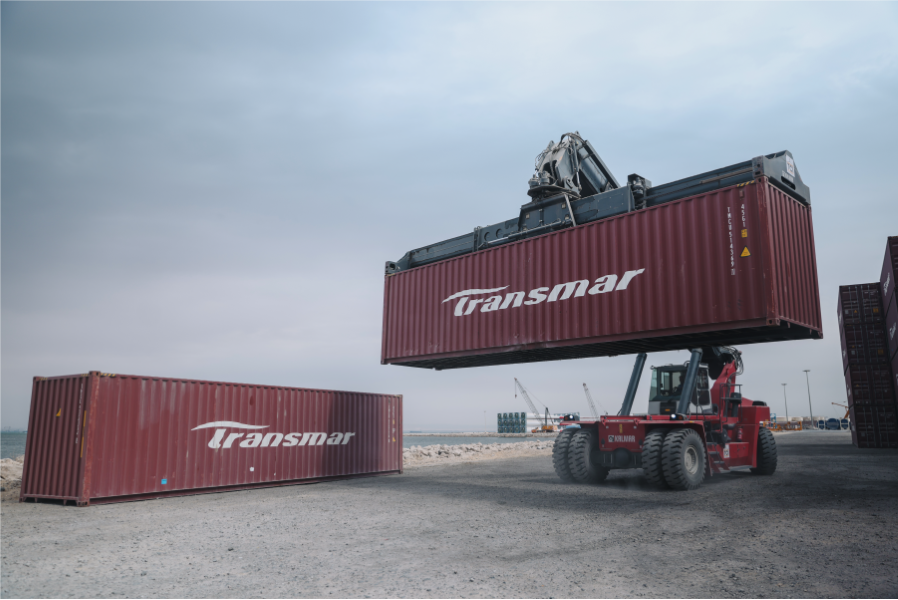
The war is pushing UAE-bound boxes to the east coast, and Khorfakkan is doubling capacity to catch them

1

WHAT WE’RE TRACKING TODAY

TODAY: Hormuz pushes UAE boxes to Khorfakkan + Tokyo to fund Doha’s Dreamliners

Good morning, ladies and gents, and happy Monday. We have a packed issue to start the week.

The weekend was anything but quiet for the oil market. Brent closed Friday at USD 109.86 / bbl, its highest in five months, after Saudi-led forces reported destroying ballistic missiles fired at the Kingdom’s energy hubs, the Financial Times reports. Attacks on ships in Hormuz have also picked up. “We are nowhere near normal in the Middle East,” says RBC’s Helima Croft. Prices eased this morning after Washington waived sanctions on Russia.

Saudi crude exports are back above pre-war levels, and Bahri is lining up more Saudi-built ships.

Our big story is on the other side of the peninsula. Gulftainer is spending USD 2 bn to double Khorfakkan to 10 mn TEUs and catch the boxes shipowners won’t send into Hormuz. Jebel Ali still has four decades of freezone on its side.

Crude comeback

Saudi crude exports have climbed back to above pre-war levels as the East-West pipeline recovers and tankers return to Bab Al Mandab. Exports averaged 8.1 mn bbl / d in the first half of October, exceeding the 7.2 mn bbl / d for February, according to TankerTrackers. The pipeline, shut after a drone attack in September, is back to about 5.8 mn bbl / d of its 7 mn bbl / d capacity.

Bab Al Mandab is carrying about half of its pre-escalation Saudi volume. Six Saudi tankers crossed the strait in the first 12 days of October. That puts flows at around 1.5 mn bbl / d, against 3 mn bbl / d before the Houthi escalation, Asharq Business reports. Saudi-backed Yemeni government forces retook the coast along the strait, including Dhubab, earlier this month. Yanbu loaded around 2.47 mn bbl / d in early October. Cargoes that don’t head south can move north through the Suez Canal or Egypt’s Sumed pipeline, which can carry 2.5 mn bbl / d to the Mediterranean.

Costlier shipping could force Riyadh to lower prices. Higher fuel use and tight tanker availability are pushing up shipping costs, market analyst and Sandstone Group CEO Stuart Turley tells EnterpriseAM. “[Saudi Arabia] will be forced to [mark down] their oil to offset the higher tanker fees. But it will be better to get an order for cashflow, than hold out for market prices.”

What’s next: The Kingdom is exploring additional overland routes to Europe and aims to increase pipeline export capacity to 10 mn bbl / d. Kuwait is in talks to join a proposed Saudi line to the Red Sea.

Full tilt

The UAE pumped a record 5.3 mn bbl / d in September, up 400k bbl / d from August as it kept barrels moving despite the Hormuz squeeze, according to IEA figures cited by Bloomberg. Crude production topped 4.4 mn bbl / d. That’s close to maximum capacity and beats the crude record set in June.

Leaving Opec gave the UAE the room to pump: The UAE’s exit from Opec earlier this year removed production restrictions that had frustrated Abu Dhabi for years.

Getting the oil out did the other half of the job: The Adcop pipeline carries roughly 1.8 mn bbl / d to Fujairah, outside the strait. For barrels loaded inside the Gulf, the UAE has been among the region’s most successful producers in keeping shipments moving. Shuttle tankers carried crude to transfer points off Fujairah, where buyers’ ships collect it without entering Hormuz.

Some of September’s supply came out of storage. The UAE drew down observable above-ground inventories by more than 270k bbl / d in September, taking them to an all-time low, the IEA says. That leaves a thinner buffer against further disruption.

Made in KSA

Bahri plans a second IMI order next year: Saudi Arabia’s National Shipping Company (Bahri) will place a second order with the Saudi shipbuilder International Maritime Industries (IMI) in 2027, CEO Ahmed Subaey told Asharq Business without giving the order's size or value. Bahri is also moving to own LR1 and LR2 product carriers and is eyeing new segments, including Suezmax and Aframax crude tankers, and other gas types beyond LPG and ammonia, through its partnership with Petredec. The company will also add two vessels by year-end, taking its fleet to 109 from 82 four years ago.

IMI’s yard will build most of the new ships: Bahri has a 10-year agreement with IMI, in which it holds a near 20% stake, covering 53 vessels, and has committed to building most of its new ships at the yard, Subaey said. The first order, a SAR 762 mn contract with IMI for six dry bulk carriers, is for delivery between 2028 and 2029.

REMEMBER- Bahri has been riding the tanker boom: The company’s net income surged 574% y-o-y to nearly SAR 2.8 bn in 2Q 2026, while revenue jumped 156% to SAR 6.3 bn on higher freight rates and Bahri chartering in more tankers to meet customer demand.

Market watch

Oil prices slipped this morning after US President Donald Trump waived sanctions and tariffs on Russia, Reuters reports. Brent crude futures fell USD 1.94 to USD 107.92 / bbl by 02:27 GMT, while West Texas Intermediate (WTI) was down 83 cents to USD 100.58 / bbl.


The Baltic Index extends its slide: The Baltic Exchange's dry bulk freight index — which tracks rates for ships carrying dry bulk commodities — fell about 1.3% to 2,515 points on Friday. The capesize index declined 2.2% to 3,249 points, while the panamax index fell 1.8% to 2,314 points. The smaller supramax segment gained 0.5% to 1,865 points.


The Drewry World Container Index rebounded 3% to USD 4,485 per 40-ft container last week, according to the latest index readings. Transpacific rates were mixed, with Shanghai-Los Angeles up 3% and Shanghai-New York down 1%, while Shanghai-Rotterdam rose 6% and Shanghai-Genoa 7%. Carriers are pushing Asia-Europe FAK rates to USD 4.5-4.8k from 19 October. Drewry says the hike is uncertain because resumed Suez transits and fewer blank sailings are adding capacity.

***

YOU’RE READING EnterpriseAM Logistics, the essential MENA publication for senior execs who care about the industry that connects producers and retailers to global markets. We’re out Monday through Thursday by 10:15am in Cairo and Riyadh, and 11:15am in the UAE.

EnterpriseAM Logistics is available without charge thanks to the generous support of our friends at Hassan Allam Utilities and Transmar.

Were you forwarded this email? Tap or click here to get your own copy of EnterpriseAM Logistics.

Want to send us a story idea, request coverage, ask for a correction, or otherwise get in touch? Reach out to us on [email protected].

DID YOU KNOW that we also cover Egypt, Saudi Arabia, and the UAE? ***

This publication is proudly sponsored by

2

Ports

The war is pushing Gulf container trade to ports outside Hormuz, and Khorfakkan is doubling capacity to catch it

The war is redrawing the Gulf’s container map, and ports just outside Hormuz are expanding to capture diverted cargo. Most shipowners won’t risk their vessels getting stuck behind the strait, so boxes bound for the UAE and northern Oman are landing on the UAE’s east coast and at Oman’s Sohar instead. The biggest wager so far is Khorfakkan, Gulftainer’s flagship terminal and the UAE’s largest container port outside Hormuz. It’s set for a USD 2 bn expansion that will double its capacity to 10 mn TEUs, alongside 2-3 mn TEUs of inland logistics capacity.

That flips a pecking order that held for decades. The east coast has long operated in the shadow of Jebel Ali’s 14 mn TEU hub. “This [expansion] has been on our radar since last year, but recent disruptions accelerated our plans,” Farid Belbouab, Group CEO of Gulftainer, tells EnterpriseAM in an exclusive interview. “2026 became the inflection point where Khorfakkan evolved from a transshipment hub into a key gateway on the UAE’s East Coast.”

Belbouab says the build-out will follow demand. “The expansion of Khorfakkan to 10 mn TEUs is not about building capacity overnight; it is about building an ecosystem aligned with demand,” he says. Phase 1 takes the terminal to 5 mn TEUs, with modular expansion to 10 mn+ TEUs “in the next few years,” underpinned by what he calls structural shifts in trade.

A port that lost its clients is back in business

Khorfakkan spent the 2010s losing ground to its bigger neighbors. It lost “its anchor clients during the 2010s both to Jebel Ali and the fast-growing Khalifa Port,” Eirik Hooper, senior associate at maritime consultancy Drewry and a former DP World executive, tells us. Since the war began, Gulftainer has revived the underused terminal and adapted it to stand in as the UAE’s primary gateway.

Turning a transshipment hub into a gateway meant building a landside. Khorfakkan was built to move boxes from ship to ship, not from ship to truck. Its original transshipment capacity was estimated at 5 mn TEUs, but its practical gateway capacity was closer to 3-3.5 mn TEUs, Hooper says. After Gulftainer built a landside gate complex, weekly throughput rose about 700%, from about 8k TEUs to 65k TEUs, which is the terminal’s current limit. Capacity is expected to reach 5 mn TEUs by the end of the month, allowing weekly throughput of around 100k TEUs.

The real build-out is inland

Gulftainer says it planned for this. In 2025, it launched the UAE’s largest bonded dry port in Sajaa, 90 km from Khorfakkan. Cargo is sealed at the port and cleared at the customer’s doorstep in Sajaa. “This shifts Khorfakkan from a sea-to-sea hub to a sea-to-door gateway,” Belbouab says.

A second inland hub will plug the port into the rail network. The Al Dhaid Multi-Modal Logistics Hub and Freezone, 60 km from the port, will cover 150 hectares and handle 1.5 mn TEUs a year. It is designed to tie Khorfakkan physically into the Etihad Rail network and is being developed as a public-private partnership with the Sharjah Ports, Customs, and Freezones Authority.

The pitch to shippers is a single corridor from ship to warehouse. The plan is “10 mn+ TEUs at sea, supported by 2.3 mn TEUs of inland capacity across Sajaa and Al Dhaid, including 1.5 mn sqm of logistics park,” Belbouab says. “Customers today don’t want just a plot; they want a bonded, AI-enabled corridor.” He points to the Khorfakkan-Sharjah road, the upcoming Etihad Rail link to Khorfakkan and Al Dhaid, and GT Lines’ 15-vessel fleet serving China, the Indian subcontinent, the GCC, Iraq, and East Africa. “Our trade corridors reflect our integrated platform — from ports to shipping, shipping to inland, and inland to industrial parks.”

Fujairah moves the crude, Khorfakkan takes the boxes

Fujairah is the east coast’s energy gateway. In recent months, it has become Adnoc’s primary shuttle transfer hub, letting buyers collect crude without sending tankers through Hormuz. The Adcop pipeline carries roughly 1.8 mn bbl / d to Fujairah and ran near peak nameplate capacity in the immediate aftermath of the war. Adnoc is also ramping up a second pipeline to Fujairah, targeted for 2027. The Port of Fujairah handles roughly 7.3 mn mt of marine fuel a year, placing it alongside Singapore and Rotterdam among the world’s top three bunkering hubs.

Containers are a tighter fit: AD Ports pushed more than 70k TEUs through Fujairah Terminals in a matter of weeks in May, but the terminal was never built for that role. Its last major upgrade was a USD 135 mn (AED 500 mn) investment, announced in 2021, to lift container capacity to 1 mn TEUs. “Fujairah currently has limited capacity to handle a substantial volume of container cargo diverted from ports inside the strait,” Hooper says.

The big operators are moving to close that gap:

  • DP World has reached an “agreement in principle” with Fujairah Ports Authority to develop new container and multipurpose terminals at Al Rugaylat, plus a general cargo facility in Dibba. Al Rugaylat is designed for 2.5 mn TEUs, nearly three times the capacity of Fujairah’s existing container terminal;
  • AD Ports is wiring Fujairah into Abu Dhabi’s industrial base. Its rail-linked network of dry ports and cargo depots, announced in May, connects Fujairah Terminals and Khalifa Port to Kezad’s Industry City of Abu Dhabi, meaning industrial cargo can now land on the east coast and reach Kezad without transiting Hormuz. Emirates Global Aluminium, Emsteel, Al Ghurair Iron and Steel, and Tenaris have signed on as anchor clients.

Those projects give Fujairah a much broader supply-chain role, Hooper says, “though for the container market it will be secondary to Khorfakkan.” Across the border, CMA CGM and Oman’s Asyad Group have signed a framework agreement for a USD 400 mn logistics terminal at Sohar, which has become an alternative route for Gulf trade during the war.

The long way round costs more, and shippers are paying it

Every box landed outside the strait still has to cross the mountains. Cargo landed at Khorfakkan or Fujairah has to cross the Hajar mountains by truck, or eventually by rail, to reach Dubai, Abu Dhabi and the UAE’s industrial centers. Overland rerouting costs 2.4 to 4.2 times more per ton-km, according to a study, but breach-of-warranty premiums and war-risk surcharges on a Hormuz port call now outweigh that.

The bigger deterrent is the risk of getting stuck. “The majority of shipowners cannot risk their vessels getting stuck behind the strait, even if they could afford the war risk premiums being applied for both the hull and cargo,” he says. Until there is a resolution that the ins. market believes in and shipowners trust, Khorfakkan, Fujairah and Sohar will remain the primary maritime gateways for the UAE and northern Oman. That resolution looks distant, with Iran intensifying attacks on ships in recent days.

A quick return to normal would slow Khorfakkan’s later phases. Hooper says rapid normalization and the removal of Hormuz from war-risk classifications would delay phases 2 and 3 of the expansion; “otherwise, the masterplan is likely to proceed quickly to meet demand.”

Drewry’s verdict: the east coast “can be made to work” as the gateway for UAE and northern Oman consumption. It can also serve as a transshipment platform for some Upper Gulf needs, “though certainly not all,” at a higher cost base and with some strain on existing rail and road infrastructure. Ports inside the strait will keep serving Upper Gulf trades, where Hooper expects them to stay cost-competitive against routes via Red Sea ports, which carry much longer overland legs.

Jebel Ali loses some ships but keeps its crown

Regional transshipment “won’t return to the Gulf in its pre-2026 form,” Hooper concludes. Jebel Ali “will be relegated to Gulf transhipment plus re-export, a materially smaller, though still substantial, market,” he says.

Even a smaller Jebel Ali is in a different weight class. DP World’s flagship handles roughly 14-15 mn TEUs a year against capacity of more than 19 mn TEUs, and it’s tied directly into Jafza, which hosts more than 10k businesses and accounts for nearly 36% of Dubai’s GDP. Jebel Ali “will still retain its preeminence in the region largely due to Jafza, the freezone, warehousing, industrial cluster, and cargo airport around Jebel Ali, which took four decades to build and cannot be easily replicated or relocated,” Hooper says.

That freezone is where the money sits. A port earns a handling fee once per box. A freezone cluster earns rent, services and re-export margins from the businesses that own the cargo, year after year. The war can move the ships, but it can’t easily move 10k companies. Gulftainer’s answer to Jafza is Al Dhaid, which, at 150 hectares, is starting four decades behind. The nearer-term trend is east coast ports plugging into the freezones that already exist. The inland investments by Gulftainer, DP World, AD Ports and CMA CGM “are geared toward moving cargo as efficiently as possible between the east coast ports and the existing logistics hubs at Jebel Ali and Khalifa,” Hooper adds.

Knitting rival operators into one network will take time, and it will likely bend toward Dubai. “There is no substitute for competitive pressure and time to develop a cohesive logistics system among separate commercial organizations each working toward its own goals,” Hooper says. When it does take shape, he expects it to bend toward Dubai. “The Jafza logistics cluster should remain the preeminent force in the UAE, and I expect the network will be incentivized to arrange itself to prioritize Jafza’s customers’ needs.”

3

Debt Watch

Qatar Airways taps Japanese investors for the first time to finance three Boeing 787-9s

Qatar Airways is bringing Japanese investors into its fleet financing for the first time. The carrier has signed its first Japanese Operating Lease with Call Option (JOLCO) agreement to finance three Boeing 787-9 Dreamliners, according to its press release. The agreement is the first of three planned transactions covering seven aircraft in total, but it did not disclose the financing value or lease terms.

HSBC is lending, while a Japanese lessor brings in the equity. HSBC is the sole lender and debt arranger. Japan’s JP Lease Products & Services (JLPS) is underwriting and arranging the equity for this transaction and for the two that follow.

Under a JOLCO, Japanese investors fund the jet and the airline keeps the right to buy it. The structure pairs equity from Japanese corporate investors, who get tax benefits from the arrangement, with non-recourse bank debt. That gives the airline 100% financing at lease rates JLPS describes as competitive. The airline leases the jet and holds an option to buy it at a price fixed upfront, either during the lease or at its end.

Qatar Airways has a lot of jets to pay for: It placed a USD 96 bn order with Boeing in May 2025 for 160 widebody jets, with options for another 50. It also secured a QAR 4.5 bn loan from a QNB-led banking consortium in June 2025, and a sale-and-leaseback in July, when BOC Aviation bought three Airbus A350-1000s and leased them back to the carrier.

It’s widening its funding sources from a solid base. Qatar Airways booked QAR 7.1 bn in net income in FY 2025/26, down from QAR 7.9 bn the year before, and held QAR 32.7 bn in liquid funds, money-market funds, and short-term deposits at the end of March, against QAR 42.4 bn a year earlier, according to its financial release (pdf).

Emirates has used the Japanese market for years. It raised more than AED 28 bn through JOLCO agreements between 2014 and 2019 and tapped HSBC to finance six of its A350-900 aircraft.

Asian capital is also backing Gulf aviation more broadly: Dubai Aerospace Enterprise (DAE) is seeking a seven-year, USD 2.1 bn working-capital loan, largely from Asian banks, arranged by Emirates NBD, Bank of China, OCBC, and China Construction Bank Asia.

4

E-Commerce

AlShrouq Express readies drone delivery trials as Saudi tests the economics of automated delivery

Saudi last-mile operator AlShrouq Express is in the final development stages of a drone delivery service, with trials “planned in the coming months,” the company’s chief marketing officer, Malak Jarrar, tells EnterpriseAM. Conventional delivery is mostly variable cost (labor, fuel, vehicle operation and utilization), Jarrar says, while drones and autonomous vehicles shift more of it into fixed technology and hardware. That makes volume the deciding number, since the fixed cost has to be spread across as many deliveries as possible.

AlShrouq has the volume to test the math: The company’s network covers more than 55 cities and handles over 50k deliveries a day for upward of 4k clients. It is also advancing the autonomous-vehicle work it first piloted with King Abdullah University of Science and Technology (KAUST) and National Defense University (NDU) several years ago. That pilot reached more than 60 deliveries per vehicle a day “in the right environment,” Jarrar says.

Regulation sets the pace: The General Authority of Civil Aviation (GACA) issued its first drone-delivery operating permit to Terra Drone Arabia during this year’s Hajj, limited to medicines and medical logistics. That followed a drone parcel trial for postal deliveries in September 2025, and a robot food-delivery pilot in Riyadh last year under the Transport General Authority’s sandbox. AlShrouq is “following the development of the regulatory frameworks closely” and designing its systems to deploy “subject to the required approvals,” Jarrar says.

5

Also on Our Radar

Oman won’t renew Salalah port concession, Neom and Ceva eye Europe-Gulf corridor, Humain tenders USD 1 bn data center

Salalah’s ticking clock

Oman will hand the Port of Salalah to a new operator in November 2028. The Transport Ministry ruled out extending the existing concessions held by Salalah Port Services Co., according to an MSX disclosure (pdf). The Muscat-listed company will run the port until its concessions — held since 1998 — expire on 1 November 2028. The ministry says operations and development work will continue in the meantime and that a successor will be announced later, Oman Observer reports.

The decision closes a renewal process that was still open in March. Salalah Port Services had been negotiating an extension with the government as recently as March. Maersk’s APM Terminals holds around 30% of the company and manages the port, and Oman’s Asyad Group owns another 20%.

REMEMBER- Salalah is one of the region’s biggest transshipment hubs. The port completed a USD 300 mn expansion in February 2025, lifting annual container handling capacity to 6.5 mn TEUs, with actual throughput reaching 4.3 mn TEUs last year. It also handled 511k TEUs in September, beating August’s previous high.

Neom calling

Neom and Ceva want to scale up the Europe-to-Gulf route through Egypt: Saudi Arabia’s Port of Neom and Ceva Almajdouie Logistics have signed an MoU to explore a multimodal freight corridor linking Europe, Egypt, Saudi Arabia, the wider GCC, and Iraq, according to a press release. Neom brings its Red Sea terminal, and Ceva brings its cross-border trucking fleet, customs brokerage, and bonded warehousing across container, RoPax, bulk, and project cargo. The MoU doesn’t set an investment figure, timeline, or specific routes.

REMEMBER- The route already works: European trailers have been moving through Damietta, overland to Safaga, and by ferry to Neom since late April, giving Gulf-bound shippers a way around the Hormuz disruption.

Humain tenders data center

A c. USD 1 bn data center build is up for grabs in Riyadh: PIF-backed AI infrastructure developer Humain has issued a request for proposals for an EPC contract on a 100 MW AI data center in the capital’s Al Saad district, with bids due 8 November, Meed reports. The winning contractor mobilizes in January 2027 and has 25 months to deliver two 50 MW phases on a 350.2k sqm plot. The first phase is due in October 2028 and the second in January 2029. An optional third phase would take the site to 200 MW by July 2029.

IN CONTEXT- The tender sits inside a much larger footprint. Humain is developing the infrastructure for a planned 6 GW AI campus in the same Al Saad district, where Al Yamama holds the enabling-works contract.

Powering up Constanța

DP World is spending EUR 53.8 mn (c. USD 60.2 mn) to electrify its Constanța South Container Terminal in Romania, with completion scheduled for August 2028, according to a press release. The project will wire 29 container-yard blocks for electric gantry cranes. It will also add a charging hub with 10 charging points and 10 electric terminal tractors and install two shore-power systems so docked vessels can draw renewable electricity instead of running their auxiliary engines.

REMEMBER- This is the first half of a EUR 100 mn program: DP World secured financing for the program in July. This component is backed by an EU grant of up to EUR 19.7 mn and an EBRD loan of up to EUR 25 mn, with DP World covering the rest. A further EUR 46.2 mn is earmarked for electric cargo-handling equipment.


20-22 October (Tuesday-Thursday): TOC Americas, Cartagena, Colombia.

21-22 October (Wednesday-Thursday): Global Ports Forum, Singapore.

26-29 October (Monday-Thursday): Air Cargo Forum, Miami, US.

27-29 October (Tuesday-Thursday): Routes World, Riyadh, Saudi Arabia.

NOVEMBER

2-5 November (Monday-Thursday): ADIPEC Maritime and Logistics Exhibition and Conference, Abu Dhabi, UAE.

10-11 November (Tuesday-Wednesday): TOC Asia, Singapore.

10-12 November (Tuesday-Thursday): Intermodal Europe, Rotterdam, Netherlands.

11-13 November (Wednesday-Friday): Logitrans, Istanbul, Turkey.

18-19 November (Wednesday-Thursday): Breakbulk Asia, Singapore.

FEBRUARY 2027

10-12 February (Wednesday-Friday): Routes Americas, San Juan, Puerto Rico.

MARCH 2027

16-18 March (Tuesday-Thursday): CMA Shipping, Houston, US.

16-18 March (Tuesday-Thursday): Routes Asia, New Delhi, India.

APRIL 2027

20-22 April (Tuesday-Thursday): Routes Europe, Antalya, Turkey.

26-29 April (Monday-Thursday): Transport Logistic and air cargo Europe, Munich, Germany.

26-29 April (Monday-Thursday): Saudi Smart Logistics, Riyadh, Saudi Arabia.

Now Playing
Now Playing
00:00
00:00