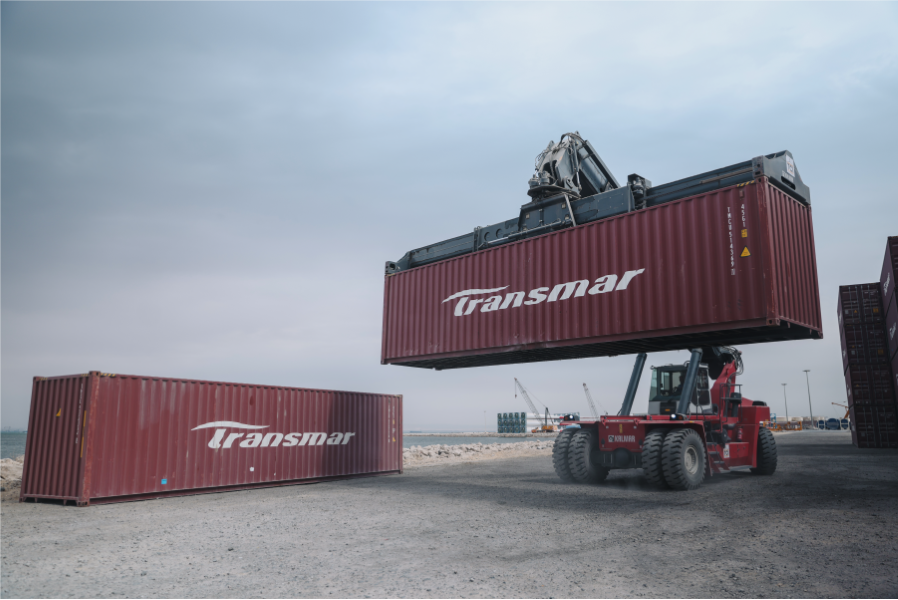
UAE warehouse tenants are staying put as rerouted cargo pulls demand toward the Northern Emirates and the east coast

1

WHAT WE’RE TRACKING TODAY

TODAY: UAE warehouse tenants stay put + OCP opens its logistics to investors

Good morning, ladies and gents. There’s plenty to get through today. Our big story looks at UAE warehouse tenants who are renewing leases rather than moving, as cargo rerouted around Hormuz pulls some demand toward the Northern Emirates and the east coast.

Riyadh’s main airport is still shut. King Khalid International Airport will stay closed until further notice. Landings and departures now need prior permission, and the restrictions have no end date, Bloomberg reports.

Also in today’s issue: Morocco is letting OCP move its phosphate logistics into two companies that can bring in investment funds. A USD 100-120 mn pipeline will carry Cypriot gas to Damietta, and a Qatari LNG cargo is taking the rare Red Sea route to Poland.

Cyprus connection

Eni and TotalEnergies are budgeting USD 100-120 mn to link Cypriot gas to Egypt’s Damietta LNG plant. The roughly 40-km onshore pipeline will run from the Zohr gas-processing facilities in Port Said to Damietta, completing the Egyptian leg of the export route for Cyprus’ offshore Cronos field, Asharq Business reports, citing an unnamed government official. Construction is set to start in early 2027 and take about 12 months from the signing of execution contracts. First Cronos gas is expected to reach Egypt in 1Q 2028, starting at about 500 mmscf / d.

Egypt has spare capacity to process and export the gas. Cronos gas will travel by subsea pipeline to Zohr’s existing facilities for processing, then overland to Damietta for liquefaction and export. Egypt has more than 2 bcf / d of spare processing capacity on the Mediterranean coast and 1.9 bcf / d of export capacity at Idku and Damietta. Cairo expects about 1.3 bcf / d of Cypriot gas from Cronos and Aphrodite by end-2028, according to the official.

Cronos is one of three Cypriot developments that Egypt has agreed to route through its infrastructure. It will buy the entirety of the 3.7 tcf Aphrodite field’s output under a 15-year agreement via a USD 2 bn pipeline Cyprus is funding in full. ExxonMobil and QatarEnergy’s Pegasus and Glaucus fields (with 7 tcf of estimated recoverable reserves) are targeting 1 bcf / d by 2030. The hub play fits Egypt’s plan to resume gas exports and lift domestic production to 6.6 bcf / d from around 3.9 bcf / d today, but the near-term goal is more modest: adding just 330 mmcf / d by year-end, mostly from Zohr and West Mina.

REMEMBER- The commercial terms are already set: Egypt signed the agreements covering transport, processing, and liquefaction of Cronos gas in October 2025, and Eni took a final investment decision on the field in July.

Red Sea run

A Qatari LNG tanker is taking the risky shortcut to Europe. The unnamed vessel, loaded in Qatar in August, is sailing north through the Red Sea and signaling Poland as its next destination, Bloomberg reports. Most ships now avoid the Red Sea and sail around Africa, which can add almost two weeks to a one-way voyage.

An LNG tanker came under fire off Yemen on Saturday. A small boat fired two rounds at an unidentified LNG tanker in the Gulf of Aden, southeast of Yemen’s Al Mukalla port, on Saturday, and the tanker’s security team returned fire, according to UK Maritime Trade Operations. Bloomberg’s tracking data suggests the Poland-bound carrier was the only LNG tanker in the area at the time. The vessel has since continued its voyage, and its identity is unconfirmed.

Why this matters: The country was Qatar’s third-largest EU customer in 2025, importing around 1.6 mn tons of Qatari LNG. Polish energy company Orlen, which holds a long-term QatarEnergy contract, has since turned to US shipments to replace disrupted Qatari supplies. The cargo is arriving into a European market holding its thinnest seasonal gas stocks in over a decade, with prices at a near four-year high, leaving buyers with less breathing room ahead of winter.

REMEMBER- Qatar’s LNG recovery is still fragile. Four LNG carriers emerged from Hormuz earlier this month in early October after largely untracked crossings. Two Ras Laffan production trains remain offline after strikes hit the complex earlier this year, removing 12.8 mtpa of capacity, while QatarEnergy continues to suspend contracted deliveries.

Flags of convenience

Egypt, Turkey, and India want to reopen the Black Sea to grain under their own flags. The three countries have proposed safe passage for vessels flying their flags into both Ukrainian and Russian ports, with Kyiv and Moscow agreeing not to strike them, President Volodymyr Zelenskyy told Bloomberg. The plan is “one ship heading to our port, and the other to Russian,” he said. Russia has refused despite repeated calls from the three intermediaries, he added, keeping Ukraine’s main grain route shut for a third month.

Egypt gets most of its wheat from Russia and Ukraine. Russia and Ukraine accounted for roughly 84% of Egypt’s wheat imports from January to August. By mid-August, other origins (including Australia and the US) were quoting USD 305-320 per ton against USD 260-280 for Black Sea cargoes.

REMEMBER- Turkey has been pushing for a reopened corridor for weeks: It was in talks with Russia and Ukraine over safe grain passage in late August. The UN-brokered Black Sea Grain Initiative moved 33 mn tons of Ukrainian grain out of the country before it ended.

Market watch

Oil prices rose this morning, with Brent near a five-month high as traders priced in risk from Houthi attacks on Saudi infrastructure and reports of attacks on vessels in the Gulf, Reuters reports. Brent crude futures climbed 55 cents to USD 110.10 / bbl by 03:19 GMT, while West Texas Intermediate (WTI) for November delivery, which expires today, was up 0.24% to USD 103.91 / bbl. The more-active December contract rose 39 cents to USD 98.93 / bbl.


The Baltic Index snaps its losing streak: The Baltic Exchange’s dry bulk index — which tracks rates for the capesize, panamax, and supramax vessel segments — rose about 1.4% to 2,546 points on Monday. The capesize index rose 3.6% to 3,365 points, while the panamax fell 1.2% to 2,286 points. The smaller supramax rose 0.2% to 1,868 points.

***

YOU’RE READING EnterpriseAM Logistics, the essential MENA publication for senior execs who care about the industry that connects producers and retailers to global markets. We’re out Monday through Thursday by 10:15am in Cairo and Riyadh, and 11:15am in the UAE.

EnterpriseAM Logistics is available without charge thanks to the generous support of our friends at Hassan Allam Utilities and Transmar.

Were you forwarded this email? Tap or click here to get your own copy of EnterpriseAM Logistics.

Want to send us a story idea, request coverage, ask for a correction, or otherwise get in touch? Reach out to us on [email protected].

DID YOU KNOW that we also cover Egypt, Saudi Arabia, and the UAE? ***

This publication is proudly sponsored by

2

STORAGE + WAREHOUSES

Rerouted cargo is pulling UAE warehouse demand toward the Northern Emirates and the east coast, while Dubai tenants stay put

Cargo rerouted around Hormuz is redrawing the UAE’s warehouse map, pulling some demand toward the Northern Emirates and the east coast while most Dubai occupiers sit tight. Warehouse renewals jumped 21.6% to a record high of about 8.2k in 1H 2026, even as rents climbed another 12.4% and new warehouse contracts fell 51.8% y-o-y, according to Cavendish Maxwell data we reported in September. Industrial and logistics requirements reached 12.3 mn sq ft, up 7% y-o-y, according to August data.

Occupiers are holding off on moving or expanding. With rents high and regional trade routes unsettled, fewer are willing to relocate, take on more space or lock into another long lease.

“The demand is still there. It’s just that it’s redistributed,” JLL Head of Industrial Advisory for MEA Abhishek Mittal tells EnterpriseAM. For some tenants, renewing makes more sense, while others are looking at locations they hadn’t considered before.

Moving is expensive, even into a cheaper unit. “Suitable space is genuinely hard to find,” CBRE MENA Associate Director for Leasing and Sales Ana Worboys tells EnterpriseAM. Add fit-out, racking, downtime and workforce disruption, and moving can easily wipe out the savings. Unless an alternative is both better and future-proofed, “extending a lease for a few years is often the more pragmatic choice.”

The war gave tenants another reason to hold off on new commitments. Some smaller retailers have temporarily routed their requirements through 3PLs and cargo aggregators instead of leasing more space directly while they reassess their supply chains, Mittal says. Others are getting more out of their existing warehouses or outsourcing overflow. “The most common pattern is deferral rather than withdrawal,” Cavendish Maxwell Research Manager Ali Siddiqui says. Occupiers are right-sizing or delaying extra capacity until they can see their business volumes more clearly.

The habit predates the war. New warehouse leasing was already down 60.2% y-o-y in 3Q 2025, while renewals jumped 62.2%, according to Cavendish Maxwell figures we reported in January. Average rents were up 16.8% at the time as suitable stock became harder to replace. The war has reinforced the instinct to stay put.

Warehousing follows the rerouted cargo

Diverted shipments are changing where operators want to be. Cargo diverted through ports in the Northern Emirates and on the east coast has made facilities near those entry points more practical for some operators, Mittal says. In his view, demand is moving around the map rather than leaving the market.

Each alternative serves a different kind of tenant. Fujairah is the most direct hedge, for users who want east coast port access and routes that cut their dependence on Hormuz. Sharjah remains the obvious alternative to Dubai, thanks to its proximity and lower rents, and Ajman is gaining traction.

The space is there, and it’s getting cheaper: More than 10 mn sq ft of marketed warehouse space opened across the Northern Emirates in 1H, including 5.2 mn sq ft in Umm Al Quwain, and rents there fell 18.5% y-o-y, according to our August report. That reversed the previous year’s surge, when companies displaced by shortages in Dubai and Abu Dhabi helped push Northern Emirates rents up around 40%.

Dubai’s high rents make the rethink easier to justify. Industrial and logistics rents had been rising around 20% a year, according to CBRE, which hits 3PLs on thin margins especially hard. CBRE puts Dubai’s rent growth at around 12.3% now, which gives occupiers some breathing room but doesn’t make space cheap. Trading down isn’t always a bargain either: older warehouses can come with poorer layouts, lower eaves or weaker loading capacity that eat into the savings.

For many, Dubai is still hard to replace. Its ports, airports, free zones and the depth of its logistics networks keep the alternatives secondary for many occupiers, Siddiqui says. If Jebel Ali access, airport proximity or last-mile delivery is essential, the Dubai premium can still make sense.

The war is also adding demand for storage. Some manufacturers are holding more inventory locally and sourcing inputs closer to home to protect against supply chain disruption, Mittal says. Vacancies created early on by disrupted imports were quickly absorbed as companies adjusted.

Landlords still hold the cards

Rent growth hasn’t eased at the top of the market. Mittal estimates that only around a fifth of Dubai’s warehouse market qualifies as Grade A, and rents on high-efficiency stock haven’t meaningfully softened.

New money is coming, but not fast enough: Octo and GFH partnered to develop a USD 300 mn UAE-Saudi logistics platform in June, Lunate and Blackstone unveiled a USD 5 bn GCC logistics platform last October, and projects from Aldar-DP World, Sweid & Sweid, and others are in the pipeline. But much of that stock is pre-committed or built-to-suit. “Uncommitted supply — the kind that genuinely creates negotiating room — remains limited,” Siddiqui says. Mittal expects large-format projects to lift supply over the next one to two years.

Expect incentives before rent cuts. Siddiqui expects landlords to defend headline rents and offer concessions first, through rent-free periods, more flexible lease structures or other incentives. Rents in some areas are already stabilizing q-o-q, but neither Cavendish Maxwell nor CBRE sees enough available stock to put tenants in the driving seat.

What would tip the balance

The trigger is ready-to-occupy space in the core logistics corridors. A meaningful rise in uncommitted, ready-to-occupy space there would shift the balance, Siddiqui says. Until then, watch for incentives becoming standard rather than selective, and for rent growth slowing further. Rising vacancy would be the clearest sign that tenants have gained leverage, but it’s likely to come last.

For now, rerouted cargo is doing what new supply can’t yet do: giving occupiers a reason to look beyond Dubai. How much leverage that gives them depends on how long the disruption lasts and how much of the new space arrives empty.

3

Investment Watch

Morocco lets OCP move its phosphate logistics into separate companies that can bring in investment funds

Morocco has cleared OCP to move its phosphate logistics into two new companies that can take in private investors. The government has authorized the state-owned phosphate and fertilizer giant to set up two wholly owned subsidiaries, according to two government decrees cited by Asharq Business. Mzinda Logistic I will handle transport and cargo handling between Mzinda and Safi. Mzinda Logistic II will run storage at Safi’s industrial and port facilities. No partners or values have been disclosed.

The government says the split will make OCP’s logistics easier to partner on. Placing them in independent legal entities with their own governance will improve transparency and efficiency, the government says, according to Asharq. It also opens the door to strategic partnerships with specialist operators and investment funds. The two companies will move and store product between OCP’s production sites, processing plants, and the industrial and port platform at Safi.

OCP is courting outside capital as sulfur costs bite

OCP is in talks with local and foreign investors over an equity injection into Mzinda, its new fertilizer hub. Surging sulfur prices forced OCP to slow the hub’s development, a person familiar with the matter told Bloomberg. OCP posted a first-half loss and may suspend dividends this year. The state owns almost 95% of the company, but OCP won’t ask it for equity, according to the same person.

The new companies will serve OCP’s biggest expansion. They will support the Mzinda-Meskala (SP2M) program, which aims to add 9 mn tons of fertilizer capacity by 2028, with 4.5 mn tons originally targeted to come online this year. Mzinda is now slated to start production next year. The subsidiaries will link their mining and processing sites to the industrial and port facilities at Safi.

Investors will want contracted cargo before they buy in

Splitting transport from storage makes each easier to finance, Wolfgang Lehmacher, former head of supply chain and transport industries at the World Economic Forum, tells EnterpriseAM. It gives each activity clearer costs. Transport earns revenue from cargo volumes, while storage is a buffer between incoming raw materials, production, and exports. The split also raises questions about who is responsible when shipments are delayed, he adds.

Investors will look at OCP’s commitments before the cargo itself. “Investors will price OCP’s promise to pay, not phosphate,” Lehmacher says. He points to the Adnoc and Aramco pipeline agreements as the template: minority stakes, long-term tariffs backed by minimum volumes, and operations kept by the parent. Those deals bought assets already in service, while early capital in OCP’s companies would carry completion and ramp-up risk, he notes. “Contracted cargo is the core. Third-party services are the upside that no investment committee will yet underwrite.”

OCP wants to stop chartering ships on the spot market

OCP is looking at long-term shipping contracts that could save it up to MAD 2 bn (USD 203 mn) a year, Bloomberg reports. The company worked with the Massachusetts Institute of Technology to work out its shipping requirements.

IN CONTEXT- Sulfur is the pressure point. OCP imports around 3.7 mn tons of sulfur annually from Gulf suppliers. When the Hormuz disruption hit supply, OCP cut production by about 30% in May and June by bringing forward maintenance. Morocco’s phosphate and derivative exports fell about 6% y-o-y to MAD 61 bn (USD 6.2 bn) in the first eight months of the year. OCP has since boosted output of TSP, a fertilizer that needs less sulfur. It is also looking to source sulfur from Spain, Canada, Kazakhstan, and the US Gulf Coast. It plans to extract 1 mn tons of sulfur from local pyrites in 2027, with potential for up to 4 mn tons by 2030, Bloomberg adds.

OCP is also adding sulfur storage. Sogea Maroc and heavy-lifting specialist Somalev have completed two sulfur storage halls under SP2M, adding 100k tons of capacity at Mzinda and 20k tons at Safi, Industrie du Maroc reports. More storage helps only if someone finances the sulfur inside it, Lehmacher says. Making spare capacity useful also requires shared inventory data, clear rules on which operations get priority, and agreed responsibility for decisions during shortages. Without those, OCP could end up paying for logistics capacity with too little cargo moving through it, he adds.

REMEMBER- OCP has been building logistics partnerships for a while. It signed an MoU with Maersk in April 2025 covering ocean and inland transport, storage, and distribution in Morocco and abroad.

4

Earnings Watch

Asyad Shipping doubles 9M earnings on higher freight rates

Higher freight rates and new ships doubled Oman’s Asyad Shipping’s income in 9M 2026. Net income jumped 107% y-o-y to OMR 67.7 mn, while revenue climbed 10% to OMR 277.4 mn, according to a preliminary disclosure (pdf).

Rates rose across all five of its shipping segments, led by crude and liner. Asyad also leaned harder into the spot market, which let it capture more of the rise, and newly delivered vessels added to earnings. The jump comes as disruption around Hormuz tied up tankers and pushed supertanker earnings to a record USD 805k per day earlier this month.

The fleet is still growing. Asyad had 51 owned vessels and 30 chartered-in ships at the end of September, with another 16 awaiting delivery. Those include six medium-range product tankers from an OMR 119 mn order with Hyundai Heavy Industries, due from 2029 under its OMR 1 bn five-year fleet expansion program.

Earnings picked up pace in recent months. Compared with 2Q 2026, revenue rose 11% and net income 26%, according to the release. That builds on a 1H in which net income surged 92% y-o-y to OMR 38.9 mn.

5

Also on Our Radar

Alandalus buys Riyadh land for warehouses, Al Sharqi opens AED 70 mn cold-chain hub in Dubai

Riyadh’s newest landlord

Saudi developer Alandalus Property is moving into logistics. The firm’s wholly owned subsidiary Marafiq Alandalus Allujistiyah has bought a 44.55k sqm plot in Riyadh’s Al Mashael district for SAR 83.8 mn, including taxes and brokerage fees, to develop logistics warehouses, according to a Tadawul filing. The move is part of the company’s 2026-2030 strategy to diversify into logistics and will be funded from its own resources or bank facilities. Alandalus expects it to show up in its 4Q 2026 financials. The filing doesn’t say what the warehouses will cost, how much space they’ll hold, or when they’ll open.

Riyadh is short on quality space. Industrial occupancy in the capital hit 98% in 1H 2025, with rents up 16% y-o-y to an average SAR 208 per sqm, according to Knight Frank. Some businesses are pausing their entry into Saudi because they “refuse to settle for subpar Grade B assets,” Knight Frank’s Adam Wynne told us in January.

REMEMBER- Al Mashael already has a DP World warehouse: DP World opened its first multi-user Saudi warehouse there in July, a 15.25k sqm facility with more than 17k pallet positions.

Cooling down

Al Sharqi opens AED 70 mn Dubai logistics hub: UAE-based Al Sharqi Shipping has opened an AED 70 mn (USD 19 mn) multi-temperature logistics and distribution hub at TECOM Group’s Dubai Industrial City, according to a statement. The site has 280k sq ft of built-up storage and a 200k sq ft open yard, holding 22k palletized tons at temperatures from ambient to -18°C. Its 38 loading lanes can handle up to 178 trucks a day for food, retail, and quick-commerce clients. The hub lifts Al Sharqi’s combined capacity to 37.8k pallet positions.

REMEMBER- Dubai Industrial City keeps pulling in food logistics money. Silver Line Gate Group broke ground on an AED 200 mn food manufacturing and warehousing project there in 2024.


20-22 October (Tuesday-Thursday): TOC Americas, Cartagena, Colombia.

21-22 October (Wednesday-Thursday): Global Ports Forum, Singapore.

26-29 October (Monday-Thursday): Air Cargo Forum, Miami, US.

27-29 October (Tuesday-Thursday): Routes World, Riyadh, Saudi Arabia.

NOVEMBER

2-5 November (Monday-Thursday): ADIPEC Maritime and Logistics Exhibition and Conference, Abu Dhabi, UAE.

10-11 November (Tuesday-Wednesday): TOC Asia, Singapore.

10-12 November (Tuesday-Thursday): Intermodal Europe, Rotterdam, Netherlands.

11-13 November (Wednesday-Friday): Logitrans, Istanbul, Turkey.

18-19 November (Wednesday-Thursday): Breakbulk Asia, Singapore.

FEBRUARY 2027

10-12 February (Wednesday-Friday): Routes Americas, San Juan, Puerto Rico.

MARCH 2027

16-18 March (Tuesday-Thursday): CMA Shipping, Houston, US.

16-18 March (Tuesday-Thursday): Routes Asia, New Delhi, India.

APRIL 2027

20-22 April (Tuesday-Thursday): Routes Europe, Antalya, Turkey.

26-29 April (Monday-Thursday): Transport Logistic and air cargo Europe, Munich, Germany.

26-29 April (Monday-Thursday): Saudi Smart Logistics, Riyadh, Saudi Arabia.

Now Playing
Now Playing
00:00
00:00