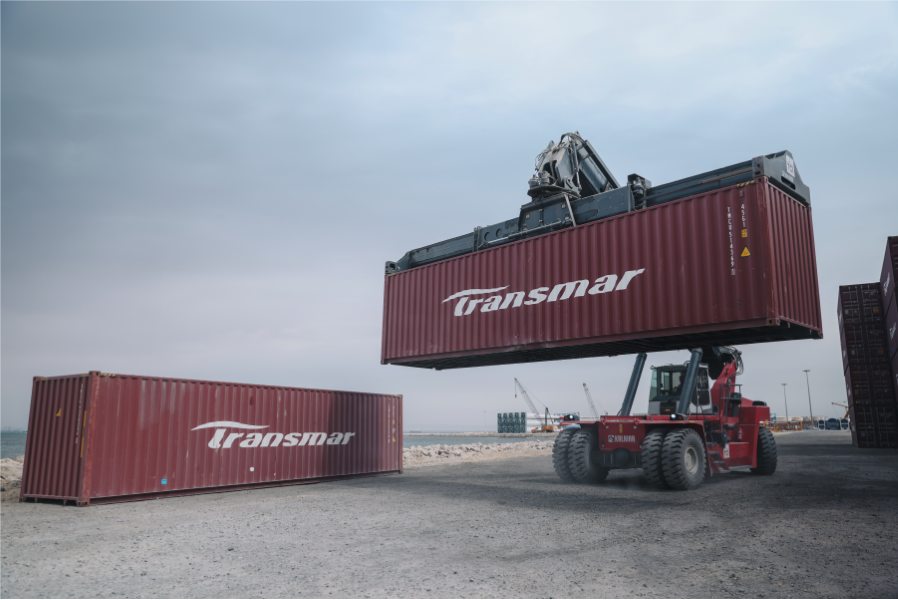
Marsa Maroc secures new 20-year concession for Casablanca’s TC3

1

WHAT WE’RE TRACKING TODAY

TODAY: Marsa Maroc locks in 20-year TC3 concession + XRG increases stake in Rio Grande project

Good morning, nice people, and happy Monday. If today's issue has a theme, it's commitment. Marsa Maroc has secured a 20-year concession extension for Casablanca's Container Terminal 3, with MAD 3 bn now committed to nearly double the terminal's capacity by 2030. Adnoc's XRG is running the same playbook, further offshore. It closed its second stake increase in Rio Grande LNG, picking up another 7.6% of Trains 4 and 5 from GIP.

A rival’s crisis, a rare opening

Saudia and Etihad eye early delivery slots amid Air India uncertainty: Flag carrier Saudia and the UAE’s Etihad Airways are reportedly in preliminary talks with Boeing and Airbus to secure delivery positions as early as 2029 and 2030, Bloomberg reports, citing unnamed sources. The two airlines are looking to capitalize on slots that could open up if Air India pulls back on its order commitments.

What’s going on with Air India? Air India Group posted a c. USD 2 bn loss for FY 2025/26, compounded by surging fuel costs, Pakistan’s airspace ban — which has added distance and cost — and broader disruptions from the regional conflict, Reuters reported.

Why the slots matter: For airlines, jumping the delivery queue is rare. A near-term slot means newer, more fuel-efficient aircraft in service sooner as Gulf carriers work towards modernizing their fleets and boosting passenger capacity as they expand their international networks.

Another brick in the anti-Hormuz wall

Potential investments from Abu Dhabi in a route linking Syrian ports with Iraq’s Umm Qasr and onward to Khalifa Port in the UAE would be “welcome initiatives” that Syrian Transport Minister Yarub Badr said are waiting to be “translated into projects” in an interview with The National.

BACKGROUND- Discussions between Abu Dhabi and Damascus on the logistics corridor surfaced last week, and they cover possible investment in Syrian freezones, dry ports in Damascus, Aleppo, and Homs, and a proposed logistics hub at Al Tanf border crossing. The move comes just a week after AD Ports launched a Khalifa-Umm Qasr service aimed at connecting the Gulf with Turkey and Europe.

Why this matters: Overland bypasses have become a key hedge for Gulf states against blockades in Hormuz after the disruption caused by the conflict over the past few months, with the UAE saying it’s working towards zero reliance on the strait.

Market watch

Oil prices fell this morning as Opec+ raised output targets and Hormuz exports recovered, Reuters reports. Brent crude futures dipped USD 0.34 to USD 71.78 / bbl by 04.08 GMT, while West Texas Intermediate (WTI) was down USD 0.20 to USD 68.49.


The Baltic Index keeps climbing: The Baltic Exchange’s dry bulk index — which tracks rates for the capesize, panamax, and supramax vessel segments — rose 2.5% to 2,717 points on Friday. The capesize index climbed 4.6% to 4,100 points, while the panamax index edged 0.4% to 2,203 points. The smaller supramax index slipped 0.1% at 1,673 points.


The Drewry World Container Index surged 9% to USD 4,530 per 40-ft container last week, according to the latest index readings. The lift came as transpacific and Asia-Europe rates moved higher, with Shanghai-New York up (11%), Shanghai-Los Angeles (10%), and Shanghai-Genoa (10%). The US-Iran interim agreement has helped reopen Hormuz and restore vessel traffic, but suspended escort operations after an attack near Oman have kept Middle East security risks and rate uncertainty elevated.


Opec+ sticks to the script with another output hike: Opec+ approved an output increase of another 188k bbl / d in August — the alliance’s fifth consecutive monthly increase as producers continue unwinding voluntary supply cuts despite mounting concerns that the market is tipping into surplus, according to a statement. The decision follows identical quota increases for June and July — plus 206k bbl / d for April and May — and forms part of the group’s phased rollback of the 1.65 mn bbl / d voluntary production cut agreed in 2023.

The production increases are only beginning to translate into actual barrels. While quotas have continued to rise, actual output has yet to fully recover after the war disrupted exports. Opec’s latest monthly report (pdf) showed production stood at 33.13 mn bbl / d in May, down by 185k bbl / d m-o-m and still below pre-war levels of 42.72 mn bbl / d, although output began recovering in June as exports gradually resumed.

That recovery is now reshaping the market: The easing of disruptions following the ceasefire has released more crude into global markets just as demand growth slows. Opec recently cut its 2026 global oil demand growth forecast to 1 mn bbl / d from 1.2 mn bbl / d, while still expecting total demand to reach 106.1 mn bbl / d

What comes next? Assuming the alliance continues increasing quotas at the current pace, the remaining 379k bbl / d of the original voluntary cuts could be fully restored by the end of September, according to Reuters’ calculations.

Data point

493k — that’s how many containers Qatar’s ports handled in 1H 2026. Qatari ports also handled 273k tons of general cargo, 325k tons of bulk cargo, 25k vehicles and equipment units, and 112k head of livestock. Vessel calls reached 866 — down 41.8% y-o-y over the same period.

PSA

Red Sea shipping just got pricier: French shipping firm CMA CGM is set to apply a USD 1k peak season surcharge from 18 July until further notice on all cargo moving from Northwest India, Southeast India, Pakistan, and Sri Lanka to Red Sea ports.

*** YOU’RE READING EnterpriseAM Logistics, the essential MENA publication for senior execs who care about the industry that connects producers and retailers to global markets. We’re out Monday through Thursday by 10:15am in Cairo and Riyadh, and 11:15am in the UAE.

EnterpriseAM Logistics is available without charge thanks to the generous support of our friends at Hassan Allam Utilities and Transmar.

Were you forwarded this email? Tap or click here to get your own copy of EnterpriseAM Logistics.

Want to send us a story idea, request coverage, ask for a correction, or otherwise get in touch? Reach out to us on [email protected].

DID YOU KNOW that we also cover Egypt, Saudi Arabia, and the UAE? ***

This publication is proudly sponsored by

2

Ports

Marsa Maroc to nearly double TC3's capacity under new 20-year concession

Marsa Maroc secured a 20-year extension for Container Terminal 3 (TC3), operated through its wholly owned TC3PC subsidiary, Morocco World News reports. The Moroccan operator has also laid out an MAD 3 bn investment program across its two container terminals at the port, which it says will take TC3’s annual capacity to 900k TEUs by 2030 from 600k TEUs.

What’s in store? The project involves expanding quay infrastructure, upgrading cargo-handling equipment, and reconfiguring storage areas across the two container terminals operated by Marsa Maroc — upgrades aimed at boosting operational efficiency and increasing cargo throughput capacity.

REMEMBER- Marsa Maroc announced plans to invest nearly MAD 21 bn in port-expansion projects through 2030, including an MAD 4.4 bn plan to modernize and expand capacity at Casablanca and Jorf Lasfar. The European Bank for Reconstruction and Development also extended a EUR 65 mn loan to Marsa Maroc in December 2024 for works at Casablanca and Jorf Lasfar

Why it matters: The Moroccan port operator plans to rank among the region’s leading port operators by the end of the decade — and the firm says this investment reinforces Casablanca’s role as Morocco’s primary maritime gateway.

3

M&A Watch

XRG completes its stake buildout across all five Rio Grande LNG trains

Adnoc’s international investment arm XRG closed the transaction to increase its stake in the Rio Grande LNG project in Texas — a move Adnoc’s international investment arm first flagged back in January. XRG picked up an additional 7.6% equity interest in Trains 4 and 5 from an acquisition vehicle of BlackRock’s Global Infrastructure Partners (GIP), according to a statement.

The transaction cleared the Committee on Foreign Investment in the United States (CFIUS) along with other customary regulatory approvals — worth noting given how often US foreign-investment reviews have slowed down Gulf transactions this year. No investment value was disclosed.

Why it matters: XRG now holds equity in all five trains at Rio Grande LNG, up from three when it first bought in. Combined, Trains 4 and 5 add roughly 12 mtpa of liquefaction capacity to a facility already expected to produce around 30 mtpa in total — one of the largest LNG export builds in the US. XRG also holds a 20-year, 1.9 mtpa offtake agreement from Train 4, so the equity stake now sits alongside a locked-in buyer position. It first bought an indirect 11.7% stake in Rio Grande’s Phase 1 (Trains 1-3) in September 2025, also through GIP.

4

Also on Our Radar

DP World opens a Sokhna distribution hub + Egypt signs a transport-corridor MoU with Turkey

One hub, many markets

DP World has launched Egypt’s first integrated logistics distribution center at Sokhna Logistics Park, according to a statement. The facility offers freight forwarding, port services, warehousing, inventory management, order fulfilment, customs handling, and transport coordination, plus value-added work like assembly, packaging, labeling, and product customization — all under one roof.

The first agreements map a regional distribution play. DP World signed three initial customers: a Kenya-based tea exporter handling around 1k TEUs annually into Egypt, a global consumer-goods distributor serving eight markets across Saudi Arabia, the Levant, and the Horn of Africa, and a German fiber-optics and digital-infrastructure company using the hub to reach Egypt, North Africa, and the GCC.

Egypt wants a seat in every corridor

Egypt and Turkey signed an MoU to cooperate on regional and international transport corridors — aiming to strengthen connectivity between Asia, Africa, and the Arab world — during Transport Minister Kamel El Wazir’s visit to the Türkiye Maritime Summit. The agreement covers cooperation on transit transport, new trade routes, and strategic corridors including the Middle Corridor and Iraq’s Development Road.

Why it matters: The MoU lays the groundwork for broader transport integration between Egypt, Turkey, Saudi Arabia, Jordan, and Syria, as governments seek to improve multimodal connectivity and diversify trade routes linking Asia, Africa, and Europe. It also supports Egypt’s ambition to become a regional transport, logistics, and transit trade hub by expanding its role in emerging trade corridors beyond the Suez Canal.

5

Logistics in the News

How the market that cried shortage is turning into a surplus

The oil market has flipped from fearing a shortage to bracing for a glut. Three months ago traders were pricing in a severe supply disruption, now mns of barrels are flooding back onto the market, prices are sliding, and the conversation has shifted from scarcity to surplus, Bloomberg reports.

The turnaround has been fast: Brent has erased all of its wartime gains, falling around 43% from its late-April peak, while physical crude markets are showing their weakest pricing signals since the pandemic. More than 60 mn barrels stranded during the conflict have re-entered global markets, just as Gulf producers ramp up exports and Iranian crude returns following the US sanctions waiver.

China is the other half of the surplus story: China helped stabilize oil markets during the war by sharply cutting imports — freeing up barrels — as logistics through the Gulf became increasingly uncertain. But now that supplies are starting to gain traction, Chinese refiners have yet to return to meaningful volumes. Imports remain some 5 mn bbl / d below pre-war levels, leaving producers across the Middle East chasing a much smaller pool of buyers.

For perspective: Oman crude — one of the Middle East’s key benchmark grades — has fallen to its widest reduction to Dubai since 2020, while some Atlantic Basin producers have been forced to offer steep price cuts to attract buyers. Cargoes are also traveling farther than usual in search of demand, with UAE crude being marketed as far away as the US and Hawaii.

The result is a market that suddenly looks oversupplied. Analysts at Goldman Sachs and Morgan Stanley have warned that the oil market risks slipping into a glut heading into next year unless demand picks up or producers slow supply growth.

Market share or market support?

Opec’s new dilemma: During the conflict, the producer alliance’s priority was restoring disrupted supply and reassuring markets that enough oil would be available. Now, the question is becoming whether those same barrels risk overwhelming demand.

That puts the oil cartel back in familiar territory. If inventories continue rebuilding and prices remain under pressure, the group may once again have to choose between defending prices through fresh production cuts or continuing to increase output to protect market share. The dilemma could prove difficult after several producers spent months preparing to bring shut-in capacity online.

REMEMBER- Asking members to reverse course so quickly would reopen the same internal tensions that have repeatedly tested the alliance over the past years (think UAE’s exit and Iraq’s warnings on quota increase). Having invested heavily in expanding production capacity, several members have become reluctant to leave expensive capacity sitting idle for prolonged periods, raising the possibility that the group may tolerate lower prices for longer if it believes maintaining or expanding market share outweighs the benefits of another round of supply cuts.

What happens next will depend on three things: whether the US-Iran MoU holds, whether Opec is willing to slow or reverse its production increases to support prices, and whether China returns to the market in force. Until then, traders see the market shifting from managing scarcity to managing excess supply.


AUGUST

30 August-1 September (Sunday-Tuesday): Air Cargo Middle East, Riyadh, Saudi Arabia.

30 August-1 September (Sunday-Tuesday): Saudi Warehouse and Logistics Expo, Riyadh, Saudi Arabia.

SEPTEMBER

16-17 September (Wednesday-Thursday): Saudi Maritime & Logistics Congress, Dammam, Saudi Arabia.

22-23 September (Tuesday-Wednesday): Breakbulk Americas, Houston, US.

22-24 September (Tuesday-Thursday): Seamless Middle East, Dubai, UAE.

28-30 September (Monday-Wednesday): Transport Logistics Middle East, Riyadh, Saudi Arabia.

OCTOBER

12-14 October (Monday-Wednesday): The Airport Show, Dubai, UAE.

20-22 October (Tuesday-Thursday): TOC Americas, Cartagena, Colombia.

21-22 October (Wednesday-Thursday): Global Ports Forum, Singapore.

26-29 (Monday-Thursday): Air Cargo Forum, Miami, US.

27-29 October (Tuesday-Thursday): Routes World, Riyadh, Saudi Arabia.

NOVEMBER

2-5 November (Monday-Thursday): ADIPEC Maritime and Logistics Exhibition and Conference, Abu Dhabi, UAE.

10-11 November (Tuesday-Wednesday): TOC Asia, Singapore.

10-12 November (Tuesday-Thursday): Intermodal Europe, Rotterdam, Netherlands.

11-13 November (Wednesday-Friday): logitrans, Istanbul, Türkiye.

18-19 November (Wednesday-Thursday): Breakbulk Asia, Singapore.

FEBRUARY 2027

10-12 February (Wednesday-Friday): Routes Americas, San Juan, Puerto Rico.

MARCH 2027

16-18 March (Tuesday-Thursday): CMA Shipping, Houston, US.

16-18 March (Tuesday-Thursday): Routes Asia, New Delhi, India.

APRIL 2027

20-22 April (Tuesday-Thursday): Routes Europe, Antalya, Turkey.

26-29 April (Monday-Thursday): Transport logistic and air cargo Europe, Munich, Germany.

26-29 April (Monday-Thursday): Saudi Smart Logistics, Riyadh, Saudi Arabia.

Now Playing
Now Playing
00:00
00:00