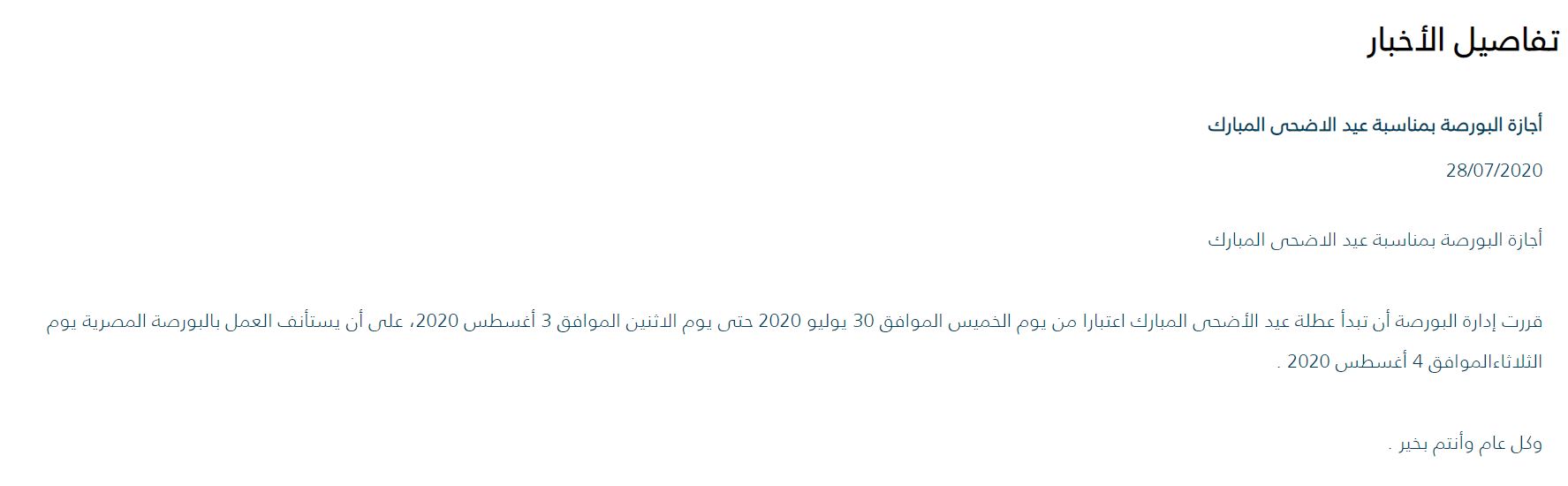
Good morning, friends, and Happy Eid to you all. Today is the last workday of the week as banks(pdf), the EGX and the private sector are off starting from tomorrow (the wa’fa) until Monday, 3 August, in observance of Eid Al Adha.
We’re going to be off, too and will be back in your inbox at the appointed hour on Tuesday, 4 August.
COVID-19 IN EGYPT-
The Health Ministry yesterday confirmed 465 new cases of covid-19, up slightly from 420 on Sunday. This brings the nation’s total confirmed cases to 92,947. The ministry also reported 39 new deaths yesterday, increasing the overall death toll to 4,691. We now have a total of 35,959 cases who have fully recovered.
Pharma player EIPICO has begun manufacturing covid-19 treatment Epifluver-Favipiravir 200 mg after receiving the green light from the Egyptian Drug Authority, according to a bourse disclosure (pdf).
ON THE GLOBAL FRONT-
Google’s 200k employees will be working from home for at least the next 12 months, the company announced, according to the Wall Street Journal.
Covid-19 is not seasonal and we’re in the midst of what will be one “big wave”: World Health Organization Spokeswoman Margaret Harris poured cold water on the idea that the pandemic could slow down in warmer climates and during the summer season, saying that it is currently not behaving like an influenza, according to Reuters. Instead, she said, we should think of the pandemic as one big wave that needs to be flattened.
Global air travel may not recover to pre-pandemic levels before 2024, the International Air Transport Association’s chief economist Brian Pearce said in a briefing to journalists, the Associated Press reports. The global body previously predicted a full recovery by 2023 but has pushed its estimate back a year as the virus continues to spread in the US and the developing world.
GLOBAL MACRO-
Fed extends emergency lending programs until the end of the year: The US Federal Reserve has agreed to extend the multitude of lending facilities introduced in March to stabilize the financial markets by three months until the end of the year, the Financial Times reports. The extension of the programs, which inject liquidity into the short-term funding and corporate bond markets, were agreed by the board on the opening day of the bank’s two-meeting to review monetary policy.
Stimulus putting USD reserve status in jeopardy, Goldman warns: The greenback’s dominant position as the world’s reserve currency may be under threat if the wave of fiscal and monetary stimulus launched this year triggers inflation, Goldman Sachs analysts warned yesterday. The escalating flight into gold is indicative of a market increasingly concerned about hedging against a debasement of the currency and record-low interest rates caused by the stimulus. So much so that there are now “real concerns around the longevity of the USD as a reserve currency,” they wrote.
OPEC is waking up to the prospect of a post-oil future: There are fears among OPEC members that the slump in global demand for oil triggered by the pandemic may be the tipping point for ushering in a future less reliant on hydrocarbons and more thirsty for renewable sources of energy, Reuters reports, citing industry insiders. Daily crude consumption fell by as much as a third earlier this year, and as momentum builds behind green energy and electric vehicles, oil producers are concerned that demand may never recover to pre-covid levels.
AND THE REST OF THE WORLD-
The IMF could offer Lebanon a bailout of USD 5-9 bn — as little as half of the USD 10 bn it originally sought to recover from its severe financial crisis — as negotiations between the two continue, Economy Minister Raoul Nehme told Bloomberg Television. He gave no time frame for when a possible agreement could be reached. Lebanon needs a total of USD 30 bn for recovery, and if an agreement with the IMF can be reached, will look to allies and leverage international donor pledges of some USD 11 bn in 2018 in exchange for promised reforms, but the IMF agreement is a crucial first step, Nehme said.
Former Malaysian PM handed 12-year jail term in 1MDB scandal: Malaysia’s former prime minister Najib Razak has been sentenced to 12 years in jail and fined almost USD 50 mn after a Malaysian court found him guilty of all seven charges for his role in the 1MDB scandal. Razak was charged with money laundering, abuse of power and criminal breach of trust, after he allegedly plundered bns of USD from state investment fund 1MDB to buy property, artworks and finance The Wolf of Wall Street. The Guardian and the Wall Street Journal both have the story.
And Goldman gets a comparative slap on the wrist: Goldman Sachs, which allegedly facilitated Razak’s looting of the fund, agreed to pay a USD 2.5 bn fine (a third of what the finance minister had demanded) in return for the government dropping criminal charges against the bank and halting legal proceedings against 17 executives.
The president of the African Development Bank has been cleared of misconduct following an independent inquiry, paving the way for him to run unopposed for another five-year term next month, the Financial Times reports. Whistleblowers had claimed that Akinwumi Adesina was favoring his Nigerian countrymen in the development bank’s hiring process, as well as approving hefty severance packages.
*** It’s Hardhat day — your weekly briefing of all things infrastructure in Egypt: Enterprise’s industry vertical focuses each Wednesday on infrastructure, covering everything from energy, water, transportation, urban development and as well as social infrastructure such as health and education.
In today’s issue: Our three-part series on the feasibility of the government’s plan to convert us into a nation of drivers powered by natgas continues. Today, we look at the financing and infrastructure challenges
The two most popular topics of the year — the coronavirus and the GERD — captured the attention of the nation’s talking heads again last night.
Covid is back on the airwaves: Presidential health advisor Mohamed Awad Tag El Din urged people to maintain social distancing and keep using masks to prevent a resurgence in the virus during an interview with Yahduth Fi Misr’s Sherif Amer. Although recent positive figures suggest the outbreak might be on the wane, respiratory viruses will gather steam from October and risks remain about the prospects of a second wave, he said (watch, runtime: 3:17), (watch, runtime: 3:35) and (watch, runtime: 3:33).
Saving water: President Abdel Fattah El Sisi has directed the government to employ advanced irrigation methods to a mn acres to help the country use its water resources more efficiently, Agriculture Minister Elsayed El Quseir told Ala Mas’ouleety’s Ahmed Moussa (watch, runtime: 18: 44).
GERD talks: The next round of negotiations over the filling and operation of the Grand Ethiopian Renaissance Dam (GERD) will run for the next two weeks, Foreign Ministry spokesperson Ahmed Hafez told Yahduth Fi Misr’s Sherif Amer. Hafez said that Foreign Minister Sameh Shoukry is holding talks with his counterparts in many countries, and that they are in contact with US lawmakers about the situation. He reiterated Egypt’s determination to reach a fair agreement that includes the rights of the three countries to the Nile’s water and that
Egypt is willing to continue negotiations until an agreement is reached (watch, runtime: 6:03).
INVESTMENT WATCH- The way to a foreign investor’s pocket book is through their stomach. Ours is a consumer-led economy, and Egyptian consumers love food above all else. Fitting, then, that we head off on our Eid holiday with news of new FDI in food and food-centered retail:
India’s LuLu Group is planning to invest USD 1 bn in Egypt over the next three years to build out its branch network, Internal Trade Development Authority (ITDA) head Ibrahim Ashmawy said, according to Al Mal. The Abu Dhabi-based, Indian-owned hypermarket operator inaugurated its second branch in Egypt — which cost EGP 180 mn — earlier this week. LuLu had said last year it plans to open two branches in Egypt in 1H2020, including one in Wadi Degla and another in the Fifth Settlement. The company said in summer 2019 that it would invest USD 500 mn in its expansion in Egypt.
Kraft Heinz will invest over EGP 920 mn in Egypt over the next five years to add 14 new production lines, Managing Director Hany Elmessiry said, according to the local press. The company plans to increase its output to cover domestic consumption and sell to export markets. The company exports nearly EGP 680 mn-worth of goods, or 20% of its annual output, to countries in the Gulf and Africa.
Hero Foods is planning to invest USD 5 mn by the end of 2020 to expand its jam factory in Qalyubia, Middle East and Africa (MEA) operations head Mahmoud Bazan tells the local press. The Swiss food manufacturer will use the investments to add capacity to what is already one of the largest jam factories in the MEA region. The company has spent over USD 70 mn in expansions and upgrades since it acquired the factory in the early 2000s.
Related
INVESTMENT WATCH- The next step in our journey to an EV future will cost about EGP 500 mn: The plant that will eventually assemble 25k electric vehicles a year in partnership with China’s Dongfeng Motor Corporation will cost EGP 500 mn to get off the ground, Public Enterprises Minister Hisham Tawfik was quoted as saying by Al Mal. Under the MoU signed late last month between the Chinese firm and the Metallurgical Industries Holding Company, production is slated to begin in the last quarter of 2021 at facilities owned by El Nasr Automotive.
We’ll know more soon about the government’s plan to roll out EVs around the country: Tawfik recently handed documents to the presidency outlining a national incentives strategy for the production and ownership of EVs, he said, adding that the cabinet will issue a statement soon with more details. Incentives involve a set price for charging the vehicles, agreements with private mall operators to set up charging docks, and subsidies of around EGP 50k per vehicle. Tawfik first announced the subsidies, along with a three-year plan to build 1k fast charging stations, earlier this year. Alongside those measures, public authorities, economic bodies, and public sector companies will be required to replace 5% of their fleet every year with electric cars, Tawfik also said recently.
Background: We noted last year that the government is working on a new policy framework to encourage the use of EVs under instructions from President Abdel Fattah El Sisi. We also looked into whether Egypt is actually ready to embrace a market for EVs in a recent edition of Hardhat, our weekly infrastructure vertical.
Also in the pipeline — funding for electric taxis: The Public Enterprises Ministry is planning to roll out a program to provide financing for electric taxi purchases, Tawfik said. Details on the program are also due out soon, he added, hinting that there could similarly be a separate financing program for purchases of personal EVs.
In related news, Tawfik held talks yesterday with the Chinese ambassador in Cairo Liao Liqiang on collaboration in EV manufacturing. The two agreed to compile a shortlist of potential Chinese partners to work with the government on its EV development plan, according to Masrawy. They also discussed the MoU with Dongfeng, plans to concentrate Egypt’s EV efforts in facilities owned by El Nasr, as well as have the state-owned company act as an agent for Chinese EV makers, and cooperation in manufacturing key EV components through “multiple forms of partnership” with a Chinese company leading in the field. There was no mention of the latter company’s name nor specifics on the potential partnership.
Related
Strong growth in automotive sales in 1H2020 despite pandemic: Automotive sales climbed 22% in the first six months of the year, despite the coronavirus pandemic weighing on the sector for much of the second quarter, industry data show. Figures released by the Automotive Marketing Information Council (AMIC) show that dealers sold 90.4k vehicles (including passenger cars and commercial vehicles) in 1H2020, up from 74.8k during the same period in 2019. The six-month figures are supported by a strong 1Q performance that saw sales grow 50% on an annualized basis, before the government’s partial lockdown of the economy between April and June which curbed imports and temporarily shuttered dealerships.
Crunching the numbers: Distributors sold almost 11k more passenger cars during the first six months of the year than they did in the equivalent period last year, with sales figures rising 22% to 62.2k vehicles. Bus sales surged 80% to 12.7k, while truck sales fell slightly to 15.6k vehicles. The report, which relies on self-reporting by member distributors, shows Chevrolet as the top-selling brand, capturing a market share of 20.4%. Toyota came second with a 12.3% market share, followed by Nissan at 8.9%.
Related
Related
Gov’t considers flight discounts to support tourism sector: The government is considering including domestic tourism in its recently launched consumer spending initiative by offering discounts on domestic flights and other means of transportation to support the country’s ailing tourism sector, Al Mal reports, citing unnamed sources. The report comes just days after the government pushed ahead with a new program that aims to catalyze bns in consumer spending to drive economic growth in this time of corona.
Background: The government launched its “Not Too Expensive for You (Ma Yeghlash Aleik)” program at the beginning of this week to stimulate some EGP 125 bn-worth of consumer spending. Citizens can obtain discounts of 15-25% on a range of goods including electronics, appliances, clothes and furniture, while ration cards will be topped up by EGP 200 per person up to a maximum of EGP 1k per family. The program is nominally supposed to run for the next three months but sources said this week that the discounts will remain in place until at least January 2021.
Related
Shareholders look to sell 7% stake in Fawry: A group of shareholders are looking to sell a combined stake of c. 7% (50 mn shares) in EGX-listed e-payment company Fawry, a source with knowledge of the transaction told Enterprise. Selling shareholders include the Egyptian American Enterprise Fund (EAEF), the International Finance Corporation (IFC), a vehicle of private equity investor Helios, asset manager ResponsAbility, the National Bank of Egypt, Banque Misr, and a number of Fawry employees. The EAEF, IFC, and Helios vehicle Link were among 40 shareholders who earlier this year were transferred the ownership of a 63.99% stake in Fawry previously held by PSI Netherlands Holding. Fawry is Egypt’s largest financial payments business. EFG Hermes is managing the offering.
Related
HHD extends contract to co-develop New Heliopolis land with Sodic: State-owned Heliopolis Housing and Development’s (HHD) board of directors agreed yesterday to extend the deadline by 11 months to develop a a 655-feddan plot in New Heliopolis under a 2016 agreement with upmarket real estate developer Sodic, according to a bourse disclosure (pdf). The new deadline is unclear. HHD also signed off on restructuring the EGP 5.01 bn minimum guaranteed revenues from the development, citing the current economic slowdown and its effect on the real estate market.
Background: Sodic and HHD had signed an agreement (pdf) back in 2016 to co-develop the land into a “fully integrated project” with retail, medical, educational, and sports facilities, in addition to 8,600 homes. Under the agreement, Sodic is entitled to 70% of the revenues from homes sold in the development, while the state-owned company will get the remaining 30%. Revenues from commercial and retail sales are split similarly.
Related
DISPUTE WATCH- SMW Gold pledges to develop Al Fawakhir gold mine following withdrawal of arbitration case: Russian miner SMW Gold has reached an agreement with the government to renegotiate a gold exploration contract at the Al Fawakhir concession in the Eastern Desert, Al Mal says, citing an unnamed official. SMW has been the subject of a drawn-out arbitration dispute with the Egyptian government, filed in 2013 after the Egyptian Mineral Resources Authority (EMRA) accused it of failing to invest the agreed amount in the Al Fawakhir and Om Balad concessions, awarded back in 2006.
SMW recently withdrew the case after being acquired by Africa-focused Australian miner Allied Gold, according to a letter by the Cairo Regional Centre for International Commercial Arbitration (CRCICA) that the newspaper says it has seen. Following the acquisition, SMW handed over a USD 5 mn letter of guarantee to the government to return to Al Fawakhir and USD 8.5 mn to launch the exploration program, according to the official.
Al Fawakhir isn’t a name any of us heard of in a while: Al Fawakhir is an ancient gold mine located in the Eastern Desert and for which the Pharaohs drew up the first geological map in Egypt’s history. It was developed by the British in 1948, but then closed by Gamal Abdel Nasser following the 1952 Revolution.
Related
Eni, BP, Total confirm gas discovery in North El Hammad concession:Eni, BP (pdf) and Total confirmed yesterday a gas discovery at the Bashrush well in the North El Hammad concession. Production tests yielded flow rates of up to 32 mn scf/d, which are expected to increase to 100 mn scf/d per well in the future along with a 800 barrels of condensate per day, the company said. Eni first announced the discovery earlier this month prior to testing the well for production. An official at the Egyptian state gas company EGAS claimed that reserves at the well could be as much as 250 bn cubic feet. Neither Total, Eni or BP have provided reserve estimates. Operator Eni and BP both hold 37.5% stakes in the concession while Total has a 25% stake.
Related
El Sisi says Egypt will pursue GERD negotiations, denounces calls for military action: Egypt is still committed to breaking the deadlock on the Grand Ethiopian Renaissance Dam (GERD) through negotiations, President Abdel Fattah El Sisi said yesterday, according to MENA. Speaking during the inauguration of the Roubiki industrial zone, the president denounced calls in “the media” to resort to military action over the dam, saying that ongoing talks are aimed at reaching an agreement that doesn’t threaten Egypt’s water security. El Sisi made similar remarks last week in his speech commemorating the 23 July Revolution. Bloomberg also had the story.
Egypt is also investing around EGP 1 tn to cut down on water waste and improve the utilization of our resources, El Sisi said.
Kamel heads to Sudan: Egypt’s Intelligence chief Abbas Kamel was in Khartoum yesterday for talks with Sudan’s prime minister Abdalla Hamdok, Sudan’s state news agency SUNA reported. The report offered little details about the substance of the meeting, saying only that it came “within the framework of bilateral relations.” This came as the Sudanese cabinet held a meeting to discuss the potential effects of Ethiopia unilaterally filling the dam’s reservoir on the country’s water supply.
And Shoukry has been reaching out to US lawmakers: A Foreign Ministry statement said yesterday that Minister Sameh Shoukry had held talks with a number of senior lawmakers about the status of negotiations with Ethiopia as well as the situation in Libya.
Also from the president’s remarks yesterday :
The president urged citizens against getting lax with social distancing and precautionary measures as covid-19 case and death counts drop, saying that the government could decide to re-impose the lockdown if numbers start to rise significantly again.
Egypt wants to push its exports of locally manufactured goods to “at least” USD 100 bn within the next few years and will upgrade all spinning and weaving factories in El Mahalla within two years.
Related
EARNINGS WATCH- Talaat Moustafa Group (TMG) reported a drop in net income to EGP 705 mn in 1H2020, compared to EGP 812 mn in the first half of last year, the real estate developer said in a regulatory filing (pdf). Revenues during the period came in at EGP 4.6 bn, down 7% from last year.
Credit Agricole Egypt has reported a net profit of EGP 701 mn in 1H2020, down 46% from EGP 1.3 bn in the same period last year, according to its earnings statement (pdf).
Related
*** WE’RE HIRING: We’re looking for smart and talented people to join our team at Enterprise, which produces the newsletter you’re reading right now and Making It, our very first podcast. We offer the chance to work in a unique and casual work environment that promises to be intellectually challenging and rewarding. Enterprise is currently in the market for:
A senior editorial leader, who will work on this product and help launch new products. You have at least five years of experience in journalism and a minimum of two of those should have been spent in an editor’s slot. Strong knowledge of Egypt, a demonstrated interest in business / finance, and a desire to lead a team are musts. Candidates must also be bilingual.
A seasoned reporter to join our team and create stories and packages that fascinate and inform our readers. Applicants should have serious English-language writing chops, a strong interest — and preferably some professional experience — in business / finance or business journalism, and solid analytical skills. You’ll be expected to pitch stories and take assignments, develop leads into full-blown stories, and should be fluently bilingual.
Interested in applying? To apply for the editor / reporter positions, please submit your CV along with 2-3 writing samples and a solid cover letter telling us a bit about who you are and why you’re a good fit for our team. The CV is nice, but we’re much more interested in your clips and cover letter. Please submit all applications to jobs@enterprisemea.com.
Growing debt piles are becoming increasingly insurmountable for some developing economies as they struggle to find the resources to repay bns of USD borrowed from private investors over the past decade, the Wall Street Journal says. The pandemic has made matters worse, but these countries were already ill-prepared to both service their debts and invest enough into their economies and infrastructure — which is what a chunk of the borrowing was meant to finance.
Debt levels have been soaring over the past decade in sub-Saharan Africa’s poorest countries. By 3Q2019, their debt-to-GDP ratio had swelled to 60% from 38% one decade earlier, the WSJ says, citing figures from the Institute of International Finance. The WSJ looks closely at Zambia, which is seriously strained as it rapidly approaches its 2022 due date to repay FX-denominated bonds it took to market in 2012 when its economy was on the up — largely thanks to its copper resources and China’s massive demand for the commodity. The Southern African country was meant to invest in vital infrastructure, including healthcare, but its borrowing quickly proved unsustainable when China’s economic slowdown drove down copper prices and the Zambian currency tumbled, more than tripling the country’s debt in local currency terms.
It’s not just Africa — Latin America also has a ticking debt bomb in its lap: Debt levels are skyrocketing in Latin American countries struggling to contain the fallout from the pandemic, including Argentina, Ecuador, Chile, Brazil, and Mexico, the Financial Times said. Similar to other emerging market blocs, the LatAm region was already grappling with debt defaults, slow growth, weak healthcare systems, low tax revenues, high levels of borrowing, and an over-reliance on commodity exports before the pandemic broke out.
While the WSJ doesn’t explicitly mention us, Egypt has recently been named among the emerging market economies that are “most vulnerable” to defaulting on sovereign external debt in the next year, along with Zambia, Ghana, South Africa, India, Nigeria, and Brazil. According to Oxford Economics and IMF figures, Egypt has one of the highest ratios of maturing debt and fiscal deficit to GDP among 20 EM peers, standing at around 40%. And while Egypt is much better positioned for a recovery than other EMs, part of the risk we face is being seen as one and the same as our peers as investors look at the entire asset class as homogenous.
Editor released after two years in detention:The Associated Press picks up the news that editor of Masr Al Arabia Adel Sabri was released on Monday after spending two years in detention for republishing a controversial New York Times article.
Egypt’s appetite for Brazillian poultry products shot up 27% in the first six months of the year as beef prices spiked on heightened Chinese demand, reports the Brazil Arab-News Agency (ANBA).
THE MARKET ON TUESDAY: The EGX30 ended Tuesday’s session down 0.1%. CIB, the index’s heaviest constituent, ended down 0.4%. EGX30’s top performing constituents were GB Auto up 3.7%, Elsewedy Electric up 3.5%, and Ibnsina Pharma up 3.3%. Yesterday’s worst performing stocks were EFG Hermes down 3.9%, Kima down 2.6% and Dice down 1.2%. The market turnover was EGP 1.1 bn, and local investors were the sole net buyers.
Foreigners: Net short | EGP -59.2 mn Regional: Net short | EGP -28.0 mn Domestic: Net long | EGP +87.2 mn
Retail: 57.5% of total trades | 56.6% of buyers | 58.3% of sellers Institutions: 42.5% of total trades | 43.4% of buyers | 41.7% of sellers
WTI: USD 41.05 (-1.32%) Brent: USD 43.26 (-0.35%)
Natural Gas (Nymex, futures prices) USD 1.80 MMBtu, (+3.52%, August 2020 contract) Gold: USD 1,971.40 / troy ounce (+0.82%)
3 August (Monday): The African Union will hold a meeting with Egypt, Ethiopia, and Sudan to discuss the Grand Ethiopian Renaissance Dam
5 August (Wednesday): IHS Markit PMI for Egypt released.
9-10 August (Sunday-Monday): Egyptian expats vote by post in Senate elections.
11-12 August (Tuesday-Wednesday): Senate elections take place.
13 August (Thursday): The CBE’s Monetary Policy Committee will meet to review interest rates.
13-15 August (Thursday-Saturday): RiseUp from Home digital event. Pre-registration available here.
16 August (Sunday): House of Representatives reconvenes after a brief recess.
20 August (Thursday): Islamic New Year (TBC), national holiday.
8-9 September (Tuesday-Wednesday): Run-off Senate elections.
12 September (Saturday): Court session for Egyptian Resorts Company lawsuit against The Tourism Development Authority
15 September (Tuesday): 2019-2020 academic year ends for Egyptian universities.
15-16 September (Tuesday-Wednesday): US Federal Open Market Committee will hold its two-day policy meeting to review the interest rate.
20 September (Sunday): A Cairo administrative court is due to issue a ruling in a third-party lawsuit demanding the government block YouTube in Egypt for carrying an allegedly sacreligious video. The case is an infamous 2012-vintage lawsuit still wending its way through the courts.
24 September (Thursday): The CBE’s Monetary Policy Committee will meet to review interest rates.
6 October (Tuesday): Armed Forces Day.
8 October (Thursday): National holiday in observance of Armed Forces Day.
16 September (Wednesday): The last day for the final results of the senate elections to be announced.
17 October (Saturday): 2020-2021 academic year begins for K-12 students at state schools and students in public universities


 Egypt Edition
  UAE Edition
  Saudi Edition
  MENA <> India Corridors
  Logistics (MENA)
  Climate (MENA)


 Share Issue