Get EnterpriseAM daily

Available in your choice of English or Arabic

IFC to advise Egypt’s gov’t on privatization efforts

1

What We're Tracking Today

El Sisi to meet with EU’s top diplomat. PLUS: Egypt co-hosts UN fundraiser for Sudan

Good morning, wonderful people, and happy Monday. The news cycle is only accelerating as the week continues and we have another packed issue for you today.

PSA- Eid Al Adha will begin on Wednesday, 28 June, Dar Al Ifta announced after confirming the sighting of the crescent moon marking the start of the lunar month of Dhul Hijjah, in statements here and here. We’re still waiting for official announcements on which days will be off to mark the holiday.

BEFORE WE GET UNDERWAY- At least one of us feels very old this morning — not because of the passing of a significant birthday, but because today marks the publication of the very first Enterprise story written by the Resident 15-Year-Old, whom we are pleased to announce has joined us as a summer news intern. For context: Said 15-year-old was barely seven years of age when we launched Enterprise. It feels as if it was just yesterday. As The Colonel always said: Time accelerates as you age.

THE BIG STORY here at home is the news that the International Finance Corporation (IFC) will come on board as an advisor to the state’s privatization program under an agreement it signed with the government yesterday. We spoke with IFC Managing Director Makhtar Diop about what to expect from the partnership.

Speaking of stake sales: This morning also brings news that PE outfit B Investments is looking to acquire a majority stake in financial services firm Orascom Financial Holding.

AND- Our regular interest rate poll is out: Most of the analysts we spoke to expect the central bank to keep interest rates on hold when its Monetary Policy Committee meets this Thursday, 22 June.

The Enterprise Finance Forum is our flagship gathering — the one so many of you have been waiting for. The two-day event takes place this September and will be the latest in our must-attend series of invitation-only, C-suite-level gatherings. Stay tuned for more information on the location.

TAP OR CLICK HERE if you want to express interest in attending. We’ll be sending out the first batch of invitations just after the 30 June holiday.

Do you want to become a commercial partner? Please click here.

STAY TUNED for more detail about our exciting agenda in the weeks to come.


HAPPENING TODAY-

The EU’s foreign policy chief Josep Borrell will meet with President Abdel Fattah El Sisi today, an EU statement read. Borrell met with Foreign Minister Sameh Shoukry and Defense Minister Mohamed Zaki yesterday for bilateral talks.

Assistance from EU on Sudanese refugees: The EU is providing Egypt with “immediate assistance” of EUR 20 mn to help address the “new wave of Sudanese refugees” on our southern border, Borrell said in a press conference with Shoukry yesterday. “I know this is not enough and you are going to pay much more, but at least, let us contribute a little bit in your support,” he told Shoukry.

More where that came from? Egypt is today co-hosting a hybrid “pledging event” with the UN, Germany, Qatar, Saudi Arabia, the African Union and the EU, to raise funds to pay for humanitarian assistance to Sudan and to aid the refugee crisis the war has created.

The latest in Sudan: The Sudanese Armed Forces and the paramilitary Rapid Support Forces have agreed to a fresh 72-hour ceasefire that came into effect yesterday morning to allow for aid deliveries to take place, a joint statement from the US and Saudi Arabia said.

IN THE SENATE-

The Senate will today continue discussions it began yesterday on unifying legislation governing cooperative and offering tax incentives to help them boost exports.

Most parliament-watchers are expecting the Senate to break for its summer recess after tomorrow’s session.

FURTHER AFIELD-

SCZone boss heads to India: Suez Canal Economic Zone (SCZone) Chairman Walid Gamal Al Din is in New Delhi to kick off a promotional roadshow looking to attract Indian investments to the economic and industrial areas in Ain Sokhna and Port Said, a statement said. The SCZone’s global tour has so far seen its representatives travel to China, Japan, the Netherlands, and Vietnam. President Abdel Fattah El Sisi visited India earlier this year, where he discussed potential investment in our infrastructure with local businesses.

India wants the AU to visit next: Indian Prime Minister Narendra Modi wants to make the African Union a permanent member of the G20 at the group’s summit in New Delhi this September, Reuters reports, citing an unnamed official source. The proposal comes as Modi wants to give African nations a push for more representation on the international stage, the source said. In addition to the G20’s permanent membership — 19 nations, along with the EU — the UN, World Bank, World Health Organization, Singapore, Nigeria, and Bangladesh will be attending the September summit as onlookers.

The African Export-Import Bank (Afreximbank) will continue holding its annual meetings in the Ghanaian capital today. The meetings run through to Wednesday.

Afreximbank wants African nations to end reliance on USD for regional trade: Afreximbankexpects 15-20 nations to have signed up by the end of the year for the Pan-African Payment and Settlement System (PAPSS), which aims in part to cut reliance on the greenback over time in regional trade, Afreximbank President Benedict Oramah told Bloombergahead of the annual meetings. So far, nine central banks have joined the platform since it was launchedlast year. While the platform currently uses USD as an intermediary currency, a mechanism is being developed to enable direct conversions between Africa’s 42 currencies, Oramah said. “What we are doing is to domesticate intra-African payments,” he said.

Egypt is one of the countries expected to join: That’s according to a source at the Central Bank of Egypt we spoke to yesterday, who didn’t disclose a projected timeline for doing so.

HAPPENING TOMORROW-

The House is back in session tomorrow to discuss a bill that would establish a national agency for intellectual property rights. On Wednesday, MPs are expected to discuss and vote on bills for oil exploration, joining an international convention on nuclear energy safety, and establishing the Egypt-based HQ of the African Space Agency.

FACT CHECK-

No final decision on electricity prices: The cabinet has yet to approve new electricity prices, a source at the Electricity Ministry told us yesterday, denying media reports over the weekend that claimed the government has decided to raise prices from next month. The prices circulating in the media are “mere estimations” and no final decision has been reached, they said. Recommendations for the new electricity tariffs were sent to the cabinet for approval almost two weeks ago.

So what could we see? Prices could rise 20-22% from the beginning of the next fiscal year, according to our source.

Remember: Residential electricity prices have been frozen over the past year to shield households from the rising cost of living. This has cost public finances around EGP 4 bn, our source told us.

THE BIG STORY ABROAD-

The eyes of the foreign press remain firmly on China as US Secretary of State Antony Blinken enters a second day of talks with Beijing officials. Blinken yesterday met with Chinese Foreign Minister Qin Gang, where he emphasized the need for “open channels of communication across the full range of issues to reduce the risk of misperception and miscalculation,” according to a US State Department spokesman. It is still not clear if Blinken will meet today with Chinese President Xi Jinping. (Financial Times | Reuters)

Missed this week’s Inside Industry? In our weekly vertical exploring all things industry and manufacturing, we asked industry players what they think of the Madbouly government’s new package of business reforms.

Check out our full calendar on the web for a comprehensive listing of upcoming news events, national holidays and news triggers.

ENTERPRISE IS LOOKING FOR SMART, TALENTED PEOPLE of all backgrounds to help us build some very cool new things. Enterprise — the essential morning read on all the important news shaping business and the economy in Egypt and the region — is looking for writers, reporters and editors to help us build out new publications. Today, we run four daily Egypt and MENA-focused publications, five weekly industry verticals, and a weekend lifestyle edition designed to make our readers feel just a bit smarter.

We have tons more in the pipeline — come help us build new publications. We offer the chance to work in a fast-paced newsroom on a broad range of topics and in a variety of formats. Our goal is simple: To create value for our growing community of >250k daily readers by telling stories that matter.

Journalists looking to explore business, finance and economic stories are welcome. So are recent journalism school graduates.

That said, we're looking for gifted story-tellers from all walks of life and across all professions, as long as they show a keen interest in learning to write about the stories, topics, businesses, and figures moving markets. Egyptian and foreign nationals alike are welcome to apply. So are job-switchers: If you’re an equities analyst tired of the rat race, we’re a great place to come work.

NEVER WORKED IN A NEWSROOM BEFORE? We have the Enterprise Business Writing Development Program. Whether you are a recent graduate, an industry vet, or looking to switch careers, the Enterprise Business Writing Development Program will give you the tools you need to tell the most important stories to our audience of C-suite officials, government ministers, diplomats, financiers, investors and entrepreneurs.

During the program you will learn:

  • The key news stories and trends shaping business and the economy in Egypt and the region, across various sectors;
  • Business and finance for non-finance people: Whether it's industry jargon or key concepts or simply how to read a balance sheet;
  • How to construct an Enterprise story: From idea formulation down to the structure, style and tone of writing;
  • How to develop sources that will give you the key insights needed to tell a complete story;
  • How to communicate these stories with the confidence and language of an insider.

Not an internship program — a career: The three-month program will see full-time, paid participants take part in workshops and lectures from veteran business journalists, while also working on and filing stories that will run on any of our publications. Those who have successfully completed the program, will then be given long-term job offers.

Apply directly to jobs@enterprisemea.com and mention “writing development program” in your subject line.

*** It’s Blackboard day: We have our weekly look at the business of education in Egypt, from pre-K through the highest reaches of higher ed.

In today’s issue: Beyond the bureaucracy, what challenges do investors face when setting up a new private or international school?

Solasi Wellbeing Festival has been lovingly created by Yes Yoga and Osana Family Wellness and takes place at the beautiful Somabay from 21-23 September.

Solasi brings you Sunrise Yoga, Sound Healing, Funky Classes, Morning Runs, Enlightening Workshops, Healing Treatments, Tai Chi, Meditation, Kids Activities, locally sourced food, and lots of dancing.

Don't miss your chance to take #ThreeDaysOff and flow with us at Solasi at Somabay. Head to www.solasifestival.com to find out more and book your pass today.

2

Privatization

IFC to advise Egypt on state privatization program

The International Finance Corporation (IFC) will advise the government on its ongoing privatization efforts under a transaction advisory agreement signed yesterday, the multilateral lender (pdf) and the cabinet said in separate statements. Signed by International Cooperation Minister Rania Al Mashat and IFC Managing Director Makhtar Diop, the agreement will enable the government to receive “technical assistance and advisory support” from the IFC, which will develop a strategy for selling down state assets.

On the IFC to-do list: The agreement will see IFC get involved in developing a strategy and implementation plan, preparing and restructuring assets ahead of sales, improving corporate governance, and implementing approved transactions, Prime Minister Moustafa Madbouly saidyesterday.

What’s next?We will be closely monitoring the progress of this agreement with the prime minister's office and with Minister Rania Al Mashat because we believe in the potential of transforming the Egyptian economy and really taking it to the next level,” Diop told Enterprise yesterday on the sidelines of the signing ceremony.

Some USD 2 bn in the pipeline?The IFC will help the government attract USD 2 bn in private investment to the country “over the coming years,” with some of that coming from its own funds, Al Mashat said, without providing further details.“We expect to be attracting large amounts of investments including from the IFC as we intend to double our commitment for next year in support of the government’s strategy,” Diop told us.

They’ve done it before, they can do it again:The IFC has a history of assisting governments globally in attracting private sector investments in state assets, the statement reads, adding that it has successfully facilitated asset monetization transactions for state-owned companies in countries including Kenya, Brazil, Cameroon, and more. “Our appointment as strategic advisor to support the sale and monetization of state assets will further unlock the potential of the private sector to build a sustainable, resilient, and inclusive economy for Egypt,” said Diop.

The hope is that the agreement with Egypt can be a model that can be replicated across other emerging markets, Diop said.

Part of a wider framework: The agreement “is the first operation to be signed under the recently launched 2023-2027 Country Partnership Framework with the World Bank Group, specifically supporting the government’s [state-owned enterprise] reform agenda and harnessing private capital,” Al Mashat said.

A meeting with the president:Diop sat down with President Abdel Fattah El Sisi and Al Mashat to discuss the implementation of the state privatization program, Ittihadiya said in a statement.

3

M&A WATCH

B Investments bids to acquire up to 90% of Orascom Financial Holding

B Investments eyes a majority stake in Orascom Financial Holding: EGX-listed private equity firm B Investments submitted an offer to acquire 51-90% of EGX-listed Orascom Financial Holding (OFH), the companies said in disclosures to the EGX (here, pdf and here, pdf) yesterday.

OFH majority shareholder wants to sell: OFH’s majority shareholder OTMT Acquisition and minority shareholder Orascom TMT Investments have agreed to sell their combined 51.72% stake in the company, OFH said. “The goal is to become part of a bigger entity with a strong track record in the market,” Orascom Financial Holding CEO Nils Bachtler told Enterprise yesterday.

A share swap transaction: The potential transaction is set to take place through a share swap agreement at a preliminary ratio of 1 share of B Investments total share capital (160 mn shares) for 56.76 shares of OFH share capital (4.7 bn after excluding treasury shares), according to the statements.

Expect the transaction to wrap up in 3Q, B Investments’ IR head Omar El Labban told Enterprise yesterday. Information about the due diligence processes and the fair value study of the potential transaction wasn’t made public.

OFH fits within B Investments' strategy: “We target investments that cater to the wider demographics of Egypt in consumer-driven sectors and in seasoned management teams operating in growing companies such as Contact Financial Holding — of which OFH owns a 30% stake,” El Labban told us. “After our two successful exits of Giza Systems and TotalEnergies Egypt, we are very keen on growing our investment portfolio and driving further growth to our shareholders. Our partnership with OFH is an integral part of our long-term investment strategy,” El Labban added.

The valuation could change: B Investments will appoint an independent financial advisor to determine the fair value of both companies to the potential transaction, which could result in a change to the initial share swap ratio, the statements read.

What’s next? B Investments shareholders will vote at an extraordinary general assembly meeting on a capital increase to issue new shares for the purpose of the potential transaction.

The company will then have to submit all necessary documents to the relevant regulatory bodies including the Financial Regulatory Authority. Once approved, the regulator will give OFH shareholders a deadline in which to respond to the offer.

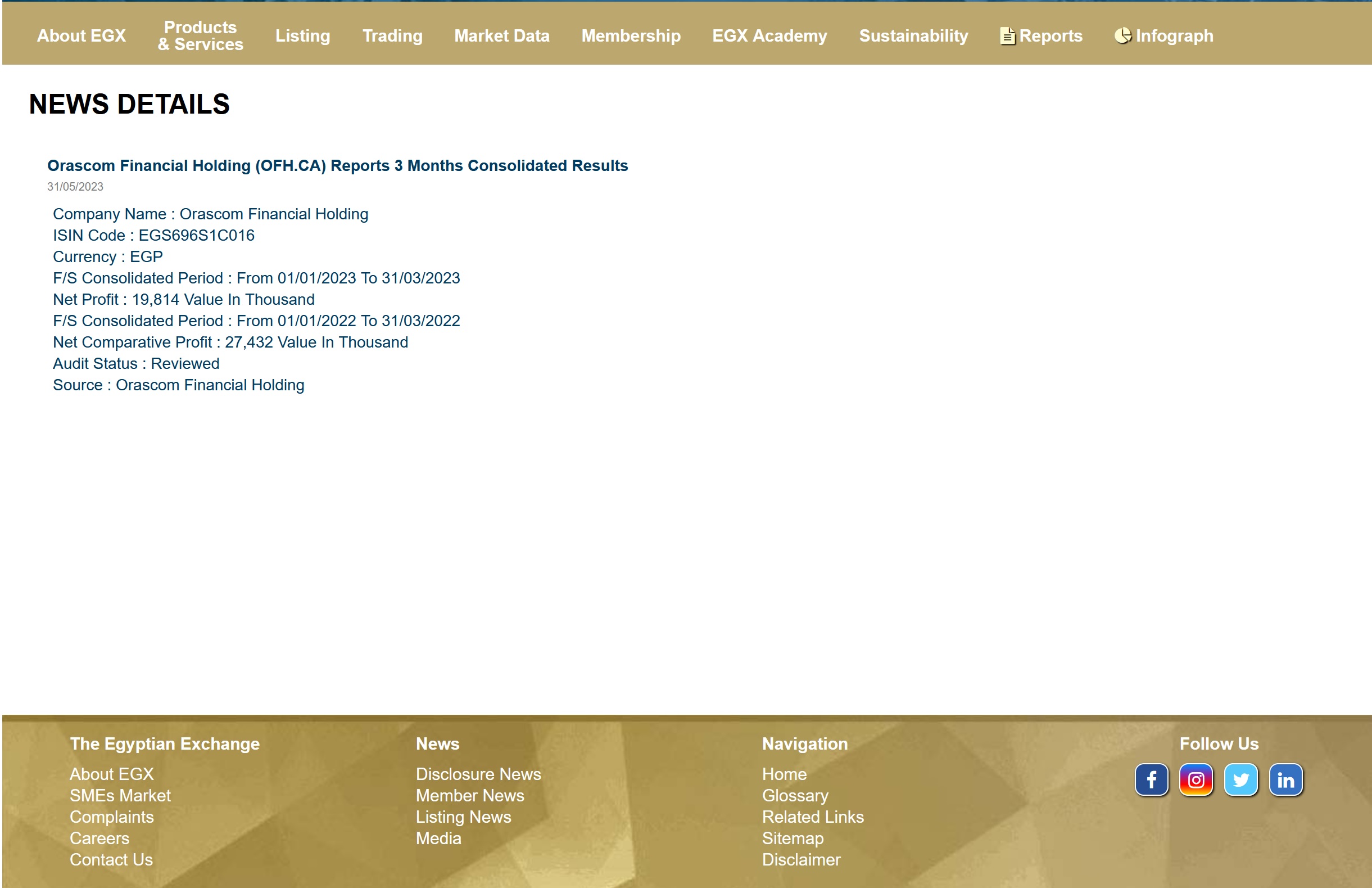
OFH by the numbers: The company’s net income declined 28% y-o-y to EGP 19.8 mn in 1Q 2023, down from EGP 27.4 mn, according to a disclosure to the EGX.

Market reax:OFH’s share price closed 19.8% up at EGP 0.29 yesterday, and B Investments closed 6.7% up at EGP 21.77.

Advisors: Zaki Hashem & Partners was appointed legal advisor of B Investments, while OFH appointed White & Case as its legal advisor, according to El Labban.

4

POLL

Egypt’s central bank expected to leave interest rates unchanged in June

The Central Bank of Egypt (CBE) will keep interest rates unchanged when it meets on Thursday as the pace of global tightening begins to ease and prospects of a near-term EGP devaluation dim, according to our interest rate poll. Seven of the eight analysts we surveyed expect the CBE to hold rates steady, while the odd one out — economist Hany Genena — sees the CBE potentially swinging either way.

Where rates currently stand: The overnight deposit rate stands at 18.25% while the overnight lending rate is 19.25% and the main operation and disc. rates are at 18.75%. The central bank has hiked rates by 1k bps since March 2022 but left them unchanged during its latest monetary policy meeting in May.

Fed pause gives space for the CBE: The US Federal Reserve’s decision to keep rates on hold last week will allow the CBE more time to assess the impact of its recent rate hikes on the economy, several analysts tell us. “A potential hold on interest rates is likely as the CBE takes time to assess the situation and to hold off any moves that may increase the cost of public debt,” says Amr Elalfy, head of research at Prime Securities. Meanwhile, Hany Aboul Fotouh, a veteran of CI Capital, Arab Banking Corporation, and HSBC, says that a pause would “correspond to the Fed holding interest rates for the first time since March 2022 … The Fed’s decision impacted central banks all around the world and their decisions regarding monetary tightening.”

Keeping borrowing costs in check: HC Securities’ Heba Mounir also believes that that the central bank will keep rates on hold, citing the government’s “need to keep local debt servicing costs in check and stop increasing the burden on corporate borrowing” as well as President Abdel Fattah El Sisi’s recent suggestion that further EGP devaluations are off the cards. Economist Mona Bedeir had the same stance, saying that “the CBE will hold interest rates, since we see no further devaluation in the short-term.”

Expectations for a further devaluation have fallen in recent weeks: Even before the president appeared to rule out a further fall in the currency, a number of investment banks including Citi and Goldman Sachs had dropped their forecasts for an imminent devaluation this quarter on expectations for fresh FX inflows from tourism and the state offering program. Naeem Brokerage still believes that the central bank will move to a flexible exchange rate but only when there is sufficient FX liquidity, Allen Sandeep, the firm’s head of research, tells us. “Without that FX liquidity buffer being secured in advance, we don’t see any rationale for a standalone deval that would only lead to … another round of cost-push on the CPI index,” he says.

More rate hikes may not help rein in inflation, some say: Banking expert Mohamed Abdel Aal argues that the FX rate has a bigger impact on prices: “Over the past 15 months, the Monetary Policy Committee hiked interest rates by 10%. Yet, inflation did not recede and is still far from the official target figure — 7% (± 2%), which confirms that inflation figures are heavily linked to the exchange rate,” he says. CBE Governor Hassan Abdalla made a similar point in April, saying policy measures other than rate hikes may be needed to rein in price hikes and address supply bottlenecks that have pressured imports.

Inflation once again approached an all-time high in May: Annual urban inflation rose to 32.7% y-o-y in May from 30.6% the month before, marking a return to the near record high inflation recorded in March. Meanwhile, core inflation — often seen as a superior measure of price growth because it strips out volatile items such as food and fuel — rose to 40.3% y-o-y in May.

And it’s expected to move higher: “Assuming a stable exchange rate, we expect urban CPI to hover around 33% until June and to climb up to 34-35% by July / August,” Sandeep says, citing expectations for higher electricity and fuel prices in the coming months.

Could we see a surprise hike? One of the analysts we spoke to, Hany Genena, said the CBE could choose to make a significant hike of at least 200 bps if policymakers are planning to imminently allow a full float of the EGP in order to push through agreement with the IMF. In that scenario, rate hikes would be needed to attempt to keep a lid on the inflation that would result from the second-round effects of further depreciation and import pressures.

Further rate hikes may do more harm than good: “Any further rate hikes would only raise the cost of capital, deficit, and squeeze liquidity,” Sandeep says.

5

M&A WATCH

Ezz Dekheila Steel handed EGP 20 bn+ valuation ahead of potential stake sale

Ezz Dekheila Steel valued at more than EGP 1k per share ahead of stake sale: The Sovereign Fund of Egypt (SFE) has received a preliminary valuation of Ezz Steel subsidiary Ezz Dekheila Steel that puts the company’s worth at some EGP 1,060.00 per share, Asharq Business reports, citing sources familiar with the matter. The valuation was conducted ahead of a potential sale that could see the government offload a 14% stake in the EGX-listed Ezz Dekheila to its parent firm.

Remember: News of a potential stake sale broke last month when several local outlets reported that Ezz Steel was in negotiations with the government to purchase the shares in Ezz Dekheila held by the National Investment Bank (NIB) and the National Bank of Egypt (NBE). A government source confirmed to us the existence of the talks.

A closer look at the numbers: The proposed share price estimates the company’s total worth at more than EGP 20.7 bn and represents a premium of almost 30% on the company’s closing share price on Thursday.

What they said: Steel giant Ezz Steel has neither made nor received a formal acquisition offer and did not initiate a valuation, a source at the company told Enterprise yesterday, reiterating what the company saidin an EGX disclosure last month. We were unable to reach a representative of the SFE, whose role in the transaction remains unclear.

Shareholder structure: NIB holds an 8.1% stake in Ezz Dekheila Steel while NBE owns 5.7% — together forming the 14% stake that the government allegedly plans to divest. Other state institutions hold about 17.2% of the company. Ezz Steel holds a majority stake of 64% and the remainder is in freefloat.

Market reax: Ezz Dekheila Steel’s share price jumped 12.7% to close at EGP 925.06 apiece during yesterday’s trading session. Ezz Steel shares closed 6.9% higher at EGP 38.50.

6

Economy

Remittance flows to rebound this year after falling in 2022

Remittances to Egypt will rebound in 2023 as the number of Egyptians working abroad picks up following the covid-19 pandemic, according to the World Bank (pdf). The Bank expects remittance flows to increase by 3.1% in 2023 followed by weaker 1.4% growth the year after. This would put annual remittances at almost USD 29.2 bn this year, according to our math.

The FX crunch meant 2022 wasn’t a great year for remittances: Remittances from Egyptians abroad fell 10% to USD 28.3 bn last year as people sold FX on the black market or held onto it on expectations for a further EGP devaluation, according to the World Bank. Egyptian authorities have devalued the currency three times over the past year, causing it to lose almost half of its value against the USD. The lender had in December estimated that 2022 inflows would come in at USD 32.3 bn, which would have marked a 2.5% increase on the year before.

It wasn’t just Egypt: Remittances to the MENA region fell almost 4% to USD 64 bn in 2022, driven primarily by lower flows to Algeria and Jordan as well as here. It is projected that remittances for the overall region will stage a moderate rebound over the next two years, rising 1.7% in 2023 and 1.8% in 2024.

7

A MESSAGE FROM HSBC

HSBC senior economic adviser Stephen King on inflation and emerging markets

Following his recent visit to the Middle East, HSBC spoke to its senior economic advisor and author Stephen King for his thoughts on the global and regional economic outlook.

How is inflation in developed markets impacting on emerging markets?

Inflationary pressures on emerging markets depend on the causes of the inflation in developed markets. Higher energy prices, for example, are a global phenomenon so are likely to raise inflation across the world. However, a domestic-rooted spike in inflation in a developed economy will most likely affect emerging markets because of the impact of tighter US or European monetary policy on the exchange rate. A stronger USD or EUR implies higher prices of imports for those emerging markets with flexible currencies.

What do you think is the biggest contributor to inflation in emerging markets? Is it the increase in money supply or external shocks? And what’s the best way to combat it?

Emerging market inflation varies from the very low — for instance, China — to the very high, such as Argentina and Türkiye. China's slow emergence from the covid-19 pandemic alongside a reluctance to offer policy stimulus on a scale equivalent to that seen in the West explains why inflation there has been muted. Elsewhere, a reluctance to raise interest rates (or even to cut rates when inflation was already high) alongside a relaxed approach to exchange rate valuations has helped stoke inflationary pressures.

Whatever the cause of the inflation, one necessary response is usually that monetary policy will have to be tightened. “Second-round effects,” such as higher wage demands or bigger price increases can stem from faster growth in the money supply or higher energy and food prices. National governments, central banks and regulators cannot rely on hopes that external pressures will ease and carry no adverse inflationary consequences.

How important is fiscal policy / balance of payments (especially when a country suffers a current account deficit) in the context of inflation?

Going back to the first question, a country with a large external funding requirement — revealed via a large current account deficit — may be vulnerable if the cost of borrowing is rising elsewhere. If, for example, the US is raising interest rates, capital flows that might easily have gone to an emerging market with a large external deficit might now head to the US. The result is likely to be downward pressure on the emerging market currency, increasing the risk of higher imported inflation.

How sticky will inflation be going forward?

Persistently high, ‘sticky’ inflation is already greater than central banks anticipated. Many central bankers feared deflation more than inflation, thinking for too long that we were living in a Japan-style world of falling prices. Continued stickiness depends on whether policymakers have the appetite to tighten policy sufficiently to squeeze inflation out of the system. There is concern about the consequences for the “real economy” and for financial stability, although alternative remedies — such as price and wage controls — have a checkered history. As such, some policymakers are simply hoping that inflation will go away, in the anticipation that so-called “second round” effects will not materialize.

How risky are devaluation-inflation and wage-price spirals for emerging markets?

It depends on the condition the emerging market is in, and those with independent central banks are likely to fare better. So too are those markets with small current account deficits or large surpluses, as are those with healthy fiscal positions that have enough “space” to raise taxes or cut spending and which don't have too much in the way of indexation of either prices or wages. Resorting to the “printing press” to solve a fiscal problem is problematic, as history and more recent examples across the world have demonstrated.

Those countries with robust currency pegs will likely fare well — they have a tried and tested monetary policy. For many countries in the MENAT region, this is very good news. Because of the Federal Reserve's actions and the USD pegs, monetary conditions have become tighter, however, regional economies are in many cases strong enough to cope.

Stephen King (LinkedIn) is HSBC’s senior economic adviser and author of We Need To Talk About Inflation: 14 urgent lessons from the last 2000 years (Yale University Press). HSBC’s column appears in Enterprise every second Monday.

8

LAST NIGHT’S TALK SHOWS

Talk shows on the IFC’s new role in Egypt’s privatization program. PLUS: Sudanese official meets El Sisi in Cairo + Investigation into migrant boat shipwreck

Topping last night’s talk shows was the IFC’s new advisory role to the government on privatization efforts. Time was also dedicated to President Abdel Fattah El Sisi’s meeting with a high-ranking Sudanese government official and the latest developments in the tragedy of the migrant boat that sank off the Greek coast last week.

The IFC’s new advisory role will build confidence among international investors on the state’s privatization program, said Kelma Akhira’s Lamees El Hadidi (watch, runtime: 6:20). Al Hayah Al Youm (watch, runtime: 4:45) and Ala Mas’ouleety also covered the agreement (watch, runtime: 3:17).

More than just an advisor: As a potential investor as well as an advisor in the privatization program, the IFC will continue to play a crucial role after offerings have closed to mobilize further investment and boost the role of the private sector, former EGX head Sameh El Turgoman told El Hadidi (watch, runtime: 6:27).

El Sisi x Sudanese Sovereignty Council: President Abdel Fattah El Sisi met with the deputy chair of Sudan’s ruling Transitional Sovereignty Council, Malik Agar, in Cairo yesterday, a statement said. El Sisi stressed the need for both sides in the conflict to enforce a permanent ceasefire and initiate a dialogue for a secure and stable future in Sudan. The meeting got coverage on Kelma Akhira (watch, runtime: 4:27), Al Hayah Al Youm (watch, runtime: 9:35), and Masa’a DMC (watch, runtime: 1:17). Agar laid out the council’s preconditions for considering peace initiatives on Hadith Al Qahera (watch, runtime: 1:23 | 1:04 | 0:56).

Migrant boat shipwreck: Athens authorities will today begin an investigation into the migrant boat that sank off the Greek coast, causing the deaths of hundreds of people including an unknown number Egyptians, Emigration Minister Soha Gendy said on Ala Mas’ouleety (watch, runtime: 3:47 | 4:10). Nine of the survivors on board the boat are under arrest for their potential involvement, Gendy said.

AND- Wafd party leader Abdel Sanad Yamama became the first person to officially announce their candidacy in next year’s presidential election after receiving the backing of 90% of the party’s high committee. Yamama made the announcement on Mostafa Bakry’s Facts and Secrets show on Sada El Balad (watch, runtime: 47:21).

This publication is proudly sponsored by

9

Also on our Radar

Abu Dhabi Ports to launch tender to build silos worth EGP 1 bn at Egyptian ports

INFRASTRUCTURE-

Abu Dhabi Ports silo project up for grabs:Abu Dhabi Ports (ADP) and its subsidiary Transcargo International (TCI) are planning to launch a tender for the construction of nine silos for storing cement and dry bulk cargo at a cost of some EGP 1 bn, Al Mal reported yesterday, citing sources it says are in the know. The silos are expected to be up and running by the end of 1Q 2024, according to the newspaper’s sources. The Emirati company signed two 15-year agreements in mid-March to develop cement terminals at the Al Arish and West Port Said ports.

BACKGROUND- ADP, which is majority owned by Abu Dhabi wealth fund ADQ, took over Transcargo last year after it acquired its parent company International Associated Cargo Carrier for USD 140 mn.

10

PLANET FINANCE

Goldman Sachs remains skeptical on US inflation outlook. PLUS: Silicon Valley investor eyes Saudi startups + Binance dodges SEC asset freeze

Goldman casts doubt on optimistic US inflation outlook: Goldman Sachs has warned that the pace at which inflation in the US is currently expected to drop may be overly optimistic, suggesting it won't decline as quickly as markets are currently pricing. The Federal Reserve recently paused its series of interest rate hikes but said it would likely resume them later in the year due to persistent price pressures and a strong labor market. (Bloomberg)

Silicon Valley VC to go big on Saudi startups: Silicon Valley-based tech investor Plugand Play Tech Center is planning to raise a USD 100 mn fund to invest in Saudi tech startups, Bloomberg reports. The investor is in talks with Jada, a USD 1 bn fund set up by the kingdom’s wealth fund, to back the venture, which is set to launch by January, the news outlet reports.

Binance side steps SEC asset freeze: Binance has avoided a total asset freeze as the cryptocurrency trading platform is pursued in courtby the US securities regulator over alleged mishandling of customer funds, reports Bloomberg. Under the agreement, the company must repatriate US customer assets worth more than USD 2.2 bn and is prohibited from spending corporate assets other than to cover operational costs.

EGX30

18,026

+0.8% (YTD: +23.5%)

USD (CBE)

Buy 30.84

Sell 30.96

USD at CIB

Buy 30.85

Sell 30.95

Interest rates CBE

18.25% deposit

19.25% lending

Tadawul

11,517

0.0% (YTD: +9.9%)

ADX

9,447

+0.7% (YTD: -7.5%)

DFM

3,789

+1.5% (YTD: +13.6%)

S&P 500

4,410

-0.4% (YTD: +14.9%)

FTSE 100

7,643

+0.2% (YTD: +2.6%)

Euro Stoxx 50

4,395

+0.7% (YTD: +15.9%)

Brent crude

USD 76.61

+1.2%

Natural gas (Nymex)

USD 2.63

+3.9%

Gold

USD 1,971.20

0.0%

BTC

USD 26,442

-0.2% (YTD: +60.2%)

THE CLOSING BELL-

The EGX30 rose 0.8% at yesterday’s close on turnover of EGP 1.83 bn. Local investors were net buyers. The index is up 23.5% YTD.

In the green: Ezz Steel (+6.9%), Eastern Company (+5.4%) and Elsewedy Electric (+4.5%).

In the red: Orascom Construction (-2.3%), Mopco (-1.1%) and Abu Dhabi Islamic Bank (-0.8%).

11

BLACKBOARD

Challenges of building a new school in Egypt

Beyond the bureaucracy, what are the challenges of setting up a new school in Egypt? Last month, we broke down the process of how to open a new private or international school in Egypt with a step-by-step guide, as outlined by the Education Ministry. While the process is relatively straightforward, it can be somewhat tedious and bureaucratic at times. Today, we look into the challenges that investors face when setting up a new private or international school, beyond the procedural issues.

REFRESHER- Setting up a school starts with determining the type of school and which curriculum it will follow, which will determine the next steps and the organization that will provide accreditation for the school. Investors need to find a plot of land that works for the school, and get clearances from various ministries to certify that there are no ownership conflicts or other issues standing in the way of the land being used to build a school. The next steps include getting a license from the Education Ministry, approving blueprints with the General Authority for Educational Buildings, constructing the actual school, and getting curriculum approval and accreditation.

Challenge #1- The financial aspect: The main challenge investors face when setting up a new school is the cost — particularly when factoring in the current high-inflation environment, our sources agree. “A new small school could cost anywhere between EGP 180-200 mn just for the basics — the building, all the furniture, playgrounds, and resources,” Emerald Education CEO Eman Korani told Enterprise. The establishment of a new school requires spending on land — which, in Greater Cairo, can range anywhere between EGP 1,735 per sqm to EGP 14,780 per sqm. Licensing a school is an additional cost, with private schools required to pay EGP 15k for a new license, in addition to EGP 5k each year for renewal, while international schools pay EGP 30k for a new license and EGP 25k for the annual renewal.

Costs are difficult to budget, thanks to inflation: “Unfortunately, in this economy, you can’t accurately predict the building costs, because they can change drastically between when you start conducting feasibility plans and setting your budget, to when you actually start building, and then to something else by the time you’re finalizing construction,” said international school consultant Walid Askar. These price increases — which affect everything from building materials to the daily wages of construction workers — are difficult to anticipate and can significantly skew a financial plan, Askar noted.

The inflexibility of tuition fees is also a thorn in investors’ side: Government regulations set a limit on annual tuition fee increases for international schools at 7% and for private national schools at 10%. “But inflation is much higher than that, which puts us as investors at risk,” Korani said. “Schools set their tuition fees from the outset and then they’re constrained by how much they can increase them each year to keep up with rising costs,” she said.

Challenge #2- The staffing: Government schools have been faced with a teacher shortage — exacerbated by low pay and a lack of necessary qualifications — for the past few years, which former education minister Tarek Shawki previously put at as many as 250k. Private and international schools face their own set of challenges when it comes to staffing, particularly securing and retaining foreign teachers. Teacher salaries typically account for around two-thirds of a school’s annual expenses, CIRA Education CEO Mohamed El Kalla previously told Enterprise. Many schools are looking to lean into more local hires for its teaching staff, as opposed to foreign teachers — whose salaries are paid out in foreign currency — to keep costs low, but this also makes Egypt a less attractive destination for international teachers, El Alsson Executive Director Karim Rogers previously said.

Challenge #3- Some regulatory + legislative limitations: The current law governing private and international school fees mandates that schools must notify the Education Ministry of their tuition fees at the beginning of each academic year, which Korani said is a “big challenge” for investors because it limits schools’ freedom in setting their own fees. “The government should trust educators and investors who chose to invest in education, which is a service to society. These investors should get encouragement and incentives, rather than limitations from the government,” she said. Korani suggested that new investors should get incentives, such as tax exemptions for the first several years of operation, to encourage more investments in the sector.


JUNE

June: Suez Canal Economic Zone India roadshow.

June: Egyptian-Saudi business forum.

June: Indian Prime Minister Narandra Modi to visit Egypt.

12 June - 15 July (Monday-Saturday): Thanaweya Amma exams.

18-21 (Sunday-Wednesday): Afreximbank annual meetings, Accra International Conference Center, Ghana.

19-20 June (Monday-Tuesday): Forum for insolvency reform and corporate restructuring in the Middle East and North Africa.

19-21 June (Monday-Wednesday): Egypt Infrastructure and Water Expo, Egypt International Exhibition Center.

19-21 June (Monday-Wednesday): Big 5 Construct, Egypt International Exhibition Center.

20 June (Tuesday): The House reconvenes.

20 June (Tuesday): Capital Markets Annual Summit, Nile Ritz-Carlton Hotel.

22 June (Thursday): Central Bank of Egypt’s Monetary Policy Committee meeting.

28 June-2 July (Wednesday-Sunday): Eid El Adha (TBC).

30 June (Friday): June 30 Revolution Day.

30 June (Friday): Application deadline for the Smart Green Projects initiative.

30 June (Friday): Egypt to exit Grains Trade Convention.

JULY

1 July: House of Representatives deadline to approve the FY 2023-2024 budget.

1 July: GAFI to launch the country’s first integrated electronic platform to facilitate setting up a business.

5 - 6 July (Monday - Tuesday): Gov’t to pay out subsidies to first wave of applicants under its sixth export subsidy program.

15 July (Saturday): Deadline for bids in EGPC’s mature oil fields tender.

18 July (Tuesday): Islamic New Year.

18-19 July (Tuesday-Wednesday): Egypt Mining Forum, Nile Ritz-Carlton, Cairo.

19 - 20 July (Wednesday - Thursday): Gov’t to pay out subsidies to second wave of applicants under its sixth export subsidy program.

20 July (Thursday): National holiday in observance of Islamic New Year (TBC).

23 July (Sunday): Revolution Day.

25-26 July (Tuesday-Wednesday): Federal Reserve interest rate meeting.

27 July (Thursday): National holiday in observance of Revolution Day.

Late July-14 August: 2Q2023 earnings season.

AUGUST

August: Hassan Allam Utilities + Agility to open Yanmu East logistics park.

2 - 3 August (Wednesday - Thursday): Gov’t to pay out subsidies to second wave of applicants under its sixth export subsidy program.

3 August (Thursday): Central Bank of Egypt’s Monetary Policy Committee meeting.

10 August (Thursday): Shalateen Mineral Resources gold mining tender closes.

22-24 August (Tuesday-Thursday): BRICS summit, Johannesburg, South Africa.

SEPTEMBER

September: Sustainable Debt Coalition Initiative agreed at COP27 to launch.

September: IDH to open first branch in Saudi Arabia.

September: The Egypt-Germany trade and investment joint conference in Cairo.

September: JETRO’s second delegation arrives in Cairo.

9-10 September (Saturday-Sunday): G20 summit, New Delhi, India.

10-12 September (Sunday-Tuesday): The International Agricultural Exhibition for Africa and the Middle East, Sahara.

15 September (Friday): IMF to review USD 3 bn program.

15 September (Friday): Deadline for FX bureaus to comply with new capital requirements.

17-18 September (Sunday-Monday): Arab Security Conference and Exhibition, Nile Ritz Carlton.

17-19 September (Sunday-Tuesday): Sharm Rendezvous, Rixos Premium Seagate, Sharm ElSheikh.

19-20 September (Tuesday-Wednesday): Federal Reserve interest rate meeting.

21 September (Thursday): Central Bank of Egypt’s Monetary Policy Committee meeting.

21-23 September (Thursday-Saturday): Narrative PR Summit, Somabay.

25 September (Monday): Nasdaq deadline for Swvl Holdings Corp to increase its market value of publicly held shares to a minimum of USD 15 mn.

25-26 September (Monday-Tuesday): Egypt to host the Asian Infrastructure Investment Bank’s annual board meeting, Sharm El Sheikh.

26 September (Tuesday): Prophet Muhammad’s birthday (TBC).

28 September (Thursday): National holiday in observance of Prophet Muhammad’s birthday (TBC).

28-29 September (Thursday-Friday) Medical Tourism Conference, Sharm ElSheikh.

OCTOBER

October: Deadline for ins. providers to link their databases with the FRA.

2-4 October (Monday-Wednesday): Sharm Rendezvous - Ins. Market, Rixos Premium Seagate, Sharm ElSheikh.

2-5 October (Monday-Thursday): ADIPEC 2023, Abu Dhabi National Exhibition Center.

6 October (Friday): Armed Forces Day.

9-11 October (Monday-Wednesday): Arabs Savings and Financial Literacy Conference, Four Seasons Hotel.

13 October- 20 October (Friday-Friday): The sixth edition of El Gouna Film Festival (GFF).

Late October-14 November: 3Q2023 earnings season.

15-17 October (Sunday-Tuesday): Egypt Automotive Aftermarket Exhibition, Cairo International Convention Center.

26 October (Thursday): Daylight saving time ends.

29-31 October (Sunday-Tuesday): Egypt Energy, Egypt International Exhibition Center.

29 October - 2 November (Sunday- Thursday): Cairo Water Week.

30-31 October (Monday-Tuesday): Intelligent Cities Exhibition and Conference, Dusit Thani LakeView, Cairo.

30-31 October (Monday-Tuesday): Global Business School Network (GBSN), American University of Cairo.

31 October - 1 November (Tuesday-Wednesday): Federal Reserve interest rate meeting.

NOVEMBER

2 November (Thursday): Central Bank of Egypt’s Monetary Policy Committee meeting.

9-15 November (Thursday-Wednesday): Intra-African Trade Fair, Cairo.

14-15 November (Tuesday-Wednesday): Destination Africa, Royal Maxim Palace Kempinski Hotel.

15-24 November (Wednesday-Friday): Cairo International Film Festival, Cairo.

19-22 November (Sunday-Wednesday): Cairo ICT, Egypt International Exhibition Center.

23 November (Thursday): Worldview Education Fair, Cairo. (Register here)

DECEMBER

10-11 December (Sunday-Monday): eGlobe Expo, St. Regis Almasa Hotel, Cairo.

12-13 December (Tuesday-Wednesday): Federal Reserve interest rate meeting.

12-14 December (Tuesday-Thursday): Food Africa Expo, Egypt International Exhibition Center.

21 December (Thursday): Central Bank of Egypt’s Monetary Policy Committee meeting.

EVENTS WITH NO SET DATE

2023: The inauguration of the Grand Egyptian Museum.

Summer 2023: EGX to launch a shariah-compliant index.

1H 2023: GAFI roadshow set to launch to drum up foreign investment for golden licenses

1H 2023: Abu Dhabi Islamic Bank intends to launch a digital consumer finance company

2H 2023: Egyptian government expected to sign agreements with a consultant for the EuroAfrica electricity interconnector.

2H 2023: President Abdel Fattah El Sisi and Turkish President Recep Tayyip Erdogan expected to hold a summit.

3Q 2023: E-Finance to launch in Saudi Arabia.

4Q 2023: EGX to launch its new futures exchange.

End of 2023: A Developments’ first phase of the Lazoghly development completed.

2024: Standard Chartered Bank to open a branch in Egypt.

November 2024: Egypt to host the 12th session of the World Urban Forum (WUF12).

2Q 2025: Safaga Terminal 2 to initiate operations.

Now Playing
Now Playing
00:00
00:00