Good morning, all. After a slow start to the week, with all eyes on the grand opening of the Grand Egyptian Museum, the news flow has picked up. Debt news leads the news well, as we follow up on our maiden local sukuk issuance.
PSA-
WEATHER- The temps are dropping in Cairo today, the capital will see a high of 27°C and a low of 19°C, according to our favorite weather app.
It’s a few degrees hotter in Alexandria, which is in for a high of 29°C and a low of 20°C.
FROM THE DEBT MARKETS-
The CBE is holding its second EUR-denominated t-bill auction of the year: The Central Bank of Egypt is looking to raise some EUR 600 mn from auctioning off one-year, EUR-denominated treasury bills, according to the CBE website. The submission deadline for the auction is today at 11am. This follows a successful issuance in August, which saw yields drop a whole 1.25 percentage points to an average of 2.25%.
HAPPENING TODAY-
Attention, aspiring MBA students. The SEED Business School Festival at Dusit Thani Lakeview today will give you the chance to discover Master’s programs, get your application fee waived, and take part in workshops. The event is free to attend, but make sure to register through the SEED Global Education website. The event will run from 4:30-9pm. For more information, check out Newton Education Services’ social media channels.
HAPPENING TOMORROW-
Non-oil private sector activity to break its seven-month streak in the red? S&P Global will release PMI figures measuring non-oil private sector activity for October on Tuesday. Last month’s report saw the country’s headline figure contracting to 48.8, taking us further away from the 50.0 threshold that separates growth from contraction, which it has only passed two times since November 2020.
Get Enterprise daily
The roundup of news and trends that move your markets and shape corporate agendas delivered straight to your inbox.
** Were you forwarded this email?Tap or click here to get your own copy delivered every weekday before 7am Cairo time — without charge.
ICYMI- Missed this week’s Inside Industry? In our weekly vertical exploring all things industry and manufacturing, we spoke to Arda Çimen, Badr plant manager at Schneider Electric. Check out the story here.
THE BIG STORY ABROAD-
No single story is dominating today’s headlines, but few are getting top billing:
Israel threatened to increase its attacks against Hezbollah in Lebanon with Israeli Prime Minister Benjamin Netanyahu saying that Israel “shall take whatever action is required” to prevent Hezbollah from opening a new front. Meanwhile, US special envoy Tom Barrack warned that time is running out for Lebanon’s government to enforce the ceasefire deal struck last year, which requires Beirut to disarm Hezbollah, something both Israel and Washington say the group is actively refusing. (Bloomberg | New York Times | Guardian)
ALSO WORTH READING THIS MORNING‑ Top AI labs including Google DeepMind, Anthropic, OpenAI and Microsoft are racing to plug a new security hole in large language models that allows hackers to embed commands in emails or websites and trick the models into spilling confidential data, the Financial Times report.
AND- US envoys are accused of deploying “bully‑boy tactics” to intimidate diplomats from Africa, the Pacific, and the Caribbean into sidelining the UN-backed Net Zero Framework for global shipping, writes the Financial Times.
*** It’s Blackboard day: We have our weekly look at the business of education in Egypt, from pre-K through the highest reaches of higher ed.
In today’s issue: We take a look at how Egypt’s corporate learning and development scene is being reshaped by economic pressures, rapid tech change, and the rise of artificial intelligence.
The Opening of The Kaktus Hotel marks a new destination in Somabay, inspired by active lifestyle and culinary destination offerings. The Kaktus has finally bloomed on the Red Sea.
Four Gulf banks will subscribe to our first-ever local sukuk issuance hitting the market today, with settlement scheduled for the day after, according to a document seen by EnterpriseAM. The EGP 3 bn, three-year ijara issuance — a leasing-based Islamic security — will be linked to assets owned by the Finance Ministry in the Red Sea’s Ras Shukeir area, a source previously told us.
(Tap or click the headline above to read this story with all of the links to our background as well as external sources.)
Who’s interested? Our maiden local sukuk issuance has attracted the interest of Abu Dhabi Islamic Bank, Kuwait Finance House, Faysal Islamic Bank, and Al Baraka Bank, in addition to primary dealers from our banking sector, a senior government source told EnterpriseAM. “Interest from those Gulf banks is expected to enhance the competitiveness of local sukuk issuances," our source told us.
The issuance is part of a wider sukuk program, which was recently quadrupled on the back of strong demand to EGP 200 bn for the fiscal year, a senior government source told us. The government originally planned to take EGP 25 bn worth of local sukuk to market this fiscal year, before doubling its target amid strong appetite.
Competitive yields and longer maturities: The bids show the yield will be highly competitive, driven by increased interest in the forthcoming issuance, according to our source. The Finance Ministry also plans to extend the maturity of the new sukuk issuances after using the first tranche to establish a pricing framework, with the aim of launching a weekly issuance with maturities ranging between 3, 5, and 7 years, the source added.
The issuance is expected to boost investments in local debt instruments and attract a new segment of investors eyeing shariah-compliant securities, with the aim of diversifying the country’s range of debt offerings, we were told.
Beltone Holding’s Beltone Venture Capital exited Moroccan last-mile delivery logistics platform Cathedis with a 100% internal rate of return, according to a press release (pdf). This transaction marks Beltone Venture Capital’s first regional exit and its third overall since inception.
(Tap or click the headline above to read this story with all of the links to our background as well as external sources.)
Moroccan investors acquired the platform: Moroccan tech company ORA Technologies and Azur Innovation Fund fully acquired Cathedis, marking the first consolidation between Moroccan startups funded entirely with local capital, according to another press release.
What they said: “We saw a clear opportunity in Cathedis Morocco’s leading last-mile delivery and logistics platform. We invested with vision, supported its growth, and exited with success,” CEO and Managing Partner of Beltone Venture Capital Ali Mokhtar said.
REMEMBER- Beltone Venture Capital has been ramping up its investments in Morocco and at home this year. The company made an undisclosed equity investment in Moroccan eyewear brand LNKO, participated in a USD 1.1 mn seed round for insurtech startup Sehatech, and invested in Sylndr’s USD 15.7 mn series A funding round.
Beltone Venture currently manages USD 50 mn in assets under management and has a portfolio of 21 tech-driven companies across various sectors in the region. It also oversees a USD 5 mn venture debt portfolio with a data-driven investment strategy.
The government is working on a new natural gas pricing formula for industry, starting with energy-intensive sectors, three government sources told EnterpriseAM. The plan aims to gradually transition to a freemarket price aligned with global benchmarks as part of efforts to establish a liberalized natural gas market, attract foreign investment, and strengthen the competitiveness of local products by properly pricing key inputs, including energy.
(Tap or click the headline above to read this story with all of the links to our background as well as external sources.)
The details: The new pricing mechanism will be based on the average cost of domestic gas production, in addition to the contracted price of gas supplied through pipelines and imported cargoes, ± USD 1, the sources said.
Policy objective: Reducing subsidies and strengthening the EGPC’s financial position as an independent entity sits at the core of the plan, sources said, adding that ensuring fair pricing for high-quality local industrial output is a key target.
The policy will first be applied to fertilizer players, one of the sources told us.
ICYMI- The government raised natural gas supply prices for the industrial sector by 28%, or USD 1 per mn British thermal units (BTU), starting 15 September in a bid to balance local market needs and secure gas supplies for factories. We published an Inside Industry shortly after the decision came into effect looking at the impact of the price hike on various industries — check it out here.
The move will not undermine industrial localization efforts, according to our sources. Under the new pricing system, the state will grant strategic and priority industries energy incentives to support localization efforts. These incentives would be financed either by the public treasury or through cross-subsidization among products to allow the petroleum sector to grow and maintain balance, they added.
A monthly gas price review is being considered, the sources said. The review may keep prices as is, raise them, or lower them, giving industries a chance to benefit if global prices decline.
What do manufacturers think? A source in the petrochemicals sector called for fair gas pricing to ensure factories can meet both domestic commitments and export obligations.
REMEMBER- The government raised the tariff for transporting natural gas through the national grid a few months back.
IN OTHER ENERGY NEWS-
BP has added 80 mcf/d of natural gas to its output from its second RW5 well in the Raven natural gas field, according to a statement from the international energy player seen by EnterpriseAM. The addition from the North Alexandria concession brings the company’s combined output from its second development phase of its Raven natural gas field — which includes the RW4 well too — to about 140 mn cf/day since the beginning of the year.
Egypt Kuwait Holding (EKH) sold its entire 63.4% stake in Delta Ins. to Casablanca-listed Wafa Assurance in a EGP 3.2 bn (c. USD 67 mn) transaction, it said in a bourse disclosure (pdf). EKH booked an estimated USD 46 mn gain from the transaction in its standalone financials, and USD 3 mn in its consolidated results. Wafa said it plans to delist Delta from the EGX and merge Delta Life with its own life ins. arm within months of closing.
(Tap or click the headline above to read this story with all of the links to our background as well as external sources.)
REFRESHER- EKH’s board approved the sale last month, following Wafa Assurance’s mandatory tender offer for up to 125 mn Delta shares (100% of the company). The MTO valued Delta at up to EGP 5 bn and required a minimum acceptance of 51%.
Part of a broader portfolio rebalancing: CEO Jon Rokk told us in September that the company was doing a housekeeping exercise to exit non-core holdings and sharpen its sectoral and geographic diversification. He said the group’s next growth chapter will focus on international expansion, including new energy and industrial investments in Saudi Arabia and the UK, while maintaining strong exposure to Egypt.
ADVISORS- Our friends at EFG Hermes brokered the transaction and acted as EKH's financial advisor, while Baker McKenzie Cairo acted as counsel for the company. Sharkawy & Sarhan and A&O Sherman Morocco provided counsel for Wafa, while Attijari Conseil served as a financial advisor and Forvis Mazars provided tax and financial advisory services out of both Morocco and Egypt.
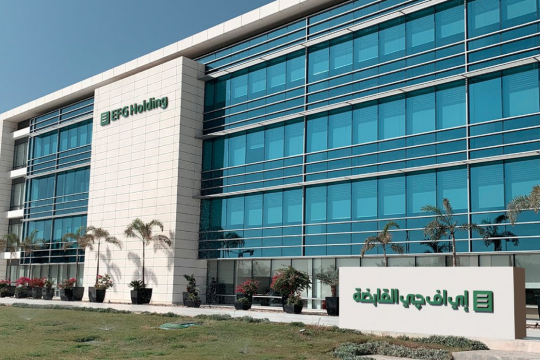
How to build a resilient company — and ensure its survival amid headwinds: EFG Holding has focused on building a resilient and shock-immune company over the past several years as the goal became “not a choice, but a matter of survival,” CEO Karim Awad said at FII9 in Riyadh last week, where EFG Hermes was the only Egyptian private sector participant (watch, runtime: 24:34). For EFG Holding — particularly considering the volatility of the Egyptian market and its macro conditions over the past several years — embedding resilience and building a shock-ready business model were existential imperatives, Awad said.
(Tap or click the headline above to read this story with all of the links to our background as well as external sources.)
When its core capital market business began facing volatility following the 2011 revolution, EFG focused first on controlling internal variables. “The first thing that we had to do to build a resilient model is control what we had under our control, which was our cost base. We started cutting our costs and became leaner to make sure that if any further shocks come in the future, we’re ready for them.”
Beyond cost reduction, EFG Holding had to fundamentally break and rebuild its structure. The strategy required abandoning comfortable, profitable but ultimately “non-synergistic” assets, pointing to EFG’s decision to exit Credit Libanais in 2018. The move to sell the asset and pivot came as the firm prioritized building a resilient structure. EFG Holding has also focused on diversification — both geographically and through lines of business — with an expanded presence and commitment across the region.
That entailed investing “a lot more effort” into markets like Saudi Arabia, Kuwait, and the UAE, while product diversification helped EFG mitigate its exposure to capital markets volatility. These diversified products provide “annuities and make sure that the business is shock ready for anything that comes in the future.”
Leading successful transitions with the aim of building a resilient business also requires governance, Awad stressed. Leaders need to be willing to “break things again,” even if it means sacrificing short-term performance in favor of the long-term strategy: “You have to have a patient board because sometimes breaking things means that you do not have the actual quarterly earnings that you want to achieve and that things take time to build.”
ALSO FROM FII9: EFG’s Ebeid touches on the regional angle of financial deglobalization: Capital flows in the Middle East have seen a gradual recalibration, with a shift from “just exporting capital” from the GCC in particular towards a more balanced capital flow structure where partnerships are the name of the game, Mohamed Ebeid, Co-CEO of EFG Hermes said at FII9 (watch, runtime: 28:40). Speaking at a panel alongside Islamic Development Bank Chairman Muhammad Al Jasser and Head of Investment and Corporate Banking at Mizuho Americas, Michal Katz, among others, Ebeid noted that “there have been a lot of partnerships coming from international investors; rather than just trying to do one-time offshore business, now they’re doing it more with local institutions and sovereign wealth funds in a more balanced way.”
That shift has also presented itself in how financing happens: “Rather than looking at global syndication from global banks, there have been sovereign sukuk issuances from governments [in the region] and different local institutions. There’s more dependency on regional private wealth, Ebeid noted. EFG Hermes’ IPO agreements also tell the same story in ECMs: In 2024, EFG Hermes led c.USD 18 bn worth of ECM transactions, with local and regional institutions, family offices, and high net worth individuals accounting for 70% on average of any transaction.
The country’s audit framework gets its first major overhaul since 2008: The Madbouly cabinet has issued a decision for a sweeping revamp of Egypt’s audit standards for the first time in 17 years, according to a statement from the Financial Regulatory Authority (FRA). The updated standards will come into effect in January 2027, replacing the country’s 2008 framework and bringing local auditing practices in line with international standards.
(Tap or click the headline above to read this story with all of the links to our background as well as external sources.)
A push for international alignment: The overhaul is designed to address gaps in Egypt’s audit ecosystem, enhance the quality of financial reporting, and align local practices with global standards. The FRA hopes the new framework will boost market transparency, improve disclosure practices, and increase investor confidence in Egypt’s capital markets.
What’s included in the new standards: The new framework consists of 46 new standards grouped into three main categories: Quality control and 37 updated audit standards; standards for limited review and assurance engagements; and a set of guidance notes and implementation tools to support auditors.
Raising the bar on quality control: A new quality control standard in the framework will require audit firms to implement internal systems that ensure compliance with legal and regulatory standards. Audit partners and offices will also be directly responsible for maintaining the quality of their reports under the updated rules.
Tackling high-risk areas more effectively: Under the new framework, auditors will now face stricter documentation and evidence requirements in sensitive areas such as fraud detection.
EGX-listed companies get new reporting requirements: Publicly listed companies will be subject to an expanded audit report format that includes the disclosure of key audit matters — a move expected to improve report clarity and enhance stakeholder insight.
The new framework also calls for broader adoption of audit tech and data analytics, while encouraging firms to train staff on modern digital tools.
The EGX30 climbed 4.4% in October to close at 38.3k points, according to the EGX’smonthly report (pdf). The gauge traded between a high of 38.4k and a low of 36.7k during the month, underperforming the EGX33 Shariah Index which advanced 7.3% over the same period. Total market capitalization rose 7.1% to hit EGP 2.8 tn.
(Tap or click the headline above to read this story with all of the links to our background as well as external sources.)
Turnover edged lower even as trading volume climbed: Total value traded on the EGX slipped 2.5% to EGP 1.65 tn in October, despite trading volumes rising to 40.1 bn securities up from 34.3 bn in September. Equities accounted for 8.7% of total turnover, while bonds and bills continued to dominate trading with 91.3% of the market.
Defensives led the rally: Education stocks outperformed with a 19.8% increase last month, followed by building materials (18.6%) and healthcare & pharma (13.1%). On the flipside, energy & support services saw the steepest decline falling 2% followed by trade & distributor names (-1.1%).
Local institutions were the only net buyers in October (excluding block trades), logging EGP 4.9 bn in net inflows. Regional and foreign institutions offloaded EGP 855 mn and EGP 1.4 bn, respectively. On the retail side, local investors sold EGP 2.2 bn, while regional and foreign individuals offloaded EGP 474.6 mn and EGP 5.3 mn, respectively.
Regional peers also ended last month in the green, with TASI up 1.3%, the ADX General Index rising 0.9%, and the DFM General Index advancing 3.8%, according to a Kamco invest report (pdf).
BROKERAGE LEAGUE TABLE-
In October: EFG’s two brokerage arms topped the EGX brokerage league table (pdf) last month with a combined market share of 21.4%, followed by Thndr (9.6%) and Mubasher (8.5%).
YTD, EFG’s two brokerages retained the top spot with a 20.9% market share, beating Thndr (7.7%) and Mubasher (7.1%), according to the bourse’s ranking (pdf) which tracked firms’ performance between January and October.
Prices for pretty much everything have risen over the last few years — and that includestipping, notes the New York Times in a deep dive into how tipping culture in Egypt has changed amid high inflation and a tough economy for many. Tipping is increasingly being relied upon by low-wage workers to make ends meet and the practice is spreading to professions that historically weren’t part of the process, notes the US paper of record.
#1- Elmarakby Steel is planning to invest EGP 500 mn to upgrade its high-carbon wire production lines over the next two years to boost local content and export competitiveness, Chairman Hassan Elmarakby told Al Borsa. The company is also implementing solar energy projects and upgrading production systems to reduce energy consumption and emissions, as well as raise total investments to EGP 6.5 bn by 2030, from EGP 5 bn today.
(Tap or click the headline above to read this story with all of the links to our background as well as external sources.)
#2- Local ice cream maker Friday plans to invest over EUR 15 mn into expanding production capacity, Chairman Mohamed Gomaa told Al Borsa. The investment will raise output from 24 tons to 36 tons per hour by adding new lines and upgrading existing machinery.
REAL ESTATE-
SED taps CCC to build EGP 12 bn mixed-use project in New Cairo: Saudi Egyptian Developers (SED) signed a construction contract with Consolidated Contractors Company (CCC) to develop its flagship EGP 12 bn mixed-use project Central in New Cairo, according to a company statement (pdf). CCC will handle full construction works under the four-year contract, covering civil, architectural, landscape, and interior finishes. Construction kicks off this month.
CAPITAL MARKETS-
#1-Misr Fertilizers Production Company (Mopco) has completed a EGP 2.5 bn accelerated bookbuild sale of 87 mn shares, sole financial advisor and bookrunner EFG Hermes said in a statement (pdf). The transaction is among the largest secondary equity sales in Egypt this year.
What they said: “This transaction exemplifies our broader efforts to deepen and grow access to liquidity in the region’s capital markets. It stands among a series of offerings that have reignited investor appetite for equities, a continuation of the momentum for new listings and follow-on offerings,” EFG Hermes Co-Head of Investment Banking Maged El Ayouti said.
#2- Real estate developer Uptown 6 October Developments is eyeing an IPO on the EGX in around three years to fund expansion plans, Chairman Ahmed Abou Zaid told Hapi Journal. The developer plans to offer 10-15% of its shares once ongoing projects are completed, which will likely be around 2028.
AUTOMOTIVE-
EIM to locally manufacture BAIC U5 PLUS:Egyptian International Motors’ (EIM) Alkan Auto is planning to invest USD 123 mn to start local production of the BAIC U5 PLUS next year, CEO Taher Shaheen told Al Borsa. The plan covers both ICE and EV models and targets a local component rate of about 45%.
The private equity industry is spooked — and it’s not just because of Halloween. Private equity is finding it increasingly difficult to raise fresh capital, leading the CEO of Swedish PE firm EQT, Per Franzén, to predict that some 80% of all private equity firms could turn into zombie firms by 2035 in comments to the Financial Times.
(Tap or click the headline above to read this story with all of the links to our background as well as external sources.)
Forget witches and ghosts, zombie firms are a more formidable spectre haunting the industry, which happens when an investment firm can no longer raise money for new funds and remains operational to manage the companies and investments it already has. Like the undead, these firms are technically alive, but are dead insofar as they no longer seal new acquisitions or raise fresh funds while they run down their existing investments.
It’s not just a nightmare on Wall Street, but a global issue, with only a third of the 15k or so PE firms having raised funds in the last seven years, according to Franzén. Of these 5k firms with some recent fundraising success, Franzén sees less than half of them carrying on this success in the next 5-10 years. But there’s good news for the largest firms with established global footprint, with 50 to 100 such firms expected to rake in 90% of all fresh funds in the next fundraising period.
REMEMBER- Hopes for a rebound of the sector at the start of the year began to fall apartby early April, when a fresh round of US tariffs sent markets wobbling after a strong start to the year. Transaction value in April fell 24% below the 1Q average, and dealcount dropped 22%, according to Bain and Company’s Private Equity Midyear Report 2025. Now, more than 18k funds are chasing USD 3.3 tn in capital — or USD 3 of demand for every USD 1 available — according to the report.
MARKETS THIS MORNING-
Asian markets are in the green this morning, with the Kospi leading gains (+2.4%) The Nikkei (+2.1%), Hang Seng (+0.5%), and Shanghai Composite (+0.1%) are looking at more moderate gains.
EGX30
38,083
-0.5% (YTD: +28.1%)
USD (CBE)
Buy 47.17
Sell 47.30
USD (CIB)
Buy 47.19
Sell 47.29
Interest rates (CBE)
21.00% deposit
22.00% lending
Tadawul
11,536
-1.0% (YTD: -4.2%)
ADX
10,100
-1.1% (YTD: +7.2%)
DFM
6,059
-0.8% (YTD: +17.5%)
S&P 500
6,840
+0.3% (YTD: +16.3%)
FTSE 100
9,717
-0.4% (YTD: +18.9%)
Euro Stoxx 50
5,662
-0.7% (YTD: +15.7%)
Brent crude
USD 65.03
+0.4%
Natural gas (Nymex)
USD 4.11
-0.4%
Gold
USD 4,003
+0.2%
BTC
USD 110,567
+0.5% (YTD: +18.2%)
S&P Egypt Sovereign Bond Index
954.04
+0.1% (YTD: +22.7%)
S&P MENA Bond & Sukuk
152.05
-0.2% (YTD: +8.7%)
VIX (Volatility Index)
17.44
+3.1% (YTD: +0.52%)
THE CLOSING BELL-
The EGX30 fell 0.5% at yesterday’s close on turnover of EGP 4.5 bn (5.6% below the 90-day average). Regional investors were the sole net sellers. The index is up 28.1% YTD.
In the green: TMG Holdings (+2.9%), E-finance (+1.8%), and EFG Holding (+1.2%).
In the red: Beltone Holding (-6.0%), Qalaa Holdings (-5.3%), and Egypt Aluminum (-2.9%).
CORPORATE ACTIONS-
Arab Developers Holding’s board approved raising the company’s issued capital to EGP 2.4 bn, up from EGP 1.4 bn, through a rights issue to existing shareholders, according to an EGX disclosure (pdf). The EGP 1.0 bn increase will be divided into 10 bn shares at a nominal value of EGP 0.10 each.
Egypt’s corporate learning and development (L&D) scene is being reshaped by economic pressures, rapid tech change, and the rise of artificial intelligence. Companies are rethinking how they train their people, with many moving away from traditional, classroom-style programs toward short, targeted, and skill-based learning that directly supports business goals, according to The Corporate Learning and Development Landscape in Egypt 2024 report (pdf) by the Onsi Sawiris School of Business Executive Education at the American University in Cairo.
THE METHODOLOGY- The report draws on interviews with 40 corporate executives across 13 industries — from banking and healthcare to ICT and agribusiness — as well as surveys of more than 100 executive education participants, highlighting a comprehensive picture of how Egyptian companies train, what skills they value most, and how they’re adapting their budgets and programs to keep up with global trends.
(Tap or click the headline above to read this story with all of the links to our background as well as external sources.)
Skills prevail over theory: Egyptian companies are shifting away from traditional, theory-heavy learning toward short, skill-based programs that deliver measurable business results. Almost one in five organizations identified technical training as their most urgent need — the highest share among all skill categories. Employers are seeking courses that close immediate gaps in areas such as AI, data analysis, and digital transformation, rather than the generic management courses that once dominated the market. Meanwhile, learners themselves are calling for hands-on, practical instruction. Experiential learning topped their list of unmet needs, with employees saying that programs often fail to provide real-world application or relevant local case studies.
Generic programs are losing ground. Around 41% of companies now favor customized training tailored to their business goals, compared with just 26% who rely on open-enrollment courses. Tailored training helps companies connect learning outcomes to their strategies and day-to-day operations. The goal is to make programs directly relevant to business performance, not just to personalize course content. Companies also want providers to blend hard and soft skills and to include industry-specific examples. In sectors such as ICT and insurance, firms report a growing disconnect between what’s being taught and what’s needed on the ground.
How do companies decide what to teach? The process of eliciting training needs has undergone its own transformation. Once driven almost entirely by HR and learning departments, training needs are now the result of cross-department collaboration. The share of companies where HR or L&D teams take the lead fell to 37% in 2024, down from a dominant 79% last year. In their place, department heads and senior management have taken a more active role, ensuring that learning priorities align with business outcomes rather than administrative checklists.
But strategy isn’t yet the main driver: Only 7% of companies base their training on long-term strategic vision — though that’s a small step up from 3% in 2023. The majority still rely on short-term needs assessments or ad hoc performance reviews to identify gaps. What’s disappeared almost entirely are market-based triggers. Unlike previous years, no company cited external pressures — such as competitor moves or market disruptions — as the reason behind their training plans. Egyptian firms are now focusing on internal skill gaps and immediate operational demands rather than external benchmarks. While this hands-on approach is practical, it also reveals that few companies use data or analytics to identify their training needs in a structured way. Many organizations still depend on manager observations or employee feedback rather than analytics or formal evaluation frameworks to determine what skills to develop.
Budgets are holding up despite the crunch: Despite the economic headwinds, the study found that 70% of companies expect to increase their training budgets in 2024. Healthcare and financial services now lead in L&D spending, overtaking automotive and oil and gas, which dominated in 2023. The trend suggests that more companies now view training as a strategic investment rather than an expense to be trimmed. Upskilling and reskilling are being seen as vital tools for retention and competitiveness, especially as companies struggle to attract and keep skilled workers. Timing also matters, as half of the companies now allocate L&D budgets in the final quarter of the year, aligning training with next year’s business planning cycle.
AI is changing how people learn: AI has become both a subject of training and a tool that shapes how learning itself is delivered. Artificial intelligence ranked as the top trending topic in corporate learning this year, cited by 30% of companies and 22% of learners. Beyond content, AI is also being used to personalize learning paths, track employee progress, and analyze performance data. Companies are beginning to experiment with AI-driven platforms and digital assessments that can tailor content to individual learning styles. Learners, for their part, are increasingly using platforms like Coursera and LinkedIn Learning for self-paced upskilling.
Local providers take the lead: With FX volatility and devaluation continuing to squeeze costs, companies are turning towards local training providers. Local providers now dominate Egypt’s corporate training market, accounting for 82% of all provider choices, up slightly from last year. Multinationals operating in Egypt still turn to international partners for executive or leadership programs, but even they are increasingly commissioning local institutions to deliver customized courses that are more affordable and contextually relevant.
Upskilling as a retention strategy: Eighty-seven percent of surveyed companies said that upskilling and reskilling are a top priority, which holds across both local and multinational firms. For employees, the payoff is tangible, as 48% said that training led to career advancement, while 28% said it resulted in both promotions and financial rewards. Another 28% reported no direct benefit, underscoring that while training opportunities are growing, their impact isn’t always guaranteed. Learners’ motivations also offer insight into Egypt’s evolving work culture. Around 43% said they seek training simply to stay current, while 30% do it for certification and 24% for promotion. In a fast-changing economy, continuous learning is increasingly seen as essential job security.
Short, intensive formats are in demand: Preferences are shifting toward shorter programs that can be completed in days or weeks, rather than months. Shorter courses fit easier into busy corporate schedules and deliver immediate value, while long-format programs are now reserved for leadership or strategic training. At the same time, on-the-job training remains one of the most widespread methods. 85% of both local and multinational firms use this as a cost-effective way to teach skills in real time. Hybrid and blended learning, which surged during the pandemic, has dipped slightly. Face-to-face training rebounded to 43% of corporate preferences in 2024, while hybrid dropped to 40% and fully online learning to 17%.
Coaching and mentoring are also making a comeback: Coaching and mentoring programs — once rare in Egyptian companies — are now mainstream. About 72% of organizations use coaching and mentoring, either formally or informally, to support staff development. Formal programs tend to focus on leadership pipelines and succession planning, while informal arrangements rely on peer-to-peer support and workplace mentorship. For multinationals, these initiatives are linked to global leadership strategies, while for local firms, they’re often used to foster loyalty and reduce turnover. A clear succession plan strategy is also gaining traction, as 62% of companies now have one in place, and among multinationals, the share rises to 80%.
Economic pressures are changing priorities: Training often takes a hit during downturns and this year was no exception. Companies reported cutting travel expenses, reducing team-building activities, and focusing only on courses tied to core business competencies. Roughly a quarter of firms said they’ve narrowed their L&D efforts to essential skills that directly impact performance. Meanwhile, others are turning to digital learning as a cost-saving solution, using online platforms to maintain training momentum while reducing overhead.
More companies are adopting formal systems to evaluate training success, moving away from simple satisfaction surveys toward data-driven assessment models. The Kirkpatrick Model — a global benchmark for measuring training effectiveness — has gained popularity, now used by 29% of companies surveyed. In most firms, HR and L&D departments are responsible for tracking performance, using a mix of KPIs, employee feedback, and supervisor evaluations.
Micro-credentials and e-learning are gaining traction: Digital platforms are transforming Egypt’s L&D ecosystem. Some 57% of organizations use e-learning platforms, with 30% opting for Coursera, 27% for LinkedIn Learning, and 23% for Udemy. Awareness of micro-credentials — short, skill-focused digital certificates — is still limited, but it is growing. Only 27% of companies are familiar with the concept, and just 21% have adopted it. Those that have said they appreciate the flexibility, affordability, and lifelong learning culture these credentials support.
What drives the provider selection: When choosing a training provider, 30% of companies care most about quality and 27% about reputation, the report found. Price, though important, ranks third with 18%. Firms are willing to pay more for proven providers rather than risk underperforming courses. Decision-making typically sits within HR and L&D departments, but finance and top management remain closely involved. Payment preferences vary, with one-third of companies preferring to pay only after successful program completion, while others opt for a 50-50 split.
Your top education stories for the week:
The Education Ministry signed a letter of intent with the UAE’s Digital School to develop technical education. The partnership aims to modernize technical schools, align them with labor market needs, and introduce programming courses under an accredited international system. (Statement)
Tunisian private equity firm AfricInvest made one of Egypt’s largest education sector investments to date in the British University in Egypt through a capital increase.
The Education Ministry signed an MoU with Japan’s Hiroshima University and education firm Sprix to offer high school students an accredited certificate in programming and AI via the Kiryu platform, the first of its kind in Egypt. (Statement)
4 November (Tuesday): S&P Global to release PMI data for September.
9-11 November (Sunday-Tuesday): The sixth edition of the TransMEA 2025 forum and exhibition, Egypt International Exhibition Center.
10 November (Monday): Capmas expected to release inflation data for October.
16-19 November (Sunday-Wednesday): Cairo ICT 2025, Egypt International Exhibition Center.
16-19 November (Sunday-Wednesday): The 12th edition of the Digital Payments and Financial Inclusion Exhibition and Forum (PAFIX 2025), Egypt International Exhibition Center.
20 November (Thursday): Monetary Policy Committee meeting.


 Egypt Edition
  UAE Edition
  Saudi Edition
  MENA <> India Corridor
  Logistics (MENA)
  Climate (MENA)


 Share Issue