Get EnterpriseAM daily

Available in your choice of English or Arabic

Egypt to launch 15-year bonds to break short-term debt churn

1

WHAT WE’RE TRACKING TODAY

GDP growth forecasts raised 0.7 percentage points from initial targets to 5.2% for the fiscal year

Good morning, good people, and Ramadan Kareem. We hope you enjoy that final, uninterrupted morning coffee today.

Today, we have a big shift in how Egypt handles its wallet, with the Finance Ministry looking to break the debt treadmill by launching 15-year bonds. Meanwhile, the Nile skyline is getting a massive facelift with an 11-km development plan that includes luxury hotels and high-rises.

And on the economic scoreboard, GDP growth forecasts were bumped to 5.2% for the current fiscal year, and the gender gap in unemployment is narrowing. We also take a deep dive into the world of private equity with Tanmiya Capital Ventures and explore why developers are finding it nearly impossible to build affordable housing without a little help from the state.

***

WISH THIS MORNING’S ISSUE was a podcast? We’ve got you. Tap or click here to listen to Morning Drive, a 10-minute version of today’s issue crafted for you to enjoy with your morning coffee, while getting the kids ready for school, or while stomping around the house wondering where the [redacted] you left your [redacted] reading glasses.
***

Watch this space

GROWTH — Egypt revised its GDP growth forecast for the current fiscal year to 5.2%, up around 0.2 percentage points from its most recent forecast, according to a cabinet statement. The full-year adjustment follows a robust 5.3% growth rate clocked in for 2Q.

Why this matters: Governments around the world often talk about the importance of underpromising and overdelivering, but end up both underpromising and underdelivering. Here in Egypt, with the government keen to signal a newfound fiscal transparency and seriousness under its reform agenda that really kicked off with the float of the EGP, the state can now point to the 12-month period’s growth outlook being a whole 0.7 percentage points above the target it originally set.

“This growth came as a result of the continued implementation of the package of structural, financial, and monetary reforms that strengthened macroeconomic stability and boosted its ability to adapt to internal and external challenges,” said newly appointed Planning Minister Ahmed Rostom.


EMPLOYMENT — The unemployment gender gap is narrowing — but there’s still a long way to go. While male unemployment was down 0.1 percentage points y-o-y to 3.8% in 4Q 2025, female unemployment fell a whole 2.3 percentage points over the same period to 14.3%, according to data from state statistics agency Capmas. Total unemployment saw a 0.2 percentage point decrease in the quarter to 6.2%.

Why this matters: The 2.3 percentage point improvement for women suggests a structural shift in how the labor market is absorbing female entrants. Female labor force participation also climbed to 21.7%, up from 18.5% last year, indicating that more women are not just looking for work — they are finding it.


CAPITAL MARKETS — Sustainable bond issuances in MENA are projected to hit USD 20-25 bn this year, as regional appetite (+3%) held up against a global slump (-21%) last year, according to a report from S&P Global. In 2025, the region’s total conventional bond issuance grew 10-15% to USD 81.2 bn, but the real story is the maturation of the sustainable sukuk market, which hit a record USD 11.4 bn (up 44% y-o-y). Sustainable sukuk accounted for 45% of all regional sustainable bond value last year, up from 33% a year earlier.

The market is a two-horse race, with the UAE and Saudi Arabia accounting for 80% of all sustainable regional bond issuances by value last year. While banks led the charge in Saudi, the UAE and Turkey saw corporates take the wheel.

Adding another layer to the funding mix, Islamic syndicated financing is also gaining traction. Outstanding global Islamic syndications rose about 16% last year to roughly USD 215 bn, lifting their share of total syndicated financing in core markets to 27.6%, Fitch says. Activity remains heavily concentrated in Saudi Arabia (34% of global outstanding) and the UAE (33%), with Egypt trailing at 8%.


ENERGY — The Energos Eskimo floating storage and regasification unit will return to Ain Sokhna by the summer to handle the jump in demand, a government source tells EnterpriseAM. The vessel left the port for maintenance last month amid a decline in seasonal demand.

The country may need its full regasification capacity to handle the expected electricitydemand rise of 6-7% in the hotter months of the year, which will be offset partly by some 130 incoming LNG shipments. The vessels are also essential to the Oil Ministry’s toll-booth approach to serving as a regional energy hub.

The roundup of news and trends that move your markets and shape corporate agendas delivered straight to your inbox.

Subscribe here

** DID YOU KNOW that we cover Saudi Arabia, the UAE and the MENA-IndiaCorridor?


Data point

77.6% — that was Egypt’s financial inclusion rate at the end of 2025, marking a 219% increase compared to 2016 and bringing the country within striking distance of its 80% target by FY 2029-30, the Central Bank of Egypt said in a statement. Today, some 54.7 mn adults aged 15 and above hold active financial accounts, out of a total adult population of 70.5 mn.

PSA-

WEATHER- It’s another cool, but dry, day in Cairo today, with a high of 23°C and a low of 12°C, according to our favorite weather app.

It’s a similar story in Alexandria, with a high of 21°C and a low of 11°C.

The big story abroad

The Netflix-Paramount-Warner Bros saga is making waves once again, after Warner Bros Discovery gave Paramount a seven-day window to propose its final bid, giving the suitor one last chance to counter rival Netflix’s offer. This came after Warner Bros rejected Paramount’s USD 30-per-share offer, but gave it a chance to put in its “best and final” offer. Investors have hinted that they will accept no less than 33 a share to consider a competing offer to Netflix’s current bid.

Social media giant Meta will buy mns of Nvidia chips under a multiyear agreement worth tens of bns of USD. The move potentially gives the chipmaker a leg up in maintaining its dominance as it faces intense competition from AMD and even from its own pool of Big Tech clients. Meta framed the move as an infrastructure agreement, whereby it will use the hardware for its AI-optimized data centers.

ALSO- A few software companies released their latest earnings early to quell the recent equity selloff prompted by fears over AI overtaking the tech sector. Speaking of the selloff, it showed signs of abating with the S&P 500 information technology sector rebounding from previous losses, closing in the green yesterday. The upswing was bolstered by gains in Apple and Nvidia stocks.

*** It’s Hardhat day — your weekly briefing of all things infrastructure in Egypt: EnterpriseAM’s industry vertical focuses each Wednesday on infrastructure, covering everything from energy, water, transportation, and urban development, as well as social infrastructure such as health and education.

In today’s issue: We talk to industry insiders to find out why the private sector needs a viable business equation to step in affordable housing.

Where the sea meets the saddle. The wait is over. The stage is revealed.

Egypt Equestrian Cup 2026. 📍Somabay. March 26 — 27 — 28

Three days of mastery. One arena. Countless legacies in motion.

2

The Big Story Today

Egypt moves to end the short-term refinancing wall

The Finance Ministry is moving beyond simple debt reduction toward a structural overhaul of the local bond market. The finalized public debt strategy — already briefed to the cabinet — aims to aggressively lengthen average maturities to 4.5-5 years, slash interest costs by 4% of GDP to 7%, and bring the debt-to-GDP ratio down to below 75% over the next three years, a senior government official tells EnterpriseAM.

The ministry is preparing to launch 15-year local bonds for the first time in a move designed to “extend the debt tenor and reduce the burden of maturities within a single fiscal year,” our source tells us. This is part of a broader reopening strategy where the government will stop launching fragmented new issuances and instead build up existing bonds to EGP 25 bn each — a key requirement for re-inclusion in major emerging market indices. Simultaneously, the secondary market is being democratized, allowing individual retail investors to trade T-bills and bonds directly on the EGX.

Why it matters: For years, Egypt has been trapped in a refinancing wall, constantly rolling over short-term debt at high costs. By pushing maturities toward a five-year average and targeting a drop in interest payments, the state is trying to claw back fiscal space. If successful, this reduces the crowding out of the private sector and signals to international markets that the era of emergency short-term borrowing is ending.

Local borrowing will continue to shoulder the lion’s share of the financing gap to hedge against exchange rate volatility. The strategy maintains a domestic-to-foreign financing ratio of 65% to 35%. To deepen the local market, the ministry plans to roll out green bonds, zero-coupon bonds, variable-rate instruments, and specific tools targeted at expats, we’re told.

In a move to de-risk the balance sheet, the ministry is cutting back on the guarantees it provides to government entities. Borrowing entities must now prove they can generate sufficient cashflow to service debt independently. “We are re-evaluating risk to reflect a portfolio management approach besides the current one focusing on analyzing specific state-owned firms,” the source noted.

This publication is proudly sponsored by

3

PRIVATIZATION WATCH

Two birds, one 11-km Nile-front plan stone

The Madbouly government is getting ready to offer up several large-scale hotel and residential projects along the Nile that could significantly change the face of the city, a senior government official tells EnterpriseAM. But driving the project isn’t just a desire to develop the capital’s main artery, but also to address the shortage of high-end hotel rooms ahead of ambitious tourism targets and a state divestment project that often finds itself stalling.

A recently approved plan will see significant changes along 11 km of the Nile and bordering areas in Maadi and Dar El Salam, including a substantial residential development in the area that now houses Tora Prison that will be done with the private sector. The plot next to the Supreme Constitutional Court, which has long been in limbo after demolitions of informal structures on the plot tragically led to the death of a child in 2014, will be developed by the Maadi Company for Development and Construction into a residential project.

The wider plan also includes a Nile-side financial and business district targeting global companies, which will be situated just south of the Maadi Yacht Club in the area formerly occupied by the military’s Maadi Factory 54, which used to churn out locally made AK47s. Chosen developers will be able to build up to 90 m high, our source tells us.

But addressing the country’s lack of hotel rooms is also a clear priority in the plan, with five plots shortlisted — mostly in Maadi — by the government to host hotel projects. These hotels are also set to significantly change the skyline of the city, with height limits reaching 140 meters — putting the planned towers among only a select group of buildings in the capital as tall. Other areas will also be earmarked for serviced apartments and entertainment areas with heights of up to 90 meters.

Why it matters: To hit the 30 mn tourist target by 2030, the country needs to add roughly 250k new hotel keys — effectively doubling its current capacity. These five new hotel plots and the decision to allow building up to 140 m will be just one way that the city will change as we push to have tourism play a larger role in the economy.

The plan also includes developing the former National Democratic Party headquarters next to the Egyptian Museum, with the winning consortium expected to be announced before the start of July, once the Sovereign Fund of Egypt wraps up its technical and financial reviews of submitted bids, we are told. Eleven consortia have thrown their hat in the ring, with a bid from a Qatari-Egyptian consortium and another from a Saudi-Emirati-Egyptian alliance being the two leading contenders, our source added.

4

Spotlight

Inside Tanmiya Capital Ventures and Egypt’s private equity market

Tanmiya Capital Ventures (TCV) is looking to deploy roughly USD 100 mn over the next two to three years, Managing Partner Mohamed Mahgoub (Linkedin) tells EnterpriseAM. Following the USD 130 mn close of its second fund in December 2024, the PE firm has already notched two plays and is hunting for four more mid-cap successes.

Things TCV looks at before investing

TCV applies “four filters” to invest in mid-cap companies — sector positioning, competitive advantage within the sector, management quality and alignment, and exit visibility. “The keyword that we always use with founders before investment is alignment,” he said. Current focus areas include food and beverage, FMCG, manufacturing, education, and select pharma plays.

Growth, not rescue: “We don’t do turnarounds,” Mahgoub says. The firm is sticking to its mandate of taking minority stakes in companies that already have the infrastructure and governance to scale. Their current hit list includes F&B, FMCG, manufacturing, higher education, and pharma.

Case study #1: Mahgoub said TCV’s investment in COPAD was driven by structural positioning rather than short-term advantage. More than “70% of their portfolio is flexibly priced,” he said, meaning a large portion of products falls under the National Food Safety Authority framework rather than the stricter drug-pricing regime of the Egyptian Drug Authority. That pricing flexibility, he explained, is critical in a market that has seen multiple currency devaluations and input-cost pressures.

Another key filter was limited exposure to government procurement cycles. “One of the main criteria we are looking at is small exposure or no exposure to public tenders,” he said, noting that delayed state payments can strain pharma manufacturers. COPAD also stands out as one of the largest and most organized family-owned pharma players in its segment, with a portfolio diversified across categories and positioned to replace smaller multinational players exiting the market. For TCV, the investment combined scale, pricing resilience, brand strength, and institutional capacity — all essential ingredients in a minority growth strategy.

Case study #2: On the topic of its Al Abd Patisserie investment, Mahgoub explained how TCV filters for scale, brand strength, and institutional capacity before investing. The company had “around 12 branches when we ventured into the business. There are now around 60 branches, heading towards 70,” he said. Beyond footprint, the brand has been in the market since 1974 and competes across “more than nine product categories,” giving it diversification and strong nationwide brand equity.

Operationally, Mahgoub highlighted infrastructure as a differentiator. The company has a robust supply chain, an engineering team capable of opening “a branch in eight weeks,” and is building what he described as the largest factory in its segment at roughly 45k sqm. For TCV, these are precisely the attributes it seeks — scale, institutional organization, strong management, and the capacity to grow in a structured, exit-ready way.

What LPs want to see in domestic family-run businesses

Mahgoub outlined a two-step transformation process that he believes ultimately draws
foreign institutional investors into Egyptian companies. For foreign and regional investors, he stressed, two elements matter most:

#1- Infrastructure and governance. This is achieved through introducing structured decision-making, clear reporting lines, defined responsibilities between management, the board, and shareholders, and institutional processes that replace informal, family-style decision-making. “The first and biggest transformation,” he said, is helping founders understand what it takes to have an institutional partner on the cap table — from governance to transparency.

#2- Credible, well-articulated growth. He explained that international institutions look for scale, clarity of strategy, and the ability to deploy capital behind the fastest-growing verticals with discipline rather than emotion.

Exit routes

On exits, Mahgoub said optionality has improved markedly over the past year. Historically, trade sales and secondary sales to larger regional private equity funds were the more visible routes, but “I think the public market has opened again,” he said, pointing to renewed foreign participation on the EGX and stronger aftermarket activity. The return of international institutional investors, he stressed, is critical.

“The comeback of international institutional investors was the gateway,” he said, noting that they are typically the largest ticket buyers and the most active in the aftermarket, often holding positions for three to five years. With Egypt being “one of the cheapest markets globally” and reform momentum continuing, IPOs are once again a viable exit path alongside sales to strategic investors from Saudi Arabia and the UAE and to larger regional or Africa-focused funds increasing allocations to Egypt.

That said, timing remains disciplined. “You do not go for a liquidity event when you achieve 100%… [and] you do not go for a liquidity event when you achieve 40% of your value creation,” Mahgoub said. Instead, TCV looks for a “sweet spot” — roughly 60-65% of targeted value creation achieved — leaving meaningful upside for the next investor.

The chosen route also depends on the founders’ ambitions: Some prefer IPOs to retain operational autonomy, while others seeking regional expansion may opt for a strategic partner. “It depends on the story,” he said, emphasizing that alignment with management ultimately determines the exit path.

The missing piece? Local funds

While IFIs remain the bedrock of Egyptian PE, Mahgoub argues the ecosystem won’t mature until local pension funds and insurers step up. “IFI investment should be a catalyst […] it cannot be the vast majority,” he says. For the private market to truly evolve, domestic institutional capital needs to follow the lead of the internationals.

5

Moves

Visa taps Malak El Baba as general manager of Egypt, Libya, and Sudan sub-region

Visa appointed Malak El Baba (LinkedIn) as the general manager of its newly launched sub-region of Egypt, Libya, and Sudan, according to a statement (pdf) from the digital payments player. El Baba steps into the role after serving as Egypt’s country manager for the past two years. She first joined the company in 2012 as marketing director for North and Francophone Africa.

AND- Al Tamimi & Company tapped Ingy Darwish (LinkedIn) as a partner at its Egypt office’s corporate department, according to a statement (pdf) from the law firm. Darwish is making a return to the company after having served as a senior associate at its UAE branch for six years until 2022. She brings expertise in M&A transactions, private equity, venture capital, corporate restructurings, and strategic investments across the MENA region.

6

EGYPT IN THE NEWS

Bloomberg does PR for the EGX

It’s not just investors here in Egypt who are paying close attention to the EGX30’s runaway start to the year, as Bloomberg is highlighting to its large readership that the country’s benchmark index is already up 27% in USD terms this year. The business news service notes that this isn’t just “far outpacing” developed markets, but is up more than 2x against the MSCI Emerging Markets Index.

At points, Bloomberg almost seems to be doing a sales pitch for Egyptian stocks, noting that a strong performance in 2026 follows a 50% return for USD investors in 2025. Looking ahead, the outlet notes that a strengthening EGP and a privatization push have “added to the appeal of Egyptian stocks.”

Bloomberg also called up some analysts to back its assessment, with Act Financial’s Allen Sandeep telling the outlet that “current valuations are still cheap” and “the EGX is right now on a positive re-rating path.”

7

ALSO ON OUR RADAR

Kemet adds 4.7 GW of new renewable energy in Upper Egypt

Kemet powers ahead with 4.7 GW renewable push in Upper Egypt

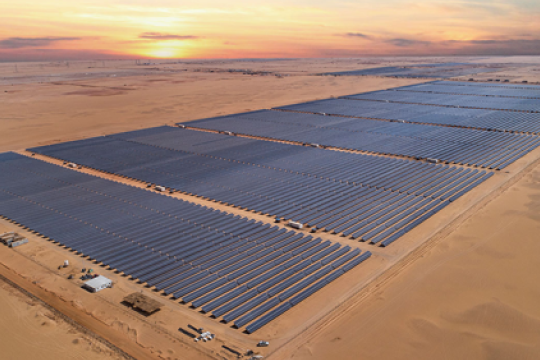
United Egypt Group’s industrial arm Kemet will add 4.7 GW of new renewable capacity through four major projects across the Bahariya Oasis and Nagaa Hammadi, according to a cabinet statement. Slated for 2027 operations, the rollout includes two solar plants in Bahariya Oasis (320 MW and 400 MW) and a massive 2 GW solar plant in Nagaa Hammadi paired with a 2 GWh independent battery energy storage system.

Why it matters: The move is another step toward the state’s 42% renewable energy target by 2030 and includes one of the region’s largest independent battery storage facilities. The storage component is critical for grid stability, allowing the national grid to manage the intermittent nature of solar power.

Bonyan locks in new tenant, eyes revenue upside

Bonyan is on a leasing streak, inking a five-year lease with Hassan Allam’s Kortech for Building 106B in Nasr City, shortly after signing Nestlé Egypt at Golden Gate Building A5, it said in a statement(pdf). The new tenant is set to move in this May, after the expiry of a legacy lease with B.Tech, giving Bonyan room to reset rents in line with current market levels.

Why it matters: Bonyan plans to reprice 15.2k sqm of EGP-denominated contracts up for renewal this year, equivalent to around 42% of its total EGP office rental income. By phasing out older contracts with sub-market rents and replacing them with new agreements at prevailing rates, the company is turning renewals into a built-in hedge against inflation and currency risk.

Edita’s distribution arm aims to turn its fleet electric

Edita Trade & Distribution — a subsidiary of Edita Food Industries — partnered with local EV startup Shift EV to electrify its nationwide distribution fleet, according to a statement (pdf). The move aims to boost operational efficiency, cut down on fuel consumption, and create cost savings.

REMEMBER- Edita Trade & Distribution maintains a fleet of 1.2k trucks and 25 distribution branches that deliver to 60k locations across the country.

8

PLANET FINANCE

MENA’s M&A surge is about buying global supply chains and tech dominance

M&A activity across the MENA region jumped in 2025, with value climbing 15% to USD 106.1 bn across 884 transactions, according to a report from EY. While domestic consolidation remained healthy, the real engine was cross-border activity, which accounted for 61% of value. The UAE and Saudi Arabia continue to dominate the landscape, capturing 59% of all regional investment and 66% of total investor activity.

Why it matters: We are seeing a shift from defensive domestic merging toward aggressive, strategic international expansion. Domestic transactions accounted for 46% of total volume at USD 41.6 bn. Outbound capital is no longer just parked in safe havens — 64% of outbound value was driven by government-related entities and sovereign wealth funds like Adia, Mubadala, and PIF, which are now using M&A to buy into global supply chains.

The sector play: Technology and diversified industrial products led the way, making up 38% of total volume. Meanwhile, the banking sector is aggressively eyeing the India-MENA corridor, evidenced by Emirates NBD’s USD 4.4 bn play for RBL Bank.

What’s next: Expect the surgical use of M&A to continue as companies look to acquire AI and tech capabilities to offset global trade uncertainties. The UAE remains the primary entry point for foreign capital, accounting for a massive 92% of total inbound value into the region.

MARKETS THIS MORNING-

Asia-Pacific markets are mixed in early trading this morning, with most of them reopening after taking yesterday off in observance of the Lunar New Year. Over on Wall Street, futures suggest that markets are in for another volatile trading day, despite hopes that the tech selloff will soon be over.

EGX30

51,834

+0.7% (YTD: +23.9%)

USD (CBE)

Buy 46.96

Sell 47.10

USD (CIB)

Buy 46.92

Sell 47.02

Interest rates (CBE)

19.00% deposit

20.00% lending

Tadawul

11,098

-0.8% (YTD: +5.8%)

ADX

10,624

0.0% (YTD: +6.3%)

DFM

6,684

-0.3% (YTD: +10.5%)

S&P 500

6,843

+0.1% (YTD: 0.0%)

FTSE 100

10,556

+0.8% (YTD: +6.3%)

Euro Stoxx 50

6,022

+0.7% (YTD: +4.0%)

Brent crude

USD 67.39

-1.8%

Natural gas (Nymex)

USD 3.05

-6.1%

Gold

USD 4,899

-2.9%

BTC

USD 67,652

-1.8% (YTD: -22.8%)

S&P Egypt Sovereign Bond Index

1,025

+0.2% (YTD: +3.3%)

S&P MENA Bond & Sukuk

153.40

+0.1% (YTD: +1.0%)

VIX (Volatility Index)

20.45

-3.4% (YTD: +48.0%)

THE CLOSING BELL-

The EGX30 rose 0.7% at yesterday’s close on turnover of EGP 7.9 bn (29.5% above the 90-day average). Regional investors were the sole net sellers. The index is up 23.9% YTD.

In the green: Orascom Development (+6.0%), TMG Holding (+4.0%), and Rameda (+3.8%).

In the red: Abu Qir Fertilizers (-1.9%), Telecom Egypt (-1.7%), and Edita (-1.7%).

9

HARDHAT

Why Egypt’s developers can’t afford to build cheap

The private sector needs a viable business equation to step into affordable housing. While Egypt faces a severe affordability crisis, with a house-price-to-income ratio that reached 15.1 in 2024, the entity best equipped to solve it — the formal private sector — has effectively ceased to participate. In 2022-2023, the formal private sector contributed only 8.8% of Egypt’s total housing production, Cairo-based think tank Alternative Policy Solutions (APS) said in a study (pdf).

This retreat is not due to a lack of demand, but a collapse in viability. For developers, the profitability gap between luxury and affordable housing has become too wide to bridge without structural intervention.

Why the private sector exits the mass market

The private sector operates on margins that typically range between 12% and 15%, Vantage Urban Development’s Chairman Mohamed Abdelgawad tells EnterpriseAM. However, rising material costs and high interest rates are currently eroding these already thin margins. Luxury developments offer higher returns that allow developers “to contribute more meaningfully to middle-income housing in the future,” Ora Developers CEO Haitham Abdelazim explains. In contrast, affordable housing operates on razor-thin margins, making it “less attractive” to commercial developers under current conditions.

The single largest barrier is the cost of land, which constitutes between 38% and 45% of the final cost of a housing unit, Abdelgawad said. Because the government allocates auctioned land through auctions to the highest bidder to generate revenue, the “raw material” for housing has become too expensive to support low-margin projects.

Developers also face what Abdelgawad calls a “triangle of time, money, and risk” created by bureaucracy. Delays in issuing building permits do not just stall constructions, but also increase financing costs. For low-margin projects that rely on speed and volume to generate a return, a delay that extends the borrowing period can wipe out the entire bottom line.

Developers are eager to adopt cost-saving technologies like pre-cast or modular construction to lower prices, Abdelgawad argues. However, current Egyptian building codes and approval processes effectively block these technologies, forcing developers to use more expensive, labor-intensive methods.

A structural disconnect also exists between the banking sector and the development cycle, creating a deadlock for affordable projects, Abdelgawad noted. Banks often refuse to finance projects until construction is complete or require assurances that exceed the project’s value, forcing developers to self-finance and carry the interest burden themselves. Abdelgawad warns that carrying these interest rates for extended periods causes net income to erode, sometimes dropping to “between 2% and 3%, and in some cases, it may reach a loss.”

Developers cannot build for customers who cannot pay. Current mortgage rules require proof of income where installments do not exceed 40% of monthly earnings. Abdelgawad explains that direct customer financing during construction is not easily done, because even if the target demographic can prove their income, the required installments may exceed 40%, leaving the developer with no liquidity to build.

The incentives for re-entry

Despite the barriers, the private sector has explicitly stated it is willing to re-enter the mass market. Abdelgawad and Abdelazim agree that developers do not fear “brand dilution” and can manage different portfolio tiers. To activate the private sector, some specific policy shifts are needed.

Land as a subsidy, not revenue: The private sector cannot deliver affordable units on land sold at market-rate auction prices, Abdelgawad said, arguing that the state must shift from an auction model to a partnership model — providing land at reduced rates or as a share of the project. This reduces the developer’s upfront capital burden and directly lowers the final unit price. A glimpse of this model is already appearing, with the government recently tapping private developers to construct 10k social housing units in a World Bank-backed pilot program.

There is a specific liquidity threshold that would bring developers back. Both Ora and Vantage executives agree that if reliable mortgage financing covering 50% of the unit price were available to middle-income buyers, companies would be ready to expand into this sector immediately. This assurance would transform affordable housing from a “theoretical segment” into “an active and scalable market,” Abdelazim said.

(** Tap or click the headline above to read this story with all of the links to our background as well as external sources.)


2026

FEBRUARY

19 February (Thursday): First day of Ramadan.

25 February (Wednesday): IMF’s Executive Board meeting for our sixth and seventh reviews

MARCH

15 March (Sunday): IMF to hold its seventh review of Egypt’s USD 8 bn EFF arrangement.

21 March: (Saturday): Eid El Fitr starts (TBC).

30 March – 1 April (Monday-Wednesday): Egypt International Energy Conference and Exhibition (EGYPES).

APRIL

2 April (Thursday): Monetary Policy Committee’s second meeting of 2026.

12 April (Sunday): Coptic Easter.

25 April (Saturday): Sinai Liberation Day.

MAY

1 May (Friday): Labor Day.

21 May (Thursday): Monetary Policy Committee’s third meeting of 2026.

27-29 May (Wednesday-Friday): Eid El Adha (TBC).

JUNE:

30 June (Tuesday): National holiday in observance of the June 30 Revolution (TBC).

JULY

9 July (Thursday): Monetary Policy Committee’s fourth meeting of 2026.

23 July (Thursday): National holiday in observance of Revolution Day (TBC).

AUGUST

20 August (Thursday): Monetary Policy Committee’s fifth meeting of 2026.

26 August (Wednesday): National holiday in observance of Prophet Muhammad’s birthday (TBC).

SEPTEMBER

15 September (Tuesday): IMF to hold its eighth review of Egypt’s USD 8 bn EFF arrangement.

24 September (Thursday): Monetary Policy Committee’s sixth meeting of 2026.

27-29 September (Sunday-Tuesday): Global Conference on Population, Health, and Human Development.

OCTOBER

6 October (Tuesday): Armed Forces Day.

29 October (Thursday): Monetary Policy Committee’s seventh meeting of 2026.

DECEMBER

17 December (Thursday): Monetary Policy Committee’s eighth meeting of 2026.

EVENTS WITH NO SET DATE

Early 2026: Passenger operations on the New Administrative Capital-Nasr City monorail scheduled to begin.

Early 2026: The government will launch the second package of tax breaks.

1Q 2026: Trial operations for the Ain Sokhna-Sixth of October section of Egypt’s first high-speed rail line scheduled to begin.

1Q 2026: Turkish President Recep Tayyip Erdogan to visit Egypt.

May 2026: End of extension for developers on 15% interest rates for land installment payments.

2H 2026: Operations at Deli Glass Co’s new USD 70 mn glassware factory kick off.

2027

20 January-7 February: Egypt to host the African Games.

April 2027: Tenth of Ramadan dry port and logistics hub to begin operations.

EVENTS WITH NO SET DATE

2027: Egypt to host EBRD’s annual meetings.

2027: Egypt-EU Summit 2027.

End of 2027: Trial operations at the Dabaa nuclear power plant expected to take place.

September 2028: First unit of the Dabaa nuclear power plant begins operations.

Now Playing
Now Playing
00:00
00:00