Egypt Edition
  UAE Edition
  Saudi Edition
  MENA <> India Corridors
  Logistics (MENA)
  Climate (MENA)


 Share Issue







Good morning, friends. Today’s issue is led with a first look at the draft budget for the next fiscal year, which signals a shift toward recovery with projected revenues surpassing EGP 3.5 tn and an ambitious goal to trim the deficit to 4.9%. Also in macro news, First Abu Dhabi Bank’s 2026 outlook describes Egypt and the GCC as benefiting from “strengthening macroeconomic and credit fundamentals” — a sharp contrast to the US and Europe, where they are facing a deepening risk that a “stagflationary environment may evolve.”
Also catching our attention is the government fronting EGP 8 bn to upgrade Damietta Port to make it tender-ready for international investors, a major digital overhaul in the mining sector as gold exploration contracts go paperless, the final countdown to the Egypt-Saudi electricity interconnection, which is set to go live “in the coming weeks,” and much, much more.
So, when do we eat? Maghrib prayers are at 5:50pm in the capital, and you’ll have until 4:59am tomorrow to hydrate and caffeinate ahead of fajr.
***
WISH THIS MORNING’S ISSUE was a podcast? We’ve got you. Tap or click here to listen to Morning Drive, a 10-minute version of today’s issue crafted for you to enjoy with your morning coffee, while getting the kids ready for school, or while stomping around the house wondering where the [redacted] you left your [redacted] reading glasses.
***
Watch this space
LEGISLATION — The House is considering a new legislative framework that would grant the New Capital a unique statutory status and potentially a new name: Memphis. The move aims to formalize the city’s role as the nation’s political and administrative heart following the full transfer of the government, House of Representatives, and judicial bodies to the new site.
What’s the change? Under the draft Local Administration Law submitted by MP Mohamed El Fayoumi, the city would be established as a “district of a special nature” within the Cairo Governorate to get around the constitutional requirement of having Cairo as the capital. The proposal would also see the New Capital governed by a presidential appointee with the rank of minister, who would manage the city alongside a board of trustees, providing the executive flexibility required for its oversight.
Why it matters: Currently, the city operates largely under the management of the Administrative Capital for Urban Development. Formalizing its status under the proposed Local Administration Law would clearly delineate how the city integrates with the broader Cairo Governorate while maintaining its administrative independence. It would also provide the constitutional and regulatory ground for the city to function as the permanent capital of the republic, moving beyond its current status as a new urban community.
MINING — The Oil Ministry is developing a new digital platform for gold exploration contracts to move away from the traditional, area-specific bidding process, a senior government official tells EnterpriseAM. The new system aims to simplify the entry process for international mining firms by eliminating the need for periodic auctions with all the steps they involve — such as getting a booklet, securing a spot in the tender, and the exorbitant ins. fee required.
Why it matters: The shift from sporadic bidding rounds to a simplified electronic system marks a major attempt to reduce the bureaucratic friction that has historically slowed down Egypt’s mining sector. And the state is going to speed up mining activity if it hopes to get close to meeting its target of raising the mining sector’s share of GDP to 5-6% from less than 1% currently.
What’s next? The platform is expected to launch following the completion of a national aerial survey for minerals and the amendment of the Egyptian Mineral Resources Authority’s regulatory structure to allow for the issuance of new exploitation licenses, our source tells us. The ministry has already identified Al Baramiya, Anoud, and Fatiri in the Eastern Desert, and Umm Al Rus and Wadi Mubarak in Marsa Alam as regions that will be among the first offered under the new contracting system.
INFRASTRUCTURE — The 3 GW Egypt-Saudi electricity interconnection project moved into its final testing phase, with Electricity Minister Mahmoud Esmat announcing that operations are set to begin “within the coming weeks.” This timeline provides the most specific official window to date for the interconnection project that serves as the cornerstone of Egypt’s ambition to become a regional energy hub.
Why this matters: By linking up the two grids, both countries can capitalize on different peak demand hours, allowing for a more efficient exchange of surplus power and reducing both fuel consumption and the resulting drain on the public purse.
IPO WATCH — Homegrown Copad Pharma is looking to list 30% of its shares on the EGX by 4Q, Chairman Ahmed Hosny told Al Borsa. The pharma player is looking to raise EGP 3 bn from the offering, which will fuel expansion plans.
Get Enterprise daily
The roundup of news and trends that move your markets and shape corporate agendas delivered straight to your inbox.
** DID YOU KNOW that we cover Saudi Arabia, the UAE and the MENA-IndiaCorridor?
** Were you forwarded this email? Tap or click here to get your own copy delivered every weekday before 7am Cairo time — without charge.
Happening tomorrow
The IMF’s Executive Board will meet tomorrow to discuss greenlighting the release of USD 2.3 bn into state coffers from the combined fifth and sixth reviews of the Extended Fund Facility (EFF) and the Resilience and Sustainability Facility.
The USD 2 bn from the EFF and nearly USD 300 mn under the climate-linked facility follow a markedly more positive outlook on the country from the Fund after it reached a staff-level agreement for the reviews. IMF Managing Director Kristalina Georgieva has commended the government’s “seriousness” and progress on reforms despite political and economic difficulties.
But that doesn’t mean the IMF doesn’t want to see more progress moving forward, with the upcoming seventh review, likely to be held in late April or May, set to hinge on the acceleration of the state privatization program and further budget consolidation, a source familiar with Egypt’s negotiations with the Fund has previously told EnterpriseAM.
Data point
USD 41.5 bn — these are the total remittances Egyptians abroad sent home in 2025, a 40.5% y-o-y increase, according to a statement from the central bank. The uptick follows the death of the parallel market that had absorbed remittance flows and diverted them away from official channels before the float of the EGP in 2024.
This uptick can be linked to exchange rate stability and monetary discipline, making bank transfers more attractive than unofficial channels for Egyptian expatriates looking to send money back home, EG Bank Board Member Mohamed Abdel Aal tells EnterpriseAM.
How to sustain the trend? Abdel Aal highlighted three key factors to ensure continued inflows: exchange rate stability and clear monetary policies, a reduction in digital transfer costs, and continued strong demand for Egyptian labor abroad.

PSA-
WEATHER- It’s another sunny and cool day in Cairo today, with a high of 21°C and a low of 11°C, according to our favorite weather app.
The sun is also out in Alexandria with the odd cloud, with a high of 19°C and a low of 11°C.
The big story abroad
The massive tech selloff is once again making waves in the global press. IBM is the latest victim of the AI scare, ending yesterday down 13.2% — its most drastic dip in 25 years — after Anthropic claimed its Claude Code offering could automate much of the work done by solutions currently provided by the tech giant.
The “sell first and ask questions later” trend was exacerbated in part by a bearish report from an obscure firm called Citrini Research, whose hypothetical scenario predicted a serious threat posed by AI advancement to food delivery services and credit card companies. Other disconcerting predictions made by the report included mass unemployment for white-collar workers.
Keeping investors spooked are comments made by Franklin Templeton Investments CEO Jenny Johnson, who told the Financial Times, “you really have to question if enterprise software companies can thrive” in light of new AI models.
CLOSER TO HOME- Stablecoin for Gaza? The Gaza Board of Peace is looking to roll out a stablecoin in Gaza, allowing Palestinians in the strip to transact digitally, the Financial Times reports, citing five people it says are familiar with the discussions. The proposed currency is expected to be pegged to the USD and will not become a new Palestinian currency, the sources said.

*** It’s Going Green day — your weekly briefing of all things green in Egypt: EnterpriseAM’s green economy vertical focuses each Tuesday on the business of renewable energy and sustainable practices in Egypt, everything from solar and wind energy through to water, waste management, sustainable building practices and how you can make your business greener, whatever the sector.
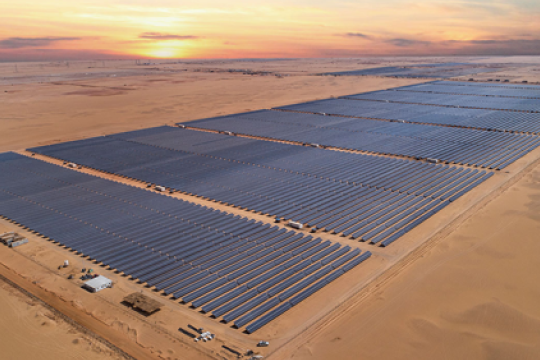
In today’s issue: We look at how access to industrial licenses is now increasingly tied to whether a project can shoulder part of its own electricity load and do it using renewables.