Get EnterpriseAM daily

Available in your choice of English or Arabic

Business leaders aren’t happy with regulations on real estate

1

What We're Tracking Today

EGP inches higher against the USD

Good morning, friends, and happy hump day to you all. Energy and real estate top our news well this morning and the EGP strengthened fractionally the greenback once again yesterday as emerging markets return to fashion.

On the real estate front: The Egyptian Businessmen’s Association, an influential industry group, has pushed back on recent changes of regulations on projects along the North Coast and Cairo-Alexandria Desert Road. The EBA called the changes “worrying” and warned in a letter to the prime minister that they could impact corporate appetite to invest in the sector.

From the Dept of Keeping the A/Cs On: Cabinet is reportedly debating whether to push planned hikes in the price of electricity back as far as next year instead of next month. No decision has been taken yet. The oil ministry, meanwhile, is hoping to see recoverable gas stocks rise 15% this fiscal year.

We also have the rundown on what’s attracting more and more Chinese renewable energy component makers to Egypt and a quick look at Elmenus’ strategic pivot as it brings in a new CEO.

^^ We have all that and more for you below in a packed issue.

BUT FIRST- At least five people are reported dead and in a shooting the building that asset manager Blackstone calls home in New York City.

MORNING MUST-READS-

All of us should be diving a bit deeper in AI and emerging markets, we think.

#1- It looks like AI could be eliminating jobs that would normally be taken by fresh college grads, at least in the United States, the Wall Street Journal reports, arguing that LLMs are perfectly well-suited to do tasks that used to be done by 22 year-olds.

The confounding variable: The story makes an increasingly common argument about what AI could do to the job market — but it’s an open question how much of the elimination of summertime and entry-level jobs owes to LLMs. What are the odds that companies are also cutting jobs in the face of economic uncertainty thanks to the impact of the Trump administration’s economic policies?

Either way: Many CEOs are happy to slash jobs right now, seeing it as a badge of honourat the dawn of the AI age.

#2- Everything old is new again: Emerging markets are back in fashion after a decade of looking as appealing as grandpa’s platform shoes and bellbottoms. The catalyst? Worries about where the American economy is heading and what some claim are the final days of the USD’s global hegemony: “Suddenly, this year, people are paying attention,” one fund manager says. Read Almost every corner of emerging markets is surging as USD sinks on Bloomberg.

PSA-

WEATHER- It’s going to be a little cooler in Cairo after the heat wave of recent days, with a high of 38°C and a low of 26°C, according to our favorite weather app.

It’s going to be muggy in Alexandria, with a high of 33°C and a low of 24°C.

EGP WATCH-

The EGP once again inched up against the greenback yesterday, with the USD changing hands at EGP 48.74-48.84 at the National Bank of Egypt and Banque Misr, and at EGP 48.73-48.83 at CIB. The currency has so far this month gained 1.7% (or EGP 0.82) against the USD.

DIVE DEEPER- We looked at the dynamics behind the EGP’s gains against the USD earlierthis week.

PRIVATIZATION WATCH-

Where’s the follow-up unit for state-owned companies? Prime Minister Moustafa Madbouly met with Planning Minister Rania Al Mashat, Investment Minister Hassan El Khatib, and Finance Minister Ahmed Kouchouk to review the steps taken to set up the new follow-up unit for state-owned companies, according to a cabinet statement. The unit will act as a coordinating body for decisions on the fate of state-owned firms and will be responsible for maintaining a comprehensive database of government-owned assets — particularly those up for privatization.

The unit’s decisions will be binding on all government bodies once it’s formally established, Madbouly said. It will also coordinate with ministries to ensure unified application of state asset policies, and will build on the work of the Sovereign Fund of Egypt and the government’s IPO unit.

REMEMBER- The cabinet had greenlit a draft law to set up the unit back in May 2024. It is expected to support implementation of the state ownership policy by identifying companies to exit, designing divestment strategies, and helping shape legal frameworks to improve state-owned company performance. The law was passed by the House of Representatives in June.

ECONOMIC POLICY-

The Planning Ministry is in the final stages of drafting a national economic development narrative that will act as a “unified reference” for Egypt’s policy agenda through 2030 and beyond.

One strategy to rule them all? The strategy will consolidate existing government playbooks — including the FDI strategy, industrial development and trade policy, and the national employment strategy — under one framework aligned with Vision 2030.

Five pillars: macroeconomic stability, FDI, industrial and trade development, labor market flexibility, and regional planning are the building blocks of the strategy. Prime Minister Moustafa Madbouly reviewed the latest draft with Planning Minister Rania Al Mashat yesterday, according to a cabinet statement.

WATCH THIS SPACE-

#1- El Sisi calls on Trump, world leaders to help end the war in Gaza: President Abdel Fattah El Sisi called on US President Donald Trump and other world leaders to act swiftly to end the war in Gaza and allow the entry of the humanitarian aid in a televised speech yesterday (watch, runtime: 7:30). El Sisi warned that conditions in the territory have become “tragic and intolerable” in recent months. The president stressed that Egypt will never play a negative role toward its brothers in Palestine, adding that Cairo has been working with Qatar and the US since 7 October 2023 to end the war, facilitate the flow of aid, and secure the release of hostages.

This comes days after aid trucks started making their way from Egypt to Gaza shortly after Israel said that it had resumed airdropping aid into Gaza and claimed that it will “stop fighting” for up to 10 hours each day in some areas of Gaza to allow food distribution.


#2- A new Egyptian-Saudi-Iraqi trade corridor just completed a successful trial run: A pilot shipment has successfully traveled along a new multimodal corridor connecting Egypt, Saudi Arabia, and Iraq, according to Saudi state news agency SPA. The shipment began in Cairo, passed through Safaga Port, crossed the Red Sea to Saudi Arabia’s Neom Port, and then continued overland to Erbil, Iraq.

It takes half the time: The trial found that the corridor slashed delivery time for Saudi Arabia-bound shipments coming from Egypt by more than 50% compared to traditional routes.

** DID YOU KNOW that we cover Saudi Arabia and the UAE?

** Were you forwarded this email? Tap or click here to get your own copy delivered every weekday before 7am Cairo time — without charge.

CIRCLE YOUR CALENDAR-

#1- Preparations are underway for this year’s Egyptians Abroad Conference, which will be held next week. The two-day event kicks off on Sunday at the Triumph Hotel in New Cairo, according to a statement from the Foreign Ministry.

REMEMBER- Expatriates are becoming an increasingly essential part of the country’s economy, with remittances being up for 15 consecutive months since the float of the EGP did away with the parallel market that drove remittances through informal channels. Money sent from abroad is expected to have made up around 8% of the country’s entire GDP in 2024, up from 5% in 2023 and 6.1% in 2022.


#2- The deadline for pre-2020 tax dispute settlement requests is just two weeks away, with companies having until 12 August to apply, the Egyptian Tax Authority said in a reminder. The Finance Ministry is rolling out measures to make it more attractive for businesses to settle disputes dating to before 2020, including by paying a fixed percentage of taxes owed. Businesses will be able to make payments in four installments over a 12-month period without paying late fees or additional interest charges.

Check out our full calendar on the web for a comprehensive listing of upcoming news events, national holidays and news triggers.

THE BIG STORY ABROAD-

The EU is already souring on the trade agreement it reached with the US a day earlier. The EUR dropped the most in over two months against the USD yesterday, falling more than 1% after having risen to a three-year high last week amid hopes for an agreement. German Chancellor Friedrich Merz said the agreement would have knock-on effects across the bloc, even possibly extending to the US, while French Prime Minister Francois Bayrou criticized the EU’s “submission.” The agreement secured a 15% tariff on the EU’s exports to the US.

Negotiators are still expected to hammer out the details of the agreement for a non-binding text that could take weeks to complete. This means volatility is still on the table, chief Germany economist at Oxford Economics said in a note. (Bloomberg | Financial Times)

MEANWHILE- Officials from the US and China met yesterday in Stockholm to begin talks to resolve disputes and either extend the 90-day truce on tariffs agreed in May for another three months or reach a permanent agreement ahead of a 12 August deadline. (Reuters)

SPEAKING OF DEADLINES… Trump is giving Russia’s Vladimir Putin a tighter deadline for a ceasefire in Ukraine, telling him he now has 10-12 days to do so or face additional economic pressure from the US. (Wall Street Journal | Reuters | Bloomberg)

ALSO- Trump went against Israeli Prime Minister Benjamin Netanyahu’s recent statements and said that many were starving in Gaza, and that the US will work on opening food centers “with no fences or boundaries to ease access.” (Reuters | Bloomberg)

*** It’s Going Green day — your weekly briefing of all things green in Egypt: EnterpriseAM’s green economy vertical focuses each Tuesday on the business of renewable energy and sustainable practices in Egypt, everything from solar and wind energy through to water, waste management, sustainable building practices and how you can make your business greener, whatever the sector.

In today’s issue: We look at why Chinese firms are bringing their solar component manufacturing to Egypt.

Whether you’re diving into turquoise waters, catching the golden hour from your terrace, or just letting time drift by — Somabay is summer, redefined. Your ultimate escape, every single time.

2

Real estate

Egyptian Businessmen’s Association push back against “worrying” real estate regulatory changes in letter to PM

“The real estate market has witnessed worrying developments that threaten appetite to invest in the industry,” the Egyptian Businessmen’s Association (EBA) said in a letter to Prime Minister Moustafa Madbouly seen by EnterpriseAM. Referring to a recent decision by the Madbouly government to impose new levies on land owned by developers on the Cairo-Alexandria Desert Highway and North Coast, the association added that the new levies also “impact the trust built over many years between the state and investors in this vital sector.”

(Tap or click the headline above to read this story with all of the links to our background as well as external sources.)

ICYMI- Developers recently received surprise letters from the New Urban Communities Authority demanding levies, which included an “improvement fee” for developers who own land or projects going back up to 7km on either side of the desert road to pay up to EGP 1.5k per sqm, a 10% transfer fee on North Coast projects in the event that the land owner is not the real estate developer, and a three-month deadline for non-compliant developers to obtain the required construction licenses or lose rights to use the land.

The surprise fees have led to “a state of concussion and anxiety among investors and developers,” the EBA argues. The association said the decision to impose an “improvement fee” on desert road projects as a retroactive decision “contradicts the principles of stable investment policies.” It also described the decision to calculate the North Coast transfer fee based on current assessed land value — and not the price at the time of purchase or contracting — as “doubling unexpected burdens.” The three-month deadline to sort out construction licenses was also critiqued for not “taking into account the complex timeline for issuing decisions and licenses, especially given well-known bureaucratic challenges.”

The EBA called for the changes to only apply to future projects, so as to shield existing and underway projects from the retroactive decisions. The association talked up its support for efforts to regulate the real estate market and called for a meeting between developers, relevant ministers, and other officials to “contain the situation before its effects on the sector worsen.”

IN OTHER REAL ESTATE NEWS-

#1- NUCA is looking to bump the price per sqm at which it offers land in its next sale of ready-to-deliver residential plots in some 20 governorates, Al Arabiya reports, citing what it says are officials at the New Urban Communities Authority.

#2- Our friends at SODIC launched the first overseas branch of Michelin-recognized Portuguese restaurant Cavalariça at its North Coast project June, the real estate developer said in a statement (pdf). The move is part of SODIC’s broader push into lifestyle and hospitality, joining Dubai’s Surf Club and Nobu projects.

This publication is proudly sponsored by

3

Energy

Egypt weighs delaying electricity price hikes until early next year

The Madbouly government could postpone electricity price hikes until January 2026, a government source told EnterpriseAM yesterday. This is one of three potential scenarios for electricity price increases — the other two are implementing the increases next month or postponing them until September.

This potential delay until early 2026 is largely driven by two factors. First, the energy sector has secured its natural gas needs at a price below global rates through recent short and medium-term agreements. Then, there is the decline in the EGP/USD exchange rate — providing the government the flexibility needed to absorb the cost of pushing back these anticipated hikes, the source added.

The proposed hikes? Up to 40% based on consumption: The proposed electricity price increases will range from 15% to 40%, with the exact percentage directly tied to customers’ consumption tier, our source said. A government source told us earlier this month that the Electricity Ministry proposed scenarios to the cabinet that include postponing any electricity hikes to September to shield citizens from inflationary pressures.

The final decision hinges on key factors, according to our source. First, inflation indicators, as the Madbouly government seeks to ease the burden on citizens. Also, the state’s financial capacity to absorb the subsidy cost is a significant consideration.

Electricity price hikes will be based on studies, which are expected to be finalized soon, taking into account the exchange rate forecasts and overall costs, the source said.

Electricity consumption hit a new peak at 39.4 GW on Sunday, after a few days of extreme heat pushed energy demand to a series of record highs. Power plants are fed 3.3 bn cubic feet of natural gas a day — taking up 65% of the country’s gas supplies, according to our sources.

The IMF expects electricity subsidies to hit EGP 75 bn during this fiscal year, matching the amount the government allocated in its budget. Looking ahead, these subsidies are projected to drop to EGP 45 bn in FY 2026-2027, before gradually increasing to EGP 50 bn in the subsequent fiscal year and to EGP 56 bn in FY 2028-2029 and finally to EGP 63 bn in FY 2029-2030.

REFRESHER- The Electricity Ministry has raised electricity prices by 14-40% between August and September 2024. The cost of electricity production has soared after the float of the EGP, becoming more of a burden on the state budget.

4

Energy

Egypt looks to increase recoverable gas stocks 15% over FY 2025-26

The government is working to increase local gas stocks by more than 15% y-o-y in the current fiscal year, pushing up the country’s total field reserves by some 300 bn cubic feet to 2.2 tn cubic feet of recoverable natural gas, Al Arabiya reports, citing an unnamed government official. Three international companies are currently stimulating wells in the region, aiming to lift production and reserves by 10-15% annually, the source added.

(Tap or click the headline above to read this story with all of the links to our background as well as external sources.)

Domestic gas reserves and production are up, though likely not by enough to keep pace with rising energy demand, which hit an all-time high of 39.4 GW on Sunday, surpassing the previous record, set only the day before. Summer demand is expected to peak at 7.5 bn cubic feet a day (bcf/d) in July and August, leaving the country with a 3.0 bcf/d supply gap to be filled with LNG imports or piped Israeli gas, according to industry publication Middle East Economic Survey (Mees).

REMEMBER- Following a costly few months of energy imports to bridge the gap between local production and demand, the Oil Ministry has been working to increase local energy production in 2025. We reported in February that the government is planning to clear all arrears owed to international oil companies by the end of 2025.

Adding to the hoped-for increase in local production and gas reserves is Shell’s investments in its Mediterranean concessions, which will see the company funnel USD 160 mn into drilling exploratory wells in the North East Amriya and North Cleopatra concessions in 2H 2026, Asharq Business reports separately, citing an unnamed government official.

Italian energy giant Eni is also aiming to add some 60 mcf/d of new gas output from the Zohr field next month, as the company brings its Zohr 13 well online, Asharq Business reports, citing an unnamed government official. The added volumes could provide a lift to our largest gas field — which has seen its output fall to around 1.4 bcf/d down from 1.5 bcf/d at the start of the year, the official said.

Tags:
5

A MESSAGE FROM VISA

In the new era of agentic commerce trust, security and privacy are everything

Visa has processed 3.3 tn transactions on its network since the launch of e-commerce in the year 2000. Today, the Visa network connects users with 4.8 bn credentials to 150 mn or more sellers around the world in 200 plus countries and territories in 150 currencies.

The number and scale of those transactions generate hundreds of data elements that tell stories. Access to this data makes Visa a powerhouse that detects patterns that help build solutions that deliver better buyer experiences and grow sales for sellers with a lower risk of fraud, fewer declines, and more fulfilled transactions.

As we go forward on the AI journey, trust in agentic commerce will be key from both a buyer and seller perspective. Visa is leading the way by combining innovation with security, transparency, and user control.

Today, nearly 50% of Visa’s digital transactions are tokenized, and the growth continues to be tremendous.

Visa’s AI-ready cards use tokenized credentials to ensure only authorized AI agents can transact, adding a vital layer of protection. Users stay in control with customizable settings like spending limits and credential activation, empowering them to embrace AI-powered payments confidently.

In case you’re wondering — how does tokenization work? A token replaces your 16-digit card number with a unique 16-digit cryptographically protected code. Using Visa’s authentication protocols and connectivity to nearly 14.5k financial institutions, you will first be authenticated by your bank. They will then generate a token that will be specific to your AI agent. The token will remain locked until you tell the agent what you want it to do. In short, nothing happens without your permission.

Replacing passwords with biometrics. Visa also sees a future where biometrics can replace passwords. In 2024, the company announced the launch of Visa Payment Pass key, a biometric solution based on cross industry standards, and It’s been deployed across Europe with very positive results and is expected to be rolled out globally throughout 2025 and into 2026.

6

Diplomacy

Egypt lays out vision for two-state solution at New York conference

Abdelatty outlines Egypt’s vision for peace at New York summit: Foreign Minister Badr Abdelatty represented Egypt at the high-level conference on two-State solution for Israel and Palestine in New York yesterday, according to a ministry statement. In his address, Abdelatty called for a clear political horizon based on the full implementation of the two-state solution and urged Israel to end its occupation of Palestinian territories and halt all unilateral actions — including settlement expansion — in line with key UN Security Council resolutions.

(Tap or click the headline above to read this story with all of the links to our background as well as external sources.)

A two-state solution is looking less and less likely: “[The two-State solution is] farther than ever before,” UN Secretary-General António Guterres said. “What is the alternative? A one-state reality where Palestinians are denied equal rights, and forced to live under perpetual occupation and inequality? A one-State reality where Palestinians are expelled from their land?”

Abdelatty emphasized the urgency of enabling humanitarian access to Gaza, restoring UN and UNRWA operations, and empowering the Palestinian Authority to govern both Gaza and the West Bank. He also reaffirmed Egypt’s support for the Arab-Islamic early recovery and reconstruction plan, noting that Cairo stands ready to co-host an international donor conference once a ceasefire is secured.

No to forced displacement: The minister reiterated Egypt’s firm opposition to the forced displacement of those in Gaza and to any Israeli moves to impose sovereignty over the West Bank.

ON THE SIDELINES-

Abdelatty, UNDP official discuss Gaza reconstruction: Abdelatty met with Haoliang Xu, acting head of the UN Development Programme (UNDP), on the sidelines of the gathering, to discuss Gaza reconstruction and ongoing development cooperation. The two sides exchanged views on Gaza, with Abdelatty doubling down on Egypt’s rejection of the forced displacement of Palestinians, and highlighting coordination with the US and Qatar on ceasefire efforts.

PLUS- Abdelatty held talks with Canadian Foreign Minister Anita Anand and Brazilian ForeignMinister Mauro Vieira to discuss regional and bilateral issues. He called for deeper trade and investment ties with both countries, inviting Canadian companies to tap into Egypt’s improved business climate and reaffirming interest in expanding cooperation with Brazil under their 2024 strategic partnership framework. The three ministers also exchanged views on Gaza, with all sides emphasizing the urgency of securing a ceasefire and ensuring unhindered humanitarian access.

7

Moves

Walid El Saadany named new Elmenus CEO, succeeding Amir Allam

Local food ordering platform and restaurant directory Elmenus tapped Walid El Saadany (Linkedin) as its new CEO to take over the role from company founder Amir Allam (Linkedin), the company said in a statement (pdf). “With nearly two decades of experience spanning entrepreneurship, logistics, venture capital, and platform scaling, Walid El Saadany brings a uniquely balanced perspective to Elmenus,” according to the statement, which highlighted his role in leading Otlob during its acquisition by Foodpanda and its agreement with Delivery Hero that saw the company rebrand as Talabat.

“It is now the right time to pass the baton as the company enters a new phase of sustainable growth building on the brand’s strong foundations and loyal customers. I remain fully committed as a board member and advocate of our mission to elevate Egypt’s food industry,” said outgoing CEO Allam, who had led the company since its founding in 2011.

Elmenus is doubling down on AI and building outside of Cairo after a furious battle for market share with deep-pocketed Talabat. The company has raised USD 30 mn in funding since Allam founded it 12 years ago from investors including our friends at Algebra Ventures as well as Careem and Global Ventures.

8

ALSO ON OUR RADAR

Orascom Construction to move to ADX

CAPITAL MARKETS-

Goodbye Nasdaq Dubai, hello ADX: Orascom Construction is repositioning itself within the region’s capital markets after its board approved moving its primary listing from Nasdaq Dubai to the Abu Dhabi Securities Exchange (ADX), according to a disclosure (pdf). The listing shift comes as the ADX continues to assert itself as one of the region’s capital markets heavyweights, offering deeper liquidity and stronger institutional flows via entities like sovereign wealth funds ADQ and Mubadala. Born in Egypt, Orascom Construction is also listed on the EGX.

What’s next? The decision now awaits shareholders’ approval and regulatory clearance. Shareholders will be able to vote on the proposed changes on 12 August.

MEANWHILE- Orascom Construction will distribute an interim dividend of USD 0.25 per share on 13 August to its shareholders, according to a separate disclosure (pdf).

INVESTMENT WATCH-

Chinese companies are kicking the tires on potential investments in textiles here: A 15-member delegation of Chinese textile and garments industry reps met yesterday with officials from the Egyptian Federation of Industries to explore investment opportunities in the textile and ready-made garments sectors, according to a statement. The delegation said Egypt ranks “number one” in Africa for textile investment, citing the country’s low labor costs, a skilled and youthful workforce, and access to major trade blocs across Asia, Africa, and the Americas. The delegation had met a day earlier with SCZone Chairman Walid Gamal El Din to discuss the sector’s investment potential.

Chinese textile players have been loving the local market, with a long list of Chinese projects in the pipeline, namely in the Qantara West industrial Zone. Most recently, Shandong Sunshell Group and Zhejiang Charming for Dyeing and Finishing inked contracts for textile and garment factories in the zone with a total investment of USD 65.5 mn.

Part of the SCZone’s China push: The visit comes on the heels of the SCZone’s investmentroadshow in China earlier this month, where officials pitched Egypt as a hub for textile manufacturing, EV assembly, and port logistics.

RENEWABLES-

#1- Korra Energi will build a USD 1 mn hybrid solar plant for the Esh El Mallaha Petroleum Company (Eshpetco), which will serve one of its oil fields, the local energy solutions firm said in a statement. The 1.4 MW project will be integrated with Korra’s existing 3.5 MW flare gas recovery project at the site, helping the oil company reduce its reliance on the national grid, cut costs, and improve its environmental credentials.

(Tap or click the headline above to read this story with all of the links to our background as well as external sources.)


#2- Hong Kong-based renewables firm United Energy Group and China’s Longi Green Energy will develop a 20 MW hybrid solar plant under a strategic cooperation memorandum they signed, according to a statement from the Chinese Embassy. The power — equivalent to the energy demands of 6k Egyptian households — will help reduce emissions.

TRADE WATCH-

Turkey slapped anti-dumping duties on Egyptian plastic film imports — AKA biaxially oriented polypropylene (BOPP) film — following the outcome of a 2024 trade probe into unfair pricing, Turkish newspaper Turkiye Today reports, citing the country’s gazette.

The details: The duties on the stretchable plastic used in food and consumer goods packaging will range between 12.85% and 62.94% of the product’s CIF value, depending on the exporter. The decision is aimed at shielding Turkey’s domestic manufacturers from price undercutting and restoring fair competition, after the probe concluded that Egyptian, Chinese, and Russian imports were undercutting domestic prices and harming local manufacturers.

9

PLANET FINANCE

US trade policy grinds down global corporate investment, with less impact on financial markets

“Sands in the wheels” of global trade and capital spending: While financial markets project an image of stability, the global economy is showing deepening scars from Washington’s trade policies, with companies worldwide freezing investments and living with slimmer margins to absorb the fallout from the highest US tariff rates since the 1930s, Bloomberg reports. The economic pressure is set to intensify as another one of President Donald Trump’s tariff deadlines goes into effect this Friday.

(Tap or click the headline above to read this story with all of the links to our background as well as external sources.)

How bad are the tariffs, actually? The average US tariff has increased to almost 13.5% from 2.5% last year before Trump took office, with that number expected to rise further to 16% after the latest agreement with the EU is implemented, according to Bloomberg Economics estimates. Tariffs act like “a tax that puts sand in the wheels of supply chains and global trade,” even if they are not as high as previously feared, Daniel Harenberg of Oxford Economics said.

Trump’s “America First” policies could cost the global economy USD 2 tn by 2027, according to projections by Bloomberg Economics. Business investment forecasts for 2026 have been lowered across all G7 nations and nearly halved for the US, Canada, Japan, and Italy specifically. Uncertainty from the trade war has led companies to delay major investments amid the highest US tariff rates in decades, and some investments that have been announced are mainly geared towards restructuring supply chains to work around tariffs, UNCTAD said in its annual World Investment Report.

Reality check: Despite Trump’s claims of a “booming” economy, tariffs continue to erode corporate net income. Treasury Secretary Scott Bessent celebrated the investment rebound as “CapEx Comeback;” however, it is largely an artificial pre-tariff surge that has since stalled.

The global macroeconomic picture stands in contrast with a rally on Wall Street pushing stock valuations to near-record highs, but the “euphoric” conditions are sparking fears of a market bubble, the Financial Times reports. The S&P 500 hit record peaks, Nvidia became the first USD 4 tn public company, “meme stocks” reappeared, and BTC rose past USD 120k. This is a “dangerous set up,” showing parallels to the dot-com boom, as investors, relieved by recent trade agreements, drive markets higher despite underlying risks,” Pimco CIO Dan Ivascyn warns.

MARKETS THIS MORNING-

It’s a sea of red in Asian markets, with Japan’s Nikkei, South Korea’s Kospi, China’s Shanghai and the Hang Seng Index all down in early morning trading as investors are in wait-and-see mode with ongoing US-China trade talks. The picture is only slightly rosier over on Wall Street, where futures indicate the Dow Jones, S&P 500, and Nasdaq will all open just barely in the green later today.

EGX30

34,076

-1.4% (YTD: +14.6%)

USD (CBE)

Buy 48.71

Sell 48.84

USD (CIB)

Buy 48.73

Sell 48.83

Interest rates (CBE)

24.00% deposit

25.00% lending

Tadawul

10,885

-0.7% (YTD: -9.6%)

ADX

10,362

+0.2% (YTD: +10.0%)

DFM

6,168

+0.3% (YTD: +19.6%)

S&P 500

6,390

0.0% (YTD: +8.6%)

FTSE 100

9,081

-0.4% (YTD: +11.1%)

Euro Stoxx 50

5,338

-0.3% (YTD: +9.0%)

Brent crude

USD 70.18

+2.5%

Natural gas (Nymex)

USD 2.99

-3.9%

Gold

USD 3,367

-0.8%

BTC

USD 118,259

-0.8% (YTD: +26.4%)

S&P Egypt Sovereign Bond Index

881.9

+0.1% (YTD: +13.4%)

S&P MENA Bond & Sukuk

146.2

0.0% (YTD: +4.5%)

VIX (Volatility Index)

15.03

+0.7% (YTD: -13.4%)

THE CLOSING BELL-

The EGX30 fell 1.4% at yesterday’s close on turnover of EGP 4.8 bn (4.7% below the 90-day average). Local investors were the sole net buyers. The index is up 14.6% YTD.

In the green: GB Corp (+2.1%), Egypt Kuwait Holding -USD (+0.5%), and Fawry (+0.3%).

In the red: Palm Hills Developments (-3.8%), Edita (-3.6%), and Mopco (-3.5%).

10

Going Green

Faced with tariff pressures at home, Chinese firms are manufacturing solar energy components in Egypt

Why are Chinese solar manufacturers increasingly coming to Egypt? Chalk it up to tariff pressures at home and the appeal of investor incentives here — to say nothing of a large, growing domestic market for solar power.

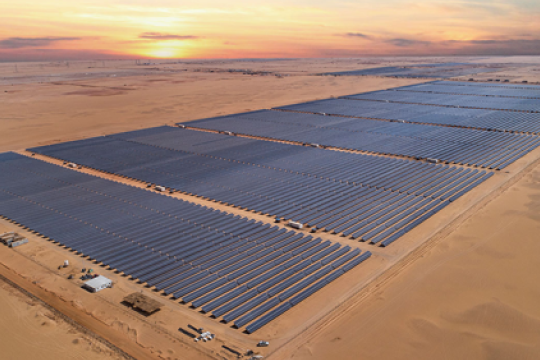
Chinese solar power component manufacturers have been moving their production facilities to Egypt and the rest of the MENA region as they face pressure in their home market due to ongoing trade wars and geopolitical friction. The shift towards manufacturing components in the region comes as Egypt — and others across MENA — roll out incentives for these manufacturers to set up shop locally. In Egypt specifically, the government sees localizing the production of solar power components as a top priority, naming solar cells among 12 products that it wants to begin manufacturing locally.

(Tap or click the headline above to read this story with all of the links to our background as well as external sources.)

The global backdrop: The US has for years levied tariffs on Chinese-made solar equipment, starting with broad-based import tariffs through to finalizing antidumping and countervailing duties under the Trump administration. When Chinese companies shifted their assembly lines to Southeast Asia to dodge these barriers, Washington responded with new investigations into “circumvention” — threatening tariffs on plants in Vietnam, Malaysia, and Thailand. China’s Jinko Solar and Trina Solar are among the highly affected firms.

Tariffs changed the calculus for many firms: “If it wasn’t for tariffs, it’s very easy and convenient for Chinese manufacturers to stay in China — everything is familiar, cheap, and the whole supply chain is there,” Head of Solar Supply Chain at global consultancy and research firm Wood Mackenzie Yana Hryshko told EnterpriseAM.

But the localization drive in Egypt + MENA was also a pull factor: From the US InflationReduction Act’s incentives for American-made panels, to new rules in the Gulf, buyers increasingly favor locally-made solar products. “I think even domestic content requirements contributed more than tariffs” to Chinese manufacturers moving out of China, Hryshko told us. In other words, to sell into big markets, Chinese manufacturers must be in those markets.

The regional edge: Starting around 2023, Egypt, Saudi Arabia, the UAE, and Oman rolled outthe red carpet for solar manufacturers, providing generous incentives, government co-investment, and infrastructure support. These supportive policies are further helped by the region’s favorable geography — the Suez Canal Economic Zone gives manufacturers an easy route to export their output to European and US markets quicker than from East Asia, cutting transit time and cost. “The Middle East, especially Egypt, has a perfect position — close to anywhere basically,” Hryshko said.

Altogether, it’s a perfect storm: “Would they move only because of tariffs? I don’t think so. But would they move only because of favorable policies? For sure. Here you have a perfect combination — favorable policies and tariffs,” Hryshko noted.

Egypt is emerging as a key beneficiary of this shift: Long known more for its year-round sunny climes than for making panels, Egypt is now on the manufacturing map thanks to a handful of Chinese-led projects, particularly as the SCZone has been aggressively courting manufacturers. The pitch? A strategic location, existing infrastructures, and government support all the way up to the prime minister.

That pitch is paying off: In November last year, JA Solar unveiled plans for two factories, targeting 2 GW of solar cells and 2 GW of modules per year, with investments estimated at USD 138 mn for the cell plant and USD 75 mn for the module facility — aiming to source key inputs like glass and aluminum locally. Also last year China’s Elite Solar laid the foundation stone on its USD 150 mn solar factory in the SCZone’s TEDA in partnership with Teda Investment Holding — the company behind the China-Egypt TEDA trade zone. The facility will produce N-type solar cells and photovoltaic (module-cell-wafer) systems, with an initial capacity of 2 GW per year.

Not only factories, but also distribution: Chinese giant Trinasolar — which holds a 25% market share in Egypt’s solar module distribution segment — is supported by its local distributor, Maryzad, Global Sales VP and MEA Head Vincent Wu told EnterpriseAM. Maryzad has launched a dedicated solar logistics center in the SCZone, which is designed to accelerate regional distributions — not just across Egypt, but also to KSA, Sudan, Lebanon, and Libya. This vision positions the country as a key logistics and service hub for Trinasolar’s MEA operations, Vincent told us.

Another key takeaway from MENA’s solar push is that facilities here are built to last: Earlier waves of solar manufacturing were often built reactively — small facilities set up hurriedly to dodge the latest tariff, often just assembling modules from imported cells. Many ended up with outdated equipment and never moved beyond a few gigawatts. Southeast Asia and even the US became, as Hryshko noted, a kind of “cemetery of PV manufacturing” — filled with older technology and sub-scale plants, always one policy shift away from obsolescence. In the Middle East, however, the projects have been large-scale and vertically integrated from the beginning.

This integration — wafers, cells, and modules under one roof (or at least within one industrial zone) — cuts costs, improves quality control, and minimizes supply chain risks. For instance, China’s Sunrev Solar — which is building a USD 200 mn integrated industrial complex for solar energy components — plans to add ingot and wafer production in the project’s phase, so that eventually the silicon feeding its cell lines will be locally cast and sliced.

SOUND SMART- Solar panels are the end-product of a vertically tiered supply chain that starts with polysilicon — the raw material purified and cast into ingots. These ingots are sliced into wafers, which serve as the base for manufacturing solar cells. Cells are the functional heart of a panel, converting sunlight into electricity through photovoltaic reactions. Once interconnected, the cells are laminated, framed, and wired into complete modules — the final product installed on rooftops and utility-scale farms.

More Chinese investments are rolling in: China’s SBH Kibing Solar New Energy was recently looking to set up a USD 700 mn solar panel glass manufacturing facility in the SCZone — with the majority of output earmarked for export. The plant would provide a critical piece of the supply chain puzzle — glass can be up to 75% of a solar panel’s weight, so having a regional source lowers costs for production in Egypt and nearby markets.

And local players are happy to see that shift: Some 70% of solar power plant costs are USD denominated as solar panels are imported, Romany Hakeem, chairman of solar panel installation company BeNeshty Solar and deputy chairman of the Sustainable Energy Development Association, told EnterpriseAM last year. Some local companies have opted to locally assemble solar panels to cut down the installation costs, Hakeem told us.


Your top green economy stories for the week:


JULY

End-July 2025: Egypt and Jordan to connect fifth FSRU ‘Energos Force’ to Arab Gas Pipeline via Aqaba port.

Also happening this month:

  • The first operational trial of Egypt-KSA electricity interconnection line
  • China’s State Grid aims to finalize contracts for two solar projects

AUGUST

3-4 August (Sunday-Monday): Egyptian Abroad Conference, Triumph Hotel in New Cairo.

3-5 August (Sunday-Tuesday): Edugate Cairo, Royal Maxim Palace Kempinski Hotel in New Cairo.

6 August (Wednesday): Egugate Alexandria, Hilton Green Plaza Hotel in Alexandria.

7 August (Thursday): Finance Ministry to begin disbursement of 50% of exporters’ pre-June 2024 dues over a four-year plan.

12 August (Tuesday): Egyptian Tax Authority deadline for pre-2020 tax dispute settlement requests.

28 August (Thursday): Monetary Policy Committee meeting.

Mid-August: Launch of electronic platform to register Old Rent Law tenants.

Tourism Development Authority to waive late payment penalties for land purchases if full installments are paid

Late-August: Deadline for cement factories to restart production.

SEPTEMBER

8-11 September (Monday-Thursday): EFG Hermes London Conference takes place in the British capital.

15 September (Monday): IMF to hold its combined fifth and sixth reviews of Egypt’s USD 8 bn EFF arrangement.

24-27 September (Wednesday-Saturday): Cityscape Egypt 2025, Egypt International Exhibition Center.

The Egyptian-Moroccan Business Council to send a delegation of 23 local companies to Rabat.

The Engineering Export Council of Egypt will ship a commercial delegation to Russia to ramp up exports to European markets.

Egypt Education Platform (EEP) to launch two new schools in Alexandria and Somabay.

Egypt Otsuka’s nutritional products factory in Tenth of Ramadan to begin operations, with exports to Gulf countries expected by January 2026.

OCTOBER

2 October (Thursday): Monetary Policy Committee’s sixth meeting.

7 October (Tuesday): The 2025 EnterpriseAM Egypt Forum.

12-16 October (Sunday-Thursday): Cairo Water Week, Cairo.

19-22 October (Sunday-Wednesday): Arab African Investment and International Cooperation Summit.

23-25 October (Thursday-Saturday): Stone Africa Expo, Cairo International Conference Center.

October: The third iteration of the Export Smart Exhibition and Conference.

NOVEMBER

16-19 November: Cairo ICT 2025, Egypt International Exhibition Center

20 November (Thursday): Monetary Policy Committee meeting.

November: Egypt to join the EU’s Horizon Europe research and innovation program.

DECEMBER

1-4 December: Egypt Defence Expo (EDEX), Egypt International Exhibition Center.

25 December: (Thursday): Monetary Policy Committee meeting.

EVENTS WITH NO SET DATE

Mid-2025: EGX launches sustainability index.

3Q 2025: Nasr Automotive begins locally manufacturing passenger cars.

3Q 2025: Polaris Parks to finalize contracts for two new industrial zones in the new capital and Sadat City.

Mid-2025: The Administrative Capital for Urban Developments to roll out the second phase of offering industrial plots to investors

2H 2025: Potential visit by Chinese President Xi Jinping to Egypt

4Q 2025: The beginning of construction works on China’s State Grid two solar projects.

4Q 2025: GB Auto starts assembling one of China’s Great Wall Motor models in 4Q 2025.

4Q 2025-1Q 2026: Kasrawy Group to launch first Avatr EV models in Egypt.

2025: The InterAcademy Partnership assembly.

2025: Nile Basin States Summit, Cairo, Egypt.

2025: Release of the government’s Startup Charter document.

Before 2025-end: The government will launch two ro-ro shipping lines with Saudi Arabia and Turkey.

2026

Early 2026: Passenger operations on the New Administrative Capital–Nasr City monorail scheduled to begin.

1Q 2026: Trial operations for the Ain Sokhna–Sixth of October section of Egypt’s first high-speed rail line scheduled to begin.

1 January: European Union’s Carbon Border Adjustment Mechanism (CBAM) to fully come into effect.

15 March 2026: IMF to hold its seventh review of Egypt’s USD 8 bn EFF arrangement.

May 2026: End of extension for developers on 15% interest rates for land installment payments

15 September 2026: IMF to hold its eighth review of Egypt’s USD 8 bn EFF arrangement.

2H 2026: Operations at Deli Glass Co’s new USD 70 mn glassware factory kick off.

2027

20 January-7 February: Egypt to host the African Games.

April 2027: Tenth of Ramadan dry port and logistics hub to begin operations.

EVENTS WITH NO SET DATE

2027: Egypt to host EBRD’s annual meetings for 2027.

End of 2027: Trial operations at the Dabaa nuclear power plant expected to take place.

September 2028: First unit of the Dabaa nuclear power plant begins operations.

Now Playing
Now Playing
00:00
00:00