Get EnterpriseAM daily

Available in your choice of English or Arabic

Analysts see room for CBE to cut rates on Thursday

1

WHAT WE’RE TRACKING TODAY

The Pharaohs’ Afcon campaign begins

Good morning, wonderful people. We’re reading the coffee grinds at the bottom of our cup to get us started this morning.

Egypt is moving from a “raise all the debt” stance to one of “pay it down to a sensible level.” That’s the key message the Madbouly government is delivering to the business community, foreign investors, and the public alike heading into the final days of 2025.

Debt messaging in overdrive: Prime Minister Mostafa Madbouly, Finance Minister Ahmed Kouchouk, and CBE Governor Hassan Abdalla sat down yesterday to brief President Abdel Fattah El Sisi on the state of the economy and public finances. The briefing came just days after Madbouly released a lengthy op-ed defending the government’s debt management record and promising “exceptional solutions” to ease fiscal pressures “in the coming days.”

Officials at all levels overuse the phrases “within the coming hours” and “in the coming days,” but still: Cabinet is signposting a policy shift. Madbouly set a target of bringing the ratio of external debt-to-GDP down to 40% by the end of the current fiscal year in June 2026 from 44% today — a level Madbouly was at pains to note falls within the internationally accepted “safe range” of 40-45%.

The messaging push is laying the groundwork for 2026: With parliamentary elections wrapping on 10 January just in time for the end of the current House’s five-year term, the Economic Group is staking out its policy framework for the year ahead.

Madbouly’s op-ed was unusually candid: He took direct aim at the “roads and bridges” critique — the narrative that infrastructure megaprojects drove the debt buildup at the expense of social spending — arguing it creates a “false confrontation” between physical investment and human development. The real question, he wrote, isn’t the size of the debt or the buildout of public infrastructure, but how debt gets managed and whether it crowds out social spending or supports growth. Watch this space.


Watch this space

CAPITAL MARKETS — Trading on the EGX could be extended by an additional hour with an earlier start and later close, according to a statement from the bourse seen by EnterpriseAM. The proposed 9:30am start and 3pm finish — instead of the current 10am-2:30pm window — could increase trading volumes, deepen liquidity, and align the local bourse more closely with regional peers, according to the statement.

Extending trading hours could help lift trading volumes, but the move would not, on its own, bring in fresh liquidity, CI Capital Head of Research Monsef Morsy told us. “More IPOs, different listings across different sectors, a better representation of the sectors within the real economy being represented on the market is definitely one thing to also improve overall liquidity and eventually increase foreign participation,” he added.


CUSTOMS — Coming up on the 12-month mark, the Egyptian Customs Authority is reviewing its policy on personal mobile-phone imports, a senior government official told EnterpriseAM. Lest you think the state is going to drop the measure: We don’t expect significant changes to the policy, which grants Egyptians the right to bring in one handset free of customs and taxes (equivalent to 37.5% of the customs value of the device) every three years.

Note that we said “Egyptians”: Foreign residents, including investors and senior executives, aren’t allowed a new device every three years. The rule as it stands is that foreign residents get one customs-free phone activated with an Egyptian SIM as a one off.

The government argues that resident foreigners and citizens are still treated the same, our source says, explaining that the three-year exemption for citizens was introduced specifically with Egyptians working abroad in mind.

Data point

USD 12 bn — the total value of Egyptian investments in Africa, President Abdel Fattah El Sisi said. Total annual trade between Egypt and the wider continent stands at some USD 10 bn, according to the president.

That’s a lot of zeroes, but in the wider scheme of things, we have plenty of room to grow. By comparison, South Africa leads the continent with USD 33 bn of total investments in Africa, while the Netherlands tops the list globally with USD 109 bn, according to UN Trade and Development.

Why? Egyptian businesses lack the banking rails to travel south. Unlike South African firms, whose national banks expanded across the continent to support client investments, Egyptian investors face a financing vacuum: Local banks rarely fund capex outside the country and state-backed risk insurance is virtually nonexistent. Consequently, even willing investors are forced to self-fund projects in volatile markets, often deciding that the risk-reward ratio is far worse than the safer, familiar yields found in the Gulf or the domestic treasury market.

Happening this week

TODAY — The Egyptian national team will face Zimbabwe in their opening match of the 2025 Africa Cup of Nations, marking the start of Egypt’s Group B campaign. Football fans will be closely watching the Pharaohs’ performance, with supporters looking to see if the team has what it takes this year to break its 15-year medal drought in the tourney.

THURSDAY — Results from the latest set of runoffs in elections for the House of Representatives are due out on 25 December. The National Elections Authority is aiming to wrap the full election cycle by 10 January 2026 ahead of the expiry of the current parliament’s term at month’s end.

** DID YOU KNOW that we cover Saudi Arabia, the UAE and the MENA-IndiaCorridor?

** Were you forwarded this email? Tap or click here to get your own copy delivered every weekday before 7am Cairo time — without charge.

PSA-

WEATHER- Cairo could be in for a light drizzle today as the Egyptian Meteorological Authority forecasts low clouds across the capital. Expect a high of 22°C and a low of 11°C, according to our favorite weather app.

The big story abroad

Oil prices ticked up in Asia this morning after US forces tried to tighten their blockade of oil tankers coming into and out of Venezuela. The US coast guard is reportedly pursuing in international waters a tanker that was heading into Venezuela. The development comes barely two days after it raided a Panama-flagged ship and two weeks after it seized a third.

It’s otherwise a particularly quiet morning in the global business press — markets seem already to be sliding into the Christmas week news slowdown. That has the business pages serving up year-end fare including:

We’re not sure 2025 is going to give up the ghost quite so easily, but … we’ll take it.

*** It’s Blackboard day: We have our weekly look at the business of education in Egypt, from pre-K through the highest reaches of higher ed.

In today’s issue: If 2024 was the year of surviving all sorts of headwinds, 2025 was the year of structural change, with everything from overseas expansions and domestic shake-ups.

Christmas is just the beginning. At Somabay, the celebrations unfold day by day, night by night, building all the way into the New Year. From rooftop takeovers and beach parties to late-night performances and full-band shows, the season is curated to let you choose your moment and celebrate it your way — right through the final countdown and beyond.

New Year’s and beyond at Somabay.

Celebrate when it feels right: Pick your night. Book your plans.

Discover the full December & NYE calendar here. Welcome the New Year at Somabay.

2

The Big Story Today

The Central Bank of Egypt could have room for one last rate cut in 2025

A larger-than-expected dip in the annual inflation rate for November is raising expectations of one more interest rate cut for the year when the Central Bank of Egypt’s Monetary Policy Committee (MPC) meets on Thursday for its final gathering of the year. The CBE left interest rates unchanged during in November, part of an on-again, off-again easing cycle it started in April.

The consensus: 12 out of the 14 economists and banking experts we spoke to expect to see a 100-200 bps rate cut on Thursday, adding to 525 bps of rate cuts delivered throughout 2025. The majority of those we polled expect the CBE to opt for a 100 bps cut. The overnight deposit rate is currently at 21.00%, the overnight lending rate at 22.00%, and the main operation and disc. rates at 21.50%.

Inflation is increasingly under control

We’re entering 2026 with inflation approaching the CBE’s target of 7% (±2%) by the end of 2026. Annual urban inflation eased 0.2 percentage points in November, broadly defying expectations to end the month at 12.3%. A drop in food and beverage prices — down 2.6% on a monthly basis — unexpectedly offset a rise in fuel prices. That “positive surprise” indicated that the impact of fuel price hikes on overall inflation was limited, supporting the central bank’s ability to proceed with a rate cut, our friend Mohamed Abu Basha from EFG Hermes told us.

Seasonal demand pressures are already behind us, with the bulk of purchasing and imports for Ramadan already secured as of a month ago and all logistical and financial arrangements for year-end book closing also wrapped, former Banque Misr Vice Chairman Sahar Al Damati told us. Closing out Ramadan-related demand pressure early, combined with the EGP’s 7% YTD appreciation against the USD, provides the CBE with greater flexibility to cut interest rates by 1-2% this week, Damati said.

Manufacturers would welcome a rate cut

High real interest rates — the nominal interest rate minus the rate of inflation — mean the CBE has significant breathing room to cut rates without sending prices up, several analysts said. The margin on real interest rates stands at about 9%, which “allows the central bank to favor investment and growth through easing while still maintaining a restrictive enough stance to combat inflation,” Thndr’s Esraa Ahmed told us. This margin also creates room to lower rates to support economic activity by reducing borrowing costs for private sector companies, while reducing the government’s debt burden, economist Hany Abou El Fotouh said.

Not a silver bullet, but an important step: “The full effects of repeated interest rate cuts are not immediate, but emerge over time as companies benefit from lower financing costs. This reduction in the financial burden on production allows firms to either become more competitive by lowering prices or absorb some energy cost increases instead of fully passing them on to consumers,” veteran banker Mohammed Abdel Aal explains.

The carry trade factor

Falling US rates mean that the yield spread between the EGP and the USD remains attractive to carry traders even if Egypt brings down its rates, Abdel Aaal said. Even with a cut, Egypt’s carry trade will remain attractive to global investors, HC’s Heba Monir agrees, noting that the latest 12-month T-bills (25.3%) imply a positive real interest rate of 10.5% (after taxes), ensuring that the CBE can afford to lower rates to stimulate the domestic economy without triggering capital flight. Monir expects a 150 bps cut this week.

Abou El Fotouh argues that cutting rates too aggressively could make our carry trade less attractive to foreign investors. “If the real rate falls too quickly and is no longer perceived as sufficient by international investors, it could lead to an exit of hot money, threatening the stability of the EGP,” he said.

The 2026 outlook

Will the CBE deliver aggressive rate cuts in 2026? As inflation converges toward the central bank’s target of 7% (±2%) by 4Q 2026, analysts are pricing in deeper cuts over the next 12 months. Folks we spoke with see anywhere between 500-600 bps to as much as 800 bps in cumulative rate cuts in the 12 months to come.

The combination of weakened purchasing power and the pressure of fiscal adjustments has hit a tipping point. “Prices have in fact begun to decline, as we can observe as consumers, amid weakening purchasing power, meaning that demand is no longer able to accommodate further price increases. Administered prices have also largely absorbed these adjustments,” Al Ahly Pharos’ Hany Genena told us.

Significant rate cuts could “help sustain positive real rates in Egypt that could be warranted in the absence of major progress on additional fiscal reforms, privatization of SOEs, and / or completion of pending IMF reviews,” Deutsche Bank’s Samira Kalla said.

Factors that will determine the pace of easing: Planned fiscal consolidation measures, including the pending hikes in electricity and tobacco prices, passing the IMF’s reviews on our progress on structural reforms, will determine the pace and magnitude of next year’s cuts, Kalla said.

Inflation outlook: Inflation is broadly expected to continue its downward trajectory next year, with CI Capital seeing it standing at 9% by the end of 2026. Capital Economics suggests that while we may see some near-term volatility due to seasonal and administered price changes, the long-term trend is firmly on a downward trajectory: “Looking ahead, we think that Egypt’s headline inflation rate will bump around current rates in December and early 2026, although disinflation will kick in by the end of 1Q and inflation will converge toward the upper bound of the CBE’s target range.”

KEY CONTEXT: Debt service easts up almost half of the government’s total expenditure and about 80% of revenues. Every 100 bps cut saves the state budget approximately EGP 70 bn, according to Finance Minister Ahmed Kouchouk.

(** Tap or click the headline above to read this story with all of the links to our background as well as external sources.)

3

TAX

Gov’t eyes solidarity contribution at 0.5-1% of net income, scrapping revenue-based levy

EXCLUSIVE- Companies’ solidarity contribution could soon be calculated on net income, rather than the current revenue-based calculation. The finance and investment ministries are nearing an agreement to restructure the solidarity contribution, shifting the levy from a percentage of gross revenues to a tax on net income, a government source tells EnterpriseAM.

The proposal currently on the table would set the contribution at 0.5% to 1% of net income, payable alongside the annual corporate income tax return. This would replace the current system, which charges 0.025% of revenues.

The shift answers a private sector demand

WHY THIS MATTERS- Under the current revenue-based model, companies have to pay up even if they’re making losses. The contribution is currently treated as a cost that cannot be deducted to lower your tax bill, creating an additional burden that erodes capital and liquidity, our source explained.

What’s the hold up? A tug-of-war over funding. Investment Minister Hassan El Khatib first announced plans to overhaul the contribution back in September 2024, but the proposal stalled with the bureaucracy. The solidarity contribution provides roughly 60% of the actual funding for the Universal Health Ins. System. Authorities were hesitant to tweak the formula for fear of creating a funding gap, but a compromise was reached, with the Finance Ministry agreeing to cover any shortfall in revenue resulting from the change. That will ensure the insurance system’s rollout timeline stays on track, we were told.

Next steps: A draft bill is being prepared for cabinet review, after which it will be sent to the House of Representatives when the next parliament is seated in January.

(** Tap or click the headline above to read this story with all of the links to our background as well as external sources.)

4

Energy

Egypt to keep FSRUs until 2030 in strategic energy pivot, despite Israeli gas agreement green light

Egypt has shelved plans to phase out its floating storage and regasification units (FRSUs) in the near term, opting instead to keep the vessels as a strategic backup until at least 2030, three government sources told EnterpriseAM.

The market had assumed the FSRUs were leaving. Israeli Prime Minister Benjamin Netanyahu gave the green light to a USD 35 bn gas export agreement between Israeli and Egyptian companies last week, setting up the expectation was that pipeline gas would replace expensive chartered vessels importing LNG.

Instead, the government is adopting a dual-sourcing strategy — maximizing pipeline imports while keeping FSRUs to handle peak demand, cover infrastructure delays, and maintain export optionality.

Why it matters

This signals a fundamental shift in how the government manages energy security — moving from crisis management (think, scrambling for cargoes) to strategic redundancy. By keeping the infrastructure, the government is paying a premium to ensure it is never held hostage to a pipeline outage, a sudden heatwave — or Israel turning off the export tap again.

The move is also driven by the physical reality of the infrastructure gap. Construction on the new gas transmission pipeline to channel larger quantities from Israel won’t begin until the first quarter of next year and isn’t expected to finish until early 2028, making the existing FSRUs the primary fail-safe for the national grid until that link is fully operational.

Even with the vessels staying in place, our external energy bill is set to decline as the volume of LNG imports drops. The government plans to slash LNG imports by roughly 30% next year, targeting between 120 and 125 cargoes. Negotiators are also using the improved supply outlook to squeeze suppliers on price, with the Oil Ministry currently negotiating to lower the import premium to between USD 0.75 and USD 1.00 per MMBtu over the Dutch TTF benchmark — a significant reduction from the crisis-level premiums seen recently.

The retention of the FSRUs is also consistent with our ambition to become a regional natural gas hub. Cairo and Amman are coordinating to jointly use the regasification infrastructure, creating a shared pool of assets that lowers the cost burden for both nations, our sources told us. Looking further ahead to the 2028-2030 window, the government aims to pivot the infrastructure from import defense to export offense, utilizing the FSRUs to direct surplus output from liquefaction plants to Europe once new pipeline flows from Israel’s offshore Leviathan field stabilize.

(** Tap or click the headline above to read this story with all of the links to our background as well as external sources.)

5

Coffee with…

Acwa Power Egypt Country Director Hassan Amin on why desalination is about a whole lot more than addressing water scarcity

Coffee with Acwa Power Egypt Country Development Director Hassan Amin: EnterpriseAM sat down with executive committee member of the Regional Center for Renewable Energy and Energy Efficiency and Egypt’s Country Development Director at Acwa Power Hassan Amin (LinkedIn) to discuss the role Acwa Power has played in the country’s energy transition and what’s next for the Saudi renewables giant in Egypt.

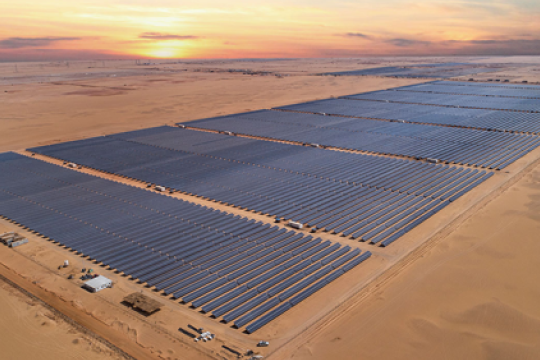
Acwa Power started operations in Egypt more than ten years ago, back in late 2014, Amin told us. Initially, the company was focused on a 2.3 GW combined cycle project (pdf) in Dairut, but as Egypt shifted its focus toward renewables, the project was later replaced by a 1.1 GW wind farm in the Gulf of Suez, on which construction began at the start of the year, we were told. The company’s first projects to get off the ground were three solar projects in Benban totaling 120 MW, which created a solid presence in the country for Acwa Power to build on, he said.

The company’s next project in Kom Ombo claimed the mantle of having the country’s cheapest solar energy tariff at the time for the whole of North Africa, which furthered Acwa Power’s position in the renewables market. This 200 MW solar farm has now been up and running for a year and a half, we were told, powering some 130k households and offsetting 280k tons of carbon dioxide every year.

Looking ahead, Acwa Power is interested in Egypt’s desalination push, which Amin thinks the company could play an important role in, given “we are the largest producer of desalinated water in the world and would like to transfer our expertise to Egypt.”

“Desalination is about more than addressing water scarcity or the Renaissance Dam in Ethiopia,” as it can expand habitable areas outside of the Delta and the thin strip of land hugging the Nile, Amin argued. The declining cost of desalination supports the move to think about desalination away from just water scarcity, he added.

In some cases, desalination can actually be cheaper than pumped water, Amin pointed out. Pumping water from the Nile to the Red Sea requires a huge amount of energy and infrastructure, not to mention the amount of water that’s lost from leakage, which can reach 20-25%, he added.

Green hydrogen may be the fuel of the future, but every new technology faces challenges, Amin argued. In the same way that solar used to be criticized as an unviable alternative to fossil fuels due to its cost premium, green hydrogen will at some point be competitive with the energy sources it’s trying to replace. And with a competitive price will come offtakers willing to commit to the switch.

Acwa Power is open to any type of renewables project regardless of the tech used, whether battery energy storage systems, pumped storage, or other technologies, Amin told us, explaining that “in the end, we are a developer, not a technology provider.”

(** Tap or click the headline above to read this story with all of the links to our background as well as external sources.)

6

Moves

Microsoft taps former government lead Mohamed Kassem as GM

Microsoft Egypt appointed Mohamed Kassem (LinkedIn) as its general manager, the company said in a statement. Kassem, who has been the company’s government sector lead, most recently led national digital transformation initiatives and public-sector innovation across cloud, AI, and cybersecurity. Kassem will now oversee Microsoft’s business in Egypt and work with government, public, and private sector partners to accelerate digital transformation in the country.

This publication is proudly sponsored by

7

ALSO ON OUR RADAR

Logistics zones could get their own authority + Taj-branded Continental Hotel

A new independent government authority to manage logistics zones?

EXCLUSIVE- A proposed Logistics Zones Authority would manage, launch and award projects for logistics zones in the country, independent from the General Authority for Land and Dry Ports, a source from the transport sector told EnterpriseAM. The potential move — which is not final and is still being discussed inside the Transport Ministry — comes as the government has some 30 logistics zones to offer up to local and foreign investors, our source said.

The creation of the new authority would help streamline investments into logistics zones, as the authority would allocate land directly to investors and have the ability to draft flexible contracts suited to the nature of each zone, whether agricultural, industrial, or commercial, the source told us.

The Continental Hotel is getting Taj branding

Indian luxury hotel brand Taj Hotels will refurbish and manage the historic Continental Hotel in downtown Cairo, according to a cabinet statement. The project — which will see the Tata Group company cooperate with state-owned Egyptian General Company for Tourism and Hotels (EGOTH), was already kicked off in 2Q 2025.

Background: We first heard in 2023 that the government is planning a tender for a private partner to refurbish the Continental Hotel — a project that has been stalled ever since. The project comes as part of the government’s push to repurpose historic buildings in Downtown Cairo into commercial spaces and hotels.

Remittances were up again in October

Egyptians working abroad sent home USD 33.9 bn in the first ten months of 2025 — up 42.8% on the same period last year, according to fresh CBE data. October saw USD 3.7 bn in inflows, a 26.2% y-o-y jump. Inflows have also steadily ticked up month-on-month, coming in at USD 3.5 bn in August and USD 3.6 bn in September.

IEE to acquire two smart infrastructure companies in deals worth EGP 740 mn

Industrial Engineering Enterprises (IEE)’s board greenlit the acquisition of local smart infrastructure provider Enterprise Sigma Technology and tech-enabled parking manager Smart Garages, in two separate transactions. The acquisition of Enterprise Sigma Technology is valued at EGP 300 mn while the Smart Garages acquisition is valued at EGP 440 mn, according to a disclosure (pdf) to the EGX.

The details: The transactions will be carried out through capital increases and are awaiting both shareholder and regulatory approvals, a source with knowledge of the transaction told EnterpriseAM. IEE will use Enterprise Sigma Technology to expand into the manufacturing of equipment serving public utilities, the source added.

Tamweely, MLF Finance close new securitized bond issuances

#1- Mortgage lender MLF Finance closed a EGP 1.14 bn securitized bond issuance, the first transaction under a three-year multi-issuance program worth up to EGP 12 bn, according to a statement (pdf). The issuance is backed by a receivables portfolio originated by MLF Finance and is structured into four tranches, rated AA+, AA, A+, and A- by Meris.

ADVISORS- EFG Hermes Investment Banking acted as financial advisor and lead arranger. NBE, CIB, Banque du Caire, and EFG Hermes Promoting & Underwriting served as underwriters, with NBE as custodian and Banque du Caire as bookrunner. KPMG served as auditor, while Dreny & Partners provided counsel.


#2- Tamweely Financial Services closed a EGP 1.2 bn securitized bond issuance, the second tranche under the non-bank financial services firm’s EGP 5 bn securitization program, according to a statement (pdf). The issuance is backed by a portfolio of future receivables from microfinance contracts and is structured into four tranches with tenors ranging from 6 to 24 months, rated P1 and A- by Meris.

ADVISORS- Al Ahly Pharos acted as lead arranger and underwriter. Al Ahly Pharos, Banque du Caire, Suez Canal Bank, and NBE served as underwriting guarantors. Banque du Caire acted as subscription receiver, Suez Canal Bank as custodian, Matouk Bassiouny & Hennawy as counsel, and Baker Tilly as auditor.

General Misr plans to open EGP 1 bn car assembly plant

General Misr plans to set up a EGP 1 bn automotive assembly plant for Chinese SWM vehicles sometime between 2026 and 2027, Asharq Business quotes General Manager Nashaat Abu Hetta as saying. The company is using an existing plant for local assembly until the new plant comes online. General Misr also plans to launch an electric vehicle line from the Chinese brand in the local market by 2027.

(** Tap or click the headline above to read this story with all of the links to our background as well as external sources.)

8

PLANET FINANCE

Global M&A rebounds in 2025, led by mega-transactions, tech, and AI

Global M&A snapped back in 2025 — though unevenly. Transaction value jumped 36% and is on track to hit a total of USD 4.8 tn, which would make 2025 the second-strongest year on record for M&A, Bain & Company said in a new report. Volumes rose just 5%, making clear this was a rebound driven by transaction value, not a flood of activity.

Go big or don’t bother: Transactions above USD 5 bn accounted for more than 75% of incremental transaction value as infrequent, deep-pocketed buyers re-entered the market. Around 40% of these agreements were “transformative,” meaning they were worth more than half the buyer’s market cap.

Tech did the heavy lifting: Technology M&A surged more than 75% y-o-y, powered by AI-related agreements. Nearly half of strategic tech transaction value was tied to AI-native targets or capabilities, underscoring how acquirers are choosing to buy transformation rather than build it slowly.

Growth is back in fashion. Roughly 60% of large transactions in 2025 targeted revenue expansion or new capabilities — the highest share on record — reversing the cost-cutting, consolidation-heavy playbooks that dominated during the downturn.

Still, M&A lost the budget fight: Despite the rebound, companies allocated just 7% of total capital spending to acquisitions — a decade low — as capex and R&D took priority. The Magnificent Seven alone spent nearly USD 500 bn on capex and R&D through 3Q, crowding out dealmaking.

US and China were still the two biggest M&A markets: US targets drove nearly half of global strategic transaction value growth, while Greater China led by transaction count thanks to domestic activity. EMEA’s M&A market lagged — with volumes falling 7% despite strong growth in transaction value.

MARKETS THIS MORNING-

Asian markets are in the green this morning after China held its loan prime rates steady, with Hong Kong’s Hang Seng and China’s CSI 300 both gaining more than 0.5%. Japan’s Nikkei was also up 1.6%, while South Korea’s Kospi rose 1.8%. Over on Wall Street, futures are also edging higher ahead of a shortened holiday week.

EGX30

41,348

+0.9% (YTD: +42.9%)

USD (CBE)

Buy 47.48

Sell 47.61

USD (CIB)

Buy 47.50

Sell 47.60

Interest rates (CBE)

21.00% deposit

22.00% lending

Tadawul

10,484

+0.3% (YTD: -12.9%)

ADX

9,967

-0.3% (YTD: +5.8%)

DFM

6,114

+0.6% (YTD: +18.5%)

S&P 500

6,834

+0.9% (YTD: +16.2%)

FTSE 100

9,897

+0.6% (YTD: +21.1%)

Euro Stoxx 50

5,760

+0.3% (YTD: +17.7%)

Brent crude

USD 60.87

+0.7%

Natural gas (Nymex)

USD 4.06

+1.9%

Gold

USD 4,396

+0.2%

BTC

USD 89,132

+0.8% (YTD: -4.8%)

S&P Egypt Sovereign Bond Index

981.82

+0.1% (YTD: +27.7%)

S&P MENA Bond & Sukuk

151.80

-0.1% (YTD: +8.4%)

VIX (Volatility Index)

14.91

-11.6% (YTD: -14.1%)

THE CLOSING BELL-

The EGX30 rose 1.0% at yesterday’s close on turnover of EGP 7.3 bn (35.8% above the 90-day average). International investors were the sole net buyers. The index is up 39.0% YTD.

In the green: Egypt Aluminum (+5.6%), ADIB (+3.6%), and CIB (+3.2%).

In the red: Eastern Company (-2.9%), Raya Holding (-2.6%), and Beltone Holding (-2.5%).

9

BLACKBOARD

2025 was a year of overseas expansion and domestic shake-ups for the education sector

If 2024 was the year of survival (read: inflation, tuition hikes, and currency volatility), 2025 was the year of structural surgery. For decades, the business community’s complaint has been consistent: graduates are not workforce-ready. This year, policy and private sector responses finally aligned to address that gap. From the radical slimming down of the Thanaweya Amma curriculum to the aggressive rollout of vocational schools and the mandatory introduction of AI, the theme of 2025 was employability over credentialism.

While the state looked inward to fix the system, the private sector looked outward. 2025 will be remembered as the year Egypt became a net exporter of education management, with major operators placing flags in Saudi Arabia and — in a historic first — the US. Below is the breakdown of how the education sector fared in 2025.

Deep-pocketed investors made their mark on the local education market + Egyptian players look abroad

The year started with a bang when the Saudi Public Investment Fund-backed Social Impact Capital cemented its grip on CIRA Education in an EGP 3.4 bn transaction that brought its total stake to 88.7%. The acquisition signaled that the sector’s leading private-sector operator was clearing the decks for a new phase of aggressive growth both in and outside of Egypt.

This PIF-backed warchest was soon put to good use, with the EGX-listed education outfit moving to acquire up to 90% of its subsidiary Cairo for Educational Services and buying 51% of L’École Française d’Hurghada to enter the Red Sea market.

CIRA Global Ventures also acquired a stake in Falcon Academy — the first time an Egyptian education group has made a strategic entry into the North American K-12 market — signaling that CIRA Education now has the balance sheet and confidence to compete in the world’s most mature market.

EFG Hermes-backed K-12 operator Spark Education Platform also got in on the expansion action, acquiring a majority stake in Riyadh’s Qimam El Hayat International School in January and partnering with GEMS to launch schools in KSA and Bahrain by June. Smaller players also looked to expand and acquire in the GCC, including local startup iSchool, which acquired Saudi-Egyptian peer Algoriza’s edtech arm Seeds to cement its foothold in the Kingdom.

Businesses moved to produce the talent they need by building schools themselves

The disconnect between the skills of university graduates and labor market needs drove a massive wave of investment in technical education in 2025. GB Corp partnered with Saxony Egypt University (which officially opened its doors in April) for automotive mechatronics and the Egyptian Drug Authority backed pharma-tech schools in August, showing that businesses are no longer waiting for universities to produce talent — they’re building the schools themselves, as they have with vocational training for more than a decade.

The Central Bank of Egypt even began its rollout of a first-of-its-kind bachelor’s program in banking sciences in partnership with the Higher Education Ministry and the Supreme Council of Universities. The degree — offered by selected universities and institutes to high school graduates — aims to arm students with specialist knowledge, practical skills, and ethical foundations to succeed in an industry being reshaped by rapid digital transformation.

Egyptian universities looked abroad, while foreign investors eyed Egypt

2025 was the year the strategy shifted from merely attracting foreign students to exporting entire campuses. Cairo University and Alexandria University led the charge with advanced plans to establish physical branches in Riyadh, Doha, and Abu Dhabi, aiming to directly serve the massive Egyptian expatriate community and the growing Gulf student market on their own turf.

The private sector followed the same vector, with Future University in Egypt signaling its entry into the UAE’s postgraduate market and Alexandria University renewing its push into Africa. This geographic diversification represents a critical evolution in the sector’s business model: By generating tuition revenue in foreign currency abroad, universities are effectively building a natural hedge against domestic volatility while projecting Egyptian soft power across the MENA region.

While Egyptian universities went abroad, the state continued to give incentives to foreign universities to set up shop here — a clear strategy to stop the drain of hard currency from students studying overseas. This included facilitating the entry of new players like Queen Margaret University and Edinburgh Napier University as policymakers explicitly target the segment of the population most likely to export hard currency via tuition fees.

The state also doubled down on its higher education capacity at home to address the concentration of high-quality national universities in and around Cairo. The government approved the establishment of 12 new national universities in a single sweep, targeting governorates like Sohag, Luxor, and the New Valley. This strategy aims to decentralize quality education, stopping the internal migration to Cairo while offering a state-backed alternative to private universities.

The end of Thanaweya Amma as we knew it, the introduction of the Egyptian Baccalaureate, and the return of the SATs

The ghost of the Thanaweya Amma — the high-stress, memorization-heavy nightmare of many an Egyptian household — was finally exorcised this year. After years of floating alternatives, the Education Ministry pulled the trigger on a massive restructuring that prioritized depth over breadth. The decision to slash the number of core subjects and to relegate second languages to pass/fail status was controversial, but it signaled a shift toward specialization.

The rollout of the Egyptian Baccalaureate in October gave private operators the premium national product they have long craved, effectively bridging the chasm between the rigid Thanaweya Amma and international diplomas. For school operators, this was an immediate commercial W, capturing families desperate to escape the single-exam nightmare but unable to stomach the soaring costs of IB or American diplomas. It has created what many operators hope will be a stickier middle-tier product that balances affordability with international-style flexibility.

SATs are back — and so are the waitlists. After a four-year hiatus, the SAT officially made itsreturn to Egypt in June, sparking a scramble for seats at American-diploma schools. With the College Board rolling out a new “leak-proof” digital format, confidence in the American track surged almost overnight. Admissions officers told us at the time that the decision triggered a wave of transfers — particularly among students in grades 10 and 11 — who had previously been hedging their choices with IGCSEs or national certificates.

AI went from buzzword to syllabus

2025 marked the year the state formalized AI education, moving beyond vague notions of digital literacy to specific, examinable skills. The Education Ministry rolled out mandatory AI curricula for select primary and secondary grades starting in the 2025-26 academic year, focusing on applied programming and ethics rather than just theory.

(** Tap or click the headline above to read this story with all of the links to our background as well as external sources.)


DECEMBER

25 December: (Thursday): Monetary Policy Committee meeting.

EVENTS WITH NO SET DATE

2H 2025: Potential visit by Chinese President Xi Jinping to Egypt

4Q 2025: The beginning of construction works on China’s State Grid two solar projects.

4Q 2025: GB Auto starts assembling one of China’s Great Wall Motor models in 4Q 2025.

4Q 2025-1Q 2026: Kasrawy Group to launch first Avatr EV models in Egypt.

2025: The InterAcademy Partnership assembly.

2025: Nile Basin States Summit, Cairo, Egypt.

2025: Release of the government’s Startup Charter document.

Before 2025-end: The government will launch two ro-ro shipping lines with Saudi Arabia and Turkey.

2026

JANUARY

1 January (Thursday): European Union’s Carbon Border Adjustment Mechanism (CBAM) to fully come into effect.

7 January (Wednesday): Coptic Christmas.

25 January (Sunday): Revolution Day / Police Day.

FEBRUARY

10-12 February (Tuesday-Thursday): Gitex Global’s AI Everything Middle East & Africa Summit

19 February (Thursday): First day of Ramadan (TBC).

MARCH

15 March (Sunday): IMF to hold its seventh review of Egypt’s USD 8 bn EFF arrangement.

21 March: (Saturday): Eid El Fitr starts (TBC).

30 March – 1 April (Monday-Wednesday): Egypt International Energy Conference and Exhibition 2026 (EGYPES)

APRIL

12 April (Sunday): Coptic Easter.

25 April (Saturday): Sinai Liberation Day.

MAY

1 May (Friday): Labor Day.

27-29 May (Wednesday-Friday): Eid El Adha (TBC).

May: NEBU Egypt’s Gold & Jewelry Exhibition.

JUNE:

30 June (Tuesday): National holiday in observance of June 30 Revolution (TBC).

JULY

23 July (Thursday): National holiday in observance of Revolution Day (TBC).

AUGUST

26 August (Wednesday): National holiday in observance of Prophet Muhammad’s birthday (TBC).

SEPTEMBER

15 September (Tuesday): IMF to hold its eighth review of Egypt’s USD 8 bn EFF arrangement.

27-29 September (Sunday-Tuesday): Egypt will host the fourth edition of the Global Conference on Population, Health and Human Development.

OCTOBER

6 October (Tuesday): Armed Forces Day.

EVENTS WITH NO SET DATE

Early 2026: Passenger operations on the New Administrative Capital–Nasr City monorail scheduled to begin.

Early 2026: The government will launch the second package of tax facilitation measures.

1Q 2026: Trial operations for the Ain Sokhna–Sixth of October section of Egypt’s first high-speed rail line scheduled to begin.

May 2026: End of extension for developers on 15% interest rates for land installment payments

2H 2026: Operations at Deli Glass Co’s new USD 70 mn glassware factory kick off.

2027

20 January-7 February: Egypt to host the African Games.

April 2027: Tenth of Ramadan dry port and logistics hub to begin operations.

EVENTS WITH NO SET DATE

2027: Egypt to host EBRD’s annual meetings for 2027.

2027: Egypt-EU Summit 2027

End of 2027: Trial operations at the Dabaa nuclear power plant expected to take place.

September 2028: First unit of the Dabaa nuclear power plant begins operations.

Now Playing
Now Playing
00:00
00:00