Get EnterpriseAM daily

Available in your choice of English or Arabic

Institutional investors snap up shares of Valu

1

WHAT WE’RE TRACKING TODAY

We’re months away from fully settling dues owed to IOCs

Good morning, friends. We have a ton of companies coverage for you this morning, including news of an accelerated book build that saw institutional investors snap up shares of fintech darling Valu, word that Edita has lined up funding to grow its production capacity as it looks to deliver EGP 26 bn in sales this year, and Fawry targeting the gig economy with a new micro ins. product.

^^ We have all of this and more in this morning’s issue, below.

Hey, Enterprise? Why do you write “ins.” and not the word that makes clear someone bought a policy covering them against risk? It’s annoying, we know. But welcome to the world of email deliverability algorithms, wherein a bot decides whether we hit your inbox or not. The full version of the word “ins.” almost invariably sends us to a bad folder, not to your inbox.

***

WISH THIS MORNING’S ISSUE was a podcast? We’ve got you. Tap or click here to listen to Morning Drive, a 10-minute version of today’s issue crafted for you to enjoy with your morning coffee, while getting the kids ready for school, or while tearing apart the kitchen for the [redacted] car keys that were, as always, in the [redacted] pocket of yesterday’s jacket.
***

PSA-

It’s almost time for us to move our clocks forward 60 minutes to get an extra hour of daylight (or lose an hour of sleep, depending on how you look at it) — daylight saving time takes effect at midnight next Friday. While the cabinet has yet to make an official announcement, by law we welcome daylight saving time on the last Friday of April. We turn our clocks back an hour on the last Thursday of October.

We’re sure the Madbouly government is happy to welcome an extra hour of daylight, as the nation currently faces an inflated energy bill thanks to rising energy prices on the back of the ongoing regional war. The rest of us? Not so much: The time change messes with our biological clocks.


WEATHER- It’s another spring day in Cairo, with a sunny morning and cool evening — the capital is looking at a high of 26°C and a low of 14°C, according to our favorite weather app.

It’s a little cooler for our friends in Alexandria, which is in for a high of 24°C and a low of 13°C.

Happening today

The House of Representatives is set for a high-stakes session today to debate amendments to the Competition Law and to hear directly from Prime Minister Mostafa Madbouly. The legislation would, if passed, give the Egyptian Competition Authority to hand down financial penalties directly, without the need to launch traditional criminal proceedings.

Mergers will also be under the microscope. The bill introduces a mandatory pre-merger notification and review system for what policymakers call “economic concentrations.”

So who needs clearance? Transactions would be subject to review if the combined in-Egypt annual turnover or assets of the involved parties exceed EGP 2.5 bn (provided that at least two of the parties to a transaction have assets or turnover north of EGP 500 mn). A company with global revenues of more than EGP 15 bn going after a local target with more than EGP 500 mn on the top line would also need clearance.

More details emerge on gov’t taxation plans

The Finance Ministry is putting together a second package of nearly 30 tax amendments it thinks will see it collect an additional EGP 300 bn in revenue without introducing new taxes. The package — set to roll out in June — targets holding companies, state-owned enterprises (SOEs), and foreign businesses, a government official tells EnterpriseAM.

What are we expecting? A key change to look for is how the government taxes holding companies selling assets, including stocks or properties. Instead of taxing the parent company, “taxes would be collected from subsidiaries and then the collected amount would be deducted when accounting for the holding companies,” our source tells us. The package also decouples local tax audits from international transfer pricing audits, which will “ensure local activity audits do not have to wait for international transfer pricing files.”

The government will also exempt foreign financing directed toward national projects from loan return taxes, while eyeing more taxes from the net income of SOEs, the source added.

Why it matters: The Finance Ministry aims to collect a record EGP 3.5 tn in tax revenues in FY 2026/27, and the package is a key part of its strategy. The package alone is projected to contribute 1.2% of GDP in additional revenue, paving the way for EGP 5.5 tn in annual receipts by 2030.

REMEMBER- We’ve been following the Finance Ministry’s preparations of a sweeping package of 49 tax and customs reforms that target boosting both foreign direct investment and portfolio inflows. The goal is to raise the tax-to-GDP ratio to 15-16%, bringing Egypt in line with middle-income peer averages from its current position of 12.5%.

Almost time to cease paying the piper

The government only has USD 900 mn left to settle with International Oil Companies (IOCs), and it intends to pay up in full by the end of June. The gov’t paid out USD 300 mn to IOCs last week, according to a report. It intends to close the chapter on arrears payment by the end of 1H in a bid to gain back trust and investments in the petroleum sector, a government official tells us. It’s also developing a new framework to “prevent the reaccumulation of dues to foreign partners,” they added.

Efforts look like they’re already paying off. IOCs are committing to ramp up production and expand exploration activity, including Shell’s plans to raise its gas production capacity by 160 mmcf/d by the end of this year, according to a separate report.

But there is a price to pay: “To honor our commitments to our partners, we have to make sure that we reduce the gap between the price of the commodities that we’re providing, in terms of petroleum goods, and the cost [of delivering] those goods, which is why there’s been a constant adjustment in pricing,” Oil Minister Karim Badawi previously said at an Amcham gathering attended by EnterpriseAM.

Looking forward: The government is studying a return to the automatic fuel pricing mechanism once global prices stabilize, linking domestic retail prices of certain petroleum products to international benchmarks, our source tells us. The government wants to curb inflation and have better control over the import bill. On its way to gradually phase-out of fuel subsidies, it recently applied a cost-recovery mechanism that helped slash fuel subsidy allocations to EGP 16.5 bn, down from EGP 75 bn in the current budget.

Local contractors can breathe easy

The government is giving companies working on public contracts six months of wiggle room as the conflict in the Gulf weighs on supplies and finances, according to a document seen by EnterpriseAM. The relief measure covers all ongoing contracts as of 1 March, including projects currently in the tendering or technical evaluation stages.

Why this matters: Local contractors are being given room to navigate their cashflow constraints without the threat of government litigation or technical defaults amid disrupted supply chains, sources at the Egyptian Federation for Construction and Building Contractors tell us. The government is also giving itself a buffer to pay its own dues, after its decision to rationalize public spending in late February, we’re told.

We’ve seen this before: The cabinet gave similar extensions for the better part of four years starting in 2020, when the local market was dealing with fallout from Russia’s war in Ukraine. Committees will now review extension requests case-by-case to ensure that the six-month buffer accounts for specific delays in shipping and raw material availability.

Data point

USD 890 per ton — that’s the price local firms charged for six to seven shipments of exported fertilizers last Friday. Exporters charged significantly higher prices compared to the recent global average of USD 835 and nearly double the pre-crisis price of USD 484.

Egyptian fertilizer producers are leveraging the closure of the Strait of Hormuz to ramp up exports to India at record-high prices, Agritrade CEO Ahmed Hegras to Al Arabiya. The move comes as India grapples with a severe energy supply deficit after major Gulf exporters — including Saudi Arabia, Qatar, and the UAE — suspended shipments due to the Hormuz blockade. This has positioned Egypt as the region’s most critical alternative supplier, with the potential to tap into some USD 1.6 bn in unutilized export capacity.


Meet EnterpriseAM MENA+, our new flagship newsletter covering the flows of capital, people, and ideas across the Middle East — and beyond it.

MENA+ covers AI and tech — and geopolitics, the war for talent, which BSD is on top (and who's gunning for them), the changing energy economy, new corridors to India and China, and much, much more.

What’s with the “+” in MENA+? We think one of the most powerful stories in the region is the *export* of ideas and capital not just to neighboring regions (Asia, the Stans) but to international financial centers. MENA countries are jockeying for position in the new global economy now taking shape, and we’re going to shape that conversation.

Tap or clickhere to get your own copy delivered to your inbox every Monday, Wednesday, and Friday before 12pm UAE.


The big story abroad

US-Iran talks are reportedly on track for later this week in Islamabad. Tehran will reportedly dispatch a negotiating team today, though it remains unclear who will lead it. US President Donald Trump said the two-week ceasefire will expire on Wednesday evening Washington time and that an extension is unlikely.

Meet Apple’s new CEO: After much speculation about who would lead the iPhone maker after CEO Tim Cook steps down, Apple’s board of directors has named John Ternus, the current senior vice president of hardware engineering, to lead the tech giant starting in September. Cook will become executive chairman of the board.

In other tech news: Amazon and Anthropic will spend over USD 100 bn on AI infrastructure over the next 10 years, as per a new agreement to secure up to 5 GW of new capacity to train and run Claude — the hottest AI application at the moment.

AND- Warsh faces the Senate. The Senate confirmation hearing for Fed Chair nominee Kevin Warsh is scheduled for today, marking the first major test for the Trump nominee. We will be closely watching what he says about reshaping monetary policy amid a shifting global economy. Warsh is expected to navigate a narrow path between the White House’s push for lower rates and Wall Street’s fears regarding Federal Reserve independence.

What to expect: Warsh is expected to tell senators that the Fed’s independence is not “particularly threatened when elected officials… state their views on interest rates,” according to remarks seen by the Financial Times. He will also emphasize the importance of the Fed’s independence in setting rates to keep inflation in check.

*** It’s Going Green day — your weekly briefing of all things green in Egypt: EnterpriseAM’s green economy vertical focuses each Tuesday on the business of renewable energy and sustainable practices in Egypt, everything from solar and wind energy through to water, waste management, sustainable building practices and how you can make your business greener, whatever the sector.

In today’s issue: We take a deep dive into the groundwork for a nationwide green labeling system for plastics.

From 7–9 May, the Somabay Endurance Festival returns to the Red Sea for Egypt’s leading multi-sport challenge, where swimming, cycling, and running meet one of the region’s most iconic coastal destinations.

This year also introduces a new racing venue and enhanced endurance course experience, elevating the competition and athlete journey even further.

In partnership with The TriFactory, Somabay continues to lead the way in sports tourism, active lifestyle experiences, and world-class events. Register here.

2

The Big Story Today

Valu-added with a secondary sale

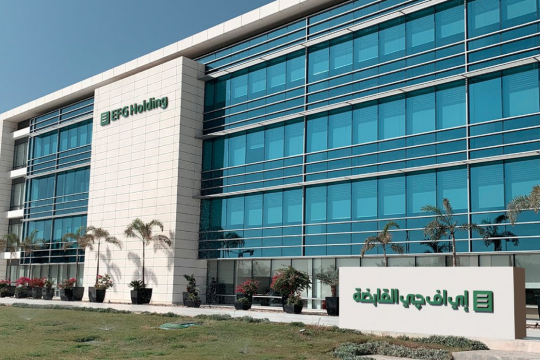
Institutional investors love Valu: “An accelerated bookbuild (ABB) involved a sale of 53.8 mn shares, owned by one of the shareholders of Valu, representing 2.55% of Valu’s share capital, has been successfully placed and sold mainly to institutional investors,” EFG Hermes Co-Head of Investment Banking Maged El Ayouti told EnterpriseAM. EFG Hermes acted as the financial advisor and bookrunner on the sale, which we believe took place last week.

From an in-house startup, Valu has transformed into an EGX mainstay, with its share price up 40% at the close of trading yesterday from the EGP 8.88 at which it closed on its first day as a listed company in June 2025.

Why it matters: The placement of a more than 2.5% stake in the fintech pioneer is another sign that investors (including some international names) are looking at Egypt once again. The benchmark EGX30 is up a hair over 18% so far this year, outpacing the DFMGI (-3%), the ADX (flat), and the Tadawul’s all-share index (+9%).

So, who sold? EFG Holding isn’t saying. The finance unit of EFG Holding is the largest single shareholder with a stake of c. 67%, while global retail and computer giant Amazon exercised a three-year-old option to take a 3.95% stake when Valu made its EGX debut last year.

We think the transaction cleared on Tuesday, 14 April, when when a substantial 55 mn shares traded hands. At Tuesday’s EGP 11.21 close, the sale likely penciled out to around EGP 603.1 mn.

Uhm, Enterprise? What’s an ABB? Think of an ABB as a flash sale for institutional investors that prevents the swings in share price that could go hand-in-hand with a paced-out selldown on the open market. Because these shares are placed so quickly — brokers line up buyers in just a few hours, often overnight — and in such high volume, they often clear at a slight reduction to the previous close.

Vindicating EFG Holding’s spinoff strategy: The move comes a little under a year after the fintech's unconventional spin-off listing on the EGX, which saw corporate parent EFG Holding distribute Valu shares to its own investors as a dividend to create an instant public float. “The market was not fully valuing Valu within EFG Holding’s stock price, and this helps correct that imbalance,” EFG Holding Group CEO Karim Awad told us in the run-up to the listing.

ZOOMING OUT- Is the market lull officially over? The ABB can be seen as a signal that the EGX is open for business again after a choppy few weeks. “It stands among a series of offerings that have reignited investor appetite for equities, a continuation of the momentum for new listings and follow-on offerings, following muted ECM activity during last month against a backdrop of elevated geopolitical risk,” Al Ayouti said in a statement.

This publication is proudly sponsored by

3

DEBT WATCH

Molto money for Edita

Edita Food Industries has snapped up funding to finance expansion lines at home and abroad. The EGX-listed snackmaker signed a seven-year, EGP 600 mn medium-term loan from Arab Bank Egypt to support its 2026 investment program, Investor Relations and Investment Senior Manager Omar El Abhar tells EnterpriseAM.

What’s in the works: “The company has a planned new wafer production line in Egypt, expected to increase the locally produced segment by 35%,” El Abhar tells us. The facility will support Edita’s EGP 4 bn investment program for 2026, which targets capacity expansion and new production lines across Egypt, Morocco, and Iraq, he adds.

The company is also targeting EGP 26 bn in sales this year as new capacity and regional production lines in Egypt, Morocco, and Iraq take off, El Abhar says.

REMEMBER- Edita has been actively building out its production base, as it signed an EGP 320 mn asset purchase agreement in October 2025 to acquire additional production machinery and boost output and support export growth.

It was a good year: Edita had reported a 72.6% y-o-y increase in its net income to EGP 2.4 bn in 2025, on the back of stronger operating leverage, disciplined pricing, and sustained cost control. Meanwhile, revenues for the year also rose by 29.5% y-o-y to EGP 20.9 bn.

4

NBFS

Fawry targets gig economy with new macro-ins. subsidiary

Fintech giant Fawry is officially entering the ins. space, after securing approval from the Financial Regulatory Authority (FRA) for its new subsidiary, Fawry for Microins., with a starting budget of EGP 60 mn, of which Fawry owns 90%, according to a press release (pdf). The new arm will sell basic, low-cost coverage for health, life, personal accidents, and assets designed for gig workers and small businesses.

The rationale: “The ins. market in Egypt is very small and untapped, with lots of room for growth, for both existing and non-existent products,” Fawry’s Director of Investor Relations Hassan Abdelgelil tells EnterpriseAM. “In fact, there are ins. products that exist with no cost-effective avenue to reach potential customers,” he added.

Why it matters: Fawry is leveraging the power of embedded finance to open up a new revenue stream, where it doesn’t have to build an expensive new sales team to sell ins.; the company is simply adding a button to a network that 24 mn app users already access. This proves that dominating the distribution channels is just as important as the product itself.

Earnings snapshot: The EGX-listed fintech giant saw its net income surge 79.8% y-o-y lastyear to reach EGP 2.9 bn, while its top line jumped 57% y-o-y to EGP 8.7 bn.

Tags:
5

A MESSAGE FROM AUC ONSI SAWIRIS SCHOOL OF BUSINESS EXECUTIVE EDUCATION

From people management to people intelligence: How AI is transforming HR

Artificial intelligence is redefining the role of human resources within modern organizations. What was once an administrative function focused on recruitment, compliance, and recordkeeping is increasingly becoming a strategic partner powered by data and intelligent systems.

Recruitment is one of the most visible areas of change. AI-powered platforms can screen large volumes of applications within minutes, identifying candidates whose skills best match a role’s requirements. Automation also improves the candidate journey, allowing HR professionals to focus less on paperwork and more on engaging with talent.

The impact extends beyond hiring. By analyzing performance data, learning patterns, and workforce behavior, AI systems help organizations identify skill gaps and design more targeted development pathways. Predictive analytics can also help leaders detect early signals of disengagement or turnover, enabling organizations to intervene before challenges escalate.

Technology alone, however, is not sufficient. Effective adoption requires thoughtful implementation and strong governance to deploy AI responsibly. Organizations must ensure transparency, address potential algorithmic bias, and maintain human oversight in decision-making.

As organizations adapt to these changes, executive education is evolving in parallel. At AUC Onsi Sawiris School of Business Executive Education, digital business programs covering AI, data-driven decision-making, and digital leadership aim to help leaders understand how these tools influence workforce strategy and organizational priorities. The portfolio also includes individual AI-native programs across finance, healthcare, marketing, and digital transformation, with HR-focused offerings currently in development.

6

EARNINGS WATCH

Swvl is not dropping off of Nasdaq just yet

If you’ve seen Nasdaq’s delisting notice for Dubai-headquartered mobility startup Swvl from last November, you might think it’s on a crash course — especially if you check its market cap, which is currently at USD 15.7 mn, way below the USD 35 mn threshold Nasdaq requires. You might also remember it’s not their first delisting notice, with the company getting several more back in 2023. But the actual story is a little more complicated than that.

Listed companies only need to meet one of three standards to remain listed on the stock exchange, and the market cap threshold is just one of them, according to Nasdaq’s latest listing guide (pdf). The other two standards are: if the company’s net income exceeds USD 500k (in the last fiscal year or two of the three most recent fiscal years), or if total shareholders’ equity exceeds USD 2.5 mn.

While the Dubai-headquartered company falls short on the final standard, its net income and shareholders’ equity sit comfortably above those thresholds, according to its 2025 earnings presentation (pdf). The company recorded a gain last year, with net income coming in at USD 1.3 mn, up from a net loss in 2024. Meanwhile, its total equity is currently at USD 2.9 mn, up from USD 680k the year before.

The turnaround came as revenues grew 41% y-o-y to USD 24.2 mn, and as its restructuring earlier in 2023 and 2024 — with a larger focus on B2B and B2G contracts — started reflecting in its balance sheet, Swvl CFO Ahmed Misbah told EnterpriseAM. The net loss from the past few years were a result of the unwinding and restructuring the firm undertook, which was largely expected, as CEO Mostafa Kandil told us earlier in 2024. They were wagering on those turnaround strategies to reap some results in 2025, as Kandil said at the time — which it did.

The company’s strategy was to focus on expanding in the Gulf and the US — both moves for which it has already started to make strides. Its Gulf revenues grew 122% y-o-y to USD 8 mn, and a bulk of that is thanks to its growth in the UAE, Misbah said. The company relaunched operations in the UAE — after halting them earlier due to low margins — early 2025, and it has since secured four large enterprise contracts there, he added. That includes a USD 5.5 mn one it announced last February.

Earlier in its expansion phase, the startup was focusing on growth and market entry, even if at extremely low margins. That’s changing now, Misbah said, adding that the company has become “more disciplined about the contracts we take on, and no longer pursue that low margin on account of top-line growth.”

Gross margins fell slightly to 18.2% last year, mostly due to early-stage contracts in the UAE carrying lower margins, according to the presentation. Still, they’re much higher than where they were pre-restructuring, at about 14-18%, and are expected to rise further as “we deepen our understanding of clients’ operations and our route optimization takes effect,” he explained.

“The GCC remains one of our highest priority areas and segments for multiple reasons, firstly because we understand the market inside out, and we have connections across the region that we’re now able to cross-leverage across multiple geographies,” Misbah said. While Saudi Arabia remains its largest market, Misbah expects the UAE to “take off” pretty soon, and it’s also secured its first contract in Kuwait. Qatar is also on their radar, he added.

Egypt is still its biggest market in terms of revenue share, with revenues growing 20% y-o-y to USD 16.2 mn.

Meanwhile, in the US, the company is still in its early stages of operations, with the first hire made there recently expected to build up a sales pipeline in that market, Misbah said. The company is expected to build its staff and invest more resources there as they secure more contracts, he noted. Their first order of business? Shuttle buses for the 2026 World Cup.

Looking ahead? The company expects growth to accelerate into FY 2026. That growth is also of much “higher quality,” the firm said in its presentation, reflected by a larger portion of recurring and USD-denominated revenues.

It also plans to invest further in its investor relations, which it expects to help prop up its share value, he said, especially after working largely “in stealth mode” over the past few years while it was deep in its restructuring strategy. The company’s shares rose 2.5% yesterday to close at USD 1.62 apiece, down sharply from their listing price of USD 9.95.

7

Also on our Radar

EETC taps Kharafi National to upgrade West Bakr substation

The national grid is getting an upgrade that will allow it to absorb and distribute 2.8 GW of new wind energy coming from the Gulf of Suez, with the Egyptian Electricity Transmission Company (EETC) tapping the infrastructure firm Kharafi National to add two 500 kV gas-insulated switchgear units to the West Bakr substation in the Canal Electricity Zone, Al Mal reports.

Why this matters: The Gulf of Suez has become the country’s main wind energy corridor, with multi-GW pipelines coming online in the next five years, including the Gulf of Suez wind projects led by Orascom Construction, Scatec, and Masdar — to be completed in 12-14 months. Grid readiness is the constraint Egypt is now trying to fix as more renewable power comes online.

8

PLANET FINANCE

Stablecoins stir dollarization fears across emerging markets

Central bankers are worried that the USD is staging a digital coup. The growing use of USD-linked stablecoins is accelerating dollarization in emerging markets — outpacing regulators and weakening central banks’ control over monetary policy — while also creating new channels for tax evasion and cybercrime, the Financial Times reports.

SOUND SMART- Stablecoins are crypto tokens pegged to fiat currencies like the USD. They are gaining ground as a low-cost, near-instant alternative to traditional cross-border transfers.

These assets are taking off in emerging markets: In several EMs, stablecoins are already grabbing a “significant share” of the transaction pie, the IMF’s Tobias Adrian said. People are using them to hedge against local inflation and currency depreciation and to bypass government restrictions on access to foreign currency.

By the numbers: Standard Chartered expects stablecoin EM holdings to jump to USD 1.22 tn by 2028 from USD 173 bn currently, with growth concentrated in financially stressed economies like Egypt, Pakistan, and Bangladesh.

Why regulators are worried

Evicting the local currency: Dollarization can limit central banks’ control over money supply and policy, making it vulnerable to US monetary shifts and posing “serious risks for financial integrity,” Bank for International Settlements chief Pablo Hernández de Cos said.

A very one-sided market: Around 98% of the USD 315 bn stablecoin market is USD-denominated, spurred in part by US policy moves integrating the sector into the regulated financial system.

Beyond policy issues, there’s a growing crime problem: Stablecoins open “new avenues for tax evasion”, Hernández de Cos said, citing estimates that they account for most illicit crypto transactions. The Financial Action Task Force has likewise warned that stablecoins were “attractive for criminal misuse” and increasingly used to launder proceeds from ransomware, phishing, and other cyber-enabled crimes.

The response plan

Regulators playing catch-up: The pace of global rule-making for stablecoins has slowed, with Bank of England Governor Andrew Bailey warning that regulators will soon have to “come to terms” with their growing use — particularly where they replace domestic currencies in everyday transactions.

But policy responses are emerging: Countries can counter dollarization risks by strengthening macroeconomic frameworks, said deputy head of the IMF Dan Katz. Brazil has already moved to regulate stablecoin providers under anti-money laundering rules and imposed a USD 100k cap on many foreign transfers.

The BIS is building alternatives: The bank is working with central banks and commercial lenders on potential alternatives to stablecoins, including tokenized bank deposits designed to offer similar speed and efficiency without ceding monetary control.

MARKETS THIS MORNING-

Hopes of easing tensions between the US and Iran, amid reports that the two sides are at the negotiation table this week, pushed stocks higher this morning. Japan’s Nikkei and South Korea’s Kospi are both up over 1% in early trading. Over on Wall Street, markets are expected to open higher, with futures in the green.

EGX30

51,813

-1.1% (YTD: +23.9%)

USD (CBE)

Buy 51.92

Sell 52.06

USD (CIB)

Buy 51.91

Sell 52.01

Interest rates (CBE)

19.00% deposit

20.00% lending

Tadawul

11,367

-0.9% (YTD: +8.4%)

ADX

9,842

-0.8% (YTD: -1.5%)

DFM

5,862

-2.1% (YTD: -3.1%)

S&P 500

7,109

-0.2% (YTD: +3.7%)

FTSE 100

10,609

-0.6% (YTD: +6.6%)

Euro Stoxx 50

5,983

-1.2% (YTD: +2.3%)

Brent crude

USD 95.48

+5.6%

Natural gas (Nymex)

USD 2.67

-0.7%

Gold

USD 4,842

+0.3%

BTC

USD 75,866

+2.8% (YTD: -13.4%)

S&P Egypt Sovereign Bond Index

1,040

+0.1% (YTD: +4.7%)

S&P MENA Bond & Sukuk

152.1

+0.3% (YTD: +0.1%)

VIX (Volatility Index)

18.87

+8.0% (YTD: +26.2%)

THE CLOSING BELL-

The EGX30 fell 1.1% at yesterday’s close on turnover of EGP 8.4 bn (22.3% above the 90-day average). Local investors were the sole net buyers. The index is up 23.9% YTD.

In the green: Ibnsina Pharma (+3.7%), Rameda (+2.2%), and Palm Hills Developments (+1.0%).

In the red: AMOC (-3.9%), Raya Holding (-2.3%), and Telecom Egypt (-2.3%).

9

Going Green

Plastics green label gets green light

Egypt is laying the groundwork for a nationwide green labeling system for plastic products, starting with a pilot phase targeting packaging and plastic bags as part of a broader push to transition toward a circular economy, according to a statement from the Environment Ministry. The certification will be granted to manufacturers that redesign products to be recyclable, incorporate recycled inputs, or use biodegradable materials.

Over time, the system is expected to expand across all industries, Waste Management Regulatory Authority (WMRA) head Yasser Abdallah tells EnterpriseAM. Regulations are nearing completion ahead of a wider rollout under the Environmental Law framework, with technical guidelines and an electronic registration system for producers also in development, according to the ministry.

Why this matters: The government is treating plastics as a contained test case to pilot compliance with green manufacturing and sustainable production standards before scaling across sectors, Abdallah says. The initial phase will focus on commonly used products such as plastic bags and packaging materials, which will need to meet specific environmental criteria to reduce pollution. Authorities are already working with a number of factories in preparation for the rollout, with plans to expand the system gradually to other industries as part of a broader transition toward green manufacturing.

The system is also being designed with exports in mind. Discussions around the green label are aligned with Egypt’s preparations for the EU’s Carbon Border Adjustment Mechanism (CBAM), we’re told. The aim is to help Egyptian manufacturers reduce emissions and meet evolving international standards, strengthening their competitiveness in export markets that are increasingly prioritizing sustainability.

The policy shift signals a broader rethink, but industry players say recycling alone won’t solve the problem. While Egypt has made progress in expanding recycling infrastructure and raising awareness over the past five years, the current approach still focuses too heavily on downstream solutions, Banlastic Egypt co-founder and R&D head Manar Ramadan tells us. In her view, the more effective strategy would be to reduce plastic use at the source through stronger policies such as bans or fees, which remain largely absent. She adds that recycling should not be the primary focus, as it comes later in the waste management hierarchy after reduction and reuse.

Recycling demand is rising, but it is still uneven. Interest in recycled plastic products has grown, particularly among corporates and consumers, Ramadan told us. Companies are increasingly requesting recycled materials for certain products, and consumers are becoming more open to using them. However, she notes that this demand is not always consistent and is sometimes driven by trends rather than long-term behavioral change. While awareness has improved, it has yet to translate into stable, widespread demand across the industry, she added.

A green label could help — if it’s enforced. The certification is expected to raise awareness and make environmentally friendly products more visible in the market, which could support the growth of eco-friendly businesses. However, the effectiveness of the system will depend on proper monitoring and enforcement. Without clear oversight, there is a risk that the label could be misused, undermining its credibility, according to Ramadan.

The economics remain a core constraint. Recycling continues to face structural challenges that limit its scalability. Ramadan explains that the process is often more expensive than using virgin raw materials due to higher energy and processing costs, making it less attractive for manufacturers. This cost imbalance creates a disincentive for businesses to adopt recycled inputs, even as awareness and demand begin to grow.

The informal sector is both a constraint and a critical part of the system. Egypt’s waste management ecosystem relies heavily on informal waste collectors, who handle a significant share of recyclable materials. Ramadan says that while formalizing the system is important from a policy perspective, excluding these actors could weaken overall efficiency. Integrating them into a more structured system would require not only operational inclusion but also improved social protections such as health ins. and better working conditions. She adds that the scale of waste generated in Egypt makes it difficult for formal systems alone to manage collection and sorting, reinforcing the need for a hybrid approach that builds on existing informal networks rather than replacing them.

Egypt is moving beyond expanding recycling capacity toward influencing how products enter the market in the first place. The green label could help create a clearer signal for both producers and consumers, but its impact will depend on enforcement, cost dynamics, and how effectively it accounts for the realities of Egypt’s existing waste system.


2026

APRIL

25 April (Saturday): Sinai Liberation Day.

MAY

1 May (Friday): Labor Day.

5 May (Tuesday): S&P Global to release PMI figures for April

7 May (Thursday): CBE expected to release foreign exchange reserve data for April

10 May (Sunday): Capmas expected to release inflation data from April

21 May (Thursday): Monetary Policy Committee’s third meeting of 2026.

27-29 May (Wednesday-Friday): Eid El Adha (TBC).

JUNE

15 June (Monday): Seventh review of the IMF’s Extended Fund Facility

30 June (Tuesday): National holiday in observance of the June 30 Revolution (TBC).

JULY

9 July (Thursday): Monetary Policy Committee’s fourth meeting of 2026.

23 July (Thursday): National holiday in observance of Revolution Day (TBC).

AUGUST

20 August (Thursday): Monetary Policy Committee’s fifth meeting of 2026.

26 August (Wednesday): National holiday in observance of Prophet Muhammad’s birthday (TBC).

SEPTEMBER

15 September (Tuesday): IMF to hold its eighth review of Egypt’s USD 8 bn EFF arrangement.

24 September (Thursday): Monetary Policy Committee’s sixth meeting of 2026.

27-29 September (Sunday-Tuesday): Global Conference on Population, Health, and Human Development.

OCTOBER

6 October (Tuesday): Armed Forces Day.

29 October (Thursday): Monetary Policy Committee’s seventh meeting of 2026.

DECEMBER

17 December (Thursday): Monetary Policy Committee’s eighth meeting of 2026.

EVENTS WITH NO SET DATE

Early 2026: Passenger operations on the New Administrative Capital-Nasr City monorail scheduled to begin.

1Q 2026: Trial operations for the Ain Sokhna-Sixth of October section of Egypt’s first high-speed rail line scheduled to begin.

May 2026: End of extension for developers on 15% interest rates for land installment payments.

July 2026: British Prime Minister Keir Starmer set to visit Egypt.

2H 2026: Operations at Deli Glass Co’s new USD 70 mn glassware factory kick off.

2026: The Egyptian-American Economic Forum.

2027

20 January-7 February: Egypt to host the African Games.

April 2027: Tenth of Ramadan dry port and logistics hub to begin operations.

EVENTS WITH NO SET DATE

2027: Egypt to host EBRD’s annual meetings.

2027: Egypt-EU Summit 2027.

End of 2027: Trial operations at the Dabaa nuclear power plant expected to take place.

September 2028: First unit of the Dabaa nuclear power plant begins operations.

Now Playing
Now Playing
00:00
00:00