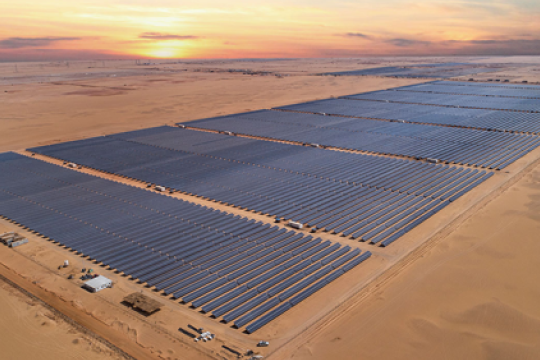
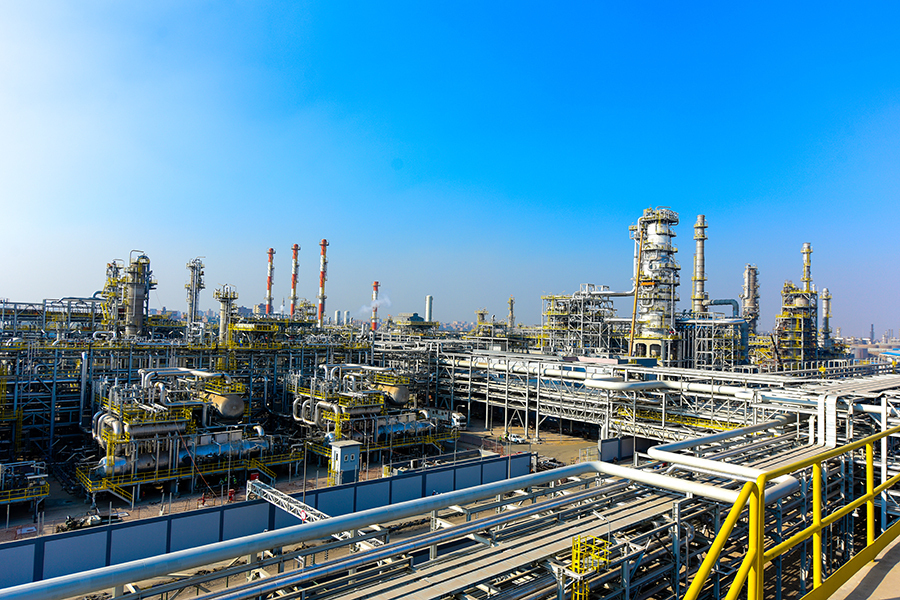
The first phase of the Burullus (pictured above) and New Cairo power stations were inaugurated on Thursday by President Abdel Fattah El Sisi and German Chancellor Angela Merkel. Once complete, the power stations will be the largest gas-fired combined cycle power plants in the world, Orascom Construction says. “Orascom and its consortium partner, Siemens, already connected a total of 2,400 MW to Egypt’s national grid at both power plants, exceeding delivery targets by 20%. Once complete, each power plant will generate a total of 4,800 MW.”
We had a quick talk with Orascom Construction CEO Osama Bishai to ask, for starters, how do you exceed delivery target by 20% on what are already the world’s two largest power plants?
Osama Bishai: The original plan from Siemens was for a staggered target based on the delivery sequence of the equipment: First Beni Suef, then Burullus, then the New Capital. It turns out that the New Capital site is almost ideal in its closeness to Cairo — and it had none of the onsite challenges of Burullus or Beni Suef. We added an additional 400 MW over the target capacity at the New Capital. Meanwhile, we’re also involved in other power plant projects and are converting 1,500 MW simple cycle plants we delivered in 2015 to combined cycle by adding an additional 750 MW. We’re also in final negotiations on a 250 MW wind farm with French and Japanese partners.
Tap here to read “Five Questions with Osama Bishai,” which also covers:
- The industries driving Orascom Construction’s Egyptian order book in the next few years;
- How Orascom Construction is doing post the float of the EGP;
- Why the government should tap the private sector to invest in infrastructure.
Related
The Electricity Ministry signed a EUR 238 mn agreement with Siemens to build six power transmission stations to help transport power generated from the new plants, which are expected to save Egypt an annual USD 1.3 bn in fuel costs, Minister Mohamed Shaker said on Thursday. Siemens will design, build, and operate the project, as well as supply the equipment needed, while Elsewedy Electric will take charge of the project’s electromechanical works, under the terms of the MoU signed during the Egypt Economic Development Conference in 2015.
Siemens also inked a nine-year maintenance contract for the three plants on Friday, Al Mal reports. The company’s financial services arm has already started drafting a financing plan for maintenance operations, Siemens CEO Joe Kaeser said in a press conference after the inauguration, adding that the larger portion of the funding needed for the construction of the plants has also been secured.
Related
The Egyptian Financial Supervisory Authority (EFSA) has given the green light to the sale of CI Capital to a consortium of investors, according to a disclosure from CIB. CIB says EFSA said it had no objection to a number of investors with whom the bank had inked sale and purchase agreements (SPAs) in December. CIB says it is currently reviewing the non-objection and studying the final agreement structure. The SPAs were signed with a group of non-related Egyptian and Gulf investors for an aggregate 71.94% of CI Capital in transactions worth a combined EGP 683.4 mn that valued the investment bank at EGP 950 mn. At the time, the investor consortium was said to include: Arafa Group’s Alaa Arafa, construction magnate Mahmoud El Gammal, Tiba Group’s Saddiq Afifi, former Zamalek football club chairman Mamdouh Abbas, five unnamed stakeholders in Zahran Group, Compass Capital’s Shamel Aboulfadl and Ayman Mamdouh Abbas, and Alameda Healthcare’s Fahad Khater.
On Thursday, we reported that Saddiq Afifi and Mamdouh Abbas backed out of the agreement. Ayman Mamdouh Abbas followed the news by suggesting that the individuals making up the investor consortium would look into revising each of their proposed stakes to account for those who withdrew, but EFSA Chairman Sherif Samy threw cold water on that suggestion by saying that any investor looking to increase their stake to more than 5% would require obtaining a non-objection from EFSA first. A source tells Al Borsa the transaction could be completed this month.
A source close to the transaction credits Investment and International Cooperation Minister Sahar Nasr for moving the transaction along toward close. “She’s being very hands on — a nearly year-old transaction is closing because she is making the clearing of hurdles a priority,” the source said.
Related
Nasr orders full report on stamp tax, including alternatives: Investment and International Cooperation Minister Nasr ordered a “full report” on the effects and alternatives to imposing a stamp tax on stock market transactions to ensure the market and the government’s reform program are not harmed, at a meeting with Egyptian Financial Supervisory Authority head Sherif Samy on Thursday. Samy tells Al Mal that a decision on the tax must be taken as soon as possible. The proposed stamp tax, which the Tax Authority had suggested last week would be “ideal” at 0.175%, is expected to be submitted to the cabinet’s economic group for discussion within days. Finance Ministry Amr El Garhy had said that the tax could be increased gradually, but gave no details on the increase. Nasr also discussed protecting minority shareholders at a meeting with EGX Chairman Mohamed Omran, according to a ministry statement. Nasr and Omran looked into the upcoming amendments planned for the Capital Market’s Law, which could entail changes to how private placements are regulated, the issuance of sukuks and give the EGX flexibility to set lower listing fees to attract smaller companies to the bourse.
Related
Egypt’s foreign reserves rose to USD 26.54 bn in February, the central bank said in a statement, marking a gain of USD 178 mn from the previous month. The CBE also says that fluctuations in FX rates are reflective of supply and demand, and the USD/EGP rate reaching 16.10 shows the market is self-correcting, according to an emailed statement.
Related
Inching closer towards a Turkey-style migration agreement with the EU: German premier Angela Merkel promised Egyptian President Abdel Fattah El Sisi additional aid to “help to thwart migration to Europe” through Egypt during her two-day state visit, according to Bloomberg. The EU has offered Turkey some EUR 6 bn in aid for refugees and has also offered to support Egypt through its refugee plight.
Merkel also pledged some USD 500 mn in funding through to 2018 to support economic reforms and SME development, Investment and International Cooperation Minister Sahar Nasr announced on Thursday during the Egyptian-German Business Forum — which saw CEOs of major German firms in attendance. The amount, which will be coordinated with the IMF, will be received “in the form of grants and concessional funds,” a top government official tells Reuters.
She also assured El Sisi that German companies are eager to expand their investments in Egypt, encouraged by recent economic reform measures. Talks between the two also looked at cooperation on regional stability, countering terrorism, and reinforcing the role of German development agencies under the terms of a 1959 cooperation agreement signed between the two countries. As we noted last week, Merkel views investment as a crucial means to help stem inflows of refugees in host nations. Merkel also extended a formal invitation to El Sisi to attend an African development summit in Berlin next June, according to an emailed statement from Ittihadiya.
Merkel wants to kill the automotive directive? Merkel reportedly voiced her objections to the automotive directive,which she says violates the terms of Egypt’s trade agreements with EU countries and could compromise future dealings and investments, according to sources close to the German delegation. Speaking to Al Mal, they added that members of the Federation of Egyptian Industries (FEI) have reportedly promised Merkel that the directive — which would give tax breaks to Egyptian manufacturers and protect them against unfair advantages now enjoyed by EU, Turkish, and Moroccan imports — will not be issued until they’ve conducted a comprehensive study to ensure that none of its clauses are in direct conflict with standing agreements. European car makers and their local importers had expressed similar thoughts on the bill in a letter to the European commission last week, but FEI members had then said it was unlikely for the government to move based on European reactions to the bill. The automotive directive, which is currently before the House of Representatives’ Industry Committee and should be heading into a plenary session by mid-March, has been delayed by a lobbying war pitting auto assemblers and auto importers against each other.
Related
Egypt has implemented 90% of Russia’s security requirements to resume flights, and four items remain, Russian Federation Council chairwoman Valentina Matviyenko said at a joint presser with House of Representatives speaker Ali Abdel Aal yesterday, Al Shorouk reports. Once Egypt completes the remaining requirements, a Russian delegation will visit to discuss the possibility of resuming flights, which is a step “everyone is waiting to announce as soon as possible,” said Matviyenko — who is in town as part of a larger trade delegation to discuss investments in the Russian Industrial Zone. Russia’s Transport Minister Maksim Sokolov had said last week that flights to Egypt could “in principle” resume in March, and expects Russian carrier Aeroflot to be the first Russian airline to resume flying to Egypt, starting with direct flights to Cairo. Matviyenko also touched on the Daba’a power plant, saying it is a “strategic and the biggest joint project” between Russia and Egypt, and that Moscow is invested in seeing the project through, Sputnik reports.
Matviyenko also met with President Abdel Fattah El Sisi, during which the two sides discussed Egypt’s fight against terrorism, according to Al Mal. Prime Minister Sherif Ismail discussed with the chairwoman furthering economic cooperation between Russia and Egypt, including in the pharma and steel industries, as well as attracting more Russian investments in gas and oil exploration projects, the newspaper reports.
As for the Russian Industrial Zone, a final agreement establishing it will be signed in May, Trade and Industry Minister Tarek Kabil said, according to Ahram Gate. The signing is expected to take place during meetings of the Russian-Egyptian Joint Committee in Moscow. His statements follow a meeting with Russia’s First Deputy Trade and Industry Minister Gleb Nikitin, who also met with Military Production Minister Mohamed Al Assar to discuss cooperation in manufacturing health and transport equipment, as well as in the auto feeder industry, Daily News Egypt reports.
Related
Ampal says arbitrator’s decision means Egypt has to pay up: Ampal-American Israel Corporation, the Israeli company involved in the failed plan to import natural gas from Egypt through its 12% stake in Eastern Mediterranean Gas (EMG), says a decision by the International Centre for Settlement of Investment Disputes (ICSID) means that it is on track to receive compensation from Egypt. Globes says that “the arbitration panel has ruled that Egypt was responsible for confiscation and other violations” and was disclosed “after being submitted to New York Bankruptcy Court hearing the case of Ampal, which filed a lawsuit against the Egyptian government in 2013.” ICSID has yet to set the size of the award, but the ruling caps it at USD 174 mn. In 2013, Ampal was liquidated under Chapter 7 bankruptcy proceedings, but its bondholders, who expect to be the main beneficiaries of the ruling, have not been compensated. A partner at an Israeli law firm representing EMG told Haaretz: “The uniqueness of the arbitration panel is that its decisions can’t be appealed … Since you can’t appeal the verdict, the decision can be enforced and the property of Egyptians abroad, who aren’t entitled to any government protection, can be confiscated.” The Ampal case is unrelated to the EMG in 2015 where the International Chamber of Commerce court of arbitration in Geneva also ruled against Egypt.
Could there be a possible impact on current investment regulations? ICSID had found Egypt’s revocation of the tax exemption status of the EMG project until 2025 — afforded to it under the private free zones system — to be tantamount to expropriation and in breach of the bilateral investment treaty, according to IAReporter (paywall). Basically, by canceling private free zone status to companies, Egypt could be holding itself liable in international arbitration. We do not see this as being a problem, as we noted last week that the Investment Ministry plans to honor existing agreements with companies and allow them to extend their agreements under the new Investment Act.
On a related note, Yossi Abu, CEO of Delek Drilling and Avner Oil, said a new 500 km pipeline from the Leviathan gas field “could have gas flowing to Turkey by the end of 2020, about a year after it comes online for the Israeli market,” Reuters reports. “Additional export destinations being discussed are Egypt, Europe and the Palestinian territories, including power plants in the Gaza Strip and West Bank, Abu said.”
Related
Auto companies are reportedly looking into reducing their prices to counteract a recent slump in sales, following the lead of big industry names such as GB Auto and Mansour Group, Al Mal reports. The move to reduce prices has stimulated car sales, encouraging other companies to follow suit, an unnamed auto distributor tells the newspaper. The Finance Ministry’s decision to cap customs duty exchange rate at EGP 15.75 until mid-March has also provided companies with the space to reduce prices, particularly as most vehicles currently in the market were imported at a higher USD rate, the source says. Companies will likely resort to slashing prices as a temporary measure to speed up the sale of current stockpiles, and will reassess their pricing schemes once these stockpiles are cleared, according to the newspaper. GB Auto had announced last week it is offering discounts ranging from EGP 18k-51k on all Hyundai, Chery, Geely, and Mazda cars. Al Borsa has the full list of GB Auto’s prices before and after the reductions.
Among those following the trend is Nissan Egypt, which is expected to announce price reductions of up to 2-3% today, an official distributor tells Al Borsa. The company had reportedly ordered distributors to halt all auto sales until it comes up with a new pricing scheme. Kia Motors has reportedly also cut its prices by EGP 10-80k, the newspaper adds.
Related
Int’l business journalists get a taste of Egypt at AUC benefit dinner in Manhattan: On Wednesday evening at the Mandarin Oriental in New York, the American University in Cairo held its 6th annual benefit dinner honoring Suad Al-Husseini Juffali, an AUC advisory trustee and chair of the Ahmed Juffali Foundation, a philanthropy dedicated to social work in the Middle East. Two AUC students shared their academic experiences at AUC as examples of the impact Mrs. Juffali’s generosity has had on the lives of many students. The extraordinary and internationally acclaimed Egyptian soprano Fatma Said gave a magical performance: Said is the first opera singer in Egypt to be awarded the country’s Creativity Award for her outstanding artistic achievement on an international level.
Of special note, at CIB’s table, trustee Hisham Ezz Al-Arab’s guests included senior editors and journalists from the leading international media outlets: The Financial Times, New York Times, Wall Street Journal, Bloomberg and Reuters. Also at the table were fellow trustee and Qalaa Holdings Managing Director and Co-Founder Hisham El Khazindar and AmCham Inc. CEO Hisham Fahmy.
Related
An internal investigation carried out by French cement giant LafargeHolcim uncovered that a Lafarge cement plant in northeast Syria’s Jalabiya indirectly paid off local armed groups to protect the facilities from being overtaken by Daesh, Al Mal reports. According to the report, the factory’s management paid an intermediary to arrange with various armed groups to allow the facility to continue operating and to protect its employees, which the company has described as “unacceptable.” The French government reportedly also suspects the company purchased oil in Syria to continue powering the plant, defying EU sanctions at the time against the Syrian government.
Related


 Egypt Edition
  UAE Edition
  Saudi Edition
  MENA <> India Corridors
  Logistics (MENA)
  Climate (MENA)


 Share Issue