The hospitality export

1

WHAT WE’RE TRACKING TODAY

THIS MORNING: Fertiglobe is eyeing overseas acquisitions + the T-sukuk market stays busy

Good morning, everyone, and happy Friday. The UAE is going global on hospitality, even as homegrown developers keep launching mega-projects against the grain of a fragmented real estate market in Dubai.

UAE investors are ramping up their overseas hospitality wagers, from UK golf resorts to Egypt’s North Coast, shifting from passive property ownership to hospitality plays combining real estate upside with recurring income.

Back on home turf, some of Dubai’s biggest developers are pushing ahead with mega-project launches just as 2Q is showing signs of a fragmented real estate market, with transactions down 19% q-o-q. Fresh from its export diversification plans, Fertiglobe is now eyeing overseas acquisitions, and Taqa taps the blue bond market.

It’s also a big day on the earnings front, with the likes of Mashreq, Adnoc Drilling, Aldar, ADIB, and Tecom all posting their results.

WEATHER- Temperatures today will hit 45°C in Dubai with an overnight low of 34°C, and 45°C in Abu Dhabi before cooling to an overnight low of 32°C, according to our favorite weather app.

Fertiglobe eyes overseas M&A

Fertiglobe is eyeing overseas acquisitions as it aims to expand beyond its core ammonia and urea business, CEO Ahmed El Hoshy told AGBI. The company is assessing potential investments in North Africa, sub-Saharan Africa, Western Australia, and the US, where abundant shale gas could provide competitively priced feedstock. The Adnoc-backed fertilizer producer — which already operates production facilities in the UAE, Egypt, and Algeria — remains “relatively selective,” El Hoshy said, without disclosing investment timelines.

Moving downstream at home: Fertiglobe is also considering plants in the UAE that would convert more of its ammonia into higher-value fertilizers and chemicals rather than exporting it as raw material. “There’s an entire downstream journey that we’re very upstream of right now,” El Hoshy said.

BACKGROUND- Fertiglobe is diversifying UAE export routes to maintain fertilizer shipments during a prolonged Hormuz closure. El Hoshy previously said that the company continued operations by trucking fertilizer cargoes overland to ports outside Hormuz before loading them onto ships. The company exported volumes equivalent to 56% of its UAE production during 2Q despite the logistical constraints.

Gulf aviation recovery back on ice?

International carriers are extending flight suspensions across the Middle East after a fresh round of US-Iran strikes upended a fragile recovery, according to the National. Carriers including Air France, KLM, and British Airways have extended suspensions or reduced services to Dubai, Riyadh, Doha, and Tel Aviv, and other Middle East destinations, with some cuts made permanent.

Market fees get a trim

The UAE Capital Market Authority’s (CMA) board has scrapped 15 fees after reviewing its fee framework, state news agency Wam reports. The abolished fees cover a range of services and activities under the authority’s supervision, with the exact services and implementation details set out in the board resolution, which licensed firms have been asked to review.

The rationale: The move is meant to lower costs and simplify services for licensed companies and individuals — part of the CMA’s broader effort to make market activity easier without easing supervision. Earlier this year, it expanded its remit and rolled out a new virtual assets framework, bringing trading, custody, advisory, portfolio management, and platform activity under tighter oversight.

AED debt stays busy

The UAE’s July Treasury sukuk and bond auctions drew AED 4.83 bn in bids for a combined AED 1.1 bn issuance, state news agency Wam reports. That implies 4.4x oversubscription across the AED-denominated T-sukuk maturing in October 2027 and the T-bond tranche maturing in January 2031.

The pricing: The October 2027 T-sukuk cleared at a 4.49% yield to maturity, pricing 24 bps above comparable US Treasuries. The January 2031 T-bond cleared at 4.48%, pricing 4 bps above comparable US Treasuries. The auction adds more depth to the UAE’s AED yield curve, giving investors another local low-risk instrument and issuers a stronger domestic pricing benchmark.

Dubai records 161k new residents in 1H

161k — that’s the number of new residents that came to Dubai in 1H, bringing the emirate’s total population to over 4.7 mn at the end of the period, Khaleej Times reports, citing data from the Dubai Population Clock.

The stats follow on from last year’s momentum, during which the population grew 7.5% to 4.6 mn. However, Savills recently predicted that population growth in the emirate would moderate to around 2% this year, down from 4.1% in 2022.

The big story abroad

Earnings season is leading the conversation in the global business press this morning, as Apple and Amazon released their earnings overnight.

Amazon’s 2Q 2026 net income jumped 244% y-o-y to USD 62.6 bn, with revenues outstripping analyst expectations to come in at USD 200.6 bn, up 19.6% y-o-y, according to its earnings release.

Apple also saw its revenues coming in above estimates for its fiscal third quarter at USD 109.4 bn, up 16% y-o-y, while net income was USD 29.8 bn for the quarter, it said in its earnings. The earnings — Tim Cook’s final set as Apple’s CEO — disappointed, however, as the company pointed to a muted forecast as chipmaking supply chains present a bottleneck.

In non-business news, the story making the rounds is US President Donald Trump’s announcement that Hamas has agreed to a disarmament plan that will see the group cede control of Gaza in exchange for Israel also withdrawing from the strip. While neither Hamas nor Israel appear to have commented on or confirmed the plan, the agreement — brokered by Egypt, Qatar, and Turkey — is reportedly planned as a phased withdrawal and disarmament.

***

You’re reading EnterpriseAM UAE, your essential daily roundup of business, economics, and must-read news about the UAE, delivered straight to your inbox. We’re out Monday through Friday by 7am UAE time.

EnterpriseAM UAE is available without charge thanks to the generous support of our friends at Mashreq and Hassan Allam Properties.

Were you forwarded this email? Tap or click here to get your own copy of EnterpriseAM UAE.

Want to send us a story idea, request coverage, ask for a correction, or otherwise get in touch? Reach out to us on [email protected].

DID YOU KNOW that we also cover Egypt, Saudi Arabia, and the MENA logistics industry?

***

This publication is proudly sponsored by

Rise every day
From OUR FAMILY to YOURS
2

THE BIG STORY TODAY

UAE capital is moving from trophy hotels to overseas destination plays

UAE investors are making bigger overseas hospitality plays, from Europe’s resort markets to Egypt’s North Coast. The assets look different — UK golf resorts, Mallorca luxury hotels, French tourism platforms, Ras El Hekma branded residences and beach clubs — but the logic is increasingly similar: Hospitality is becoming a way to combine real estate upside, recurring income, destination-building, and brand power.

We spoke to hospitality analysts to understand what is driving that shift, where mature European assets fit against higher-growth destinations like Egypt, and what investors need to price in when they move from passive property ownership into operationally intensive hospitality.

Hospitality is becoming destination real estate

Hospitality is being treated as a strategic real estate asset: “Hospitality is increasingly being viewed as a strategic real estate investment rather than simply an operating business,” Hala Matar Choufany, president for Middle East and Africa at HVS, tells EnterpriseAM UAE. Investors are looking for value from the underlying real estate, operational upside, asset management, repositioning, branding, and refurbishment.

The attraction goes beyond income: Hospitality offers portfolio diversification and “a degree of protection against inflation,” Choufany says. Assets trading below replacement cost or destinations with strong growth potential can create meaningful value — especially for UAE investors that have spent the past two decades developing, owning, and managing hospitality assets at home.

UAE investors are exporting know-how, not only capital: They are bringing “development expertise, master-planning experience, operational know-how, brand relationships, and a deep understanding of destination creation,” Choufany says. That is the bigger shift: Hospitality is becoming a way to take the GCC destination model abroad.

Knight Frank sees the same masterplan logic: Oussama El Kadiri, partner and head of hospitality at Knight Frank, says much of the development is now centered on mixed-use projects where tourism assets elevate the wider offering. Hotels, resorts, and leisure infrastructure add “a sense of exclusivity and credibility,” helping developers command premiums on residential and commercial components.

Europe gives stability, Egypt gives runway

Mature markets offer predictability: In the UK and Europe, UAE investors are typically looking for “stability, transparency, established demand drivers, and predictable cashflows,” Choufany says. Those markets appeal to family offices, institutional investors, and long-term capital looking for capital preservation alongside steady income.

Europe is mostly a standing-asset game: Charles Human, managing director at HVS Hodges Ward Elliott, says Europe’s appeal is strongest in gateway cities and prime resorts, but the strategy is usually acquisition-led. “Most of the investments into Europe are by standing investments, so existing hotels,” he says. Development is much harder because land is scarce and planning permission is difficult, especially for luxury hotels in primary markets.

Egypt is a growth wager: Choufany says Egypt’s North Coast and other emerging destinations offer “lower entry costs, significant tourism potential, ongoing infrastructure investment, and the [prospect] to be part of shaping entirely new destinations.” The risks are higher, but so is the potential for capital appreciation and operational growth.

Knight Frank puts it plainly: European assets benefit from “more protective urban planning and lower revenue volatility,” El Kadiri says, which matters for sovereign wealth funds and family offices. Egypt offers a higher risk-return profile — and remains “the strongest tourism economy in Africa,” with resilience even in the current geopolitical context.

The playbook is becoming more balanced: “In reality, many UAE investors are not choosing one over the other,” Choufany says. The direction is toward portfolios that combine stable, income-generating assets in mature markets with selective exposure to higher-growth destinations.

Staying cautious on calling this a flood into Europe: “For the UAE, we’ve seen a bit of investment in recent years, but I would say that it certainly isn’t a clear trend that it’s rising,” Human says. He argues Middle Eastern hospitality capital into Europe has fallen from pre-Covid peaks, partly because regional markets are absorbing more of that capital.

But European transactions show that mature-market exposure can take several forms:

  • Select Group’s UK golf resort acquisition fits the mature-market side of the strategy, adding three Delta Hotels by Marriott golf resorts to a UK portfolio that already includes The Mere and Old Thorns;
  • Dubai Holding’s Mallorca acquisition adds the luxury resort angle, expanding a European Jumeirah footprint that already includes London and Capri;
  • Mubadala Capital’s Pierre & Vacances bid goes one step further, giving the Abu Dhabi investor exposure to a European tourism operating platform — not just a single hotel asset.

Ras El Hekma is the big test case

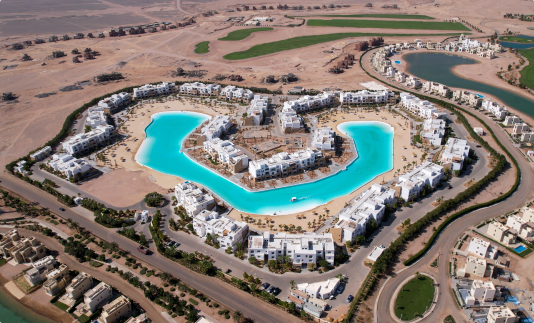
Ras El Hekma is where the UAE destination model goes full scale: ADQ appointed Modon Holding as master developer for the megaproject after Egypt and the UAE signed their USD 35 bn investment agreement in 2024. Modon has called Ras El Hekma one of its most significant projects outside the UAE.

The project is already moving from masterplan to brand stack: Modon announced Montage Ras El Hekma in May, including a 200-key resort and 96 branded residences, with swimmable lagoons, spa, dining, retail, and family-oriented amenities. In July, it followed with Nammos Ras El Hekma, combining residences, a 79-key resort, Nammos Village, dining, wellness, and beach-club components. Modon has also been awarding construction packages, most recently an EGP 10 bn infrastructure contract for the first district last month, following an earlier EGP 15 bn package for residential, hospitality, and infrastructure works.

This is the mixed-use thesis in action: Choufany says tourism developments are increasingly built around ecosystems that combine hotels, branded residences, retail, entertainment, marinas, wellness, and infrastructure. That creates multiple revenue streams and allows investors to “unlock value well beyond hotel operations alone.”

Branded residences do a lot of the heavy lifting: “Branded residences, in particular, have become a key driver of project viability,” Choufany says. Residential sales can accelerate capital recovery, strengthen returns, and reduce development risk, while the hotel component lifts the wider destination.

Marinas are not just scenery: El Kadiri says marinas can become the “beating hearts” of new destinations, lifting premium positioning, diversifying retail, and supporting higher sales and rents for residential units with marina views.

The UAE knows this model

This is familiar terrain for UAE capital: “This destination-led approach is very familiar to UAE investors, as it mirrors the model successfully implemented across much of the GCC over the past two decades,” Choufany says. The same logic that shaped Dubai and Abu Dhabi’s hospitality-linked masterplans is now being applied overseas.

That is the soft-power angle — with a business model attached: Hospitality anchors residential sales, retail footfall, lifestyle positioning, and international visibility. Choufany says UAE investors have built a capability to integrate “hospitality, lifestyle, entertainment, and real estate into cohesive destinations,” which is becoming a competitive advantage internationally.

For developers, hospitality helps sell the wider project: El Kadiri says tourism-focused assets help differentiate masterplans in an increasingly competitive market, especially when they attract international buyers and investors. The hotel may not be the only earnings engine, but it gives the destination credibility.

Hospitality is not passive property

Hospitality’s risk profile is typically heavier than traditional real estate. “Despite its attractiveness, hospitality remains one of the most operationally intensive real estate sectors,” Choufany says. Performance depends on tourism demand, airline connectivity, geopolitics, operating costs, labor availability, management quality, and brand positioning.

Underwriting needs to be sharper: Choufany says investors entering new markets need to assess regulatory frameworks, currency exposure, execution risk, infrastructure readiness, and the sustainability of demand. The best outcomes depend on feasibility studies, disciplined underwriting, realistic budgets, and active long-term asset management.

Knight Frank’s warning is similar: Hospitality is a “niche asset class with higher capital requirements and longer holding cycles,” El Kadiri says. New entrants need to understand placemaking, tourism fundamentals, and revenue volatility — and bring in the right partners before design and execution.

This development risk is especially relevant in emerging destinations. Human notes that Middle East hospitality investment is often development-led, while Europe is more acquisition-led. New-build projects carry construction-cost risk, delivery risk, and the possibility that competing projects weigh on performance later.

What could slow the wave?

Europe is not suddenly cheap: Human doesn’t see hotel pricing as the big driver of UAE investment into Europe. If prices dropped materially, Middle Eastern capital could become more active, he says, but that is not the base case. “We’re not really foreseeing” a major hotel value drop that would pull in more buyers, he says.

Regional instability could redirect some capital — just not yet: Human says some market participants are asking whether Gulf instability could push more investors toward stable markets such as Europe. “It could happen,” he says, but “it’s certainly not a trend that we’re witnessing at the moment.”

The bigger story is selectivity: UAE capital is choosing between stable, standing assets in mature markets and higher-risk destination plays where it can bring development expertise. That is why a UK golf resort, a Mallorca luxury hotel, a French tourism operator, and an Egyptian coastal megaproject can sit inside the same investment theme.

What to watch next: Choufany expects UAE investors to remain active internationally where they can combine capital, expertise, and destination-development capability. Human is more cautious on Europe, where supply is tight, development is difficult, and pricing is not expected to fall sharply. The next phase will be less about trophy assets and more about whether UAE investors can keep exporting the GCC destination model without underpricing the operational risk.

3

REAL ESTATE

Fragmentation isn’t stopping mega-developments

Project launches are down, and delivery schedules are lagging by as much as a year, and yet it appears to be full steam ahead for some of Dubai’s biggest developers. We spoke to industry experts about the apparent trend of megaproject launches at a time of falling transactions.

IN CONTEXT- Fragmentation is showing through in Dubai’s housing market, with 2Q data showing transactions falling 19% q-o-q, as launches collapsed to 5.3k units from 45k in the quarter before. That’s all happening just as delivery volumes reached their highest level in years.

Part of the dip in launches can be explained by data earlier in the year. Cavendish Maxwell’s Ali Siddiqui tells us that the lion’s share of 1Q launches came in January, with momentum already moderating through the rest of the quarter after the market saw “an exceptionally active launch cycle over the past few years.” Paired with the usual Ramadan slowdown, Siddiqui points to the moderation trend starting to emerge before the outbreak of the regional war, which also triggered a downturn in market activity.

The developer split

It’s also shaping up to be a tale of two types of developers, with Fitch’s Diego Della Maggiore noting a growing prioritization of projects likely to achieve certain funding, capex, and pre-sale rate thresholds like large-scale builds, with more established players best placed to be behind such projects.

While 2025 was a good year for smaller developers, Siddiqui also sees larger players dominating when it comes to launches going forward, with the market favoring “larger, well-capitalized developers.” Smaller developers may end up focusing instead on JVs, partnerships, and a general, more measured strategy, Siddiqui says.

That trend is already in action, with recent large-scale launches from Emaar and Majid Al Futtaim — the size and scale of which are hard to ignore. Emaar is lining up a AED 200 bn mixed-use project, complete with residential, commercial, retail, and civic assets, while Majid Al Futtaim is planning a AED 62 bn mega-community.

The master-planned communities approach offers several draws for Tier 1 developers over numerous, smaller projects, especially in current market conditions, Siddiqui tells us. The phased delivery approach allows for more flexibility when it comes to managing pricing, supply, and construction timelines at a time when “transaction volumes are moderating and off-plan absorption is being tested,” he says. All this considered, “the shift toward master-planned communities is likely to continue,” Siddiqui tells us.

This tactic also helps larger developers match sales with execution capacity by allowing the release of units in a staged approach, Maggiore tells us. On the flip side, “smaller developers may find that harder, especially if land, construction, and financing costs stay high,” he adds.

Megaprojects are here to stay, for now: Should population inflows to Dubai continue, sales absorption hold steady, and demand remain for locations like Dubai South, Maggiore sees the big players as continuing to opt for the big-ticket, phased developments. “If demand softens or execution bottlenecks ease, launch activity could broaden again across more mid-sized schemes,” he added.

What to expect: “This is likely to translate into fewer headline launches, larger project sizes, and longer delivery schedules, while actual unit release remains staggered over time,” Maggiore says.

Working through the soft patch

Escrow isn’t everything: Continued building through soft patches is often chalked down to escrow-backed pre-sales, but Siddiqui and Maggiore tell us there’s more to consider here. While escrow-backed pre-sales are an important mechanism for helping project delivery, they’re still very much project-specific, rather than used to fund a wider pipeline, Siddiqui says.

And when this runs dry? Homebuilders will turn to working capital lines to plug a gap if escrow funds drop, Maggiore tells us. However, he also points out that the lion’s share of debt raised from debt capital markets goes towards land acquisitions.

There’s also an important timing consideration. Maggiore tells us that, typically, buyer payment plans are structured to be paid as 60% during construction and 40% at project handover, meaning that for developers to tap into escrow funds, construction should be progressing. Here, pre-sales appear to fund a large portion of construction costs, bolstered by other avenues like equity and financing, he adds.

Delays ≠ cancellations

When it comes to the risks, “it’s important to distinguish between delays and cancellations,” Siddiqui adds. Despite moderating sales activity, rising construction costs, and tighter financing conditions, Siddiqui emphasizes that most affected projects have had their timelines adjusted, with only a few seeing outright cancellations. Strong capital positions and experience are also on the side of the most well-established developers, meaning that the primary risk lies in delivery timelines, he said.

It’s a different story for smaller developers, however. The risks are bigger for smaller developers whose balance sheets are less prepared to handle overrun costs and a prolonged sales slowdown, he said.

Is there an oversupply issue?

A larger danger lies in a supply and demand mismatch, as the property market is seeing record handovers and an uptick in supply at the same time transaction volumes are falling and demand-side indicators like new residence permits are down 15% q-o-q.

REMEMBER- Fitch previously forecast a 15% market correction for this year on the back of an uptick in supply. Currently, the macroeconomic shock is showing through on the volume side, rather than pricing, Maggiore tells us. “The same supply pipeline is meeting softer tourism, slower expatriate inflows, weaker sentiment, and tighter liquidity conditions,” he adds.

It’s also a question of where, according to Siddiqui, who points to possible “localized imbalances in specific segments and locations.” He also noted that completion rates often fall below projections and that a supply and demand mismatch has long been a staple of the market.

The outlook

The confidence is still there for bigger names. The groundwork for these larger builds would’ve been laid prior to softening conditions, meaning that pushing ahead signals conviction in the market’s structural demand trajectory, Siddiqui tells us.

Phased launches are a way of staggering costs for them. While smaller players are more at risk, for larger names, sukuk and bond issuances, the option to tap strong institutional and sovereign support, and strong credit profiles to keep access to funding on the table are also all on their side, according to Siddiqui.

Scaling back capex is also in the cards, Maggiore said, while also pointing to the possibility of authorities stepping in to allow deferred land payments, more flexibility when it comes to escrow mechanisms, or financing to attract buyers. Developers could also team up via JVs, co-investment, and land partners, he adds.

4

DEBT WATCH

Taqa issues USD 750 mn blue bond

Abu Dhabi National Energy Company (Taqa) issued a USD 750 mn, five-year blue bond, according to a press release. The private placement carries a fixed coupon of 5.125% and is listed on the London Stock Exchange’s International Securities Market. Taqa said the proceeds would go toward financing sustainable water and wastewater management projects.

The first of its kind: The offering marks the first blue bond issued by a government-related entity in the GCC and brings Taqa’s total issuance of green and blue bonds to USD 2.6 bn.

REMEMBER- The Gulf’s first public blue bond was issued by Emirates NBD earlier this year, raising a total of USD 1 bn split across a blue bond and a green bond tranche, with the orderbook more than twice oversubscribed. Meanwhile, other private placements (like FAB’s blue bond) have taken place in the past, and these are often bought by development banks and ESG funds, which could involve some mandate-buying strategies.

IN CONTEXT- The issuance comes after Abu Dhabi Power Corporation (ADPower), which is owned by Abu Dhabi sovereign wealth fund L’imad, moved to take full control of Taqa last month. The move is set to give L’imad full ownership of the utility giant.

Advisors: Standard Chartered Bank acted as the sole placement agent for the transaction.

5

EARNINGS WATCH

A sea of earnings from Mashreq, Adnoc Drilling, Aldar, ADIB, Tecom

Mashreq sees net income rise 26% y-o-y in 2Q

Our friends at Mashreq saw 2Q net income rise 26% y-o-y to AED 2.1 bn, with total operating income up 11% y-o-y to AED 3.4 bn, according to the bank’s management discussion and analysis (pdf). The biggest growth came from investment income, which rose 185% to AED 286 mn, while inflows from interest and Islamic financing accounted for the lion’s share of revenues with AED 2.2 bn.

On a 1H basis, net income climbed 17% y-o-y to AED 4.05 bn, while total operating income recorded an 8% uptick to AED 6.8 bn. Once again, investment income saw the largest growth, up 57% to AED 335 mn, thanks to realized gains on investment securities and favorable fair value movements on the lender’s equity investment holdings. Interest and Islamic financing income brought in AED 4.2 bn, and non-interest income was up 17% y-o-y to AED 2.6 bn on the back of stronger trade finance, syndication, and transaction banking activity.

The int’l network did some heavy lifting: Inflows from ins., FX, and other income rose 13% y-o-y to AED 1.6 bn on the back of strong cross-border flows and transaction banking activity throughout the lender’s international network.

The balance sheet remained strong: The lender’s total assets rose by 25% on a yearly basis to close out 1H at a record AED 365.7 bn on the back of growth across all client businesses. Customer loans were up 26% y-o-y to AED 169.1 bn, as customer deposits rose by 28% y-o-y to AED 227.2 bn.

Aldar records 18% bottom-line uptick

Aldar Properties reported an 18% y-o-y increase in net income after tax to AED 4.9 bn in 1H 2026, according to a company disclosure (pdf). Revenue rose 8% y-o-y to AED 16.8 bn, while EBITDA increased 19% to AED 6.3 bn on the back of revenue recognition from the company’s development backlog, strong occupancy, rental growth across its recurring-income portfolio, and contributions from recent acquisitions.

Group development sales declined 34% y-o-y to AED 12.1 bn as Aldar took a more measured approach to new project launches in the UAE. UAE sales fell 46% y-o-y to AED 9.4 bn, though demand from overseas and expatriate buyers remained strong, accounting for AED 7.6 bn, or 80%, of total domestic sales.

The domestic sales drop was partially offset by sales growth at Egypt’s SODIC, jumping 171% y-o-y to AED 1.4 bn, and the UK’s London Square, up 236% y-o-y to AED 1.2 bn. SODIC benefited from mid-market project demand, while London Square was boosted by three new residential launches in London.

ADIB crossed AED 300 bn in assets as 1H income rises

More income and less expenses boost ADIB: Abu Dhabi Islamic Bank’s (ADIB) bottom line was up 8% y-o-y to AED 1.9 mn on the back of a 7% y-o-y uptick in total operating income to AED 3.3 bn and a dip in provisions for impairment, according to its earnings release (pdf).

Driving growth: Revenues from funds were up 11% y-o-y to AED 2 bn, with non-funded income recording a 2% yearly uptick to AED 1.2 bn. ADIB cited increased income from fees, FX transactions, and cards as boosting its 2Q results.

On a 1H basis, the lender posted net income of AED 3.8 bn in 1H 2026, up 8% y-o-y, as total operating income climbed 9% y-o-y to AED 6.5 bn. ADIB’s total assets rose above AED 300 bn for the first time, with a 17% y-o-y rise bringing the total to AED 304 bn, as the lender saw 125k new customers in 1H. Customer financing, which was up AED 43 bn y-o-y, was cited as a key driver of growth.

Adnoc Drilling’s bigger fleet delivers modest growth

Adnoc Drilling’s net income rose 2% y-o-y to USD 359 mn in 2Q 2026, while revenue grew 3% to USD 1.2 bn, according to its earnings release (pdf) and management discussion and analysis report (pdf). Growth was supported by 30 rigs added in Oman and Kuwait through its SLB and MBPS transactions and two offshore rigs integrated last year, partly offset by rig repurposing and lower unconventional activity.

Oilfield services saw the biggest bottom line growth as the segment’s net income jumped 78% y-o-y to USD 48 mn despite an 8% revenue decline, as lower unconventional activity cut costs and a more favorable service mix lifted profitability. That supports the longer-term shift we previously reported, with Adnoc Drilling targeting a roughly 50-50 revenue split between drilling and manufacturing and oilfield services within five years. Offshore net income rose 6% to USD 151 mn, while onshore earnings fell 12% to USD 160 mn as higher fuel costs and the regional acquisitions pressured margins.

On a 1H basis: Revenue grew 4% y-o-y to USD 2.5 bn, while net income rose 2% to USD 706 mn. Its fleet expanded 21% to 171 rigs, including 30 outside the UAE. After quarter-end, a repurposed land rig began operating in Oman, marking the company’s first organic deployment there.

Outlook + dividends: Adnoc Drilling maintained its 2026 guidance for around USD 5 bn in revenue and USD 1.45-1.5 bn in net income. The board approved a USD 262.5 mn 2Q payout, or around 6 fils per share, bringing 1H distributions to USD 525 mn. Its USD 1.05 bn dividend floor for 2026 is set to rise by at least 5% annually through 2030.

Occupancy gains and customer retention lift Tecom Group’s 1H net income

Dubai business district developer Tecom Group reported a 7% y-o-y increase in recurring net income to AED 401 mn in 2Q 2026, while revenue increased 11% y-o-y to AED 786 mn, according to its latest earnings release. For 1H, the group recorded a 9% y-o-y increase in net income to AED 805 mn in 1H 2026, while revenue climbed 11% to AED 1.54 bn.

Behind the numbers: Overall portfolio occupancy hit 97% in 1H, with customer retention holding strong at 94% in its commercial footprint and 99% across industrial assets, underscoring sticky tenant demand. Growth was led by a 22% y-o-y jump in land lease revenue to AED 361 mn — boosted by new land acquisitions leased in 2025. Meanwhile, industrial revenue rose 15% to AED 239 mn and commercial revenue climbed 11% to AED 783 mn on sustained demand for Grade-A space.

Dividends: Funds from operations increased 12% y-o-y to AED 1.1 bn in the first half of the year, backing an approved interim dividend payout for the period of AED 440 mn.

6

ALSO ON OUR RADAR

An AI-focused industrial venture + CBUAE clears KamelPay

Another AI venture

Dubai-based Robo.ai and Abu Dhabi-based Eleven International Holding launched Alif Holding, an AI-focused industrial group targeting infrastructure, government, and industrial sectors, according to a press release. There’s also a localization draw, with the two aiming to establish engineering, assembly, and production in Abu Dhabi.

The details: Alif Holding will focus on developing and scaling AI solutions, like robotics, manufacturing, industrial AI, LLMs, and digital twins. It aims to roll out these solutions across critical industries, including energy, oil and gas, critical infrastructure, and utilities.

Fintech KamelPay secures CBUAE payment licences

Dubai-based payroll service provider KamelPay secured Stored Value Facilities (SVF) and Retail Payment Services (RPS) licences from the Central Bank of the UAE, making it among a small pool of fintechs authorized to offer regulated payment services in the country, per a press release.

Who are they? Founded in 2021, the fintech offers payroll and corporate payment solutions through its PayD and AbsoluteCard platforms. It currently has upwards of 2k corporates on its roster, processing payments for over 400k employees across the construction, retail, logistics, and financial services industries.

7

PLANET FINANCE

Central banks bought less gold in 1Q than initially estimated -WGC

Central banks recorded their lowest 1Q gold net purchases in over 15 years, after an initial estimate of 244 tonnes of purchases was revised down to a mere 57 tonnes, according to a World Gold Council (WGC) report picked up by the Financial Times.

The gap: The revision occurred after gold previously thought to be flowing to official channels was reclassified into the over-the-counter (OTC) category. Central bank disclosures on gold purchases only take place on a voluntary basis, and purchasing tracking is becoming increasingly opaque, especially when it comes to China — a big buyer that only discloses a portion of purchases.

The bigger picture: The new stat puts purchases at their lowest for a 1Q period in over 15 years, the report said. Purchases picked up in 2Q to reach 289 tonnes, marking a 5x increase compared to the first quarter, largely on the back of purchases by China and Poland. However, overall central bank demand was at its lowest 1H stat since 2022.

There’s also a geopolitical element: Gold purchasing reporting also became complicated following US sanctions on Russia in 2022, which drove developing economies to diversify away from the greenback, leading institutions to disclose far less to the IMF.

Major sovereign buyers now reveal only a fraction of their transactions, forcing analysts into a “game of cat-and-mouse” to trace actual physical flows, said John Reade, market strategist at the WGC.

Why Middle East capital is in the mix: Following regional conflict disruptions, several Middle Eastern sovereign wealth funds unloaded bullion reserves to offset declines in oil and gas revenue, according to Reade. Elsewhere, official institutions in Turkey, Russia, and Azerbaijan were net sellers during 1H.

Why the pullback: Central banks act as the gold market’s buyer of last resort, accounting for up to a third of global 2Q demand. When prices pull back, official sector buying typically absorbs excess supply, creating a hard floor under bullion. When its gold purchasing activity slows, this price floor supporting the global gold market starts cracking. This comes at a time when gold prices have already fallen by around 30% from January peaks.

What else weighs on the demand: Although 1H gold demand went up 2% y-o-y to 2.5k tonnes, momentum was weighed down by gold exchange-traded fund (ETF) liquidations, which saw outflows of 45 tonnes (USD 4bn) in 2Q alone.

ADX

9,879

+0.4% (YTD: -1.1%)

DFM

5,792

-0.1% (YTD: -4.2%)

Nasdaq Dubai UAE20

4,708

+0.5% (YTD: -3.7%)

USD : AED CBUAE

Buy 3.67

Sell 3.67

EIBOR

3.5% o/n

4.3% 1 yr

TASI

10,590

+0.4% (YTD: +0.9%)

EGX30

53,442

-0.4% (YTD: +27.7%)

S&P 500

7,438

+1.7% (YTD: 8.7%)

FTSE 100

10,897

-0.1% (YTD: +9.5%)

Euro Stoxx 50

6,344

+1.5% (YTD: +9.6%)

Brent crude

USD 88.00

-1.2%

Natural gas (Nymex)

USD 2.76

+0.2%

Gold

USD 4,140.20

-0.5%

BTC

USD 64,170.37

+0.1% (YTD: -26.7%)

Chimera JP Morgan UAE Bond UCITS ETF

AED 3.61

-1.1% (YTD: -1.6%)

S&P MENA Bond & Sukuk

149.86

-0.4% (YTD: -1.3%)

VIX (Volatility Index)

17.01

-17.28% (YTD: +14.3%)

THE CLOSING BELL-

The ADX rose 0.4% yesterday on turnover of AED 835.8 mn. The index is down 1.1% YTD.

In the green: Al Buhaira National Ins. Company (+8.5%), Abu Dhabi National Co. for Building Materials (+6.9%), and NMDC Group (+3.2%).

In the red: Phoenix Group (-4.8%), Invest Bank (-3.4%), and Sudan Telecommunications Group Company (-3.1%).

Over on the DFM, the index fell 0.1% on turnover of AED 572.9 mn. Meanwhile, Nasdaq Dubai was up 0.5%.


SEPTEMBER

1-3 September (Tuesday-Thursday): Middle East Energy, Dubai World Trade Center, Dubai.

7-9 September (Monday-Wednesday): AIM Congress, Dubai World Trade Center.

7-9 September (Monday-Wednesday): International Property Show, Dubai World Trade Center, Dubai.

12-13 September (Saturday-Sunday): Emirates International Congress on AI & Visionary Leadership in Transforming Healthcare, Adnec Center Abu Dhabi.

14-17 September (Monday-Thursday): Arabian Travel Market, Dubai World Trade Center, Dubai.

15-16 September (Tuesday-Wednesday): Federal Open Market Committee (FOMC) meeting.

17-19 September (Thursday-Saturday): International Real Estate & Investment Show (IREIS), Adnec, Abu Dhabi.

29-30 September (Tuesday-Wednesday): AFCM Annual Conference, Abu Dhabi.

OCTOBER

4-10 October (Sunday-Saturday): World Space Week, Abu Dhabi.

5-7 October (Monday-Wednesday): AI Everything Global, Adnec Center, Abu Dhabi.

12-14 October (Monday-Wednesday): Airport Show, Dubai World Trade Center, Dubai.

14-15 October (Wednesday-Thursday): Sharjah Investment Forum, Jawaher Reception and Convention Center, Sharjah.

13-15 October (Tuesday-Thursday): Annual Meeting of Global Future Leaders, Dubai.

20-22 October (Tuesday-Thursday): Future Health Summit, Adnec Center Abu Dhabi.

27-28 October (Tuesday-Wednesday): Arab Competition Forum, Dubai.

27-28 October (Tuesday-Wednesday): Federal Open Market Committee (FOMC) meeting.

30 October (Friday): Large businesses achieving annual revenues equal to or above AED 50 mn must appoint an accredited service provider for e-invoicing implementation.

Signposted to happen sometime in October 2026:

  • Abu Dhabi Space Week, Abu Dhabi.

NOVEMBER

2-6 November (Monday-Friday): Dubai Future Finance Week, Dubai.

4 November (Wednesday): Digital Transformation Summit, Sofitel, Abu Dhabi.

9-10 November (Monday-Tuesday): Annual government meetings, Abu Dhabi.

9-12 November (Monday-Thursday): EMEA Council on Hotel, Restaurant and Institutional Education Conference, Dubai College of Tourism, Dubai.

10-12 November (Tuesday-Thursday): Dubai International Electric Vehicle Exhibition & Conference, Dubai World Trade Center.

16-18 November (Monday-Wednesday): World Police Summit, Dubai World Trade Center, Dubai.

18-19 November (Wednesday-Thursday): Touchdown Middle East 2026, Conrad Abu Dhabi Etihad Towers, Abu Dhabi.

25-26 November (Saturday-Sunday): Doers Summit, Dubai Silicon Oasis, Dubai.

DECEMBER

2-4 December (Wednesday-Friday): UN Water Conference, UAE.

4-6 December (Friday-Sunday): Formula 1 Abu Dhabi Grand Prix, Abu Dhabi.

8-9 December (Tuesday-Wednesday): Capital Market Summit, Madinat Jumeirah, Dubai.

8-9 December (Tuesday-Wednesday): Federal Open Market Committee (FOMC) meeting.

8-10 December (Tuesday-Thursday): Abu Dhabi Water & Power Week, Adnec Center, Abu Dhabi.

Signposted to happen sometime in 2027:

  • 1 January: Deadline for large businesses to implement e-invoicing;
  • 1Q 2027: Completion of the first phase of Hassyan seawater desalination project;
  • 1-3 February (Monday-Wednesday): World Governments Summit;
  • 31 March: Small businesses with annual revenues of less than AED 50 mn are obliged to contract with an accredited service provider for e-invoicing implementation;
  • 31 March: Government entities are required to appoint an accredited service provider for e-invoicing implementation;
  • 21-22 April (Wednesday-Thursday): Token2049, Dubai;
  • 1 July: Deadline for small businesses to implement e-invoicing;
  • 1 October: Deadline for governments to implement e-invoicing;
  • Abu Dhabi’s solar and battery energy facility, combining 5.2 GW of solar capacity and 19 GWh of battery storage, is set for commissioning.

Signposted to happen sometime in 2028:

Signposted to happen sometime in 2029:

  • Sibos 2029 organized by the Society for Worldwide Interbank Financial Telecommunication (SWIFT), Dubai;
  • Annual Meetings of the World Bank Group and the International Monetary Fund, Abu Dhabi;
  • The commissioning of the seventh phase of Mohammed bin Rashid Al Maktoum Solar Park.
Now Playing
Now Playing
00:00
00:00