Get EnterpriseAM daily

The new rules of Hormuz passage

1

WHAT WE’RE TRACKING TODAY

TODAY: Show your flag and you may just pass

Good morning, friends. It’s another morning of watching Hormuz and wondering whether oil tankers are moving — or sitting still. Elsewhere in the region, eight Egyptian sailors were kidnapped after the oil tanker M/T Eureka was hijacked yesterday near Yemen and rerouted to Somali waters. Foreign Minister Badr Abdelaty tasked Egypt’s embassy in Mogadishu with coordinating efforts to secure the crew’s release.

Adding to the pressure on already jittery energy markets, Washington released 53.3mn barrels of crude from its Strategic Petroleum Reserve to help stabilize prices amid the Iran war, loaning supplies to nine companies, including ExxonMobil, Trafigura, and Marathon Petroleum.


Riyadh to Mumbai. Abu Dhabi to Singapore. Dubai to London. Cairo to Shenzhen.

The most important business stories in MENA aren’t happening inside MENA anymore — they’re happening at the edges, where regional capital meets global ambition.

EnterpriseAM MENA+ is our new flagship newsletter, built to cover the flows of capital, people, and ideas across the Middle East — and beyond it. AI, geopolitics, the war for talent, sovereign wealth strategy, the changing energy economy, and the new corridors reshaping global trade.

Tap or click here to get your own copy delivered to your inbox every Monday, Wednesday, and Friday at 12pm UAE | 11am KSA | 11am Egypt.


Watch this space

REGASIFICATION — Aqaba gets a fresh floating gas buffer: Jordan’s National Electric Power Company (Nepco) signed an agreement with US LNG infrastructure firm Excelerate Energy to lease a floating storage and regasification unit for the Sheikh Sabah LNG Terminal in Aqaba. The agreement comes before the current floating unit, Energos Force, expires at the end of June 2026.

This is a bridge, not the final setup: The leased unit is meant to keep Aqaba running until Jordan completes its planned onshore regasification unit, which is designed to improve the efficiency and reliability of the country’s gas import infrastructure.

Why it matters: Aqaba is becoming more than a domestic supply valve, with Jordan supplying Syria with natural gas through the Arab Gas Pipeline after importing and regasifying LNG at Aqaba. Similar arrangements with Lebanon are being finalized.


GROUND HANDLING — BAS takes its ground-handling play into Saudi: Bahrain Airport Services (BAS) is set to launch operations in Saudi Arabia under BAS Saudi, establishing an Eastern Province base focused on ground-handling services.

Why it matters: The move extends BAS beyond Bahrain International Airport into the region’s rapidly expanding aviation market, with plans to pursue operating rights across multiple Saudi airports and explore windows in Oman for MRO and technical inspection services.

Market watch

Oil prices rose nearly 1% this morning as fragile Iran talks kept supply fears alive, Reuters reports. Brent crude futures increased USD 0.86 to trade at USD 105.07 / bbl by 04.11 GMT, while US West Texas Intermediate (WTI) gained USD 0.99 to USD 99.06 / bbl.


The Baltic Index rises once again: The Baltic Exchange’s dry bulk index — which tracks rates for the capesize, panamax, and supramax vessel segments — was up 1.8% to 3,031 points on Monday. The capesize increased 0.4%% to 4,976 points, while the panamax index gained 2.2% to 2,283. The smaller supramax rose 0.3% to 1,527 points.

Data point

14.5 mn — that’s the total cargo tonnage handled by Saudi ports in April, Mawani said on X. Transshipments accounted for 130k TEUs during the month, while livestock volumes stood at over 830k heads. Passenger traffic totaled 70.7k, vehicle throughput reached 53.9k, and container volumes came in at 508.8k.

PSA

Maersk rolls out a heavy-load fee on Asia-Europe boxes: Danish carrier Maersk is introducing a heavy load surcharge on all 20-ft containers moving from East Asia to North Europe and the Mediterranean, effective 25 May. The fee is set at USD 400 per 20-ft container when the verified gross mass exceeds 25 tons. This will apply across all ocean products, including contract cargo, SPOT, and Maersk Go, among others.

***YOU’RE READING EnterpriseAM Logistics, the essential MENA publication for senior execs who care about the industry that connects producers and retailers to global markets. We’re out Monday through Thursday by 9:15am in Cairo and Riyadh, and 10:15am in the UAE.

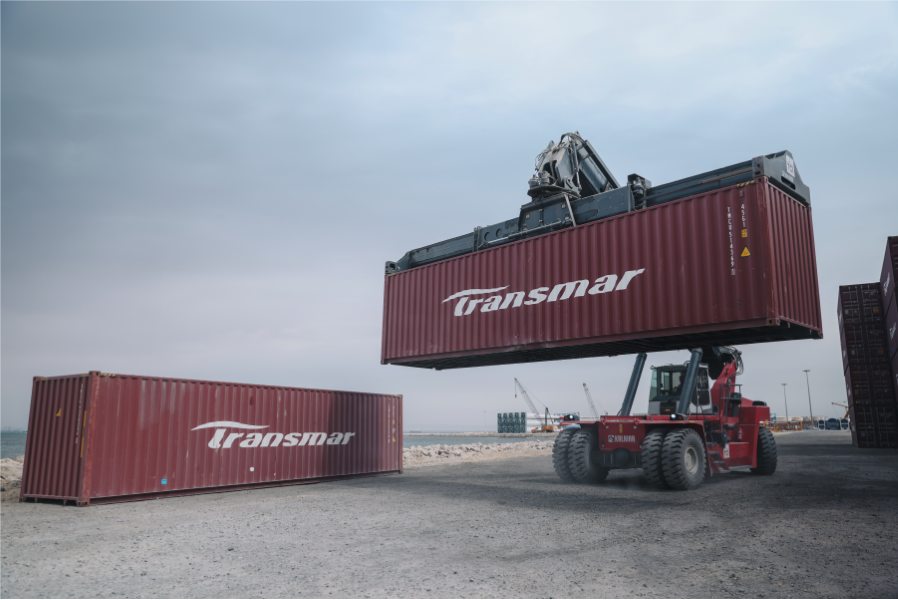
EnterpriseAM Logistics is available without charge thanks to the generous support of our friends at Hassan Allam Utilities and Transmar.

Were you forwarded this email? Tap or click here to get your own copy of EnterpriseAM Logistics.

Want to send us a story idea, request coverage, ask for a correction, or otherwise get in touch? Reach out to us on logistics@enterprisemea.com.

DID YOU KNOW that we also cover Egypt, Saudi Arabia, and the UAE ? ***

This publication is proudly sponsored by

2

The Big Story Today

The return of managed passage

We’ve been watching Hormuz shift from a hard chokepoint into something more conditional — less about outright closure or normal flow, and more about managed passage shaped by signaling, routing discipline, and political risk buffers. Recent vessel movements suggest that this isn’t just theory anymore — it’s starting to show up in how cargo is actually being moved.

What was once a single, highly exposed corridor is now behaving more like a negotiated system, where access depends as much on identity, flagging choices, and bilateral tolerances as on geography.

The flag becomes part of the freight strategy

One of the clearest recent cases is the UAE-managed LPG carrier Tara Gas — owned by Global Gas Inc. and operated by Dubai’s Matrix Maritime — tracked transiting Hormuz via an Iran-approved route after departing Sharjah, with AIS data reportedly placing it past Iran’s Larak Island along established shipping corridors.

Dual identity in real time: Ship-tracking data cited in Bloomberg indicates the vessel is broadcasting Indian affiliation while remaining UAE-owned and managed. The ship has also previously carried Iranian LPG cargoes, including a shipment to China earlier this year.

Signaling becomes part of the route: The key detail is the way ownership and crew are being presented alongside the physical movement of cargo. In this case, Indian neutrality is being reflected in the vessel’s declared profile while it continues commercial operations in a sensitive route.

Ins. markets are starting to shape the corridor itself: Some marine underwriters now require vessels to follow Iranian-approved transit as a condition for securing war-risk coverage, effectively turning route discipline into part of the ins. process itself.

The LNG lane turns into a managed sequence

LNG flows are running in sequence: At the same time, a Qatari LNG carrier is en route fromRas Laffan to Port Qasim — passing through Hormuz under current operating conditions.

First clearance has already occurred: This follows the earlier transit of Al Kharaitiyat, which became the first Qatari LNG vessel to clear the strait since the outbreak of hostilities. Pakistan is now expected to receive additional LNG cargoes from Qatar in the coming days, with multiple shipments already scheduled and at least two other Qatar-loaded LNG tankers tracking within the Gulf with Pakistani destinations listed.

“The first cargo has set a precedent — a ‘proof of concept’,” Wideangle LNG Consulting Director Jean-Christian Heintz tells EnterpriseAM when speaking about whether more Qatari tankers could be passing through the strait in the upcoming days.

The distinction matters more for LNG than crude: Oil markets can absorb disruption through storage, rerouting, and pipeline bypasses. LNG chains are far less flexible — cargoes depend on liquefaction, limited tanker availability, and fixed regas capacity at destination markets.

Our take: What is emerging is a repeatable flow structure rather than isolated movements — LNG shipments are being conducted through sequenced, scheduled voyages between supplier and buyer, with routing patterns increasingly defined in advance rather than adjusted ad hoc.

3

M&A Watch

Bosta's last mile with Beltone

Beltone VC and Citadel offload Bosta stakes at 75% IRR — just as the logistics player eyes the EGX: Beltone Venture Capital and UAE-based Citadel International Holdings exited their stake in Egyptian last-mile logistics player Bosta via their joint fund, netting a 75% internal rate of return (IRR), Beltone stated (pdf). Details about the buyer and the valuation weren't disclosed.

Beltone, however, will still maintain a relationship with the logistics player. “We have exited via our joint fund with Citadel, but Beltone Venture Capital still holds an undisclosed stake in Bosta,” Ali Mokhtar, CEO & managing partner of Beltone Venture Capital, tells EnterpriseAM.

Plus: A 75% IRR is a real number in a climate where the devaluation has eaten through a lot of returns over the past three years. It also comes at a useful moment for Beltone Venture Capital, which has now booked five exits since its 2023 launch and two from its joint fund with Citadel.

What's next: Bosta is reportedly preparing for a USD 170 mn IPO on the EGX later this year. It’s worth watching whether the unnamed buyer is positioning ahead of that listing or if this is a clean pre-IPO secondary.

4

Earnings Watch

More 1Q earnings roll in

Aramco’s net income jumps in 1Q, courtesy of the East-West pipeline

Aramco posted strong growth in its bottom line in the first quarter, with its net income up 25% y-o-y to USD 32.5 bn. Higher oil prices and refining margins helped Aramco offset the impact of supply disruptions and attacks on energy infrastructure across the region.

Behind the resilience was Saudi’s rerouting infrastructure, which spared it — and the global energy market — the worst of the negative impacts of the Hormuz disruption. The East-West pipeline “has proven itself to be a critical supply artery, helping to mitigate the impact of a global energy shock and providing relief to customers affected by shipping constraints,” CEO Amin Nasser said in the earnings statement (pdf).

How much time until recovery? It’s all about how long Hormuz remains shut. Reopening the Strait of Hormuz today could mean markets are set to recover in a few months. “But if trade and shipping remain curtailed by more than a few weeks from today, we anticipate the supply disruption to persist, and the market to normalize only in 2027,” Nasser said in an emailed statement to Bloomberg.

Flynas’s net income falls despite higher revenue in 1Q

Capacity growth supported Flynas’s top line, but rising costs weighed on its profitability. The low-cost carrier saw its net income fall 20.3% y-o-y to SAR 117.9 mn in 1Q 2026, according to its financial release. Revenue rose 9.7% y-o-y to SAR 2 bn during the quarter, buoyed by capacity expansion and continued passenger demand across the airline’s network.

Behind the numbers: The decline in the bottom line was driven by higher fuel costs, alongside increased handling and navigation charges, elevated maintenance expenses from greater operating activity, and additional wet-lease costs.

Agility Global posts stronger 1Q revenue

Menzies and logistics parks keep Agility in growth mode: Abu Dhabi-listed Agility Global saw its revenue jump 23% y-o-y to USD 1.4 bn in 1Q 2026, driven by strong performance at its aviation services arm Menzies, higher fuel logistics activity at Tristar, and an expanding portfolio of income-generating assets across Agility Logistics Parks, according to its financial release.

Segment-by-segment breakdown: Menzies recorded a 34% y-o-y rise in revenue to USD 869 mn, supported by full contribution from the G2 acquisition and improved portfolio yields, while Tristar saw its revenue rise 9% on the back of stronger fuel logistics activity. Meanwhile,

Agility Logistics Parks posted 44% y-o-y revenue growth, driven by more facilities transitioning into full income-generating operations.

5

Also on Our Radar

MRO hub coming to Al Ain

A new MRO facility coming to Abu Dhabi: Mubadala’s aerospace engineering and leasing arm Sanad is investing AED 480 mn in a new advanced aircraft engine components repair center in Al Ain, according to Abu Dhabi Media Office. Once fully operational, the center is expected to lift repaired component volumes in Sanad to around 65k annually. By 2030, the site is expected to support all major engine platforms.

Why now? Bringing these capabilities in-house fits in with a wider UAE drive to reduce reliance on external suppliers, expand technical offerings, and compete more directly with larger international MRO players, especially as newer engine technologies enter the commercial fleet.


MAY

12-14 May (Tuesday-Thursday): Aviation Energy Forum (AEF), Paris, France.

19-21 May (Tuesday-Thursday): Ground Handling Conference (IGHC), Cairo, Egypt.

19-21 May (Tuesday-Thursday): Terminal Operations Conference & Exhibition, Hamburg, Germany.

JUNE

2-4 June (Tuesday-Thursday): ProPak Mena, Cairo, Egypt.

4-5 June (Thursday-Friday): Supply Chain and Logistics Summit, Amsterdam, Netherlands.

6-8 June (Saturday-Monday): IATA World Air Transport Summit, Rio de Janeiro, Brazil.

10-11 June (Wednesday-Thursday): Black Sea Ports and Logistics, Istanbul, Turkey.

21-24 June (Sunday-Wednesday): Saudi Smart Logistics, Riyadh, Saudi Arabia.

22-23 June (Monday-Tuesday): Decarbonizing Shipping Forum, Rotterdam, Netherlands.

AUGUST

30 August-1 September (Sunday-Tuesday): Air Cargo Middle East, Riyadh, Saudi Arabia.

30 August-1 September (Sunday-Tuesday): Saudi Warehouse and Logistics Expo, Riyadh, Saudi Arabia.

SEPTEMBER

16-17 September (Wednesday-Thursday): Saudi Maritime & Logistics Congress, Dammam, Saudi Arabia.

22-24 September (Tuesday-Thursday): Seamless Middle East, Dubai, UAE.

28-30 September (Monday-Wednesday): Transport Logistics Middle East, Riyadh, Saudi Arabia.

OCTOBER

12-14 October (Monday-Wednesday): The Airport Show, Dubai, UAE.

21-22 October (Wednesday-Thursday): Global Ports Forum, Singapore.

26-29 (Monday-Thursday): Air Cargo Forum, Miami, US.

27-29 October (Tuesday-Thursday): Routes World, Riyadh, Saudi Arabia.

NOVEMBER

2-5 November (Monday-Thursday): ADIPEC Maritime and Logistics Exhibition and Conference, Abu Dhabi, UAE.

Now Playing
Now Playing
00:00
00:00