Get EnterpriseAM daily

AD Ports’ shipbuilding arm lands AED 1.3 bn in new vessel orders

1

WHAT WE’RE TRACKING TODAY

TODAY: Safeen Drydocks lands record AED 1.3 bn vessel orders

Good morning, ladies and gents. Today’s lineup spans shipyards, storage tanks, and the skies. We’re leading with Safeen Drydocks’ biggest catch yet — a record AED 1.3 bn haul that gives AD Ports' shipbuilding arm its largest-ever awards and a hefty orderbook to match. Meanwhile, Kuwait is spending nearly USD 1 bn to make room for more crude and to strengthen its export infrastructure. We round things out with a less cheerful outlook for Middle Eastern aviation, where the region's airlines are expected to be the only major carriers globally to slip into the red next year.


Inline Image

You’ve spent decades building wealth, and the question now isn’t how to make money — it’s how to make sure it survives you, works across borders, and doesn’t quietly erode while you’re not looking. The rules have changed. Egyptian real estate, once a near-guaranteed store of value, is competing with markets in Greece, Spain, and Dubai.

Whether it’s art as an asset, crowd-funding, or the tax implications quietly stacking up behind that second passport, the toolkit for serious capital deployment has expanded faster than most conventional advice — or most advisors — have.

In Issue 3 of EnterpriseAM Money Matters, we cover the decisions that matter most when you’re at the stage where capital preservation is just as important as capital growth — and where getting it wrong is no longer something you can simply recover from.

Tap or click here to subscribe to the Egypt edition, delivered to your inbox on Wednesday, 10 June.


Losing altitude

Airlines in the region took the earning hit: Middle Eastern airlines are expected to swing to a collective USD 4.3 bn loss in 2026 — making the region the only major airline market expected to slip into the red this year, according to IATA.

The downturn reflects pressure across the entire operating chain — airspace closures, flight cancellations, longer routings, weaker connecting traffic, and sharply higher fuel costs. IATA expects regional passenger demand to decline 11.4%, while capacity is projected to contract 4.4%.

Gulf carriers depend heavily on east-west transfer flows through Dubai, Doha, and Abu Dhabi, which makes lost connectivity more expensive than a normal demand dip.

IN CONTEXT- Gulf carriers’ reliance on east-west transfer traffic through hubs such as Dubai, Doha, and Abu Dhabi means disruptions to connectivity can have an outsized impact on earnings. While that has created a near-term opening for rivals including IAG, Lufthansa, Air France-KLM, and Cathay Pacific on long-haul routes linking Asia and Africa, Bloomberg reports industry executives as saying that the shift in demand is likely to prove temporary as Emirates, Qatar Airways, and Etihad restore capacity and passengers return to their usual transit options.

Already, Emirati airlines are preparing for more growth. Etihad is placing a double-digit order for more widebody aircraft and expects to be flying about 8% more than it was a year ago by mid-June, while Emirates — which is heavily hedged on fuel — had three-quarters of its flights operating at pre-conflict capacity as of May.

Yet another Opec+ hike

Opec+ opted to increase production quotas by 188k bbl / d in July, even if many of those barrels can’t physically reach the market. Saudi Arabia and Russia accounted for nearly two-thirds of the increase, with each receiving a 62k bbl / d quota boost, with the Kingdom — the largest swing supplier — targeting 10.4 mn bbl / d next month.

IN CONTEXT- The move marks the fourth consecutive quota increase and the latest step in Opec+’s gradual unwinding of the group’s voluntary production cuts. After putting production hikes on ice till March, Opec agreed to increase production by 206k bbl / d in both April and May, before cooling to 188k bbl / d in June.

A rise on paper: “The group will continue to unwind the voluntary cuts, but only on paper, because there will be no real increase under the current situation in Hormuz,” Kpler’s head of Middle East Energy Analysis Amena Bakr said. Producers with limited optionality — such as Iraq and Kuwait — remain unable to bring additional barrels to the market even if higher output targets are approved.

An empty seat: The meeting is the second gathering since the UAE’s exit, raising questions over how production quotas will eventually be redistributed among the remaining members.

A post-crisis plan is in place: Once shipping through Hormuz resumes, Iraq and Kuwait are expected to ramp up production to recover revenues lost during the disruption, unlike Saudi Arabia, which retains export routes that bypass the strait.

Market watch

Oil prices fell this morning after Iran and Israel signaled a halt in hostilities, Reuters reports. Brent crude futures fell USD 0.91 to trade at USD 93.34 / bbl by 04.00 GMT, while US West Texas Intermediate (WTI) dipped USD 1.13 to USD 90.17 / bbl.


The Baltic Index continues to fall: The Baltic Exchange’s dry bulk index — which tracks rates for the capesize, panamax, and supramax vessel segments — was down 2.2% to 2,916 points on Monday, driven by the bigger vessel segments. The capesize index declined 3.6% to 4,719 points, while the panamax index fell 18 points to 2,218 points. The smaller supramax index rose 8 points to 1,569 points.

*** YOU’RE READING EnterpriseAM Logistics, the essential MENA publication for senior execs who care about the industry that connects producers and retailers to global markets. We’re out Monday through Thursday by 9:15am in Cairo and Riyadh, and 10:15am in the UAE.

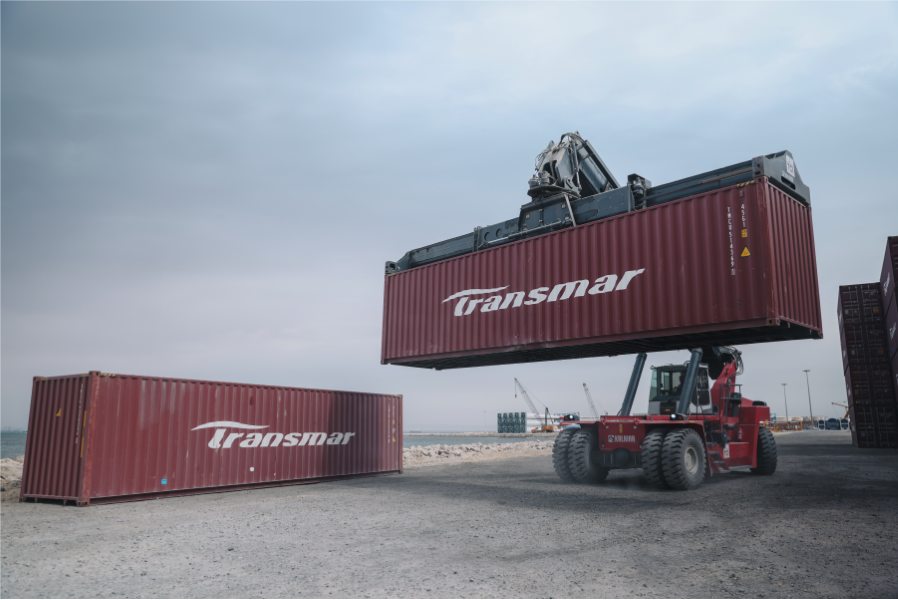
EnterpriseAM Logistics is available without charge thanks to the generous support of our friends at Hassan Allam Utilities and Transmar.

Were you forwarded this email? Tap or click here to get your own copy of EnterpriseAM Logistics.

Want to send us a story idea, request coverage, ask for a correction, or otherwise get in touch? Reach out to us on [email protected].

DID YOU KNOW that we also cover Egypt, Saudi Arabia, and the UAE? ***

This publication is proudly sponsored by

2

The Big Story Today

Safeen Drydocks lands record AED 1.3 bn vessel contracts

Safeen Drydocks has secured two vessel construction contracts worth a combined AED 1.3 bn — its largest awards to date — providing AD Ports Group’s shipbuilding arm with a substantial orderbook under its newly unified shipbuilding framework, according to a statement.

The details: The first contract covers the design and construction of four 140-meter multipurpose vessels for AD Ports Group. Each vessel will be capable of carrying up to 300 containers, more than 100 reefer plugs, high-and-heavy cargo, up to 1k vehicles, and 100 trailers. The contract covers 18 specialized marine support vessels for Nigeria’s Oilbank Logistics Services, including tugboats and pilot boats to support port operations, marine transportation, and offshore logistics.

Why this matters: The new order fits the group’s broader non-container fleet — which stood at 60 bulk, Ro-Ro, and multipurpose vessels at the end of 2025, according to the group’s financial release (pdf). The newbuilds would push the fleet segment to some 64 vessels.

The UAE is going all in on shipbuilding: AD Ports expanded the shipbuilder’s footprint through the EUR 11.2 mn acquisition of Spain’s Balenciaga Astilleros in January. The firm also {launched the Consortium} of UAE Shipbuilders in May — bringing together players across shipbuilding, vessel repair, fabrication, and marine engineering under Noatum Maritime’s coordination.

Inline Image

3

Projects

Kuwait adds a USD 992 mn contract to its crude export buffer

Kuwait wants more barrel space: Kuwait’s Central Agency for Public Tenders has approved a USD 992 mn contract to India’s engineering contractor Larsen & Toubro (L&T) to build new crude storage facilities and upgrade the country’s existing oil export network. The award follows a revised tender recommendation that selected L&T as the lowest bidder — ahead of Petrofac’s USD 1 bn (c. KWD 310.5 mn) offer.

What is being built? The project includes new storage facilities, upgrades to existing crude export infrastructure, and integration works that allow Kuwait to handle more than one crude stream across the export system.

Why this matters: Kuwait remains one of the most vulnerable Gulf exporters — especially during the Hormuz disruption — with roughly 1.9 mn bbl / d of crude and 860k bbl / d of refined products moving through the strait in 2025. The country’s main crude export outlet is Mina Al Ahmadi, with export terminals at Mina Abdullah, Mina Shuaiba, and Mina Saud, leaving the system exposed to Gulf shipping disruptions.

JPMorgan estimated the country had only around two weeks before storage constraints would face production cuts, while Kuwait Petroleum Corporation later declared force majeure and cut crude and refinery operations as exports backed up.

Part of a wider rebuild: The L&T award also lands after Kuwait secured around USD 1.5 bn in crude pipeline contracts earlier this year across South, East, North, and West Kuwait. Kuwait Petroleum Corporation has also been weighing a plan to lease 13 crude pipelines for 25 years to raise USD 5-7 bn for its wider USD 65 bn investment plan.

Inline Image

4

Also on Our Radar

Dnata secured Silk Way cargo contract, Lebanon opens second airport + new space for spare parts in Jafza

Dnata adds its services in Singapore

Dnata expands its Silk Way handling map: UAE-based aviation services firm dnata has secured a multi-year cargo and freighter contract with Azerbaijan’s Silk Way Group at Singapore Changi Airport. The contract covers more than 100 freighter flights annually and over 15k tons of cargo — including general freight, temperature-sensitive goods, oil and gas shipments, and aviation equipment.

Lebanon’s airport map expands

Lebanon gets a second runway option: Lebanon has inaugurated René Mouawad Airport in Qlayaat as the country’s second civilian airport — giving Beirut’s single-airport model a northern relief valve after years of capacity and security measures. The airport sits around 100 km north of Beirut and close to the Syrian border, with public operations expected within weeks and initial routes planned to Istanbul, Mersin, and Dubai, followed later by Athens, Cairo, and Medina.

Cargo is in the brief, but not the buildout just yet: Sky Lounge Services — a business aviation services company — earned the rehabilitation and operation contract in May, with a temporary passenger terminal due within 90 days after approvals and licenses. The first-phase specs are passenger-heavy, but the operator’s revenue scope includes air cargo, freight services, and ground handling.

Jafza adds more auto logistics capacity

Spare parts get more space in Jafza: Hellmann Worldwide Logistics and Indu Group have broken ground on a nearly 300k sq ft automotive logistics hub in Dubai’s Jebel Ali freezone, according to a statement. The project facility — which adds capacity for spare parts distribution across the GCC, Africa, and wider international markets — will include high-density bin storage, pallet racking, and dedicated handling areas for oversized automotive components.

5

Logistics in the News

China is buying less oil — but for how long?

The oil market’s biggest stabilizer right now is China buying less crude. Gulf supply is still under pressure nearly 100 days into the Iran war, but prices have stayed below USD 100 per barrel because China, the world’s largest crude importer, has stepped back from the market just as replacement barrels are getting harder to find.

Beijing’s pullback is big enough to matter: Morgan Stanley estimates seaborne crude arrivals to China fell to around 7.5 mn bbl / d over the past month — down from around 13 mn bbl / d a year earlier. Kpler’s numbers show the same direction, with arrivals falling to 6.4 mn bbl / d in May from 8.1 mn bbl / d in April and 10.1 mn bbl / d in March.

China’s oil demand is softer, but not soft enough to explain the drop in imports. Domestic demand is expected to fall by around 1.5 mn bbl / d y-o-y in 2Q, while crude imports are down by much more. Beijing is also cutting refinery runs, often under the guise of maintenance, and keeping more fuel at home instead of pushing refined products into export markets.

Inventories are doing the quiet work: China built up crude stocks when prices were lower, and now those barrels appear to be covering part of the gap between lower imports and still-high domestic demand. S&P Global Energy expects China to draw down commercial inventories by around 700-800k bbl / d through 3Q.

China has a deep inventory base to lean on while it stays away from the spot market. The US Energy Information Administration (EIA) estimates that the country’s strategic oil inventories reached 1.5 bn barrels in 1Q 2026. S&P Global says around 271 mn barrels of new commercial crude storage capacity is expected to come online across eight sites in 2026, pushing total capacity above 2.4 bn barrels.

They are also gatekeeping the exact figures: The EIA highlighted that China doesn’t publish full oil inventory data, so analysts have to estimate stocks through production, imports, exports, refining, and third-party tracking — which makes the cushion powerful but opaque.

Electrification is also easing pressure: The country has spent years reducing the oil intensity of transport through EVs, rail electrification, and renewables that feed the power system. The International Energy Agency (IEA) says EVs alone cut China’s oil demand by around 1 mn bbl / d in 2025 — roughly 15% of what road transport oil demand would have been without EVs.

What happens when China returns to oil?

China would return to a market with a thinner buffer. The IEA warns that global oil inventories could fall to critical lows before Northern Hemisphere summer demand peaks if current stock draws continue. Around half of the 400 mn barrel emergency release announced in March has not yet reached the market, Reuters reports, citing Toril Bosoni, the head of the IEA’s oil industry and markets ​division.

Replacement barrels still come with friction: Reserve releases and non-Gulf supply can soften the shock, but they don’t solve the harder question of reliable replacement crude if Gulf flows stay impaired. The constraint is not only low volume — it is also grade fit, shipping distance, and the extra cost of pulling barrels from farther away.

That leaves China’s return tied to price, margins, and stocks. Low Chinese crude imports will not last indefinitely — Beijing can lean on inventories now, but the trade-off gets harder the longer Gulf flows stay disrupted. When China needs to come back for barrels, market prices would have to rise enough to force demand lower.


JUNE

10-11 June (Wednesday-Thursday): Black Sea Ports and Logistics, Istanbul, Turkey.

21-24 June (Sunday-Wednesday): Saudi Smart Logistics, Riyadh, Saudi Arabia.

22-23 June (Monday-Tuesday): Decarbonizing Shipping Forum, Rotterdam, Netherlands.

AUGUST

30 August-1 September (Sunday-Tuesday): Air Cargo Middle East, Riyadh, Saudi Arabia.

30 August-1 September (Sunday-Tuesday): Saudi Warehouse and Logistics Expo, Riyadh, Saudi Arabia.

SEPTEMBER

16-17 September (Wednesday-Thursday): Saudi Maritime & Logistics Congress, Dammam, Saudi Arabia.

22-24 September (Tuesday-Thursday): Seamless Middle East, Dubai, UAE.

28-30 September (Monday-Wednesday): Transport Logistics Middle East, Riyadh, Saudi Arabia.

OCTOBER

12-14 October (Monday-Wednesday): The Airport Show, Dubai, UAE.

21-22 October (Wednesday-Thursday): Global Ports Forum, Singapore.

26-29 (Monday-Thursday): Air Cargo Forum, Miami, US.

27-29 October (Tuesday-Thursday): Routes World, Riyadh, Saudi Arabia.

NOVEMBER

2-5 November (Monday-Thursday): ADIPEC Maritime and Logistics Exhibition and Conference, Abu Dhabi, UAE.

Now Playing
Now Playing
00:00
00:00