Shippers take to the sky

1

WHAT WE’RE TRACKING TODAY

THIS MORNING: Jazan is under fire again

Good morning, friends. The Hormuz premium has been in the numbers for a while, but this morning it’s on both sides of the ledger.

Riyadh Air’s cargo arm is booking the upside: Shippers who have run out of patience with the long way around are buying belly space, and the demand is concentrated exactly where the water is most contested. The construction sector is paying the downside, with the detour showing up in materials and schedules.

What’s underneath both is a rebasing. Growth in construction is holding, but the composition has changed: housing and infrastructure are carrying it while contractors step back from decade-length giga-commitments. And PIF’s new coastal play at Al Khafji near the Kuwaiti border is notable less for its ambition than for its proportions.

PSA

Taxis from Saudi Arabia and Bahrain can now carry passengers across the King Fahd Causeway. The service kicked off on Sunday under new rules agreed upon by authorities in both countries. Only officially licensed taxis that meet technical and safety requirements can make the crossing, with vehicles required to be no more than five years old.

Jazan’s third fire

Saudi Arabia’s western oil hub is under fire again: Saudi Aramco’s oil facilities in Jazan were struck yesterday, with the damage still being assessed, The Financial Times reports, citing two people familiar with the matter. The city is home to Aramco’s 400k bbl / d refinery and associated energy facilities. The Houthis have not claimed responsibility for the attack.

This is the third major attack on Jazan in about six weeks. The Houthis claimed a drone strike on the refinery on 9 August, which came after missiles and drones struck the same plant on 27 July, forcing Aramco to shut it down and tightening Riyadh’s fallback map.

Jazan had already become a less reliable outlet as the fighting shifted west. The refinery shipped unusually high volumes of refined products during the first months of the US-Iran war, as disruptions around Hormuz have squeezed Saudi exports from the Gulf. Those flows fell sharply after Houthi attacks on Saudi Arabia resumed, with no refined products shipped from Jazan during August.

Close enough?

Riyadh won’t sign the International Atomic Energy Agency’s (IAEA) additional protocol — the tool that gives the UN nuclear watchdog its most sweeping inspection powers — but it’s negotiating something bespoke to sit in its place, Reuters quotes IAEA chief Rafael Grossi as saying.

The bilateral provisions under discussion would authorize the agency to monitor uranium enrichment, conversion, and reprocessing specifically, Grossi said. These are the same three activities the US-Saudi civil nuclear pact, inked in July, left open when it dropped the “gold standard” commitment to exclude them. Grossi’s statement comes after a Wall Street Journal report indicated that Riyadh has a path to enrich uranium to nearly 20% under the nuclear agreement.

Saudi Arabia is preparing measures that would go beyond its core obligations under its comprehensive safeguards agreement, Grossi said, without matching the additional protocol’s reach.

What’s next? Once finalized, the bilateral agreement between the IAEA and Saudi Arabia will be submitted to the agency’s 35-member Board of Governors for review.

To the main market

Cardboard manufacturer Paper Home wants to move to Tadawul. The company’s board greenlit the decision to transfer from Nomu to the main market, the firm said in a Tadawul filing. Now it needs to meet market listing requirements and Tadawul’s go-ahead. The company tapped Watheeq Financial as adviser for the process.

The Nomu-to-Tadawul jump round-up so far: Alwasail Industrial and Nofoth Food Products moved up in January, followed by Armah Sports and Ladun Investment in August. Meanwhile, Tam Development, Waja, and ASG Plastic Factory are all eyeing a move to the main market.

120 in sight

Goldman Sachs expects oil prices to rise as high as USD 120 a barrel if attacks on shipments in the region intensify, co-head of Global Commodities Research at Goldman Sachs told Bloomberg. The bank sees a lower target of USD 80 if regional exports normalise, while recommending that investors capitalize on natural gas and diesel to hedge against broader supply disruptions.

Energy prices have rallied amid the more than six-month war, with natural gas and refined products outperforming crude. Diesel prices have more than doubled this year, while Struyven said supply shocks are proving larger in gas and refined products than in the crude market. Brent crude currently stands at USD 98 a barrel while WTI crude reached USD 93 a barrel.

China is expected to remain a “stabilizing force” in crude markets by curbing imports as prices rise, Struyven said. The country is not predicted, however, to play the same role in natural gas and refined products.

The regional escalations are already in action: The US escalated its standoff with Iran around the Strait of Hormuz, striking three Iranian oil tankers and maintaining a naval blockade of ports after Iranian attacks on US warships, Reuters reports. Tehran threatened to retaliate over further US strikes and plans to establish a new restricted maritime zone beyond the strait, stretching from the US blockade line into parts of the GCC, Iranian security official Mohasen Rezaei said. Vessels entering the area could be added to Iran’s sanctions list, he added.

***

You’re reading EnterpriseAM Saudi, your essential daily roundup of business, economics, and must-read news about Saudi, delivered straight to your inbox. We’re out Sunday through Thursday by 7am Riyadh time.

EnterpriseAM Saudi is available without charge thanks to the generous support of our friends at Tas’heel and Hassan Allam Properties.

Want to send us a story idea, request coverage, ask for a correction, or otherwise get in touch? Reach out to us on [email protected].

DID YOU KNOW that we also cover MENA+, Egypt, the UAE, and the MENA logistics industry?

Were you forwarded this email? Tap or click here to get your own copy of EnterpriseAM Saudi delivered every weekday.

***

The big story abroad

It appears that a key obstacle to resolving the regional conflict is being removed. Iran has signaled that an agreement to facilitate shipping through the Strait of Hormuz is close to finalization after weeks of negotiations with Oman. The arrangement will involve determining a temporary safe route through the waterway for energy supplies, according to Iranian Foreign Ministry spokesperson Esmail Baghaei.

Africa’s biggest IPO yet is on the horizon. Nigeria’s Dangote Petroleum Refinery and Petrochemicals aims to list 4.1 bn shares at USD 0.4 a pop on the country’s stock exchange, launching what would be the continent’s largest-ever IPO. The company — led by Aliko Dangote, Africa’s richest man — is looking to raise at least USD 1.6 bn from retail investors across the continent, offering them two shares without charge provided they are held for a specified period.

Chinese memory maker to list in Hong Kong: China Shenzhen Longsys Electronics — one of the world’s largest independent memory module manufacturers — is set to start trading in Hong Kong today, after raising USD 903 mn in an upsized share sale. The Chinese firm's debut will test investor confidence in the AI infrastructure expansion and volatile memory prices, which have surged this year due to tight supply.

This publication is proudly sponsored by

Easier life with Tasheel
The Luxury of Certainty
2

AVIATION

Riyadh Air’s cargo arm is picking up displaced sea freight in a regional market that’s shrinking

Riyadh Air’s cargo arm says inquiries are rising as war-driven disruption to Gulf shipping pushes shippers off sea freight, Riyadh Cargo’s Chief Cargo Officer Pravin Singh tells EnterpriseAM. The strongest interest, he says, is on the Asia-Middle East-Europe lanes, the corridors most exposed to the maritime bottlenecks that have afflicted the Red Sea and Hormuz.

The market data cuts the other way, though — those Gulf-linked air corridors are contracting. Europe-Middle East air cargo fell 16.1% y-o-y in July and Middle East-Asia dropped 14.1%, both in their fifth straight month of decline, according to IATA’s latest data. Middle Eastern carriers collectively eked out just 1.7% demand growth while adding 4% capacity, pushing load factors down. In other words, the same conflict steering some shippers toward air is also suppressing the Gulf lanes overall. Riyadh Cargo may be seeing genuine inquiry growth off a tiny base, but it’s doing so in a shrinking regional market.

And the capacity to meet demand isn’t Riyadh Cargo’s to control. Launched in 2026, it runs a belly-hold-first model, meaning freight capacity scales with the passenger network rather than through dedicated freighters. That ties cargo growth to Riyadh Air’s buildout toward more than 100 destinations by 2030, from today’s 15. The structure leaves the cargo arm dependent on how quickly the passenger schedule grows, unlike dedicated freighter operators that can add aircraft when demand spikes.

Its pitch, therefore, leans on precision rather than volume, targeting high-value, time-sensitive cargo like pharma, electronics, and perishables, Singh says. To navigate capacity limits and keep freight moving, he says the carrier is relying on interline agreements with partner airlines and a ground-handling tie-up with SATS Saudi Arabia across the Kingdom's gateways.

Why it matters: The shipping disruption is creating a real opening for air freight, with Singapore-based SATS seeing a surge in revenue directly from war-related shipments, but the overall contracting market makes Riyadh Cargo’s timing awkward: the disruption creating the opening is the same force depressing the lanes it wants to grow on. The window is as much about positioning for when the network matures, and when Gulf trade normalizes, as about capturing displaced freight today.

3

CONSTRUCTION

Construction index rises for fourth consecutive month in August

Saudi Arabia’s construction sector is growing from a different base than it was a year ago. Residential and infrastructure work is taking the lead, according to the Al Rajhi Capital Saudi Construction Index (pdf), while contractors step back from decade-long giga-project commitments, industry executives told AGBI. The index held near-flat at 55.4 in August from 55.2 in July, maintaining its position above the 50.0 threshold that marks growth. August’s reading was the fourth consecutive month of expansion and its second-highest reading in the eight months since the survey began.

Residential and infrastructure did the work: Residential posted the strongest sub-sector reading at 57.5, the third time in four months it has been the fastest-growing area, on improving market conditions, new project starts, and major urban development schemes. Infrastructure came in at 53.9, its strongest of 2026 so far despite easing from July, supported by regional development, utilities investment and new road and transport projects. Non-residential structures grew at 53.5, with some firms reporting delayed decisions and continued caution among clients.

The near-term pipeline is holding up, even as the long-dated one isn’t. The Kingdom awarded SAR 111 bn in construction contracts between January and July, up almost 60% y-o-y, according to Saudi Contractors Authority data. Contractor appetite for decade-long projects has dropped over the same period as the expected wave of giga-project work failed to materialize, with the Public Investment Fund shifting focus and the private sector taking a larger role, industry executives tell AGBI.

Costs turned back up, and the driver is the route: Input price inflation accelerated in August after a three-month low in July, with firms citing higher transportation and material costs, particularly aluminium, copper, and steel. Locally produced bulk materials have stayed relatively stable, while electrical wire and cable prices are up as much as 22% and 26% y-o-y respectively, Managing Director for the Middle East and Africa at Mace Consult Chris Seymour says. With shipping through the Strait of Hormuz still below pre-war levels, materials that would normally arrive by sea are being routed through Jeddah or Yanbu and trucked to site. The disruption is showing up in freight bills and project planning, rather than in material quality, Seymour says.

That frames the index’s benign supply readings: Supplier delivery times improved for a fourth straight month, and contractors paid for that reliability through the longer land route.

Fixed-price contractors are carrying it: Some are absorbing the additional cost outright, while other clients accepted local material substitutes to avoid delays. Contractors and clients have largely managed delays through earlier planning and by bringing work forward in project schedules. Major projects including Expo 2030 and the 2034 World Cup have enough runway to absorb the disruption without moving delivery dates, according to Seymour.

The mood is still positive, if less so: 42% of survey respondents expect activity to strengthen over the next 12 months against 7% predicting a decline, with confidence strongest in residential and infrastructure on improving sales pipelines and increasing new project starts.

Tags:

4

TOURISM

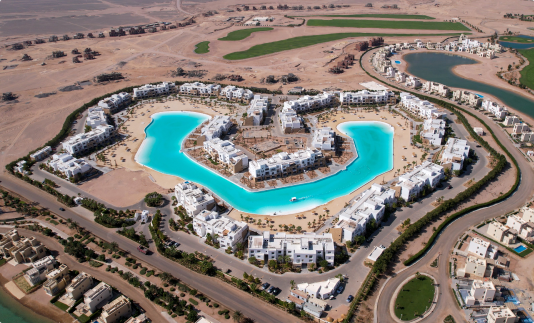
PIF puts Al Khafji on Saudi tourism map

PIF is pushing the Kingdom’s tourism map north to the Kuwaiti border. The sovereign wealth fund has launched Gulf Coast Development Company to build a 20 sq km integrated tourism and residential destination in Al Khafji, in the northern Eastern Province, according to a press release. The project runs along 10 km of the city’s Arabian Gulf waterfront.

The destination will eventually hold eight residential neighborhoods, more than 16k housing units and around 1.4k hotel keys, alongside commercial, tourism, educational, and marina facilities. It will be built in three phases, with the first — the neighborhoods, plus groundwork for the wider community — due for completion in 2030.

The private sector has an in: Gulf Coast Development Company will develop the destination with private-sector players and local and regional investors. That squares with PIF’s new 2026-2030 strategy, which moves the fund from building toward optimizing and from public sector leadership toward more private sector participation. The tourism, travel, and entertainment sector is one of six domestic ecosystems under the Vision Portfolio, alongside urban development and livability.

Why it matters: Al Khafji’s position on the Kuwaiti border gives the project a built-in catchment of visitors and residents from the Kingdom, Kuwait, and the wider GCC, and puts hotel supply in a corner of the Eastern Province that has had little of it.

The provincial pipeline is filling up: PIF-owned Asfar has signed MoUs with Al Ahsa Municipality and with private-sector companies to develop tourism projects in the governorate, PIF’s Dan Company brought in Hilton to operate three resorts in Al Ahsa across a 1.8 mn sqm Al Ahsa development, and the Eastern Province signed an investment agreement with PIF’s THE RIG to build infrastructure, including a marina, for the offshore rig-inspired destination.

5

MOVES

Tabuk Agriculture reshuffles leadership

Abdullah Al-Salhi has stepped down as managing director of Tabuk Agricultural Development, returning to the board as an independent member, according to a Tadawul disclosure. Al-Salhi, who had held the MD role since November 2025, said he could not dedicate enough time to the position in the coming period. The company said the move will also help cut the cost of overlapping executive roles now that a new CEO is in place.

BACKGROUND- Al-Salhi had briefly doubled as CEO on top of the MD role at the start of the year. That ended in June, when Khalid Al-Amoudi took over as CEO.

6

ALSO ON OUR RADAR

Acwa Power-led consortium brings world's largest off-grid renewable utility system online at Red Sea

The Red Sea gets its own grid

The Red Sea destination’s utility system is now commercially operational, kicking off a 25-year concession for an Acwa Power-led consortium, according to a press release. The system, worth USD 1.84 bn, is billed as the world’s largest off-grid renewable utilities network and the first Saudi giga-project to bring its full utilities system online without a connection to the national grid.

What it does: Marafiq Red Sea for Energy, the project company Acwa formed with China’s SPIC Huanghe Hydropower and Saudi Tabreed, will provide power, water, wastewater, district cooling and waste management to Red Sea Global’s hotels, airport, logistics hub and community facilities.

The details: The setup combines 340 MWac of solar with a 1.2k MWh battery, the world’s largest off-grid battery installation. At full capacity, it can generate up to 760k MWh of clean energy a year. The project also includes three seawater reverse osmosis plants, a waste management center, and a sewage treatment plant.

Flynas buys 10% stake in Swissport Saudi

Flynas is taking a stake in its own ground handler. The budget carrier will buy 10% of Swissport Saudi Arabia for USD 13.3 mn (SAR 50 mn), plus a small variable component, and simultaneously signed a five-year agreement making Swissport its exclusive ground handler in the Kingdom, according to Tadawul filing. The handling contract runs from March 2027 to March 2032, with Flynas holding a call option to double its stake to 20% on renewal. Swissport Saudi Arabia is currently owned by Swissport International and Oman’s Asyad Holding, which are selling the stake.

The move ends a relationship: Flynas has served notice on its current provider, Saudi Ground Services, effective March 2027.

Why it matters: Just months ago, Saudi Ground Services looked to have ring-fenced the Kingdom’s aviation core, locking Saudia, Flynas, and Riyadh Air into multi-year contracts while foreign rivals like Swissport competed for foreign-carrier and low-cost accounts like Air Arabia. Flynas shifting its handling contract to Swissport, while taking a stake in the operator, breaks that grip. For Swissport, which received its Saudi ground handling license last year, the contract is a major step-up.

Moroccan hospital debuts in Saudi

Morocco’s largest private hospital operator, Akdital, has opened its first hospital in Saudi Arabia, a 140-bed facility in Riyadh’s Al Olaya district, Asharq Business reports. The hospital spans more than 17.6k sqm and includes 11 operating rooms, more than 30 intensive-care beds, an 18-bed emergency department, and diagnostic and imaging facilities.

REMEMBER- The Arab Investment Company (Taic) acquired a 15% stake in Akdital last month to help fund its expansion, with Saudi Arabia a key focus of the growth plan.

The plan: The Moroccan company previously earmarked USD 350 mn to develop 11 hospitals across Saudi Arabia, the UAE, and Tunisia by 2030. It also plans to offer investment funds up to a 30% stake as it looks to spread its funding across bonds, bank loans and internal resources.

Akdital is entering a healthcare market that’s in expansion mode: Just last month, Al Fakeeh Care wrapped its Al Fagih acquisition, Dallah Healthcare has spent years consolidating the sector through acquisitions including Kingdom Hospital, Makkah Medical Center, Al Salam, and Al Ahsa. National Medical Care stitched together Jeddah’s Chronic Care Specialized Medical Hospital and Makkah’s Jiwar Medical Center. Meanwhile, Sulaiman Al Habib and Mouwasat are expanding mainly through new hospitals in Riyadh, Dammam and elsewhere.

Al Rasheed finalizes acquisition of 50% stake in Taif

Mohamed Hadi Al Rasheed & Partners has secured regulatory clearance to acquire a 50% stake in Taif Shipping for SAR 92.5 mn, according to a Tadawul disclosure. The company received a no-objection letter from the General Authority for Competition for the move, and other regulatory procedures still need to be completed before closing.

REMEMBER- The company signed the agreement for the acquisition in July. Al Rasheed mines and processes the silica; Taif ships and blends it for oilfield customers. Owning half the logistics chain gives Al Rasheed direct access to downstream marketing channels for its products. The transaction will be funded through Al Rasheed’s own resources and available financing facilities.

Sav to use fresh funds to expand in Saudi Arabia

UAE-based fintech Sav secured USD 3.5 mn in a pre-Series A round, with the funding earmarked for expanding its Saudi operations, according to a press release. The financing will also support the company’s plan to boost its product development, AI infrastructure, and user acquisition across the GCC. The round was led by Phoenix Venture Partners, in addition to co-investors from PVP Innovation Fund CEIC’s investor base.

About the company: Founded by Purvi Munot (LinkedIn) and Mithil Ajmera (LinkedIn), Sav is an AI-powered consumer fintech platform that combines savings, investments, gold, payments, and commerce. Its SavCore infrastructure allows users to aggregate financial accounts and automate financial decisions. The firm operates under a DFSA Category 4 license in the UAE.

7

PLANET FINANCE

BTC’s rally shows signs of running out of steam

BTC's had a rough couple of weeks, and analysts are split on whether a recent rally is here to stay. Recent weeks had seen it rise by 30% to around USD 82.8k, before later dropping back down below the 80k mark. The rally had legs from Fed Governor Christopher Waller signaling he could support leaving interest rates unchanged this month, plus a weaker USD — but a hot jobs report reversed both almost overnight.

BTC dropped 2.8% to USD 79.2k the moment the jobs data landed, as the USD strengthened and two-year Treasury yields climbed, according to Bloomberg. US payrolls rose 162k in August — well above forecasts — reviving wagers on a September rate hike, which would tighten liquidity and dent risk appetite for an asset like BTC in one move. The Fed's next decision, at its 15-16 September meeting, is now the thing the whole market is waiting on.

For now, the bulls still have room to work with. BTC stays in bullish territory as long as it holds above roughly USD 71.8k — the midpoint of last month's rally, per Reuters' technical read. But the case for caution is building too. “A clear rebound doesn't settle the debate, it arms the hawks,” Sygnum Bank's Fabian Dori told Bloomberg.

The quality of the demand behind the rally is the bigger question mark. US-listed BTC ETFs booked two days of sizable outflows in the past week, Bloomberg reported separately. The seven-day average of the Coinbase premium — which tracks whether US buyers are paying above the global price — has stayed negative for more than four months, and even last month's rally wasn't enough to flip it positive. Translation: the American buying that usually powers BTC's bigger runs hasn't shown up for this one.

MEANWHILE- A USD 320 mn incident at a Bitcoin sidechain is the wildcard. Self-described white-hat hackers exploited a software bug in Liquid Network's Elements code to withdraw roughly 4k of the 4.2k BTC held in its Liquid Federation wallet, Liquid said in an X post. Blockstream, which built the sidechain, says no keys were compromised, and unlike most crypto hacks, the funds haven't moved since, and the parties involved are negotiating an on-chain return once the bug is patched. That's a different animal from Bybit's USD 1.5 bn theft last year, which triggered a selloff that dropped BTC by as much as 28.2% — but a market that's already jumpy on ETF demand doesn't need another crypto-security headline right now, whatever the eventual outcome.

MARKETS THIS MORNING-

Asia-Pacific markets surged in early trading, with South Korea’s Kospi up 1.4% and Japan’s Nikkei up 0.5%. Meanwhile, Wall Street equities were broadly in the red, weighed down by the Middle East conflict and escalating US-Canada trade tensions.

TASI

11,025

-0.4% (YTD: +5.1%)

MSCI Tadawul 30

1,480

-0.5% (YTD: +6.7%)

NomuC

21,741

0.0% (YTD: -6.7%)

USD : SAR (SAMA)

USD 3.75 Sell

USD 3.75 Buy

Interest rates

4.25% repo

3.75% reverse repo

EGX30

56,628

-0.1% (YTD: +35.4%)

ADX

9,976

0.0% (YTD: -0.2%)

DFM

5,931

+0.8% (YTD: -2.7%)

S&P 500

7,719

-0.4% (YTD: +12.8%)

FTSE 100

10,822

-0.1% (YTD: +9.0%)

Euro Stoxx 50

6,404

+0.2% (YTD: +10.5%)

Brent crude

USD 97.00

+0.8%

Natural gas (Nymex)

USD 2.97

-0.3%

Gold

USD 4,452

-0.6%

BTC

USD 79,237

-0.9% (YTD: -9.6%)

Sukuk/bond market index

903.6

+0.1% (YTD: -1.7%)

S&P MENA Bond & Sukuk

150.68

-0.1% (YTD: -0.8%)

VIX (Fear gauge)

15.30

+5.3% (YTD: +2.3%)

THE CLOSING BELL: TADAWUL-

The TASI fell 0.4% yesterday on turnover of SAR 3.4 bn. The index is up 5.1% YTD.

In the green: Banan Real Estate (+8.0%), Armah Sports (+7.8%), and Al Etihad Cooperative (+5.2%).

In the red: Saudi Ground Services (-6.9%), Knowledge Economic City (-4.6%), and Yanbu National Petroleum (-4.1%).

THE CLOSING BELL: NOMU-

The NomuC remained flat yesterday on turnover of SAR 13.6 mn. The index is down 6.7% YTD.

In the green: Al Fakhera (+30.0%), Albattal Factory (+21.8%), and Hawyia Auctions (+7.3%).

In the red: Advance International (-12.6%), Arabian Plastic Industrial (-9.9%), and Osool and Bakheet (-9.8%).

CORPORATE ACTIONS-

Saudi Fisheries Company will vote on a proposed 500% capital increase through a rights issue at an extraordinary general meeting on 27 September, according to a Tadawul disclosure. The SAR 334.93 mn increase would lift the company’s capital to SAR 401.92 mn from SAR 66.99 mn through the issuance of 33.49 mn new ordinary shares to support its strategic plans and future operations.

The National Shipping Company (Bahri) approved a special interim dividend of SAR 1.38 bn for 1H 2026, with shareholders receiving SAR 1.50 per share, equivalent to 15% of nominal value, according to a Tadawul filing. The dividend will be paid on 27 September, with eligibility set for shareholders registered at the end of trading this Thursday, 10 September.


SEPTEMBER

8-10 September (Tuesday-Thursday): The WTM Spotlight Riyadh, Riyadh Front Exhibition & Conference Center (RFECC), Riyadh.

9 September (Wednesday): CyberHero x Riyadh, Riyadh.

14-17 September (Monday-Thursday) The fourth Unesco Global Forum on the Ethics of AI (GFEAI), The Ritz-Carlton, Riyadh.

15-17 September (Tuesday-Thursday) The Global AI Summit, King Abdulaziz International Convention Center, Riyadh.

23 September (Wednesday): Saudi National Day.

28 September-1 October (Monday-Thursday): The International Conference on Theory and Practice of Electronic Governance (ICEGOV), Prince Sultan University, Riyadh.

OCTOBER

25-26 October (Sunday-Monday): The Global Proptech Summit, Mandarin Oriental Al Faisaliah Hotel, Riyadh.

26-28 October (Monday-Wednesday): ACHEMA Middle East, Riyadh International Convention & Exhibition Center.

26-29 October (Monday-Thursday): The Future Investment Initiative, King Abdulaziz International Conference Center, Riyadh.

28-29 October (Wednesday-Thursday): Procurement and Supply Chain Futures Forum, Mandarin Oriental Al Faisaliah Hotel, Riyadh.

28-29 October (Wednesday-Thursday): Real Estate Supply Chain Forum, Mandarin Oriental Al Faisaliah Hotel, Riyadh.

30 October-1 November (Friday-Sunday): The New Global Sport Conference, Sofitel Hotel & Convention Centre, Riyadh.

NOVEMBER

11-12 November (Wednesday-Thursday): Aluminum Arabia, The Arena, Riyadh.

16-19 November (Monday-Thursday): Cityscape Global, Riyadh Exhibition and Convention Centre (Malham), Riyadh.

29 November-1 December (Sunday-Tuesday): The UN Trade and Development Global Supply Chain Forum, Riyadh.

29 November-1 December (Sunday-Tuesday): The Global Logistics Forum, King Abdulaziz International Convention Centre, Riyadh.

Signposted to happen sometime in 2026:

2027

FEBRUARY

1-3 February (Monday-Wednesday): Energy Regulators Regional Association annual conference, Riyadh.

MARCH

21-25 March (Sunday-Thursday):The World Water Forum, Riyadh.

22–24 March (Monday-Wednesday): Capital Markets Forum, Four Seasons Hotel, Riyadh

APRIL

26-29 April (Monday-Thursday): World Energy Congress, Riyadh.

JUNE

1-3 June (Tuesday-Thursday): The Saudi Entertainment and Amusement Expo, Riyadh Front Exhibition and Conference Center.

Signposted to happen sometime in 2027:

  • The Ocean Race finishes in Amaala on the Red Sea;
  • Riyadh-Kudmi transmission line to be completed;
  • Aero Middle East and Sand & Fun takes place in Thumamah Airport, Riyadh.

Signposted to happen sometime in 2Q 2027:

  • The Hail Region Water Networks Project is expected to be completed.
Now Playing
Now Playing
00:00
00:00