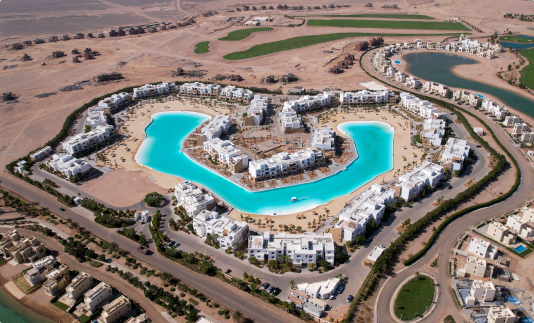
Dar Global eyes 30% foreign sales

1

WHAT WE’RE TRACKING TODAY

Saudi Arabia eyes East-West pipeline expansion

Good morning, all. We lead today’s issue with a conversation with Dar Global CEO Ziad El Chaar, who let us in on the company’s target of foreign buyers making up around 30% of its local sales now that the market is open to international investors.

Around the block(ade)

Riyadh wants a bigger back door around Hormuz: Saudi Arabia is weighing expanding the capacity of its East-West pipeline to the Red Sea, Reuters reports, citing sources familiar with the matter. The route already handles up to 7 mn bbl / d — some 2 mn bbl / d for domestic refineries, the rest for export — and the move could allow the Kingdom, and potentially its neighbors, to ship more crude to global markets without crossing Hormuz.

Neighbors want in, too: Saudi is in preliminary talks with some of its neighbors — including Kuwait, Bahrain, and Qatar — about adding 1-2 mn bbl / d of capacity, with a line for refined products also on the table, the sources add.

Slowly, and maybe surely: The project could take years and cost bns — and would need the Kingdom to rework how it prices crude sold through an expanded system. Whether that means retrofitting the existing pipeline or laying new pipe alongside it is still unsettled.

It’s getting more pressing: A Saudi-flagged crude oil tanker, believed to ​be the supertanker Wedyan, was damaged off Oman yesterday, as attacks on three vessels near the Strait of Hormuz — including a Qatari LNG carrier that Qatar said was hit by an Iranian drone — raised fresh concerns over shipping safety in the waterway, Reuters reports. The cause of the attack on the Saudi tanker remains unclear.

Oil reax: Oil surged more than 5% yesterday, with Brent climbing to USD 76.03 in post-settlement trade and WTI to USD 72.20 after the US revoked the general license authorizing Iranian crude sales.

Tensions simmer: The US launched attacks on Iranian targets last night in retaliation (we have more in the news well, below). Iran’s foreign minister responded that talks on a final agreement would not proceed if US threats continued — a direct pushback to Trump’s warning to “finish the job.” It remains unclear whether the Iranian attacks reflect a deliberate escalation or were tied to mourning ceremonies for slain Supreme Leader Ayatollah Ali Khamenei.

Analysts flagged the broader risk regardless of intent. “This shows just how fragile the ceasefire actually is,” ICIS director Ajay Parmar said. “If Iran merely threatens to close the Strait of Hormuz again, prices will spike considerably. Volatility really is here to stay.”

A license to export green hydrogen

Acwa received government approval to export green hydrogen and its derivatives — including green ammonia, green methanol, and green fuel, according to a disclosure on Tadawul. The approval also tasks the company with developing projects to produce, transmit, and export renewable electricity to European and Arab markets.

Why this matters: The mandate positions Acwa as the Kingdom’s designated gateway for green hydrogen exports, centralizing a role that could be otherwise split between multiple developers. Along with the electricity export mandate, it signals Riyadh’s intent to position the Kingdom as a renewable energy supplier, not just a fossil fuels exporter.

REMEMBER- Acwa is already laying the groundwork for a second mega green hydrogen project in the Kingdom and exploring green fuel corridors to Europe.

Another ETF market maker

SNB Capital becomes second ETF market maker: SNB Capital secured approval from the Saudi Exchange to act as a market maker for the Sab Invest Hang Seng Hong Kong ETF under the Exchange Traded Funds Market Making Framework, according to a Tadawul disclosure. The arrangement takes effect today, requiring SNB Capital to maintain a minimum order presence of 80%, a minimum order size of SAR 50k, and a maximum spread of 2%.

REMEMBER- Sab Invest became the first entity to get the green light to act as a market maker for its Quant ETF. ETF market makers are exchange members that support liquidity in listed ETFs by continuously posting buy and sell orders.

Data point

25 — that’s the number of construction contracts awarded in Saudi Arabia in June 2026, the highest monthly count so far this year, according to a Saudi Contractors Authority report (pdf). Total value came in at SAR 29.5 bn — just shy of May’s SAR 30 bn, the highest monthly value seen all year.

The breakdown: Buildings dominated the mix at SAR 20.6 bn across 14 projects — 56% of total value. The Eastern Province saw the most projects awarded all month with 10 contracts worth a combined SAR 11.4 bn. The National Housing Company was the top project owner with six contracts worth SAR 5.4 bn, followed by Aramco with two worth a combined SAR 4.9 bn.

*** You’re reading EnterpriseAM Saudi, your essential daily roundup of business, economics, and must-read news about Saudi, delivered straight to your inbox. We’re out Sunday through Thursday by 7am Riyadh time.

EnterpriseAM Saudi is available without charge thanks to the generous support of our friends at Tas’heel and Hassan Allam Properties.

Want to send us a story idea, request coverage, ask for a correction, or otherwise get in touch? Reach out to us on [email protected].

DID YOU KNOW that we also cover Egypt, the UAE, the MENA logistics industry, and the MENA <> India corridor?

Were you forwarded this email? Tap or click here to get your own copy of EnterpriseAM Saudi delivered every weekday.

***

The big story abroad

The US-Iran conflict has reignited, as the US military launched a series of retaliatory strikes against Iran, putting at risk the interim agreement inked between the two sides last month. The US Central Command said the attacks came in response to Iranian attacks on commercial vessels crossing the Strait of Hormuz earlier this week. The US strikes were reportedly launched against military targets.

Washington also revoked a waiver that allowed Tehran to sell oil openly on global markets. The 60-day exemption was issued last month, allowing the Islamic Republic to conduct such transactions in USD — even to US importers.

Iran has not claimed responsibility for the attacks on vessels in the strait, but reiterated its authority over parts of the waterway in a document submitted to the International Maritime Organization — the United Nations’ shipping agency.

We’ll be closely watching the Iranian response and how these developments impact oil prices — which dipped below USD 80 / bbl after the agreement and now sit around the USD 75 mark.

Meanwhile, in the world of AI: E-commerce behemoth Amazon plans to bankroll its AI investments by raising USD 25 bn in USD-denominated bond sales. This dovetails into a recent trend of tech players resorting to debt markets to build AI infrastructure, as seen by the likes of Alphabet, Microsoft, and Meta.

The latest offering from Meta’s AI overhaul is here — an image-generation model. Muse Spark Image can be used to generate images from scratch or edit existing images. It can also be used to power new editing features on Instagram.

And on Wall Street: Private equity firms are now saddled with a nine-year backlog of unsold companies — some 13.5k in the US alone — as potential buyers hesitate to buy software-heavy portfolios amid fears AI will disrupt tech-based business models, analysis by PwC finds. For reference, buyout firms typically aim to hold investments for around three to five years.

PLUS- Nato allies went on a USD 50 bn defense agreement spree during the summit in Ankara, signalling an attempt by Europe to meet demands from US President Donald Trump.


This publication is proudly sponsored by

Easier life with Tasheel
The Luxury of Certainty
2

REAL ESTATE

Foreign buyers to make up 30% of Dar’s local sales?

Dar Global expects foreign buyers to account for about 30% of its Saudi sales as Saudi Arabia opens its residential property market to eligible international investors, CEO Ziad El Chaar tells EnterpriseAM. The developer already received expressions of interest for around 350 units worth USD 1-1.5 bn.

“We know we are experts in attracting foreign investors to any market. We’ve done it before in so many countries,“ El Chaar said.

REMEMBER- Regulations governing foreign ownership of residential property in designated areas went into effect over the last couple of weeks, part of a broader push to attract international capital and boost the kingdom’s real estate market.

Eager to start: Dar Global is among the first developers to register on the government’s foreign ownership platform Saudi Properties, and expects to begin taking bookings shortly after its projects are approved. “Watch us within 15 days of the projects going on the platform,” El Chaar said.

Wagering on Saudi: The London-listed developer, established as the international luxury arm of Tadawul-listed Dar Al Arkan, now has USD 11.5 bn in projects under development in the Kingdom, including Trump-branded residential developments in Jeddah and Riyadh, alongside projects with Roshn. Construction is progressing on Trump Tower Jeddah and luxury mansions in Diriyah as part of its expanding kingdom portfolio.

El Chaar said the company’s expansion is supported by multiple funding sources, including some USD 600 mn in freecash on its balance sheet, as well as customer proceeds from off-plan sales and bank financing. Dar Global also secured a USD 250 mn financing facility from Emirates NBD and First Abu Dhabi Bank in April to fund new acquisitions rather than existing developments. “We are focusing on this type of funding more than entering today into sukuk or anything of that sort,” he said.

Beyond property development, Dar Global is preparing to launch its first investment fund after acquiring a DIFC-regulated asset management firm, with the fund expected to reach its first close in September. The platform will invest in income-producing assets such as hotels and commercial buildings across Saudi Arabia, the UAE, the US, and Europe.

What’s next? Dar Global is also expanding its portfolio of branded developments, with three new international brands set to launch over the next six months, including two making their Saudi debut, adding to existing partnerships with Trump, Aston Martin, and Versace, among others. El Chaar said it is “too early” to consider a dual listing, noting that Dar Global has only been listed in London for about two-and-a-half years.

Tags:

3

BANKING

Unexplained delays and blocks reportedly hit Saudi to UAE bank transfers

Saudi-UAE transfers getting stuck? Payments from banks in Saudi Arabia to accounts in the UAE have been delayed, returned, or blocked outright since at least May, often with no explanation from the banks moving them, a source in the know tells EnterpriseAM, confirming news first picked up by the Financial Times and Bloomberg.

What’s going on? The alleged cases involved money leaving a Saudi account and never landing in Dubai, some transfers held for about a week and then bouncing back, and electronic payments refused with a mere “transaction failed,” the FT reports.

What we’re hearing: Our source says the issue has been happening for about a month. They think it most likely reflects the Saudi Central Bank tightening compliance screening on inbound and outbound transfers rather than a blanket block.

Official statements point in the same direction. Sama said the financial sector “operates within a robust regulatory framework” with “no direct restrictions on specific countries,” and that banks “apply risk-based measures consistently across all transactions.” The UAE’s economy ministry also said it has had no complaints from private-sector firms about transfer problems.

If true, this would create friction in the Arab world’s largest trade relationship. Bilateral trade between the two hit USD 25.7 bn last year, up from USD 21.7 bn in 2024, and many firms run their Saudi-facing business through Dubai hubs. Some companies caught in the delays are reportedly already rerouting through Bahrain or onto costlier rails like PayPal to keep goods moving.

Why it matters: The backdrop is the sharpest Saudi-UAE rift in years, with tension over Yemen reaching a boiling point in December, followed by Abu Dhabi’s April exit from Opec. Whether these snags are routine de-risking or a symptom of that strain, they raise the cost and the uncertainty of moving money between Riyadh and Dubai.

Tags:

4

ALSO ON OUR RADAR

KSA’s Sela goes to London

PIF-owned entertainment firm Sela opened its international headquarters in London on Monday, according to a press release. The office will manage relationships with global event organizers, venues, and production partners as Sela pursues expansion beyond the Kingdom.

REMEMBER- In May, Sela inked an agreement to set up an entertainment and events venture with Egypt’s Talaat Moustafa Group — London is the second international move in quick succession.

Saudi Cargo doubles Boeing 777 fleet

Saudi Cargo is purchasing four Boeing 777 Freighters from Boeing Saudi Arabia, expanding the Kingdom’s dedicated air cargo capacity. Deliveries will begin in 4Q 2026 and continue through 2Q 2027, Saudi Cargo CEO Loay Mashabi told Al Arabiya. The first aircraft — with a range of 10k — will support Saudi Cargo’s growing international network, strengthening connectivity between Saudi Arabia and key destinations across Asia, Europe, Africa, and North America.

Why it matters: The expansion will double Saudi Cargo's dedicated Boeing 777 freighter fleet from four to eight aircraft, representing a 100% increase in cargo capacity. The national transport and logistics strategy targets 4.5 mn tons of cargo throughput annually by 2030.

The company’s total fleet is expected to reach 14 aircraft within the next six months, Mashabi said, adding that it will drive annual cargo volumes from around 600k tons to more than 1 mn tons.

Noon snaps up exam prep platform

Saudi edtech Noon Academy acquired Almakhfi, a digital education platform specializing in Qudurat and Tahsili exam preparation, according to a press release. The acquisition brings Almakhfi’s AI-powered content into Noon’s platform. Financial terms were not disclosed.

Saudi education is consolidating across the board: Noon's move is the latest in a wave of acquisitions reshaping the Kingdom’s private education sector from edtech to K-12. Al Masar Al Shamil signed a non-binding MoU to acquire 60% of Al Qalam Educational Trading last month, EFG Hermes has deployed more than half of its USD 200 mn-plus Saudi Education Fund across six schools in roughly a year, and Ashmore closed its second school acquisition in April.

5

PLANET FINANCE

Oxford Economics sees faster growth ahead, conditional on a peace that could still fall apart

The global economy is set to pick up speed in the second half of 2026 — but only if the US-Iran truce holds. Global GDP is expected to expand by 3.1% annualized in 2H, with the acceleration concentrated in developing economies, according to an Oxford Economics report seen by EnterpriseAM. The mechanism is straightforward — lower oil prices lift real disposable income and consumption. The condition to see it realized is less clear.

A coin flip peace

Oxford Economics puts the odds of a durable US-Iran agreement at 50-50. The conflict initially drove oil prices higher, lifted inflation, and weighed on growth. The ceasefire reversed that — sending prices lower and reopening the strait to shipping. But the truce is fragile. Renewed military strikes at the end of June mean the breakdown scenario is very much alive, and a return to hostilities would push inflationary pressure back up fast.

The supply chain exposure

Western AI investment has a strait-shaped vulnerability. US AI spending relies on components from Northeast Asia and ASEAN — regions exposed to disruptions in energy shipments through Hormuz. Critical components also depend on specialized manufacturers in South Korea and Germany, leaving the supply chain exposed to unexpected shocks.

China benefited from the disruptions, but that won’t last. Chinese exports benefited from the supply chain disruptions caused by the war, helping offset weakness in traditional export sectors and restrictions on refined petroleum products exports. But over the medium term, a stronger RMB, rising trade barriers, higher factory prices, and weaker global demand could leave China sitting on growing overcapacity.

The tariff calendar

New US tariffs are coming in July. The Trump administration will introduce new Section 301 tariffs to replace Section 122, which expires on 24 July. The replacement is expected to be marginally higher, targeting USD 25-30 bn in monthly revenue to help fund the One Big Beautiful Bill Act. The revised USMCA agreement, meanwhile, is no longer expected to lower tariffs, with current rates to stay in place indefinitely.

AND- Brussels and Beijing are heading for a collision. The European Commission expanded its trade-defense investigations against China to more than 50, with duties already imposed on electric vehicles, solar supply chains, and glass fiber. New economic security tools are also planned by September, raising the risk of Chinese retaliation.

What changes if the truce holds

Central banks get room to ease. Lower oil prices would reduce inflation pressures, giving central banks less reason to keep raising interest rates. The ECB’s case for additional hikes disappears — the Fed, the Bank of England, and the Bank of Japan are all expected to take a less aggressive path than the current one. A renewed escalation, though, pushes everyone back toward tightening.

Several elections could reshape the picture heading into 2027. US midterm elections are expected to produce a divided government even if Democrats win both chambers, limiting prospects for additional fiscal stimulus while raising the odds of a debt ceiling standoff. Meanwhile, Israel’s parliamentary elections could influence ceasefire negotiations with Iran. German state elections may also test coalition stability and complicate the ECB’s outlook.

The biggest upside risk to the global outlook is stronger-than-expected AI investment and productivity gains, particularly in the US and Asia. Sizable spending on data centers, utilities, and major projects such as Australia’s 2032 Olympics could deliver a bigger growth boost than current forecasts assume.

MARKETS THIS MORNING-

Asia-Pacific markets are mixed in early trading this morning. South Korea’s Kospi is down 0.5% after Samsung’s 2Q preliminary earnings triggered a selloff that pushed the tech giant down 4.4%. Japan’s Nikkei is also down, while the Shanghai Composite and Hang Seng are looking at moderate gains.

TASI

10,852

+0.4% (YTD: +3.5%)

MSCI Tadawul 30

1,444

+0.4% (YTD: +4.1%)

NomuC

22,667

0.0% (YTD: -2.7%)

USD : SAR (SAMA)

USD 3.75 Sell

USD 3.75 Buy

Interest rates

4.25% repo

3.75% reverse repo

EGX30

53,006

+1.0% (YTD: +26.7%)

ADX

9,941

+0.2% (YTD: -0.5%)

DFM

6,094

+0.1% (YTD: +0.8%)

S&P 500

7,504

-0.5% (YTD: +9.6%)

FTSE 100

10,666

+0.1% (YTD: +7.4%)

Euro Stoxx 50

6,320

-1.2% (YTD: +9.0%)

Brent crude

USD 74.24

+2.8%

Natural gas (Nymex)

USD 3.28

+0.5%

Gold

USD 4,110

-1.1%

BTC

USD 63,543

-1.1% (YTD: -27.5%)

Sukuk/bond market index

912.67

-0.1% (YTD: -0.7%)

S&P MENA Bond & Sukuk

151.95

-0.2% (YTD: 0.0%)

VIX (Volatility Index)

16.13

+3.6% (YTD: +7.9%)

THE CLOSING BELL: TADAWUL-

The TASI rose 0.4% yesterday on turnover of SAR 4.3 bn. The index is up 3.5% YTD.

In the green: Saudi Steel Pipe (+7.8%), Arabian Pipes (+6.6%), and East Pipes Integrated (+4.8%).

In the red: Saudi Industrial Export (-4.2%), United Cooperative Assurance (-4.1%), and Naseej International (-3.1%).

THE CLOSING BELL: NOMU-

The NomuC was flat yesterday on turnover of SAR 12.0 mn. The index is down 2.7% YTD.

In the green: Al Rashid Industrial (+8.5%), Alhasoob (+6.5%), and Al Mohafaza (+6.4%).

In the red: Dar Almarkabah (-7.1%), Keir International (-5.4%), and Lamasat (-5.4%).


AUGUST

30 August-1 September (Sunday-Tuesday): Saudi Paper and Packaging Expo, Riyadh International Convention & Exhibition Center.

31 August-3 September (Monday-Thursday): Leap Tech Conference, Riyadh Exhibition & Convention Center - Malham.

SEPTEMBER

8-10 September (Tuesday-Thursday): The WTM Spotlight Riyadh, Riyadh Front Exhibition & Conference Center (RFECC), Riyadh.

15-17 September (Tuesday-Thursday) The Global AI Summit, King Abdulaziz International Convention Center, Riyadh.

23 September (Wednesday): Saudi National Day.

28 September-1 October (Monday-Thursday): The International Conference on Theory and Practice of Electronic Governance (ICEGOV), Prince Sultan University, Riyadh.

OCTOBER

25-26 October (Sunday-Monday): The Global Proptech Summit, Mandarin Oriental Al Faisaliah Hotel, Riyadh.

26-28 October (Monday-Wednesday): ACHEMA Middle East, Riyadh International Convention & Exhibition Center.

28-29 October (Wednesday-Thursday): Procurement and Supply Chain Futures Forum, Mandarin Oriental Al Faisaliah Hotel, Riyadh.

28-29 October (Wednesday-Thursday): Real Estate Supply Chain Forum, Mandarin Oriental Al Faisaliah Hotel, Riyadh.

30 October-1 November (Friday-Sunday): The New Global Sport Conference, Sofitel Hotel & Convention Centre, Riyadh.

NOVEMBER

11-12 November (Wednesday-Thursday): Aluminum Arabia, The Arena, Riyadh.

16-19 November (Monday-Thursday): Cityscape Global, Riyadh Exhibition and Convention Centre (Malham), Riyadh.

29 November-1 December (Sunday-Tuesday): The UN Trade and Development Global Supply Chain Forum, Riyadh.

Signposted to happen sometime in 2026:

2027

FEBRUARY

1-3 February (Monday-Wednesday): Energy Regulators Regional Association annual conference, Riyadh.

MARCH

21-25 March (Sunday-Thursday):The World Water Forum, Riyadh.

22–24 March (Monday-Wednesday): Capital Markets Forum, Four Seasons Hotel, Riyadh

APRIL

26-29 April (Monday-Thursday): World Energy Congress, Riyadh.

JUNE

1-3 June (Tuesday-Thursday): The Saudi Entertainment and Amusement Expo, Riyadh Front Exhibition and Conference Center.

Signposted to happen sometime in 2027:

  • The Ocean Race finishes in Amaala on the Red Sea;
  • Riyadh-Kudmi transmission line to be completed;
  • Aero Middle East and Sand & Fun takes place in Thumamah Airport, Riyadh.

Signposted to happen sometime in 2Q 2027:

  • The Hail Region Water Networks Project is expected to be completed.
Now Playing
Now Playing
00:00
00:00