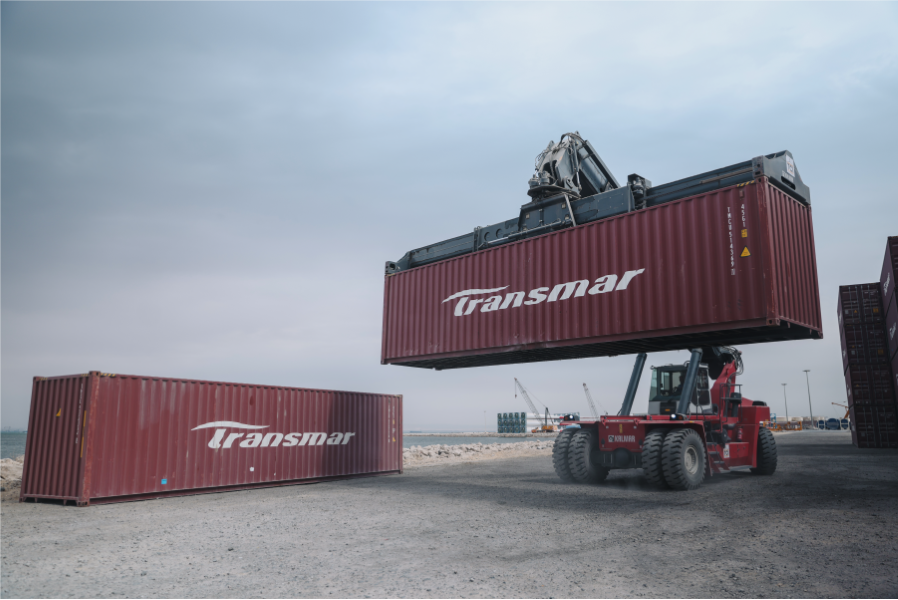
Good morning, friends. A mn containers have taken the long way around Hormuz since March, and this morning we ask what the long way around looks like for jet fuel.
DP World has moved more than 1 mn TEUs the long way around since March. It trucked and railed the containers from UAE east coast ports, which sit outside the strait, to Jebel Ali and domestic markets between early March and the end of October, Shehab Mohamad Aljasmi, chief commercial officer for ports and terminals at DP World GCC, said at a media briefing, state news agency Wam reported. The corridors now move around 3.5k TEUs a day on more than 3k trucks, 700 of them DP World’s own. Between March and June, about AED 34 bn of trade moved through a Dubai-Oman customs “Green Corridor” for sealed containers, which the two customs authorities activated within 72 hours.
Containers can take a truck, but jet fuel is a fussier passenger, which makes it our Lede this morning. Gulf airports are building more fuel storage and pipelines, and the weak point may sit upstream, at the refinery: on-site fuel covers about 10 days at Abu Dhabi and Doha, by one estimate, and an airport with no import terminal connected to its pipeline has no feasible way to replace lost refinery supply, David Tonyan of Kpler tells us.
Become a morning regular
Ports, power, data centers: who builds the region’s infrastructure, and who controls it. In your inbox Monday to Thursday. Free of charge.
Gulf airports are building more jet fuel storage and pipelines, and the weak point may sit upstream, at the refinery. Strikes set fuel tanks ablaze at Kuwait International Airport and hit fuel storage near Bahrain International Airport in March, and a separate strike on a fuel tank at Dubai International Airport (DXB) briefly halted flights. “Additional storage buys time; redundancy buys resilience,” Addison Schonland, founder of AirInsight Group, tells EnterpriseAM.
Four hubs are rethinking their fuel infrastructure: Dubai is considering fuel storage at its future Al Maktoum International Airport and a higher-capacity pipeline from Jebel Ali. Abu Dhabi is building underground tanks for 192 mn liters of jet fuel, Qatar is advancing a pipeline from Mesaieed to Hamad International Airport, and Jeddah is preparing a new fuel farm. Several of the projects predate the conflict, but the question now is how long airports can keep aircraft flying when supplies are disrupted, and not only how much fuel they can handle.
Protecting the tanks is only part of the problem: Jet fuel passes through refineries, terminals, pipelines, pumping stations, and airport distribution systems before it reaches an aircraft, so an airport can hold substantial reserves and still be exposed if the infrastructure that refills them fails. A hub is resilient when it combines usable inventory with multiple fuel sources, physically independent delivery routes, and redundant airport distribution systems, Schonland adds.
DXB shows how exposed the fuel side can be: It received 111 alerts of ballistic activity during the conflict, 17 of which resulted in strikes, one of them hitting above-ground fuel tanks and briefly interrupting operations. Underground fuel storage and reinforced infrastructure are among the protections being considered for Al Maktoum, Dubai Airports CEO Paul Griffiths told the Financial Times.
What’s being built
Abu Dhabi is putting fuel underground: Adnoc awarded a contract estimated at up to USD 400 mn in 2024 to build underground fuel-storage facilities near Zayed International Airport, with capacity for 192 mn liters of Jet A-1, Meed reported. The project has 16 storage tanks plus supporting mechanical, electrical, and safety infrastructure, and is due for completion in 2027.
Dubai is adding a larger fuel line: Emarat affiliate Emdad appointed Germany’s Bilfinger in November 2025 to design a pipeline connecting its Jebel Ali fuel terminal to Al Maktoum (DWC), according to a press release. The line is intended to carry more than 2.5 times the annual fuel volume handled by the pipeline supplying DXB.
Qatar and Jeddah are adding capacity too: QatarEnergy is pursuing a roughly 53 km pipeline from Mesaieed Industrial City to Hamad International Airport, with contractors submitting technical bids in September and commercial proposals requested in October. The country commissioned a 143 km jet-fuel pipeline from Ras Laffan in 2019, designed to allow supplies from both Ras Laffan and Mesaieed. Meanwhile, Jeddah Airports Company is planning a new fuel-farm package for 2Q 2027 as part of an expansion targeting 114 mn passengers a year by 2031.
Each project covers a different risk: Doha’s pipeline could make fuel delivery more reliable and reduce reliance on alternative transport, Jeddah’s storage could bring more fuel closer to aircraft demand and give greater cover during an upstream disruption, and Dubai’s physical protection addresses the risk of fuel infrastructure itself being damaged, Sindy Foster, principal managing partner at Avaero Capital Partners, tells us. Whether they help depends on whether they provide a usable alternative when part of the existing system fails.
Days of cover
On-site fuel covers about 10 days at Abu Dhabi and Doha, by one estimate. That’s based on public figures, David Tonyan, senior research analyst at Kpler, tells us. Storage can absorb a short interruption but can’t sustain a major hub indefinitely without replenishment, he adds.
A full tank isn’t all usable. Schonland distinguishes gross storage capacity from the fuel available for operations: minimum operating levels, maintenance, testing, and contamination reduce usable inventory, and high daily consumption at major connecting hubs can drain substantial reserves quickly.
Growth shortens the cushion: Expanding passenger traffic and aircraft movements raise daily fuel consumption, so unless storage and supply grow at a comparable pace, the same reserves give fewer days of cover, Foster tells us.
The refinery link
The biggest vulnerability may sit outside the airport: Jet-fuel pipelines depend on production facilities that can supply aviation-grade fuel, and no substitute can be built in the short term for lost refinery production, Tonyan tells us. Replacing those volumes takes another refinery, or an import terminal with a practical connection to the airport’s fuel network, he adds.
Imports could fill the gap within one to two weeks: An airport connected to a suitable Gulf import terminal could secure alternative jet fuel in that time if regional supplies remain available, Tonyan estimates. October voyages from Bahrain to Jebel Ali took about 1.3 days from loading to berth, and shipments from Jubail took 1.2-1.4 days. Moving fuel from Jebel Ali to Dubai’s airports could add another one to two days, with cargo booking, loading arrangements, and terminal availability accounting for the rest of the lead time.
Without an import terminal, there’s no fix: If no import terminal connects to a pipeline, an airport depends on its refinery and has no feasible way to replace lost supply, Tonyan argues. Road tankers can make emergency deliveries but can’t replace the pipeline volumes a major international hub needs, he adds, and a prolonged interruption would eventually force airlines to cut flights.
Two pipelines can still share one weak point. A second pipeline offers limited protection if both depend on the same terminal, pumping station, power supply, or physical corridor. Even when alternative fuel reaches an airport, it has to pass through receipt facilities, quality-control systems, pumps, and hydrants before aircraft can refuel, Schonland tells us.
Defending the system
Underground tanks don’t ensure an open airport. Protected storage can reduce exposure to drone and missile attacks, but its value depends on whether the airport can keep moving fuel through the rest of its infrastructure, MENA geopolitical risk consultant Amandeep Kaur Ahuja tells us. Sustaining refueling takes a protected, functioning system around the tanks.
More assets also mean more to defend: New pipelines, fuel farms, and delivery connections can help airports ride out shorter disruptions, but they add infrastructure that can be attacked, Ahuja tells us. They need security planning and coordination with defense authorities, and refinery dependence stays the central issue, since damage to a production facility can interrupt supply even when the pipeline survives, she adds.
Cheap attacks change what protection has to do. The conflict has shown how relatively inexpensive attacks can disrupt infrastructure supporting much larger economic activity, Ahuja argues. “Future designs of airports and aviation infrastructure will keep in mind two things: That disruption is possible at any time and at relatively low cost to adversaries; that quick restoration of services is essential,” she adds.
The test after an attack is how fast an airport can fly again. Resilience means being able to “restore operations safely and gradually scale them up,” Ahuja tells us, and protecting fuel reserves is a key part of it, since reserves are one factor an airport controls itself, unlike regional disturbances. A dependable reduced schedule that starts immediately can also secure back the trust of passengers and cargo carriers, she adds.
Keeping flights going takes military and civilian coordination. Maintaining civilian aviation through a prolonged security crisis requires coordination between military authorities, aviation regulators, and airport operators, Ahuja tells us, and threat assessments can determine whether flights resume safely. “Military assessment of threat levels can translate into immediate action for civilian entities. The coordination would need to be foolproof to achieve this,” she says. It should extend to Gulf partners and international allies with stronger intelligence capabilities, she adds, alongside stronger local capabilities.
Fallbacks and their costs
A fuel shortage can unravel an airline network before the tanks run dry. Long-haul carriers need to depart with enough fuel to complete non-stop journeys, particularly on widebody aircraft across international networks. If fuel becomes unavailable at their main hub, airlines may have to carry more from earlier airports or add intermediate refueling stops, Hans Elnaes, aviation analyst, tells us. Those workarounds get expensive for aircraft such as Emirates’ A380s, he adds.
Tankering fuel is a stopgap, with costs: Carrying extra fuel adds aircraft weight and fuel burn, can reduce available payload, and shifts fuel demand to the departure airport, Schonland tells us. It’s a useful contingency tool and not a long-term substitute for bulk fuel supply, he adds.
Reliable fuel could become a competitive edge. Repeated disruption could influence where airlines allocate aircraft, add frequencies, or launch routes, Foster tells us. Home carriers depend on their main hubs, while foreign airlines generally have more flexibility to shift capacity elsewhere, she adds.
The cost of a disruption reaches beyond the fuel farm. A short interruption at a major connecting hub can affect airport revenue, aircraft schedules, passenger transfers, and cargo operations, with recovery costs continuing after normal supplies resume, Foster argues. Backup infrastructure should be judged against the financial losses it could prevent, she adds, and not only against how often the extra capacity is expected to be used.
THE BOTTOM LINE- A project that mainly adds capacity raises the volume the system can handle in normal conditions, while a resilience investment raises what it can sustain when conditions are disrupted, Foster tells us. Some projects do both, she adds, but the benefit has to stay demonstrable as traffic and fuel demand grow. A resilience project should show how operations are protected during a defined disruption: “how much flying can continue, for how long, and how quickly supply can be restored,” she says. That could mean alternative delivery routes, more usable stock near the airport, physical protection, or independent power and pumping capability.
The Gulf’s crude export system was built to deliver consistent grades at scale to refineries configured around them, and the disruption is showing what that fit was worth. Producers such as Aramco have cut some Asian allocations, changed loading points, and handled some supplies on an ad hoc basis. The replacement barrels arriving in their place have a different profile: light-sweet crude reached a record 21% of Asia’s April-loading slate, up from 11% in February, according to Vortexa.
The fit matters because a barrel is only as valuable as what a refinery can turn it into. Replacing one mn bbl / d of Saudi, Emirati, or Iraqi crude with one mn bbl / d from the US, Venezuela, or West Africa can balance the supply spreadsheet while leaving refiners producing the wrong fuels, underusing expensive equipment, or paying more to move and process each barrel.
DATA POINT- Asia imported around 14.74 mn bbl / d from the Middle East last year, accounting for some 60% of its crude imports. Most of Asia’s refining system was built around those supplies, with Japan (95%) and South Korea (70%) sourcing most of their crude imports from the region.
Every grade has a plant to match
Two characteristics set a crude’s starting value: density and sulfur. API gravity measures how heavy crude is — the higher the number, the lighter the oil. The US Energy Information Administration generally classifies crude with more than 1% sulfur as “sour.” Light crude produces more naphtha and gasoline with relatively little processing; heavier oil leaves more residue that has to be upgraded inside complex units, and sour crude needs extra treatment and hydrogen to strip the sulfur out. Refiners also weigh acidity, metals, nitrogen, viscosity, and the yield of each fraction at different temperatures — the full chemical profile that becomes the crude assay, the document a refinery feeds into its planning model before it decides what a barrel is worth.
Aramcoalone markets five principal grades that span the range. They run from Arab Super Light, with gravity above 40 degrees and sulfur below 0.5%, to Arab Heavy, with gravity below 29 degrees and sulfur above 2.9%. The UAE’s Murban sits at the light end, at 40 degrees and 0.778% sulfur. Iraq’s Basrah Medium is much heavier and more sour, at some 28 degrees and 3% sulfur, and Basrah Heavy comes in at 23.7 degrees.
Which grade is better depends on the plant: Murban is easier to refine but generally commands a higher price. Basrah Heavy yields more low-value residue and costs more to process, but a refinery with cokers, hydrocrackers, and sulfur-removal units can buy it at a lower price and turn that residue into diesel, jet fuel, and gasoline. The cheaper-looking crude can leave the better margin, but only in the right plant.
Reductions stand in for reliability
National oil companies sold Gulf crude on scale and predictability. They supplied large, standardized volumes under term contracts and adjusted monthly official selling prices (OSPs) against regional benchmarks, which cut the uncertainty refinery planners faced and let buyers design crude slates months ahead.
Buyers value each grade by what it will make in their own plant. A refiner estimates the value of the gasoline, diesel, jet fuel, naphtha, fuel oil, and petrochemical feedstocks a grade will produce, then subtracts crude price, freight, energy, and operating costs. What’s left is the margin that grade can generate inside that specific refinery, and it sets how much the refiner can afford to pay.
That is why crude differentials move even when Brent doesn’t. A heavy-sour grade becomes more attractive when diesel margins are strong, natural gas costs are manageable, and sophisticated conversion capacity is available. Light-sweet crude gains when sulfur-removal costs rise, gasoline and naphtha are worth more, or simpler refineries are setting the marginal demand.
The war has weakened the delivery side of that offer, and Aramco has leaned on price to compensate. It cut its August OSP for Arab Light by USD 11 per barrel to USD 1.5 below the Oman-Dubai average, with equivalent reductions across its other four grades, then lowered September Arab Light to USD 2 below the benchmark, its lowest differential since June 2020. The cuts appeared aimed at recovering volumes and market share, though buyers still had to factor in higher freight and longer voyages from alternative loading points.
The replacement barrel
The first move was toward US crude, and the volumes were large. US crude exports reached 5.6 mn bbl / d in April, 21% above the previous monthly high, and Kpler estimated close to 50 mn barrels were scheduled to load for Asia that month, with Japan and South Korea leading the increase. Asian refiners are expected to buy more than 40 mn barrels of US crude for September loading, nearly double the 22 mn barrels forecast for August. Surging prices for competing Gulf grades, including Murban, have made American barrels more competitive.
Most US barrels on offer were light-sweet, a different profile from the medium-sour crude they replaced. WTI Midland could fill the lost volume. US Mars was a closer match, but supply was limited and its price surged as refiners competed for sour barrels. That kept some Asian refineries supplied and changed what came out of them. The switch did not mean light crude was inherently worse, the problem was the specific yields produced by the replacement slate inside refineries optimized around medium-sour Gulf crude. Vortexa estimated that the Gulf grades and refinery configurations it examined yielded around 60% combined middle distillates, against some 40% for WTI. Running more WTI therefore shifted output toward gasoline and naphtha, while also leaving cokers and hydrocrackers with less heavy material to convert into additional diesel and jet fuel.
West Africa filled part of the gap at a steep price. Indian refiners bought Angolan Clove and Cabinda after Gulf supplies tightened, with India’s HPCL paying some USD 15 above dated Brent. The region offers a mix of light and medium crude, but not the volume to replace the Gulf.
Russia offered a more compatible grade:Urals, its flagship export blend, is heavier and sourer than Brent or WTI but is generally classified as medium-sour, at some 30-32 degrees API and 1.3-1.5% sulfur — placing it near Arab Light and parts of the wider Gulf slate. Russia also exports other grades such as ESPO and Sokol, making its crude menu more varied than the shorthand “heavy Russian oil suggests.”
Washington decided how far Russian crude could go: In March, the US Treasury issued a sanctions waiver allowing Russian crude already loaded aboard sanctioned vessels and stranded at sea to be sold. Indian refiners quickly bought at least 20 mn barrels of prompt Russian oil. Delivered Urals moved from a reduction of some USD 13 per barrel before the war to a premium of USD 4-5 over Brent. However, the waiver released oil that physically existed but became commercially difficult to discharge. It did not remove sanctions generally or authorize unlimited new purchases. With the waiver ultimately lapsing in mid-May — but then extended the discharge deadline to mid-June — Russia still couldn’t replace the Gulf at scale.
Iran’s crude would have been among the closest replacements, and access to it also ran through Washington. Iranian Light, at some 33.6 degrees and 1.46% sulfur, is broadly comparable with Arab Light and Urals, and Iranian Heavy, at some 29.6 degrees and 2.24% sulfur, sits closer to Arab Medium than to extra-heavy Venezuelan oil. The US issued a similar waiver for Iranian crude at sea, with cargoes selling for around USD 7 per barrel above Brent. That narrow authorization expired in April. A wider opening came in June under the interim agreement, authorizing new Iranian crude and product exports, but it ended when the
agreement collapsed and the renewed US blockade drove shipments lower again.
Venezuela appeared to offer another large replacement pool, especially after Washington’s political and sanctions shift created expectations of a production boom. But its crude presented the opposite problem to WTI. Much of Venezuela's output is heavy or extra-heavy and sour. Merey, at roughly 16 degrees, is far heavier than Arab Light, Arab Medium, or Urals — produced by mixing extra-heavy crude from the Orinoco Belt with lighter material. It is attractive to specialized refineries on the US Gulf Coast, but is not a substitute for Asian plants optimized around less extreme Gulf grades.
New crude needs new kit
The Gulf’s export system and Asia’s refineries work as one chain, and the disruption hit it at the Gulf end. That chain covers refining, shipping, storage, and procurement, all configured around the characteristics of Gulf grades. A refinery designed to process Arab Medium can run on WTI, Merey, or Urals for a period, but it can’t necessarily hold the same throughput, product yields, operating costs, or margins. Shifting significantly to non-Middle Eastern grades would require costly refinery modifications and amount to “unnecessary investment” for Japan, Idemitsu Kosan President Noriaki Sakai told Reuters.
Diversifying crude is a capital project as well as a purchasing decision. Refiners need crude tanks that can segregate more grades, units flexible enough to process a wider range of density and sulfur, access to blending components, and commercial relationships across several shipping routes. Those investments improve resilience, but they also weaken the cost advantage that came from optimizing an entire plant around predictable Gulf supply.
Abu Dhabi fertilizer giant Fertiglobe’s 3Q revenue rose 19% y-o-y to USD 904.5 mn, but its net income attributable to shareholders dipped 90% to USD 22.7 mn, according to the company’s financial statements (pdf). Adjusted for one-off items, net income fell a smaller 62% to USD 51 mn. Higher ammonia prices and sales volumes lifted revenue, more than offsetting lower urea prices and a planned maintenance shutdown at its EBIC plant in Egypt. But sharply higher logistics and operating costs squeezed margins, Fertiglobe said in its management discussion and analysis report (pdf).
Exports from the UAE recovered: 95% of its UAE production was exported in 3Q, up from just 56% in 2Q. Now that the EBIC maintenance is done, Fertiglobe expects the plant’s ammonia output to rise by about 20%.
Zooming out to 9M: The broader 2026 picture is notably rosier. Over 9M, revenue jumped 44% y-o-y to USD 2.9 bn, while adjusted net income increased 56% to USD 341 mn. It closed out the nine-month period with its bottom line up 29.3% to USD 547.7 mn.
Tanker windfall
Higher charter rates and a larger fleet lifted Adnoc Logistics & Services’ 3Q net income 321% y-o-y to USD 887 mn, according to the company’s financials (pdf). Net income was still about 7% below 2Q’s record USD 951 mn, by our math. Revenues rose 149% to USD 3.3 bn.
Adnoc L&S has roughly tripled its full-year profit growth guidance: It now expects 2026 net income to grow by the low 360%s, up from the high 110%s it guided to previously. It raised revenue growth guidance to the low 100%s from the mid-20%s and expects shipping revenue to grow in the mid-270%s.
Shipping revenue nearly quintupled to USD 2.6 bn: Tanker revenue rose 358% y-o-y to USD 2 bn on elevated charter rates and a growing crude carrier fleet. Gas carrier revenue jumped 855% to USD 433 mn on new LNG carrier contracts and the addition of three second-hand VLGCs, and dry bulk and container revenue rose 169% to USD 169 mn.
Integrated logistics went the other way: Segment revenue fell 18% to USD 545 mn, and net income dropped 37% to USD 87 mn. Offshore project revenue fell 98% to USD 3 mn after the G-Island project wrapped up in late 2025, and lower jack-up barge rates and utilization, plus higher operating costs, weighed on earnings. Offshore services was the bright spot, with revenue up 12% to USD 190 mn.
The 9M picture: Net income rose 227% to USD 2.1 bn over the nine months, while revenue climbed 82% to almost USD 7 bn. Shipping revenue rose 217% to USD 5.1 bn and accounted for about USD 1.8 bn of net income. Integrated logistics revenue fell 19% to USD 1.6 bn, and services grew 5% to USD 281 mn.
Bapco’s venture arm makes its first fund investment, in US gas: Bahrain’s Bapco Energies has put an undisclosed amount into Kimmeridge’s flagship Fund VII through BeVentures, its venture arm, Bapco said in a statement. Kimmeridge is a US asset manager focused on energy. Bapco says it will get access to Kimmeridge’s natural gas and LNG expertise and research through the investment, along with possible co-investments across the gas chain.
IN CONTEXT- Bahrain’s LNG demand is still recovering. Bahrain could resume LNG imports in 2027 at levels approaching the eight cargoes received in 2025. It has received just one cargo this year, after regional disruptions reduced industrial gas demand.
Thrilla in Manila
DP World’s Manila partner gets 25 more years at South Harbour. Asian Terminals (ATI), DP World’s partner in the Philippines, has secured a 25-year extension to operate and develop Manila South Harbour, ATI said in a statement. Under the agreement with the Philippine Ports Authority, ATI’s concession, which was due to expire in 2038, now runs to 2063. ATI plans further investment in terminal capacity, automation, energy-efficient cargo-handling equipment, and digital infrastructure.
The terminal is fresh off a USD 100 mn expansion: DP World and ATI completed a USD 100 mn expansion of Manila South Harbour last year, extending Pier 3 to more than 600 meters, enlarging the container yard, and adding two ship-to-shore cranes. Annual handling capacity rose more than 25% to nearly 2 mn TEUs. The partners have since added 15 electric internal transfer vehicles, a USD 2.1 mn fleet, as part of a move to lower-emission operations.
It is also extending its concession at the Port of San Antonio, Chile’s main port, by 10 years to 2041, under an agreement with state-owned Empresa Portuaria San Antonio, Chilean trade outlet PortalPortuario reports. In return, DP World’s local unit will invest USD 227 mn in its Costanera-Espigón terminal over the next three years. With other planned works, the total comes to about USD 250 mn by the time the concession ends. Investments will be carried out over three years and are set to increase handling capacity by 300k TEUs annually, as well as bring dry bulk goods handling up to 1.8 mn tons.
Qatar’s UCC is moving deeper into Venezuela’s onshore oil: UCC Oil and Gas Holding is negotiating to take on the El Furrial and Jusepin oil and gas fields in Venezuela’s Monagas state, Bloomberg reports, citing people familiar with the talks. PDVSA already partners with UCC at El Furrial, where the Qatari company will make a “significant investment” in infrastructure, PDVSA President Héctor Obregón told a briefing.
El Furrial needs new wells and working injection systems: The field is part of the giant North Monagas complex, once Venezuela’s most productive, which holds bns of barrels of oil in place. Raising output would take heavy spending to rehabilitate wells and infrastructure and to restore the water and gas injection systems the field relies on to sustain production.
UCC wants the wheel: UCC joined BP and Adnoc’s XRG at Loran in August, an offshore gas field that straddles Venezuela’s border with Trinidad and Tobago. The group holds rights to up to 4 tcf of gas, out of an estimated 7.3 tcf in total reserves, Reuters reported. UCC was looking beyond Loran to prospects where it could “move into operatorship,” Erik Keskula, UCC Holding’s CEO for energy, told a Caracas conference on 29 September. Operating onshore would mean bringing “that whole ecosystem” with the company, he said.
UCC isn’t the only newcomer in Monagas: Foreign investors have been competing for Venezuelan acreage since the US removed Nicolás Maduro from power in January. Shell agreed a technical and financial alliance with PDVSA earlier this year at the nearby Carito and Pirital projects.
Qatar is building ties with Caracas beyond energy: Qatar Airways began flying to Caracas on 4 November, the first Gulf carrier to do so. Acting President Delcy Rodríguez arrived in Doha this weekend to discuss new investment.
Term limits
Adnoc warms to the middlemen: The state producer is in informal talks with international trading houses to sell more of its Upper Zakum, Das, and Umm Lulu crude under term contracts next year, Bloomberg reports, citing people with knowledge of the discussions. Adnoc usually sells straight to refiners and largely skips intermediaries. All three grades come from offshore fields inside the Gulf, and Bloomberg places the talks within a wider shift in how Adnoc markets in-Gulf supply after months of conflict. It’s unclear whether any of the talks have produced agreements, the people said.
The traders kept these barrels moving through the war: All three grades load inside the Gulf. Vitol, Trafigura, Mercuria, and TotalEnergies’ trading arm have moved crude out through Hormuz throughout the conflict, taking on transit risks and logistics that many refiners would have struggled to manage.
More of that trade now happens off Fujairah: Adnoc opened ship-to-ship loading at Fujairah to term customers or the three grades in July, after offering it only on spot cargoes. Platts has proposed daily price assessments, starting 1 December, for Upper Zakum, Umm Lulu, and Das cargoes transferred between Fujairah and Sohar, citing a rise in ship-to-ship trading of Middle Eastern crude in the Gulf of Oman.
Refiners have less reason to sign term agreements: Adnoc’s spot tenders have at times cleared below what term customers would have paid at official selling prices, and at least one Asian refiner plans to cut its term volumes in favor of spot. Talks on 2027 term supply would normally have wrapped up by October, but Gulf producers including Saudi Arabia have been slow to sign this year, with buyers and sellers at odds over terms and attacks continuing.
Some Upper Zakum could skip Hormuz entirely early next year: Adnoc has told some Asian refiners it may start supplying the grade to term customers from Fujairah through a new bypass pipeline in the first months of 2027, Bloomberg reported last month.


 Infrastructure
 MENA+ Edition
 Egypt Edition
 UAE Edition
 Saudi Edition
 AI + Innovation (MENA)


 Share Issue