Get EnterpriseAM daily

Is trucking the Gulf’s hedge against Hormuz risk?

1

WHAT WE’RE TRACKING TODAY

TODAY: Trucks offer a little solace for Gulf trade

Good morning, friends, and happy early Eid Al Fitr. We might be heading into the holidays, but trade isn’t pausing — flows are already shifting, with trucks stepping in where ships can’t. Meanwhile, Iraq is bringing Ceyhan back into play — a move that could add flexibility as Hormuz risks linger. Shall we?

**A QUICK PROGRAMMING NOTE- EnterpriseAM Logistics will be taking a break from your inboxes starting tomorrow in celebration of Eid Al Fitr. We’ll be back in your inboxes at the usual hour on Tuesday with everything you may have missed over the long weekend.

Watch this space

TRADE — Iraq, KRG find a fix for Ceyhan flows? Iraq and the Kurdistan Regional Government (KRG) have reached an agreement to resume oil exports through Turkey’s Ceyhan port. The move ends a long-stand deadlock over revenue sharing and technical fees that kept the pipeline dry — even as Baghdad scrambled for alternatives through Syria’s Baniyas port and Jordan’s Aqaba port.

Why this matters: The restart offers a crucial workaround to Hormuz constraints. Restoring flows could enable Iraq to ship up to 250k bbl/d from Kirkuk’s northern fields, with potential to add another 200k bbl/d from the Kurdistan region — bringing total volumes near 450k bbl/d.

But Hormuz isn’t out of the equation yet. Iraq is in talks with Iran to allow some tankers safe passage through the strait following attacks in Iraqi waters. The disruption has slashed output by roughly 70%—from 4.3 mn bbl/d to just 1.3 mn bbl/d this month — effectively cutting off the southern export route.

A backup plan in play: Beyond the pipeline, Iraq is advancing dry-land export routes, aiming to move 100k-200k bpd by truck to Baniyas and Aqaba.


DISRUPTION WATCH — Dubai International Airport continued to face severe operational bottlenecks following strikes, the Financial Times reports. After our airspace was temporarily shuttered Tuesday morning following an attack on a fuel tank earlier on Monday, and more reported attacks later in the night, flights restarted, though the airport continued to grapple with a backlog of cancellations and severe delays.

Daily port loadings have also been taking a hit: Loadings in Fujairah plummeted by 66% during the week of 9 March, falling significantly from the 1.9 mn bbl / d seen a week prior, Lloyd’s List reports, citing data by market analytics firm Vortexa.

Market watch

Oil prices fell over USD 2 this morning Iraq and Kurdish authorities agreed to resume exports, easing supply concerns, Reuters reports. Brent crude futures eased USD 2.26 to USD 101.16 / bbl by 03.57 GMT after climbing 3% on Tuesday, while US West Texas Intermediate (WTI) declined USD 2.99 to USD 93.22 / bbl.

Meanwhile, Middle East crude benchmarks are printing record highs: Dubai hit USD 153.25 / bbl for May loading cargoes, while Oman futures touched USD 147.79 / bbl, Reuters reports citing Platts. The premium to Dubai swaps surged to USD 56 /bbl from just USD 0.90 in February, with Oman showing a similar spike.

The demand side is already reacting: Crude flows to Asia dropped to 11.7 mn bbl / d in March from some 19 mn bbl / d in February. With Dubai pricing the bulk of Gulf crude into Asia, the spike is forcing buyers to either hunt alternatives or simply process less. Meanwhile, the spread with Murban, sitting at USD 111.76 / bbl, is stretching credibility, exposing how disconnected the benchmark has become from actual tradeable barrels.

The physical market is collapsing underneath the benchmark: Exports fell by some 60-70% by this week vs February levels, with flows dropping to as low as 7.5-9.7 mn bbl / d from some 25-26 mn bbl / d. Producers are shutting in output as storage fills up — with floating storage swelling to more than 50 mn barrels from some 10 mn pre war — forcing cuts estimated at 7-10 mn bbl / d across the region.

The real issue sits inside the benchmark itself — a shrinking pool of trades is setting the global prices. Platts dropped three grades tied to Hormuz flows, leaving Oman and Murban to anchor the pricing window. Traders say the Market on Close window is effectively dominated by a single buyer, with TotalEnergies lifting 24 cargoes, or 12 mn bbl this month — enough to shape the curve. Platts is now reviewing its methodology.


The Baltic Index breaks losing streak: The Baltic Exchange’s dry bulk index — which tracks rates for the capesize, panamax, and supramax vessel segments — fell 0.7% to 2,024 points on Wednesday. The capesize declined 1.3% to 2,888 points, while the panamax index gained 0.9% to 1,853. The smaller supramax index shed 1% to 1,256 points.

PSA

Oman Air Cargo adds fuel, war-risk surcharges: Oman Air Cargo is introducing fuel and war-risk surcharges across its cargo network — starting today — as jet fuel volatility and conflict-linked ins. costs push up operating expenses. The fuel surcharge will be reset weekly against the US Gulf Coast Jet A1 benchmark, while the war-risk fee will be charged per kilogram based on the shipment’s chargeable weight.

***YOU’RE READING EnterpriseAM Logistics, the essential MENA publication for senior execs who care about the industry that connects producers and retailers to global markets. We’re out Monday through Thursday by 9:15am in Cairo and Riyadh and 11:15am in the UAE.

EnterpriseAM Logistics is available without charge thanks to the generous support of our friends at Hassan Allam Utilities and Transmar.

Were you forwarded this email? Tap or click here to get your own copy of Enterprise Logistics.

Want to send us a story idea, request coverage, ask for a correction, or otherwise get in touch? Reach out to us on logistics@enterprisemea.com.

DID YOU KNOW that we also cover Egypt, Saudi Arabia, and the UAE ***

This publication is proudly sponsored by

2

The Big Story Today

The land bridge moment

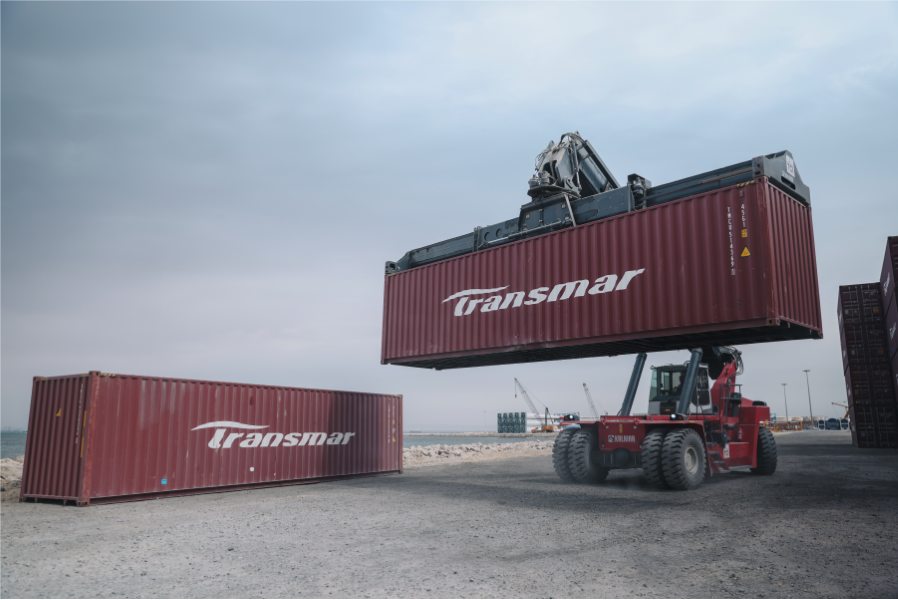
When ships stall, trucks roll: As disruption risk builds around Hormuz, Gulf producers are activating land corridors and trucking networks to keep trade moving.

But maritime transport remains unbeatable: Hormuz handles roughly a fifth of global energy trade, and replicating that volume overland could be structurally constrained. A single VLCC carries some 2 mn barrels, while a road tanker carries around 190-300 barrels — meaning 8k-10k trucks, and a lot of trips to match a single cargo.

What’s changing is not the system — it’s the geometry of power behind it: “The shift underway is less about replacing Hormuz and more about redistributing risk, access, and leverage across multiple routes — pipelines, Red Sea ports, inland corridors — rather than concentrating in a single narrow waterway,” former head of supply chain and transport industries at the World Economic Forum Wolfgang Lehmacher tells EnterpriseAM.

The model is shifting: Instead of relying on one optimal route, trade is moving toward a portfolio approach, where redundancy is built in to absorb shocks.

What is being activated now

A south-east corridor: Dubai Customs has introduced a temporary corridor between Dubai and Oman to expedite customs procedures for sea and air cargo. Shipments originally bound for Dubai’s Jebel Ali Port or Dubai International Airport are rerouted through Omani ports and airports, then transported via bonded trucks through the Hatta-Al Wajajah border crossing.

And more rerouting through Oman… Emirates Global Aluminium (EGA) will reroute its aluminum exports and raw materials through Oman’s port of Sohar in the coming days to bypass the Strait of Hormuz, three sources told Reuters. Alumina feedstock will then be transported by truck to either Dubai or Abu Dhabi for smelting.

A north-west corridor: Saudi’s parallel move centers around the logistics corridors initiative, designed to receive containers and cargo redirected from the Eastern region and other GCC ports into Jeddah and other Red Sea ports. Reports also cite fleet readiness, with 500k trucks and 18.5k licensed companies.

On the ground, this isn’t a replacement system — it’s a layered one: “We must stop asking which single route will dominate and instead design portfolios of corridors that give us options when geopolitics, markets, or climate turn against us,” Lehmacher told us.

What can be rerouted by truck, and what cannot

The trucks vs tankers debate misses the point — this is about cargo selection, not substitution. Land logistics doesn’t replace ships, but prioritizes what gets to move.

High-value and time-sensitive cargo sits at the front of the queue: Pharma, industrial components, electronics, and critical spare parts can justify expensive road diversion because downtime or stockouts cost more than freight.

Containerized consumer and industrial goods form the middle ground: Packaged food, FMCG, and general cargo can be rerouted through alternative ports and moved inland by trucks — but only at manageable volumes and limited periods before costs escalate.

Bulk commodities are the hardest to reroute: Crude oil, LNG, grains, and aluminium operate at scales where trucking is effectively irrelevant.

The economics make the hierarchy obvious: Long-haul trucking costs can be dozens of times higher per ton-km than maritime, meaning road diversion only makes sense when time becomes more expensive than transport. Heavy trucking for containers can run around EUR 0.11 per ton-km, vs a fraction of that cost for maritime transport thanks to massive economies of scale.

The limiting factor

It’s not just “put it on a truck”: A landbridge requires transit declarations, customs seal, and document verification, which compresses the pool of eligible operators and adds administrative load.

Road capacity is not just asphalt: Road freight costs also include driver and fuel costs plus intermediate-node costs like border crossings and security checkpoints — exactly the stuff that balloons when you move from steady-state trade to emergency surges.

And the risk doesn’t disappear: Every new corridor can itself become a chokepoint if built in isolation, Lehmacher said — meaning shifting flows from sea to land doesn’t eliminate vulnerability, it redistributes it.

What’s next

A routing war on the logistical front? Ports outside Hormuz — mainly in Oman — gain relevance as discharge points and staging hubs, while Red Sea gateways get a second chance at capturing flows if cross-peninsula corridors hold.

But this isn’t — or shouldn’t be — a zero-sum race for a single dominant hub: “In a world of weaponised interdependence, there is more value in a connected Middle Eastern platform of interoperable hubs – Jeddah, Yanbu, Dammam, Dubai, Abu Dhabi, Salalah, Aqaba and others – than in a race where everyone tries to become “the” hub,” Lehmacher noted.

The longer this lasts, the stickier it gets: Once routes are redesigned, cargo doesn’t automatically snap back — the winners could hold that position long after the crisis ends.

Our take

The underlying model is already changing: We are moving from an era of narrow optimization to an era of strategic redundancy, where resilient efficiency — not minimal cost — defines a well‑designed network. When the same lanes and chokepoints are repeatedly disrupted, building supply chains around a single “most efficient” route is no longer efficient; it is a concentration of risk.

The future isn’t one dominant route — it’s a portfolio of corridors. Power in global trade is shifting from control of a single chokepoint to control of multiple options when it fails.

3

Trade

Business as usual

No LC suspension in Egypt: Egyptian local banks have not suspended the issuance of letters of credit (LCs) for shipments across any regions, a senior banking source tells EnterpriseAM, fact-checking recent reports that claimed otherwise. While the escalating regional conflict has sent ins. premiums soaring and disrupted traditional shipping lanes, LCs continue to be processed — albeit after closer inspection to verify documentation in light of shifting routes.

What actually changed? Banks are not pulling the plug on credit, but they are tightening the documentation requirements. Because many global insurers are now refusing to cover the Red Sea or the Strait of Hormuz, banks require rigorous verification of revised shipping documents and route changes before approving applications. Required documentation for LC approval remains unchanged, with banks continuing to issue Form 4 to exporters, Ahmed Zaki, secretary-general of the Exporters Division at the Federation of Egyptian Chambers of Commerce, tells EnterpriseAM.

Machinery, equipment, and food commodities are processed on a shorter cycle than durable goods, automobiles, and other non-essential goods, our banking source told us. This follows central bank directives to prioritize essential and strategic goods to mitigate the impact of supply chain disruptions on global trade.

The export side: There are currently no issues with opening LCs to import goods and production inputs, particularly as demand for Egyptian exports continues to rise, Zaki told us. This is being driven in part by heightened demand from Gulf countries, with Egypt acting as a key access point via land routes.

The fact that Egyptian imports have not halted during this crisis suggests that the Central Bank of Egypt has successfully managed the current volatility, enabling local factories to operate at full capacity. This stands in contrast to the significant disruptions seen in 2022 following the outbreak of the Russia-Ukraine war. “We have not seen any restrictions on import operations whatsoever,” Zaki said.

Any decision to halt imports rests with the importer rather than the lender, Zaki said, noting that the recent spike in ins. and shipping costs is borne entirely by the importer. “As long as documentation is complete, banks proceed with opening LCs in line with priority of the goods,” he added.

4

ENERGY

LNG caught in Hormuz’s geopolitical vise

From disruption to structural crisis: As the blockade nears the end of its third week, we turn our attention to how markets are reacting — and what decision-makers should watch next. The effective closure of Hormuz has pushed the global LNG market into its most volatile period since the 1970s. What began as a security risk has evolved into a structural supply shock — removing 20% of global LNG supply overnight.

Where do we stand? The closure of the strait has locked in 1.5 mt per week from global LNG supply. Some 90% of Qatar and the UAE’s LNG exports are destined for Asia –– leaving the region the most exposed to the disruption. “Crisis conditions are current, not pending,” Davenport Energy Portfolio Manager Toby Copson (LinkedIn) told EnterpriseAM. “The absence of meaningful flexible replacement volumes means the market has no buffer,” he added.

The crisis clock: How long do we have?

We are currently in a buffer window that is rapidly closing as physical arrivals cease. The final Qatari LNG cargoes loaded before the February 28 strikes are expected to reach Asian terminals by mid-March. Once these are discharged, the physical shortfall is expected to begin in earnest.

Brace for impact: Most LNG contracts are linked to oil prices on a three-month lag, the true cost spike for consumers will not hit hot until June 2026, analysts at Wood Mackenzie warn.

The two-month threshold: If the disruption exceeds two months –– lasting into mid-May –– demand destruction becomes inevitable, according to data from Mackenzie. Asia’s LNG market demand is also expected to fall to nearly 5 mt though 3Q 2026. However, Qatari production is expected to gradually ramp its production up to “pre-crisis levels by the end of May.”

The impact will be case-by-case: Some major importers like Japan held roughly 22 days of supply in reserve as of 1 March, whereas others like South Korea hold strategic petroleum and energy reserves equivalent to roughly 200 days, but just-in-time LNG deliveries are far more fragile.

Asia is moving out of their shoulder season and Europe entering injection season, meaning “competition for spot cargoes is likely to remain intense through May and June as players work to rebalance portfolios and refill storage,” S&P Global Atlantic LNG manager Aly Blakeway (LinkedIn) told EnterpriseAM. Flat prices for NWE LNG have “jumped nearly 69% since 27 February, the day before the conflict started, while LNG spot prices in JKTC jumped 85%,” he added.

Force majeure: The energy market domino effect

Asia LNG spot prices immediately surged past USD 22.50 per mn Btu –– the highest level since it last peaked in 2023. Risk is cascading down the supply chain, with India’s Petronet LNG already invoking force majeure, highlighting the lack of viable substitute supply.

On a larger scale: “European and North Asia spot prices [are] near doubling as Qatari volumes drop out of the market,” Copson added. Buyers are being driven to chase an “already thin spot market at significantly elevated prices, while freight costs surge as tankers reroute. The knock-on effect is felt across power generation, industrial feedstock and fertiliser production.”

Can refineries just un-declare force majeure? Production restart at Qatari facilities alone carries “a minimum 4-6 week lead time under optimistic conditions,” and market pricing will remain “elevated well beyond that as confidence in supply security slowly rebuilds,” Copson explained. Therefore, even if a diplomatic resolution is reached, we’re looking down a long road before a return to normalcy, due to the technical challenges of restarting facilities that have reduced output.

We have another prediction: Looking ahead, “the market is closely watching restart timelines,” Blakeway  added. “In a best-case scenario, Qatari liquefaction could begin to come back within 6-7 weeks accounting for the restart of all the trains and liquefaction process, but even then, flows will ramp gradually,” Blakeway said.

For your eyes only: EnterpriseAM sat down with energy analyst at CMS Commodities Sacha Foss to run through everything oil and force majeure.

Any luck in getting around the blockade? While Saudi Arabia can reroute some crude via the East-West Pipeline to Yanbu, Qatar has no alternative export terminal outside the Gulf for its LNG. So far, negotiating seems to be the only hope.

Where do we go from here

The buyers are scrambling: For Atlantic Basin cargos to be shifted from Europe to Asia, a sustained premium would be required, yet current forward curves imply at least a month of disruption, with prices easing from June. Given Asia’s heavy reliance on Qatar, with around 83% of its LNG exports flowing to Japan, Korea, Taiwan and the wider region, “buyers will need to bid aggressively to pull flexible FOB cargoes from the US and West Africa away from Europe,” Blakeway explained.

Russia and US exporters are the clear near-term beneficiaries — “price-sensitive nations in South and Southeast Asia are the immediate casualties, effectively priced out of the spot market entirely,” Copson explained.

When conflict de-escalates, LNG shipping routes will have some coarse correction “as soon as options are available, like developments in BC Canada and Argentina,” Jht Consulting LLC Founder Javid Talib (LinkedIn) told EnterpriseAM. “US GOM facilities are already ramping up and increasing volumes coming online in the next five years have almost been contracted,” he added. That said, global exporters will benefit from "preferential contracting,” as buyers scramble to find alternative uptake points.

Alternative supply sources cannot fully replace Qatari volumes — despite efforts to source additional cargoes. Plummeting demand is likely, particularly through higher coal utilization in power generation and reduced industrial consumption to mitigate the crisis.

Qatar was… almost there: Qatar was on the verge of launching its massive North Field Expansion project –– slated to boost exports by 40% by 2027. Given the growing regional tension and subsequent uncertain length of production halts, Qatar may “have to recalibrate the progress,” Talib said. Just last week, Qatar Energy slowed work at the site, cutting down workers by half due to security concerns.

Supply chain trickle-down: From pipelines to pockets

Utilities across Europe and North Asia are simultaneously absorbing spot LNG at record levels — “meaning both industrial input costs and household energy bills are moving higher concurrently and consumers will feel this from multiple directions simultaneously,” Copson added.

“Buyers have been forced to bid aggressively for flexible cargoes to meet domestic demand,” Blakeway explained, with LNG markets “across the world pricing in competition for cargoes as 20% of global supply remains curtailed.”

India has already begun gas rationing for energy-intensive sectors — like refining and petrochemicals to prioritize domestic consumption. “Gas-intensive industries including petrochemicals, fertilizers, and plastics are repricing feedstock costs in real time, with downstream price increases inevitable within weeks,” Copson said.

5

Also on Our Radar

Egypt drives intra-Africa auto trade

SCZone exports 100 locally made buses to Ghana via East Port Said

Egypt expands its intra-Africa automotive trade: Egypt’s Suez Canal Economic Zone has successfully loaded a shipment of 100 Egyptian-manufactured buses onto the Sunshine Ace vehicle carrier at East Port Said — destined for Ghana’s Tema Port.

A key signal for Egypt’s export strategy: Rather than just acting as a transit point, East Port Said is facilitating the movement of high-value, locally finished goods into the West African market, signaling the operational readiness of the Suez Canal Car Trading terminal, which handled the shipment, to distribute Ro-Ro cargo at scale.


MARCH

18-19 March (Wednesday-Thursday): IntraLogisteX, Birmingham, United Kingdom.

18-19 March (Wednesday-Thursday): Green Marine Transport Conference, Amsterdam, The Netherlands.

26 March (Thursday): Gulf Ship Finance Forum, Dubai, UAE.

APRIL

12-15 April (Sunday-Wednesday): Saudi Smart Logistics, Riyadh, Saudi Arabia.

16-17 April (Thursday-Friday): Global Supply Chain and Logistics Summit, Amsterdam, The Netherlands.

23-24 April (Thursday-Friday): Sustainability World Summit, Frankfurt, Germany.

28-30 April (Tuesday-Thursday): Mediterranean Ports and Logistics, Porto, Portugal.

MAY

12-14 May (Tuesday-Thursday): The Airport Show, Dubai, UAE.

12-14 May (Tuesday-Thursday): Aviation Energy Forum (AEF), Paris, France.

12-14 May (Tuesday-Thursday): Seamless Middle East, Dubai, UAE.

19-21 May (Tuesday-Thursday): Ground Handling Conference (IGHC), Cairo, Egypt.

19-21 May (Tuesday-Thursday): Terminal Operations Conference & Exhibition, Hamburg, Germany.

JUNE

2-4 June (Tuesday-Thursday): ProPak Mena, Cairo, Egypt.

4-5 June (Thursday-Friday): Supply Chain and Logistics Summit, Amsterdam, Netherlands.

6-8 June (Saturday-Monday): IATA World Air Transport Summit, Rio de Janeiro, Brazil.

10-11 June (Wednesday-Thursday): Black Sea Ports and Logistics, Istanbul, Turkey.

22-23 June (Monday-Tuesday): Decarbonizing Shipping Forum, Rotterdam, Netherlands.

AUGUST

30-1 August (Sunday-Tuesday): Air Cargo Middle East, Riyadh, Saudi Arabia.

30-1 August (Sunday-Tuesday): Saudi Warehouse and Logistics Expo, Riyadh, Saudi Arabia.

SEPTEMBER

16-17 September (Wednesday-Thursday): Saudi Maritime & Logistics Congress, Dammam, Saudi Arabia.

28-30 September (Monday-Wednesday): Transport Logistics Middle East, Riyadh, Saudi Arabia.

OCTOBER

21-22 October (Wednesday-Thursday): Global Ports Forum, Singapore.

26-29 (Monday-Thursday): Air Cargo Forum, Miami, US.

27-29 October (Tuesday-Thursday): Routes World, Riyadh, Saudi Arabia.

NOVEMBER

2-5 November (Monday-Thursday): ADIPEC Maritime and Logistics Exhibition and Conference, Abu Dhabi, UAE.

Now Playing
Now Playing
00:00
00:00