Logistics (MENA)
  Egypt Edition
  UAE Edition
  Saudi Edition
  MENA <> India Corridors
  Climate (MENA)

 Share Issue





Good morning, folks. We’re kicking off the second week of 2026 with important regional and global updates, leading with debt and trade agreement updates from the UAE and Egypt.
Up first: Israel is demanding provisions in our USD 35 bn natural gas import agreement that would give it the unilateral right to slash how much gas it sells us. As you might expect, the terms — first made public in a regulatory filing — aren’t going down well with officials here in Cairo.
Also making the headlines this morning: Iran is threatening strikes against Israel and US military logistics hubs in the region in response to the US floating a possible strike to ‘aid’ intensifying protests against the Iranian regime. The remarks raise the temperature again in the region after months of calm, possibly risking maritime navigation in the critical chokepoint of the Hormuz Strait.
Meanwhile, Dubai Aerospace Enterprise (DAE) successfully locked in a USD 600 mn bond that was 3.3x oversubscribed despite regional tensions.
The big logistics story abroad-
Keep a close eye on how markets open this morning: US Federal Reserve Chair Jerome Powell is facing a criminal probe over the renovation of the Fed’s headquarters in Washington, DC, the New York Times reports in an exclusive, citing people it says were briefed on the matter. US President Donald Trump has long attacked Powell and pushed him to drive interest rates lower, and has frequently complained about the renovations, including in a famous video (watch, runtime: 3:17) last year during his tour of the HQ.
Powell, in a video statement (watch, runtime: 2:55), said the renovation was a “pretext,” describing the threat of criminal charges as a “consequence of the Federal Reserve setting interest rates based on our best assessment of what will serve the public, rather than following the preferences of the President.”
IN CONTEXT- This is the sharpest attack on the Fed’s independence in generations. Powell is leaving his post in May, and Trump has said he’s already chosen — but has not announced — the successor, widely expected to be Kevin Hassett, the director of the National Economic Council.
PLUS- The European Union (EU) voted to sign a long-awaited freetrade agreement with the Latin American Mercosur bloc — comprising Brazil, Argentina, Paraguay, and Uruguay — advancing the pact 25 years after talks began. The pact is another example of an emerging pattern in which several big economies pursue bilateral or small multilateral agreements to hedge against rising protectionism and trade volatility. For the signatories, the agreement could counterbalance trade losses from new US tariffs while diversifying trading partners.
Watch this space-
TRADE — The Egyptian gov’t abandoned plans to tighten import restrictions in the Port Said Freezone, a senior government official tells EnterpriseAM. Deputy Prime Minister for Industrial Development Kamel El Wazir decided to maintain the existing quota system and allow the general import of auto spare parts to continue, we were told.
What changed? Officials had been weighing a move to restrict the import of automotive spare parts exclusively to authorized service centers — a measure positioned as key to ensuring quality and curbing smuggling. Under the new directive, those restrictions are off the table, and some 70k import licenses in the zone will remain active under the current 3-15% preferential customs brackets.
It’s a smart policy: Restricting imports to authorized dealers would have choked off competition, opened the door to price hikes, curbed economic activity, and set up single points of failure in the supply chain.
DISRUPTION WATCH — Iran is threatening to strike Israel and US military logistics corridors in the region, as the US floats possible strikes on Iran to back intensifying protests calling for the fall of the current regime. The threats — made by Iranian Parliament Speaker Mohammad Bagher Ghalibaf — suggest that Iran could hit one of the US air and naval bases in Bahrain, Kuwait, the UAE, and Qatar.
Remember the Hormuz closure specter? Global markets and major oil producers in the region were sent into panic mode last summer after Iran threatened to close the Hormuz Strait in response to Israeli and US strikes against the country’s nuclear program. The maritime chokepoint is critical to the global economy and to oil producers in the GCC, with some 20% of the world’s oil passing through the strait every year.
Flights between Iran and the UAE, as well as Iran and Qatar, faced disruptions over the weekend, with around 20 flights between Iran and Dubai facing cancellation, though Emirates and flydubai’s flights seem to have departed on schedule yesterday, the National reports.
AVIATION — Egypt’s flagship carrier EgyptAir is planning to nearly double its fleet to 91 jets by 2030 — up from the 65 planes it currently holds in its fleet. Under this initiative, the airline will grow its fleet to 79 planes by 2027, then to 87 the following year. The move is slated to bolster the airline’s flight capacity to achieve its target of reaching 97 destinations by the end of the decade.
Funding already in motion: EgyptAir has financed the uptake of its first batch of five — out of its 16 A350-9 jets orderbook locked at the Paris Airshow in June last year. Egypt’s Finance Ministry also provided EGP 20 bn (c. USD 396.53 mn) financing facility to EgyptAir Holding Company to help expand the airline’s fleet.
Watch for the first A350 delivery later this year. The key metric is not the plane itself, but whether the airline can leverage its new efficiency to hold its mid-market share amid rising competition with Gulf and low-cost carriers.
Market watch-
Oil prices rose slightly this morning as concerns over Iranian oil supplies outweigh the possibility of resumed Venezuelan exports, amid intensifying protests and a possible US strike, Reuters reports. Brent crude futures were up USD 0.05 to trade at USD 63.39 / bbl as of 04:33 GMT, while US West Texas Intermediate (WTI) rose by USD 0.04 to USD 59.16 / bbl.
This comes on top of a 3% rally over the last week, as protests intensified in Iran and amid rising calls for workers in the Iranian oil sector to start civil disobedience. “The situation puts at least 1.9 million barrels per day of oil exports at risk of disruption,” ANZ analysts said in a note.
Meanwhile, Saudi crude oil flows to East Asia are expected to remain above normal levels after Aramco cut prices for the third consecutive time last week, signaling oversupply concerns, Bloomberg reports, citing unnamed traders. Asian buyers outside China — including Japan and South Korea — will receive at least an additional 9 mn bbl for February loading, lifting shipments to at least 15% above the recent average of 2.1 mn bbl / d, the business news service reported, citing data from the maritime analytics platform Kpler.
ALSO- India is set to receive an additional 2 mn bbl — about 10% above its average monthly volume — while China’s February purchases are projected at around 48 mn bbl, slightly trailing January levels. The price cuts have made Saudi crude competitive with regional spot grades as Middle East oil markets remain weak, price differentials collapse, and Dubai futures trade at a premium to immediate supply.
Baltic index downward streak isn’t going anywhere: The Baltic Exchange’s dry bulk sea freight index — which tracks rates for the capesize, panamax, and supramax vessel segments — fell 1.7% to 1,688 points on Friday, for the fifth consecutive session. The capesize slipped for the 12th day by 3% to 2,640 points, while the panamax index went up 0.7% to 1,345 points, and the smaller supramax index dropped 9 points to 976 points.
The Drewry World Container Index increased by 16% to USD 2,557 per 40-ft container last week, according to the latest index readings. This marks the fourth consecutive weekly jump and was supported by a rise in transpacific and Asia-Europe rates, especially the Shanghai-Genoa (13%) and Shanghai-Rotterdam (10%) routes.
The short-term outlook: With early bookings already building for the February 2026 Lunar New Year, Drewry anticipates a further slight rate uptick next week.
ICYMI- The container shipping market is bracing for a supply glut in 2027 that could drive a sharp dip in shipping prices, as the potential full return to the Suez Canal meets a record-breaking wave of new ship deliveries, shipowner association Bimco said in a report seen by EnterpriseAM.
Data point-
1st — that was Egypt’s ranking in Africa in Oxford Insights’ 2025 Government AIReadiness Index (pdf). Globally, Egypt climbed 14 spots y-o-y to rank 51st, also coming third in MENA after Saudi and the UAE. The Madbouly government scored a perfect 100 in the policy capacity pillar, which measures its extent to “design and implement effective AI policies.”
Egypt is in a tight competition to become the premier AI hub for the Middle East and Africa at the same time as the UAE and Saudi commit USD bns to compute capacity. The government’s National Artificial Intelligence Strategy, the second edition of which launched last year, outlines how the state aims to develop the AI sector between 2025 and 2030.
Get Enterprise daily
The roundup of news and trends that move your markets and shape corporate agendas delivered straight to your inbox.
***YOU’RE READING EnterpriseAM Logistics, the essential MENA publication for senior execs who care about the industry that connects producers and retailers to global markets. We’re out Monday through Thursday by 9:15am in Cairo and Riyadh and 11:15am in the UAE.
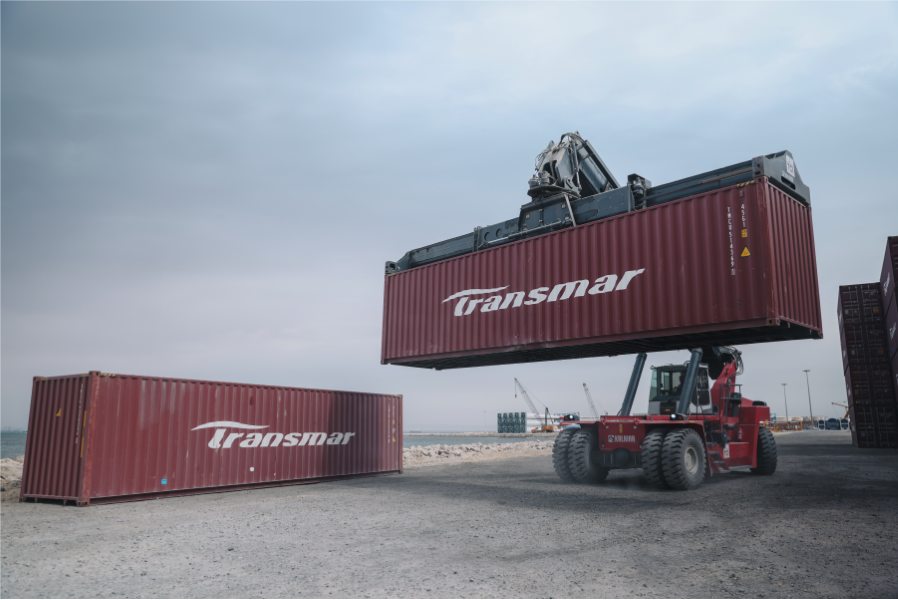
EnterpriseAM Logistics is available without charge thanks to the generous support of our friends at Hassan Allam Utilities, Transmar, and AK-Ships.
Were you forwarded this email? Tap or click here to get your own copy of Enterprise Logistics.
Want to send us a story idea, request coverage, ask for a correction, or otherwise get in touch? Reach out to us on logistics@enterprisemea.com.
DID YOU KNOW that we also cover Egypt, Saudi Arabia, and the UAE ***