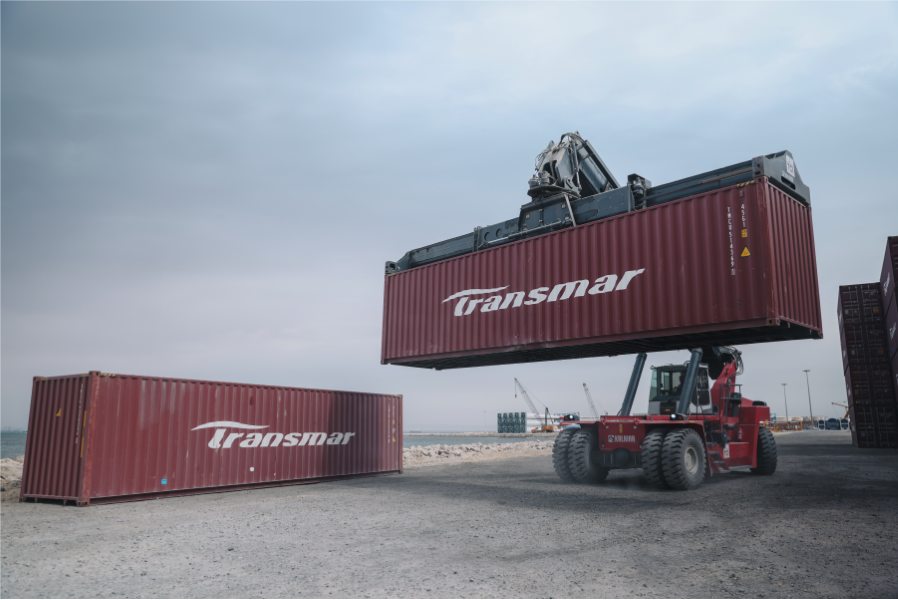
DP World, Ogun State are building a USD 7 bn deep-sea port in Nigeria

1

WHAT WE’RE TRACKING TODAY

TODAY:DP World signs a USD 7 bn Nigeria port agreement + Lesha Bank buys 33 more jets from Avolon

Good morning, friends. We have a bit of a moving morning: ports, planes, and barrels.

DP World is taking its Jebel Ali playbook to Nigeria: The Dubai operator and Ogun State signed an MoU to build a USD 7 bn deep-sea port and industrial zone big enough to take ships the congested Lagos corridor can't handle.

Qatar's Lesha Bank, meanwhile, just went shopping for jets again. The bank is buying a 33-aircraft portfolio from Irish lessor Avolon — its second major aviation deal in under a month.

And Middle East crude exports are having their best month since the disruptions began. Seven major producers are on track to ship 12.8 mn bbl/d in September, led by Saudi Arabia and the UAE — real progress, though still about 6 mn bbl/d short of where things stood in February.


We’re delighted to welcome Todd Wilcox as a guest speaker at the 2026 EnterpriseAM Egypt Forum.

Todd Wilcox is the deputy chairman and CEO of HSBC Bank Egypt, bringing more than 30 years of international banking experience. He joined Egypt from HSBC China, where he served as Senior Executive Vice President, Deputy CEO, and Executive Director of the Board.

Todd has held a series of senior leadership roles across HSBC, including CEO of Brunei for the Hong Kong and Shanghai Banking Corporation, CRO for Asia-Pacific overseeing 11 markets, and COO for Risk across all Asian markets. He also served as head of retail banking and marketing at HSBC Bermuda, and began his career with HSBC in Canada. Prior to HSBC, Todd worked at Royal Bank of Canada across a range of business and functional roles.

Join us on 5 October in Cairo. Attendance is by invitation only, and we’ve reached full capacity.

Request your invitation here to join the waitlist.

Double duty

Saudi Arabia is loading crude at Yanbu again after the East-West pipeline came back to service — though volumes are still well short of where they were before the attack. Loadings at the Red Sea port have reached nearly 2 mn bbl / d since last week, and Aramco sent customers its October loading schedule on Monday, Reuters reports, citing trade sources and shipping data. Pipeline flows stand at 2.6 mn bbl / d and should rise to 3-4 mn bbl / d in the coming days, Kpler estimates. Returning to the roughly 5.5 mn bbl / d moved before the attack could take another month.

That leaves Aramco running both routes at once, with Hormuz traffic already well off its lows. Crude transits through Hormuz, including ship-to-ship activity in the Gulf of Oman, averaged c. 9 mn bbl / d over the seven days to 22 September, up from 2.2 mn bbl / d in late July, according to Kpler. With Yanbu coming back, the Kingdom has room to split exports between the Red Sea and Hormuz.

Aramco is also trying to make the Oman leg cheaper for buyers. The company is considering price cuts of about USD 9 per barrel for crude loaded off Oman, Reuters reports, citing sources familiar with the matter. The cuts could apply to cargoes offered this week for loading in the second half of October. Recent Aramco sales off Oman went for premiums of USD 10-20 per barrel.

The price reductions could be an attempt by the oil giant to rebuild market share lost after Hormuz disruptions. The Kingdom previously adjusted its pricing terms before the East-West pipeline damage to allow Asian buyers to cope with such costs, giving them the option to price crude against the official selling price for the month of arrival rather than loading.

The missing leg

Agility is wagering on trains that drive themselves. Agility’s corporate venture arm has signed on with US-based Parallel Systems to develop, finance, and deploy the company’s battery-electric autonomous freight platform across the GCC and EMEA, according to a press release.

The vehicles will run on existing track, sort themselves into platoons, and haul intermodal containers up to 500 miles (c. 805 km) on a charge. The partners will start by scouting corridors including port shuttles, links to inland logistics hubs, and city-to-city routes, with no money or timeline attached yet.

The GCC use case is pretty clear: Rail still struggles to cover the short inland legs between ports and logistics centers that trucks dominate today. Even at the peak of the Hormuz disruption, with cargo rerouted through eastern UAE, Oman, and the Red Sea, the inland leg defaulted to trucks because cross-border rail links and port-rail connections remain patchy.


The Egyptian government locked in enough LNG and crude to carry the country through peak demand this summer, and the real question now is who pays for it and for the rebuild ahead.

PowerTrip, our new four-part signature series, follows the money behind an energy sector that went from exporting gas to importing it in just five years.

Over the four issues this autumn, we’ll look at how the lights stayed on and what that cost, who will own the next generation of power, how fast renewables can really scale, and whether Egypt’s claim to be the region’s energy hub still holds.

Issue I looks at how Egypt avoided rationing this summer, how the country went from gas exporter to importer in a decade, and what keeping the lights on actually cost us.

Tap here to subscribe to the Egypt edition, coming straight to your inbox today.

Market watch

Oil prices rose this morning as Trump denied easing Iran sanctions while Qatar pushed for peace talks, Reuters reports. Brent crude futures increased USD 0.71 to USD 103.30 / bbl by 04.08 GMT, while West Texas Intermediate (WTI) gained USD 0.43 to USD 89.81 / bbl.


The Baltic Index eases: The Baltic Exchange’s dry bulk index — which tracks rates for the capesize, panamax, and supramax vessel segments — fell 2.8% to 3,178 points on Tuesday. The capesize index declined 4.6% to 5,103 points, while the panamax dipped 0.5% to 2,390 points. The smaller supramax inched up 0.4% to 1,797 points.

***

YOU’RE READING EnterpriseAM Logistics, the essential MENA publication for senior execs who care about the industry that connects producers and retailers to global markets. We’re out Monday through Thursday by 10:15am in Cairo and Riyadh, and 11:15am in the UAE.

EnterpriseAM Logistics is available without charge thanks to the generous support of our friends at Hassan Allam Utilities and Transmar.

Were you forwarded this email? Tap or click here to get your own copy of EnterpriseAM Logistics.

Want to send us a story idea, request coverage, ask for a correction, or otherwise get in touch? Reach out to us on [email protected].

DID YOU KNOW that we also cover Egypt, Saudi Arabia, and the UAE? ***

This publication is proudly sponsored by

2

The Big Story Today

DP World and Ogun State sign an MoU for a new Nigeria deep-sea port

DP World is taking its Jebel Ali model to Nigeria: The Dubai-based operator and Ogun State signed an MoU to build the Gateway Deep Sea Port alongside Blue Marine, a 10k-hectare industrial zone, with the two pegged at more than USD 7 bn in initial investment. The port's 4 km berth and 18-meter draft can take ships too big for the congested Lagos corridor next door, the State House says.

Why it matters: The industrial land is what sets this apart from another port agreement. Blue Marine is meant for manufacturers and export businesses, so goods can be made right where they ship. Ogun says openly that it wants its own Jebel Ali, with deepwater access and industrial land built at the same time, Al Bayan reports.

The road that ties it together already has UAE money behind it: The 28 km Ogun stretch of the 700 km Lagos-Calabar Coastal Highway will link the port and zone to Lagos, the hinterland, and the wider region, alongside a planned airport and dry ports. First Abu Dhabi Bank (FAB) and Afreximbank closed a USD 1.1 bn facility earlier this year for the highway (USD 626 mn from FAB and USD 500 mn from Afreximbank) to serve the existing Lekki Deep Sea Port. If Gateway gets built, the same corridor will feed both ports.

Ogun has watched a big project slip away before, so delivery is the test. A port and refinery project earmarked for the state was held up for c. 3.5 years before it went to Lagos instead, Dangote Group President Aliko Dangote told Business Insider Africa.

Nigeria is the latest stop in DP World’s Africa push: The company said in 2024 it planned to put nearly USD 3 bn into African port infrastructure over three to five years. Since then, it has moved ahead with a 222-hectare industrial park near Mombasa and continued expanding its Dar es Salaam terminal.

3

Aviation

Lesha adds 33 aircraft as its aviation portfolio scales past 75 jets

Qatar’s Lesha Bank is buying 33 leased aircraft from Irish lessor Avolon — its second big aircraft transaction in under a month, according to a press release. The jets, leased to 25 airlines, will be managed by Lesha Aviation Services once the agreement closes. Neither company disclosed the agreement’s value or closing date, though FlightGlobal puts the portfolio at USD 1.6 bn, made up of nine widebodies and 24 narrowbodies.

The purchase would push Lesha’s closed portfolio past 75 aircraft, according to the release. Lesha Aviation Capital’s website currently lists 46 closed aircraft worth c. USD 3.3 bn — 18 more than the 28 closed aircraft we reported in early September. That matches the 18-aircraft portfolio Lesha disclosed at the time, where it took equity interests in jets leased to nine airlines across eight countries and valued at more than USD 1 bn. Adding the Avolon jets gives 79, though the count includes aircraft held through stakes, and it isn’t clear whether the website’s USD 1.7 bn, 43+ aircraft pipeline already includes the Avolon jets.

Why it matters: Long delivery delays for new planes are pushing Gulf lessors toward in-service fleets to secure predictable revenue streams. Airbus and Boeing’s combined backlogs run past 11 years, pushing lease rates higher. Other regional players have been making similar moves: Dubai Aerospace Enterprise (DAE) closed its USD 9 bn takeover of Macquarie Airfinance in July, while PIF-owned AviLease set up a leasing JV with Hassana in September 2025. Lesha also pursued Macquarie and lost to DAE in late February, and, a week later, bought Amedeo Air Four Plus for GBP 190 mn.

BACKGROUND- Lesha has built its aviation business in two years. The bank started with five Boeing 777-300ERs in late 2024, took an indirect stake in Edinburgh Airport in April 2025, opened its Dublin office that same month, and added a London office in August 2026.

Tags:

4

Shipping + Maritime

Aramco weighs discounts on Oman ship-to-ship crude as exports climb

Middle East crude exports are on track for their strongest month since the disruptions began. Seven major producers are set to ship 12.8 mn bbl / d in September, led by Saudi Arabia and the UAE, Reuters reports, citing Kpler data. Despite the uptick, that is still some 6 mn bbl / d below February levels.

By the barrel: Saudi exports are on track for 5.4 mn bbl / d, while an earlier Kpler reading put UAE shipments at 3.2 mn bbl / d by mid-September. Iraq’s Oil Ministry put its own September export average at 2.6 mn bbl / d, while Kuwait was exporting around 1 mn bbl / d in early September.

Most of these barrels change hands at sea: Producer-operated and other risk-tolerant tankers take crude through Hormuz, and buyers pick it up in ship-to-ship transfers off Fujairah and Sohar. The UAE, Qatar, Iraq, and Kuwait have all offered crude for collection outside the strait. Saudi started leaning on shuttling after its East-West pipeline was targeted and temporarily closed. Last week, 19 Saudi supertankers carrying some 2 mn barrels each left the strait, and shipments from Ras Tanura on the east coast have jumped to c. 3.6 mn bbl / d from 929k bbl / d.

Why it matters: A transfer off Oman now takes nearly 10 days, and freight costs are climbing. About 7.4 mn bbl / d of crude is set to pass through Hormuz this month, according to Kpler, and the offshore handoff is running out of room. Saudi Arabia's extra volumes, on top of transfers by other producers, have left tankers waiting for tugboats and transfer crews. Transfers used to take five to seven days, and the extra shuttle trips are tying up supertankers that would otherwise be available for charter.

5

Also on Our Radar

New shipping service links India with Gulf ports

DP World’s Cochin terminal has a new direct service to Gulf markets that stays clear of Hormuz. The new MGR IFR service out of DP World’s International Container Transshipment Terminal (ICTT) in Cochin runs every two weeks to Nhava Sheva, Fujairah, Sohar, and Aden. It uses two vessels, the Marsa Virgo and the Marsa Zenith, each rated above 500 TEU, and the first Cochin call handled more than 1k TEU, Al Bayan reports.

Both Gulf stops sit outside the strait: Fujairah and Sohar are on the Gulf of Oman, so shippers routing around Hormuz now have another direct option. For DP World, the Fujairah call feeds its east-coast buildout. The company locked in a 50-year concession in July for the Al Rugaylat and Dibba terminals, and Al Rugaylat alone is rated for up to 2.5 mn TEU a year.

IN NUMBERS- The terminal handled around 381k TEUs between April and August, up 18.5% y-o-y, while August throughput jumped 51% to a record 98k TEUs.

6

Logistics in the News

EU cuts gas storage mandate to 80% as winter buffer shrinks

Brussels wants Europeans to turn down the thermostat. The European Commission is urging EU governments to cut gas and electricity demand “for as long as necessary,” according to a letter from EU Commissioner Dan Jørgensen seen by Politico. Six months into the Hormuz closure, the letter warns that global LNG supply is tight enough that high prices risk turning into an actual shortage. Dutch TTF, Europe’s gas benchmark, is trading at c. EUR 72 / MWh, up EUR 40 / MWh since March.

Europe is heading into winter with less gas banked than it had in 2021. EU storage is currently 68% full, below the 71% it held at this point in 2021. The usual bar is 90% by 1 November — Brussels is now telling governments 80% will do, rather than force everyone to chase the same tight market and bid prices higher.

The measures on the table are the ones Brussels used in 2022. Governments are being asked to cut peak-hour power use, lower the heating in public buildings, restrict outdoor heaters, use smart meters and tariffs to shift demand, and switch off streetlights that don’t need to be on, according to Euronews. The commissioner stops short of mandatory measures.

Europe could have started cutting in the spring

The push could have come within weeks of Hormuz closing in March, mostly through public campaigns and lower heating in government buildings, Anne-Sophie Corbeau, global research scholar at Columbia University’s Center on Global Energy Policy, tells EnterpriseAM. Electricity is part of the ask because Europe burns gas to generate power. “If you reduce electricity demand, you also reduce gas demand,” she says.

An 80% start could still carry Europe through winter, if the weather cooperates. European gas demand is roughly 17% below pre-2022 levels, so entering winter at 75-80% could still hold, Corbeau says. But some 40% of demand sits with households, and power-sector gas use swings hard with the weather, hydro output, wind, and nuclear availability. Europe has also swapped its old, steady Russian pipeline gas for LNG, which means competing for cargoes in a market everyone else wants into too, she adds.

Most of the gap sits in two countries: “There are two countries which are problematic due to their low storage levels, Germany and the Netherlands,” Corbeau tells us. Both have large storage capacity sitting relatively empty, and Germany carries the added weight of heavy domestic demand. Along with Italy, France, and Austria, they’re among five countries whose storage facilities make up two-thirds of the EU’s total capacity. German sites were c. 53% full on 1 September, the lowest for that time of year in 15 years, according to storage industry group Ines. The Netherlands has already committed roughly EUR 1 bn through state-owned energy company EBN to support refilling, while Berlin “has done pretty much nothing until very recently,” Corbeau notes.

Officially, this is not a supply crisis yet. The Commission and EU governments reconfirmed last week that gas supplies remain stable and that protected customers, including households and essential services, will be covered even in a serious disruption. The sharper tools — including interruptible gas contracts, switching power plants off gas — stay holstered in national emergency plans in case things deteriorate.

Last winter is the reason not to relax: “Last winter, EU gas storage dropped by 55 percentage points from 83% to 28%. So we could end up in April next year with about only 20% in storage,” Corbeau argues.

REMEMBER- Europe has spent six months buying its way around the Gulf LNG squeeze. Missing Qatari supply pushed European and Asian buyers toward the same pool of flexible cargoes, but Europe has largely avoided physical shortages by paying more for LNG and drawing on storage. Most of the missing Qatari volumes got replaced — just not with enough extra to keep storage injections on pace, so the shortfall shows up as thinner inventories rather than empty pipelines.


OCTOBER

12-14 October (Monday-Wednesday): The Airport Show, Dubai, UAE.

20-22 October (Tuesday-Thursday): TOC Americas, Cartagena, Colombia.

21-22 October (Wednesday-Thursday): Global Ports Forum, Singapore.

26-29 (Monday-Thursday): Air Cargo Forum, Miami, US.

27-29 October (Tuesday-Thursday): Routes World, Riyadh, Saudi Arabia.

NOVEMBER

2-5 November (Monday-Thursday): ADIPEC Maritime and Logistics Exhibition and Conference, Abu Dhabi, UAE.

10-11 November (Tuesday-Wednesday): TOC Asia, Singapore.

10-12 November (Tuesday-Thursday): Intermodal Europe, Rotterdam, Netherlands.

11-13 November (Wednesday-Friday): Logitrans, Istanbul, Turkey.

18-19 November (Wednesday-Thursday): Breakbulk Asia, Singapore.

FEBRUARY 2027

10-12 February (Wednesday-Friday): Routes Americas, San Juan, Puerto Rico.

MARCH 2027

16-18 March (Tuesday-Thursday): CMA Shipping, Houston, US.

16-18 March (Tuesday-Thursday): Routes Asia, New Delhi, India.

APRIL 2027

20-22 April (Tuesday-Thursday): Routes Europe, Antalya, Turkey.

26-29 April (Monday-Thursday): Transport Logistic and air cargo Europe, Munich, Germany.

26-29 April (Monday-Thursday): Saudi Smart Logistics, Riyadh, Saudi Arabia.

Now Playing
Now Playing
00:00
00:00